HOW MUCH DNA DO HUMANS SHARE WITH OTHER SPECIES?
From chimpanzees and macaques to birds, plants and yeast, the answer depends on whether scientists count DNA letters, genes or functions.
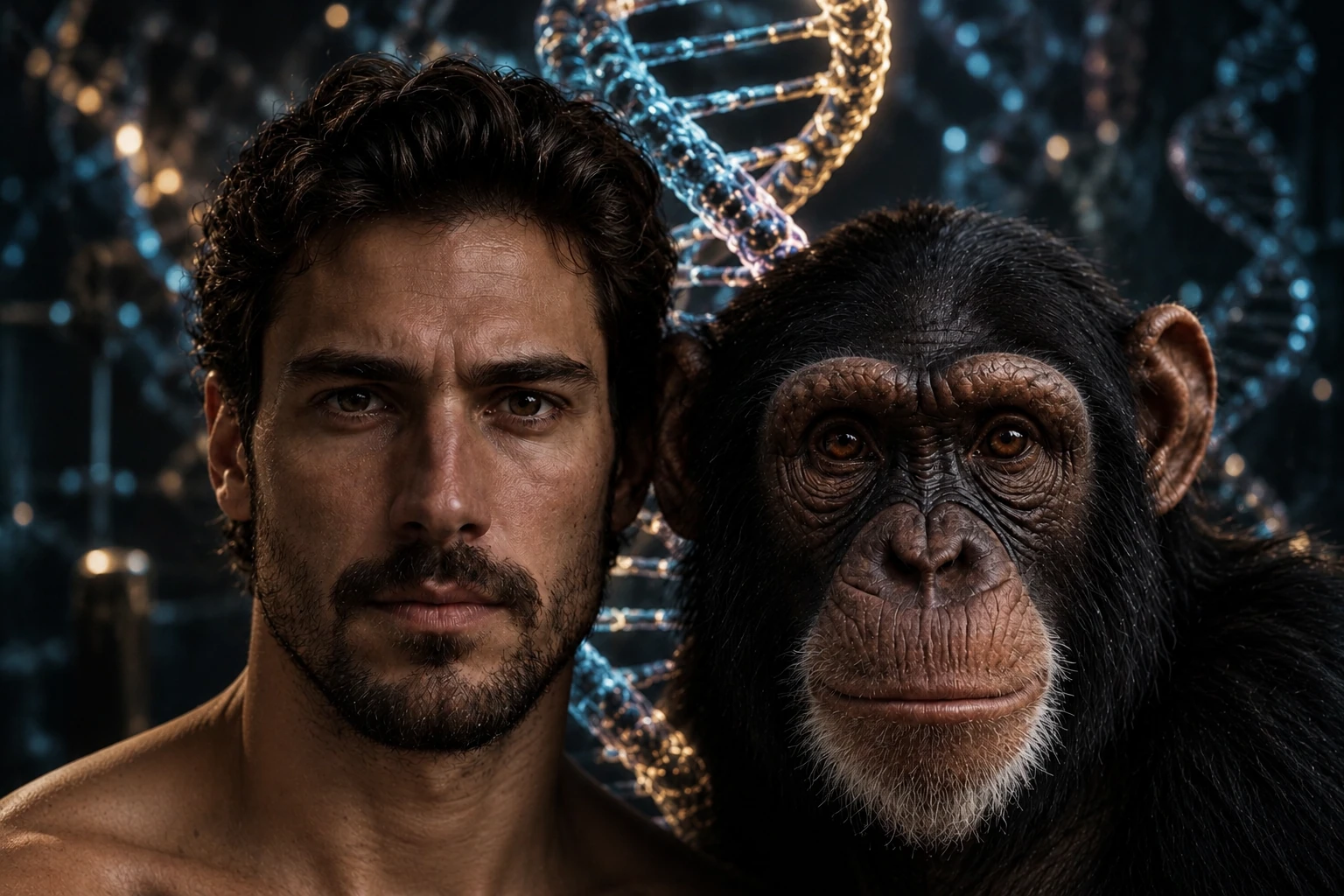
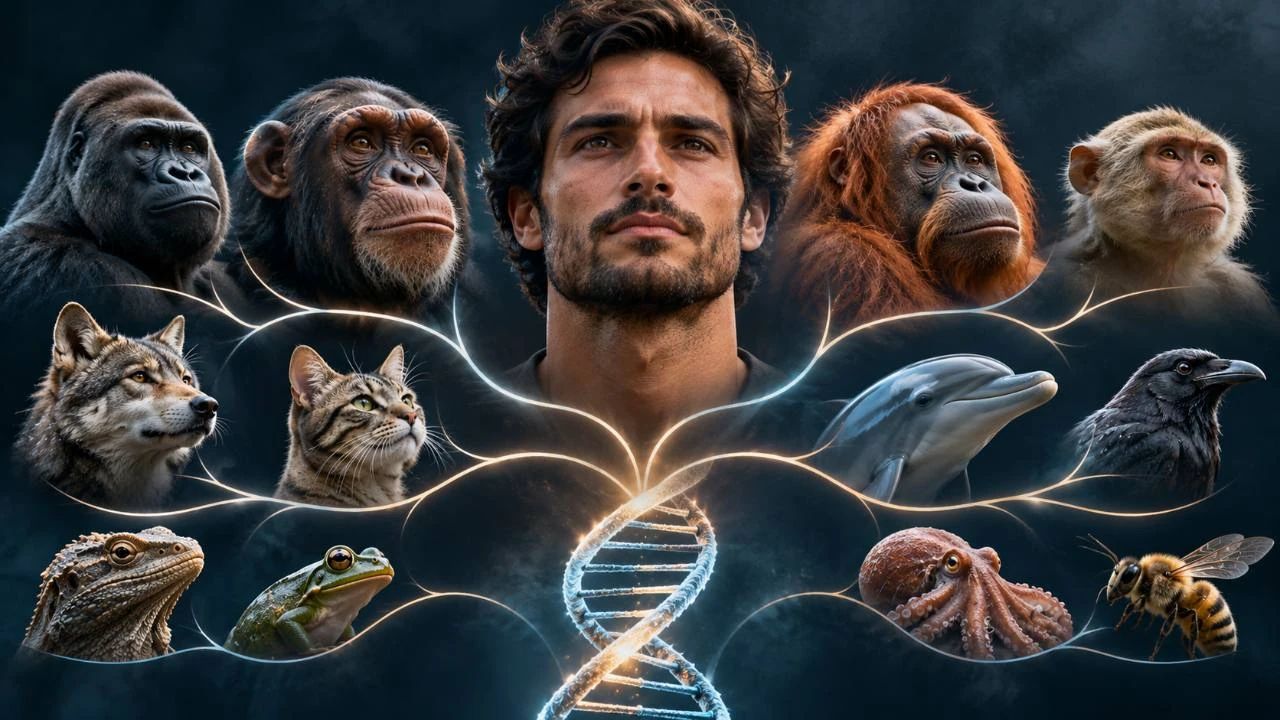
Editorial illustration of shared ancestry, supplied to PRESDA.
Humans and chimpanzees match at about 98.8% of aligned DNA letters in a landmark genome comparison. The figure comes from subtracting a 1.23% rate of single-letter substitutions from 100%. A percentage for shared genes or for entire chromosomes answers a different question. That distinction grows more important as the species being compared get farther apart on the evolutionary tree. Chimpanzee genome consortium
What scientists actually count
An alignment sets corresponding stretches of DNA side by side and measures exact matches among comparable positions. Insertions, deletions, extra copies and rearrangements can affect how much aligns in the first place. Gene orthology, by contrast, asks whether genes in two species descend from the same gene in their common ancestor. A one-to-one match means each species has one corresponding copy under the study’s rules. Chimpanzee genome consortium
The ape and monkey comparisons
The gorilla genome study reported roughly 1.75% sequence divergence between human and gorilla in its comparison, equivalent to about 98.25% identity under that measure. It also found that some regions have different local family trees. An ancestral variant can persist across successive splits and sort differently among descendants. The overall relationship still places humans and chimpanzees closer to each other than either is to gorillas. Gorilla genome study
Why the newest ape genomes add detail
In 2025, a Nature study published substantially more complete reference sequences for six nonhuman ape species. The team assembled 215 chromosomes without gaps from end to end. That matters because earlier comparisons often had their sharpest view of regions that were easier to assemble and align. Repetitive regions, large duplications and complex stretches near chromosome ends can be harder to place. Longer reads and more complete references let researchers compare some of those regions on their own terms. The new assemblies therefore extend the question beyond just counting mismatched letters in a clean alignment. Source · Yoo et al., Nature
How can 98.8 percent coexist with larger differences?
The older chimpanzee estimate describes aligned letters. The newer study reports that, across its ape comparisons, 12.5–27.3 percent of an ape genome either did not align or did not fit a simple one-to-one alignment. This range includes comparisons involving different species and captures a different phenomenon. It cannot be subtracted from 100 to replace the human–chimpanzee headline figure. Before interpreting a number, check which genomes were used and whether the calculation counts substitutions, insertions, deletions, extra copies or blocks that cannot be paired simply. Source · Yoo et al., Nature Source · Chimpanzee Sequencing and Analysis Consortium
Compare the measurement before comparing the percentage
Imagine two editions of a book. You can compare the spelling of matching lines, count how many chapters have a counterpart, or ask whether one chapter can take the place of another in a lesson. Those are separate tests. Genomics similarly distinguishes letter identity, gene relationships and experimental interchangeability. The figures in the table come from different studies and should be read with their denominators. For a closer look at what a genome contains, see PRESDA’s guide to human DNA. Source · Chimpanzee Sequencing and Analysis Consortium Source · Mouse–human orthology Source · Kachroo et al.
| Comparison | Reported value | What was counted |
|---|---|---|
| Human and chimpanzee | About 98.8% | Matching letters at aligned positions |
| Human and mouse | About 80% | Human genes with a one-to-one mouse counterpart in the study |
| Human genes tested in yeast | 47% | Tested yeast genes functionally replaced by a human counterpart |
Why shared ancestry matters in the laboratory
A recognizable counterpart can help scientists choose an organism for studying a biological process. The yeast study went further by observing whether a particular human gene could take over a function needed by yeast under its test conditions. A successful replacement is evidence about that function in that experiment. A failure can reflect differences in how the proteins work together, or limits of the conditions used, and does not erase the genes’ evolutionary relationship. Those qualifications make a measured result more informative than a sweeping statement about how much DNA humans share with fungi. Source · Kachroo et al.
The rhesus macaque, an Old World monkey, showed about 93% DNA similarity in the 2007 genome project’s comparison with humans and chimpanzees. That estimate concerns this macaque and this method. Monkeys include many lineages, so there is no single human-to-monkey percentage. NHGRI: rhesus macaque genome
Other mammals and birds
A finished mouse genome comparison found one-to-one counterparts in mice for about 80% of human genes in its annotation. The study also found different proportions when starting from mouse genes. Gene counts and the reference direction both matter. Conserved genes make mice useful models, while changes in gene regulation and physiology limit what an experiment can tell us about humans. Mouse genome comparison
About 60% of chicken protein-coding genes had a single human counterpart in the chicken genome consortium’s comparison. That is a fraction of chicken genes and cannot be compared directly with the 98.8% identity of aligned human and chimpanzee DNA letters. Both results document shared ancestry at different scales. Chicken genome consortium
Plants, fungi and the deepest shared machinery
The Arabidopsis genome revealed both genes found across eukaryotes and gene families characteristic of plants. Deeply conserved machinery helps package DNA and run cells. A universal human-to-plant DNA percentage would hide the difference between that common inheritance and billions of letters with very different histories. Arabidopsis Genome Initiative
Function is another possible comparison. In one experiment, human counterparts could replace about 47% of 414 tested essential yeast genes. That result measures successful substitution in an experiment. It does not mean 47% of the yeast genome matches ours. The useful question is always what the study counted and what it put in the denominator. Human and yeast gene replacement study
Why one genome can contain different family trees
Across most of the genome, humans and chimpanzees are each other’s closest relatives among the three species in the gorilla study. But in about 30% of the genome, gorillas are closer to one of those species than those two are to each other. Some variants already existed before the ancestral populations split and were inherited in different combinations. Geneticists call this incomplete lineage sorting. It explains why a particular stretch of DNA can tell a different story from the species tree without overturning that tree. Source · pmc.ncbi.nlm.nih.gov
Three percentages that answer three different questions
About 98.8% for human and chimpanzee refers to matching letters among comparable sequences. A fraction of genes with an identified counterpart instead asks how many genes in a chosen set have a recognizable relative. And the yeast experiment asks whether a specific human gene can replace a yeast gene under particular laboratory conditions. To interpret any headline percentage, first ask what was counted, what the denominator was and what the researchers left out. Source · pmc.ncbi.nlm.nih.gov Source · nature.com Source · pubmed.ncbi.nlm.nih.gov
Human and ape genome comparison.
FAQ
Frequently Asked Questions
Is 98.8% the exact whole-genome match with chimpanzees?
It is an approximate identity for comparable aligned DNA letters in one genome study.
Does sharing genes mean the genes work identically?
Shared ancestry does not establish identical expression or identical function.
PRESDA Dispatch
Stay Informed. Stay Aware.
A sharp briefing across AI, gaming, sport, business, world affairs, paparazzi, and lifestyle.