THE VAMPIRE CAMEL: FANGED FOSSILS REVEAL A MIOCENE PLANT-EATER
Vampyrocamelus welshi was a long-legged North American camel with enlarged teeth. The museum discovery, roughly 12–13-million-year age and herbivore interpretation.
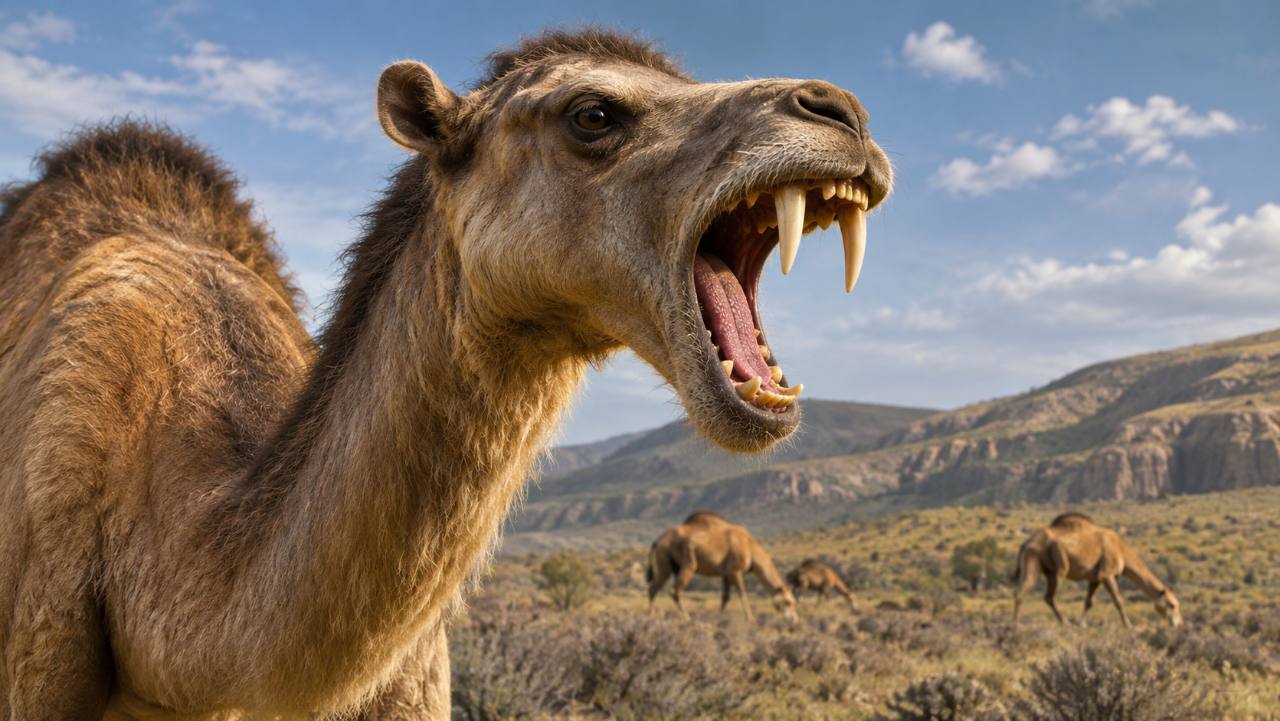
Supplied modern editorial reconstruction, preserved unchanged. It is not a fossil photograph, a verified complete anatomical model or an observed Miocene scene.
The “vampire camel” was not a blood-drinking monster. Vampyrocamelus welshi, an extinct North American camel relative described in a 2026 monograph, had enlarged, curved front teeth but is interpreted as a plant eater. Researcher Donald Prothero placed it in the Great Plains of roughly 12–13 million years ago in a November 20 interview with CBC. Its striking name describes the appearance of the teeth, not evidence of a vampire’s diet. Author’s monograph listing: The Evolution of North American Camels, November 2026CBC: direct interview with researcher Donald Prothero, November 20, 2026
The discovery also challenges a familiar picture of how palaeontology works. These fossils were not all newly lifted from a remote excavation. They had spent decades in museum collections. Re-examining them, comparing their anatomy and deciding which animals they represented produced a newly recognized genus and species from material that already existed on shelves.
| Question | What the sources establish |
|---|---|
| Identity | Vampyrocamelus welshi, an extinct North American camel relative |
| Approximate age | Roughly 12–13 million years, as described by Donald Prothero in his CBC interview |
| Diet | Interpreted as a herbivore; no evidence of blood-drinking |
| Discovery | Recognition of distinctive fossils already held in museum collections, described in a 2026 monograph |
What is Vampyrocamelus welshi?
The animal belongs to Camelidae, the family that includes living camels and their South American relatives. The 2026 work places the new form within a much broader revision of North American camel evolution. In the CBC interview, Prothero described a long-legged animal with two sets of conspicuous fang-like teeth on either side of its snout, a combination that gave the genus its memorable name. Author’s monograph listing: The Evolution of North American Camels, November 2026CBC: direct interview with researcher Donald Prothero, November 20, 2026
Its geographical record includes what are now Texas, Oklahoma and Nebraska. The approximate age reported by the researcher places it in the Miocene, long before the Ice Age camel species familiar from many North American fossil displays. “Twelve million years old” is therefore a useful shorthand for a deep-time animal, not an exact birthday established for every specimen in the collection. CBC: direct interview with researcher Donald Prothero, November 20, 2026
A new name for fossils already in storage
The monograph is listed online as The Evolution of North American Camels, dated November 2026. The species description is part of a larger attempt to reorganize the family’s fossil record. The significant event is the recognition and description of a distinct animal, rather than the claim that nobody had previously seen any of its bones. Author’s monograph listing: The Evolution of North American Camels, November 2026
That difference changes what “discovery” means. A museum specimen can be physically familiar but scientifically misunderstood or assigned to a broader group. Identifying a new combination of anatomical features gives that material a different place in the history of life. Collecting a fossil and understanding its significance may be separated by generations of researchers.
Why would a plant eater have fangs?
The most dramatic teeth are not the whole mouth. Prothero told CBC that the animal’s molars support the interpretation of a herbivorous diet. Food-processing surfaces and the rest of the dentition provide evidence that a nickname cannot. Enlarged front teeth do not, on their own, establish that an extinct mammal hunted other animals or consumed blood. CBC: direct interview with researcher Donald Prothero, November 20, 2026
The researcher also described the pronounced fangs as a male feature. Females lacked the same conspicuous enlargement. Such a difference makes competition between males a plausible explanation for the teeth, because a feature can influence encounters within a species even when it is not used to process the animal’s normal food. CBC: direct interview with researcher Donald Prothero, November 20, 2026
A behavioral explanation remains an inference
Prothero discussed fighting among male camels as a comparison for interpreting the fossils. Other reporting on the study also identifies display or competition for mates as possibilities. These explanations are hypotheses about how a structure was used. They are not direct observations of a Miocene animal fighting, courting or defending itself. CBC: direct interview with researcher Donald Prothero, November 20, 2026ScienceAlert: November 22 reporting on the new genus and its uncertainties
The distinction is useful rather than deflating. Bones and teeth can show that a feature existed, how large it was relative to other structures and whether different specimens share it. Reconstructing behavior asks another question. An interpretation becomes stronger when several lines of evidence agree, but a dramatic tooth should not be made to narrate a complete life on its own.
The museum collection behind the finding
Much of the wider camel research draws on the Frick collection at the American Museum of Natural History. The museum’s own historical account describes Childs Frick’s fossil-collecting program and the researchers who worked on its mammal material. It also records his interest in broad treatments of entire groups, including camels, rather than only publishing isolated specimens. American Museum of Natural History: Childs Frick’s fossil-collection legacy
The scale of the collection helps explain both its value and the time needed to study it. In their 2026 Geological Society of America abstract, Prothero and colleagues refer to approximately 20,000 camel specimens in the Frick collection. That is the broader camel collection, not a claim that 20,000 vampire-camel skeletons were found. Geological Society of America: authors’ 2026 research abstract
Storage preserves questions as well as objects
An old collection can retain information that was unavailable, unnoticed or difficult to compare when a fossil first arrived. A researcher examining many skulls and jaws together may recognize a recurring difference that would be hard to diagnose from one isolated fragment. Catalogues, locality information and comparisons across specimens make that work possible.
The AMNH history also shows why collections need sustained institutional care. The fossils had to be gathered, stored, moved, documented and made accessible before a later taxonomic revision could use them. The new species is one visible outcome of that long process. The supporting museum photograph illustrates related camel skeletons, not a newly assembled Vampyrocamelus skeleton, and is captioned accordingly.
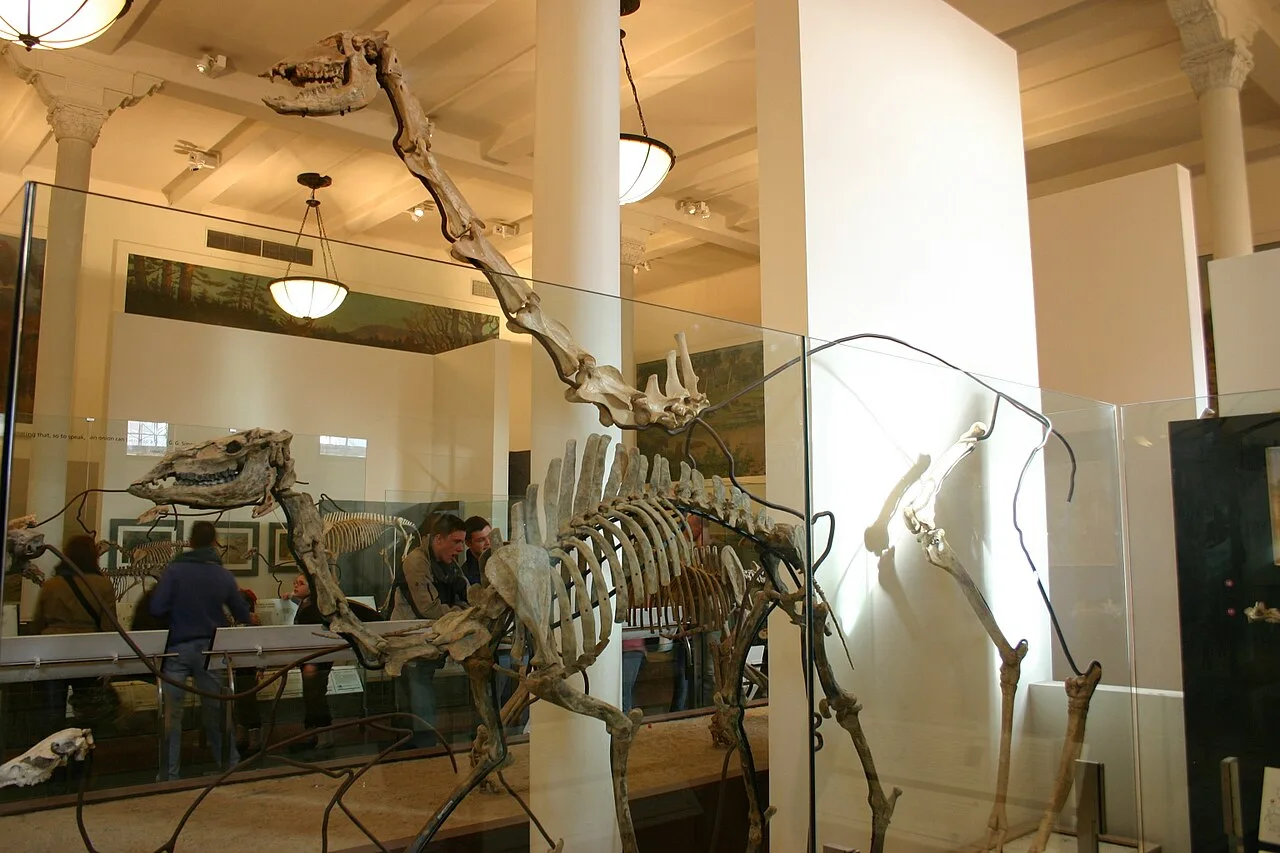
Undated museum photograph of Aepycamelus giraffinus and Procamelus grandis at the American Museum of Natural History. These related camel mounts provide comparative context; neither is identified here as Vampyrocamelus welshi.
Why identifying species changes a larger scientific picture
Taxonomy is the work of distinguishing and naming organisms, including extinct ones. A new name may appear to be a narrow technical result, but counts of species and comparisons between fossil communities depend on those identifications. If similar specimens have been split into too many names, diversity can be overstated. If distinct animals have been combined, important differences can disappear.
The authors’ GSA abstract makes this broader point explicitly. It argues that outdated camel classifications can distort attempts to reconstruct past mammal communities and their ecological history. The work therefore concerns more than an unusual set of teeth: it affects how one of North America’s important groups of herbivores is represented in palaeontological databases. Geological Society of America: authors’ 2026 research abstract
The family tree is not a line of modern camels
PRESDA’s feature on Darwin and evolutionary theory provides context for thinking about branching relationships rather than a single ladder of progress. An extinct camel relative does not have to be the direct ancestor of a living species to be scientifically important. It can document a different combination of traits within a once much broader family.
The new genus is discussed alongside other long-legged fossil camels, including Aepycamelus, in coverage of the monograph. Similar overall proportions can make isolated bones harder to assign, while a distinctive skull or dentition can provide a stronger identification. That is why the article’s comparative images are labeled by genus instead of allowing every long-necked camel reconstruction to stand for Vampyrocamelus. ScienceAlert: November 22 reporting on the new genus and its uncertainties
North America’s much longer camel history
Modern associations with deserts in Africa and Asia can obscure the family’s North American origin. The US National Park Service places that origin in the Eocene, tens of millions of years before the animal described here. Its accounts of later fossil camels distinguish genera such as Camelops and Hemiauchenia, showing that the continent supported several forms across different periods. US National Park Service: North American camel evolution and distinct fossil genera
Those later examples should not be folded into the vampire-camel story as if they were the same species. The Miocene animal belongs to a different interval from the late Pleistocene camelids described at Tule Springs. A shared family name connects the histories; it does not make their ages, bodies or environments interchangeable.
What a reconstruction can and cannot show
The supplied hero is a modern editorial reconstruction. It preserves the supplied composition, but it is not a fossil photograph or an observed Miocene scene. Hair, color, facial expression and the exact appearance of the surrounding landscape require interpretation. Their presence in an illustration should not be treated as independent anatomical evidence.
The historical Aepycamelus illustration reproduced below was published in 1931, long before the 2026 description of Vampyrocamelus. It is included to show an earlier visualization of a related long-necked camel, not as the original scientific reconstruction of the newly named species. The contrast between a specimen photograph, an archival restoration and a modern editorial image is part of reading the evidence accurately.
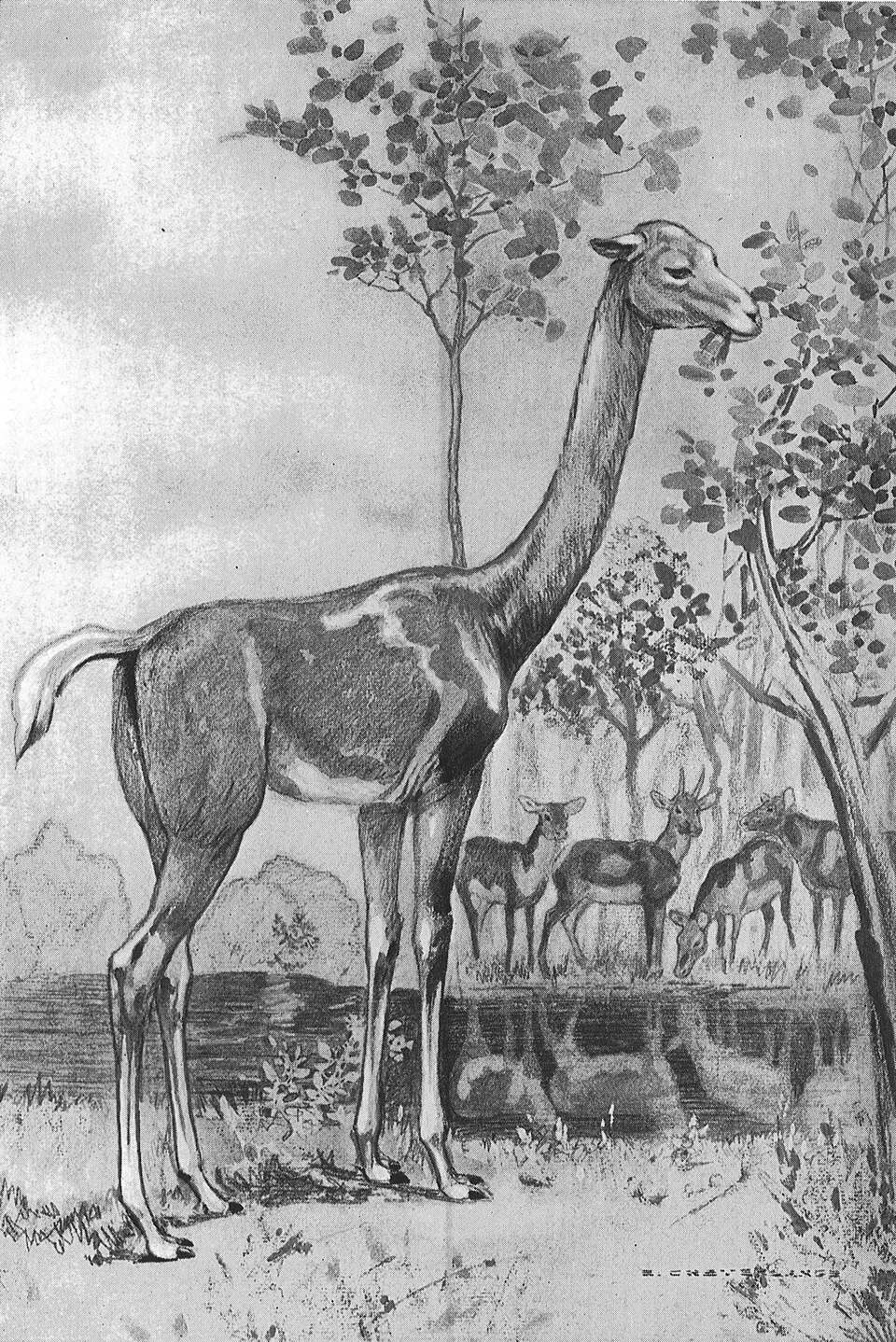
Elie Cheverlange’s 1931 restoration of Aepycamelus giraffinus and Dromomeryx borealis, from the Smithsonian Scientific Series. A historical illustration of other taxa, not a photograph or the original reconstruction of Vampyrocamelus. BHL lists no known copyright restrictions.
Elie Cheverlange / Smithsonian Scientific Series (1931) / University of Wisconsin Libraries / BHL · BHL: no known copyright restrictions
What remains to be learned
The exact purpose of the enlarged teeth remains open to investigation. More securely associated skeletal material could help researchers refine the animal’s overall form and distinguish isolated bones from those of similar camel relatives. That is a reason to keep collecting and revisiting collections, rather than turning a plausible behavioral explanation into a completed account of the species. ScienceAlert: November 22 reporting on the new genus and its uncertainties
PRESDA’s report on ancient orca fossils and large-prey hunting examines a parallel scientific problem: how anatomy supports an interpretation without directly preserving every behavior. For the vampire camel, the strongest conclusion is already interesting enough. Museum fossils reveal an unusual plant-eating mammal from North America’s deep past, and its teeth show how much remains to be understood about animals hidden behind familiar family names.
FAQ
Frequently Asked Questions
Was the vampire camel really a vampire?
No. The name refers to enlarged fang-like teeth. Researchers interpret the animal as a plant eater, not a blood-drinking predator.
How old was Vampyrocamelus welshi?
Researcher Donald Prothero described it as living roughly 12–13 million years ago. This is an approximate geological age, not a precise date for every fossil.
Were the fossils newly excavated in 2026?
The discovery involved recognizing and describing material that had been held in museum collections for decades, rather than only recovering new bones in the field.
Why might a herbivore have enlarged teeth?
The researchers suggest male competition or display as possible explanations. These are interpretations based on anatomy and comparison with living animals, not directly observed fossil behavior.
PRESDA Dispatch
Stay Informed. Stay Aware.
A sharp briefing across AI, gaming, sport, business, world affairs, paparazzi, and lifestyle.