ASTRONOMERS DISCOVER A STAR SURROUNDED BY TWO MYSTERIOUS RINGS
Astronomers have identified two gas rings around white dwarf J1328−1450. Explore the evidence, the proposed surviving bodies and what remains uncertain.
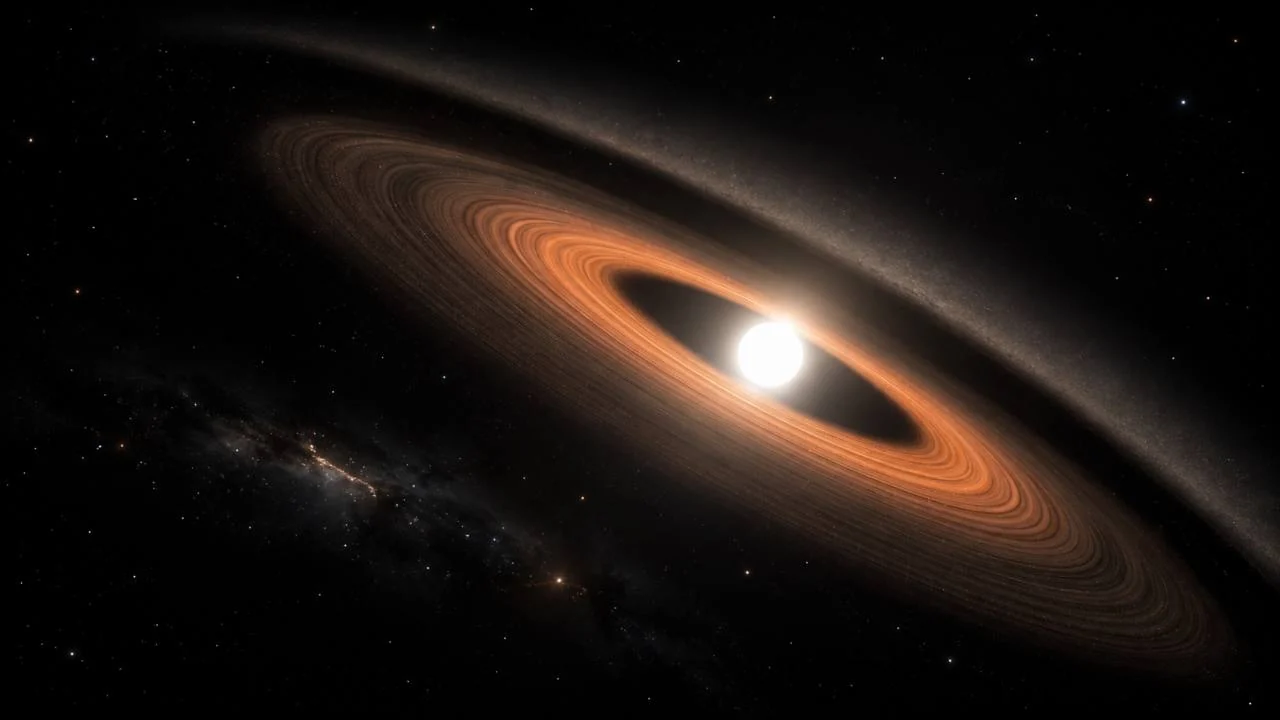
Editorial illustration, not a telescope photograph or a diagram to scale. Image supplied for PRESDA. Original creator and reuse licence not provided. WebP conversion: PRESDA.
A star’s death does not necessarily leave a simple, empty stage. Around the white dwarf J1328−1450, astronomers have identified two separate gaseous debris rings. Announced by ESO on 27 October 2026, the finding offers an unusually intricate view of planetary wreckage. The mystery lies in how this structure persists, rather than in whether the light signal exists. ESO: discovery announcement, 27 October 2026
What exactly did astronomers discover?
The study concerns a white dwarf about 1,600 light-years away. Warwick reports that its spectrum shows four peaks, rather than the two seen in comparable single-disc systems. Repeated observations from 2021 to 2023 found the configuration stable for more than two years. These are measurements of emitted light, not a photograph resolving two enormous hoops. University of Warwick: observations and stability
How can light reveal rings?
The researchers used X-shooter on ESO’s Very Large Telescope in Chile. A spectrograph separates light into wavelengths, allowing astronomers to investigate composition and motion. Gas approaching us and gas moving away contribute differently to an emission-line profile. Reading that profile resembles following several musical notes in a chord: the pattern contains information that a single overall brightness cannot provide. ESO: X-shooter instrument
The research paper, led by Nicola Pietro Gentile Fusillo and published in Nature Astronomy, interprets the observations as a double debris disc sculpted by two planetary bodies. That interpretation links geometry to a physical mechanism. It is an explanatory model that can be tested against further data, rather than a licence to describe every imagined detail of the system as observed. Nature Astronomy: A double debris disc around a white dwarf sculpted by two planetary bodies
Why call a luminous star dead?
A white dwarf is the compact core left after a Sun-like star sheds its outer layers. It remains hot and luminous while gradually cooling, although it no longer produces energy through the sustained fusion that powered its earlier life. NASA’s stellar guide explains why the term dead describes an evolutionary stage, not the sudden disappearance of all light. NASA: types of stars and white dwarfs
What is known, and what remains a hypothesis?
The two rings differ chemically: magnesium is much more prominent in the inner one. The researchers discuss debris from differently composed bodies or different layers of a disrupted body. The proposed surviving objects have not been directly imaged. Their existence and estimated sizes should therefore be reported as inferences, with further observations needed to assess the model. ESO: composition and proposed surviving bodies
A possible future, rather than a prediction of Earth’s fate
Planetary systems can persist in altered forms after stellar evolution. NASA’s Webb reporting on WD 1856 b describes another white-dwarf system with a surviving giant planet. It is a different object and a different kind of evidence. Together, such studies make the future of planetary systems an observational question, while leaving the exact fate of any individual world unresolved. NASA: Webb studies WD 1856 b
The prepared hero above is an editorial illustration, not telescope data or a diagram to scale. Keeping that distinction visible is part of understanding this discovery: the artwork invites us to look, while the spectrum supplies the evidence. Continue exploring the underlying astronomy in PRESDA’s Science section. Explore the section
Related reading: Carl Sagan’s journey through the universe.
FAQ
Frequently Asked Questions
Were two planets directly photographed?
No. The proposed surviving bodies are inferred from the gas structure and composition; they have not been directly imaged.
Is the hero image a telescope photograph?
No. It is a supplied editorial illustration, not observational data or a diagram to scale.
PRESDA Dispatch
Stay Informed. Stay Aware.
A sharp briefing across AI, gaming, sport, business, world affairs, paparazzi, and lifestyle.