ALEXANDER THE GREAT: WHY HIS FINAL TOMB REMAINS LOST
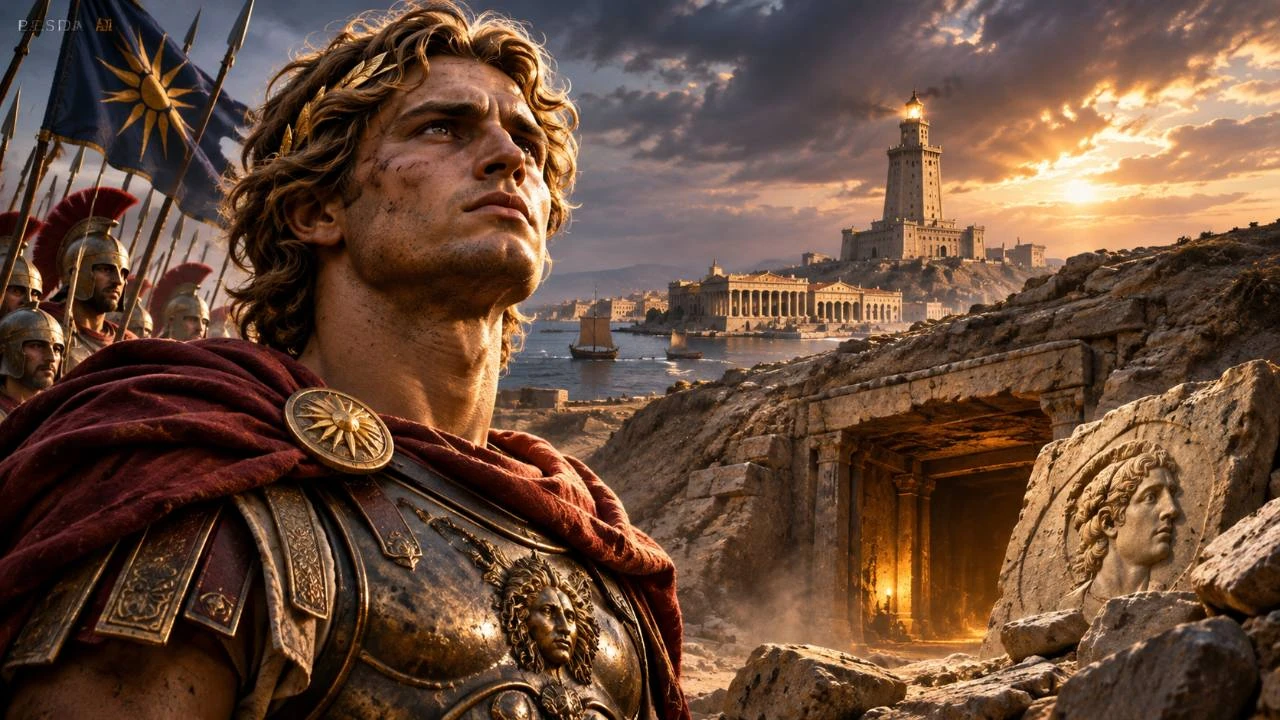
Ancient writers place Alexander’s tomb in Alexandria. Their accounts explain its political importance but leave its precise location unresolved.
AI-generated historical illustration. The entrance is imagined, and the Lighthouse of Alexandria belongs to a later period than Alexander’s lifetime.
Alexander the Great died in Babylon in 323 BCE. Centuries later, writers could still describe his burial monument in Alexandria, Egypt. Today no excavated site has been securely identified as that tomb. This is an unusual kind of archaeological mystery: the written record gives a convincing city, a recognizable royal setting and even a name for the enclosure, yet leaves too little to put a pin on a modern map. Strabo: Geography 17.1.8 and notes
How Alexander’s body reached Egypt
Alexander’s generals fought over the empire he left behind. Ptolemy secured the body and brought it to Egypt, where he established his dynasty. Possession of the remains linked the new regime to the conqueror in a way a proclamation could not. The accounts disagree over the intermediate steps. Pausanias records an initial burial at Memphis and a later transfer to Alexandria under Ptolemy II. Strabo’s account compresses the journey and places the burial in Alexandria under the first Ptolemy. Pausanias: Description of Greece 1.6–1.7
What Strabo actually locates
Strabo places Alexander in the enclosure usually called the Sema or Soma, within Alexandria’s palace district, alongside the burial places of the Ptolemies. This gives archaeologists a relationship between buildings rather than survey coordinates. Strabo also says the original gold coffin had been replaced by one he describes as glass. His testimony tells us what a writer of the Roman period understood about the monument. It cannot identify a surviving chamber by itself. Strabo: Geography 17.1.8 and notes
Why a famous monument can disappear
Alexandria has been rebuilt repeatedly, and much of the ancient city lies beneath later construction. Archaeologists can excavate only where modern conditions permit. Famous proposed locations have attracted searches, but a structure found near a plausible intersection still needs secure dating and evidence tying it to the burial. Nor is there a documented moment at which the tomb vanished. Damage, reuse, abandonment and burial beneath later layers can explain how a monument becomes unrecognizable without proving what happened to this one. Archaeological Institute of America: searches in Alexandria
The sarcophagus with Alexander’s name
The Alexander Sarcophagus in Istanbul is a genuine ancient object from the royal necropolis at Sidon. Its modern name refers to the figure identified as Alexander in its reliefs. The Turkish museum service associates the coffin with Abdalonymus, king of Sidon, as a proposed owner. The object illustrates a useful distinction: identifying a ruler in an image and identifying the person buried inside are separate archaeological claims. Turkish Museums: the Alexander Sarcophagus
What a Roman visitor tells us
Suetonius describes Octavian viewing Alexander’s body after taking Alexandria in 30 BCE. He says the future emperor paid honors to Alexander while declining to see the Ptolemies’ remains. The scene belongs to a biography written much later, and it is particularly revealing about how Roman writers framed the encounter. Alexander’s memory could serve another conqueror even after the dynasty that had built the monument lost power. Suetonius: Life of Augustus, section 18
Related reading · The evidence for Atlantis · The fall of Constantinople
FAQ
Frequently Asked Questions
Has Alexander’s tomb been found?
No excavated site has been securely identified as his tomb.
Where do ancient authors place the final tomb?
They place it in Alexandria, with Strabo locating it in the palace district.
Is the Istanbul sarcophagus his coffin?
Its name refers to the reliefs, and its original occupant is not securely identified as Alexander.
PRESDA Dispatch
Stay Informed. Stay Aware.
A sharp briefing across AI, gaming, sport, business, world affairs, paparazzi, and lifestyle.