ASTÉRIX: THE SATELLITE THAT MADE FRANCE A SPACE POWER
On November 26, 1965, Diamant launched Astérix from Algeria. Discover France’s independent orbital milestone, the silent satellite and its European legacy.
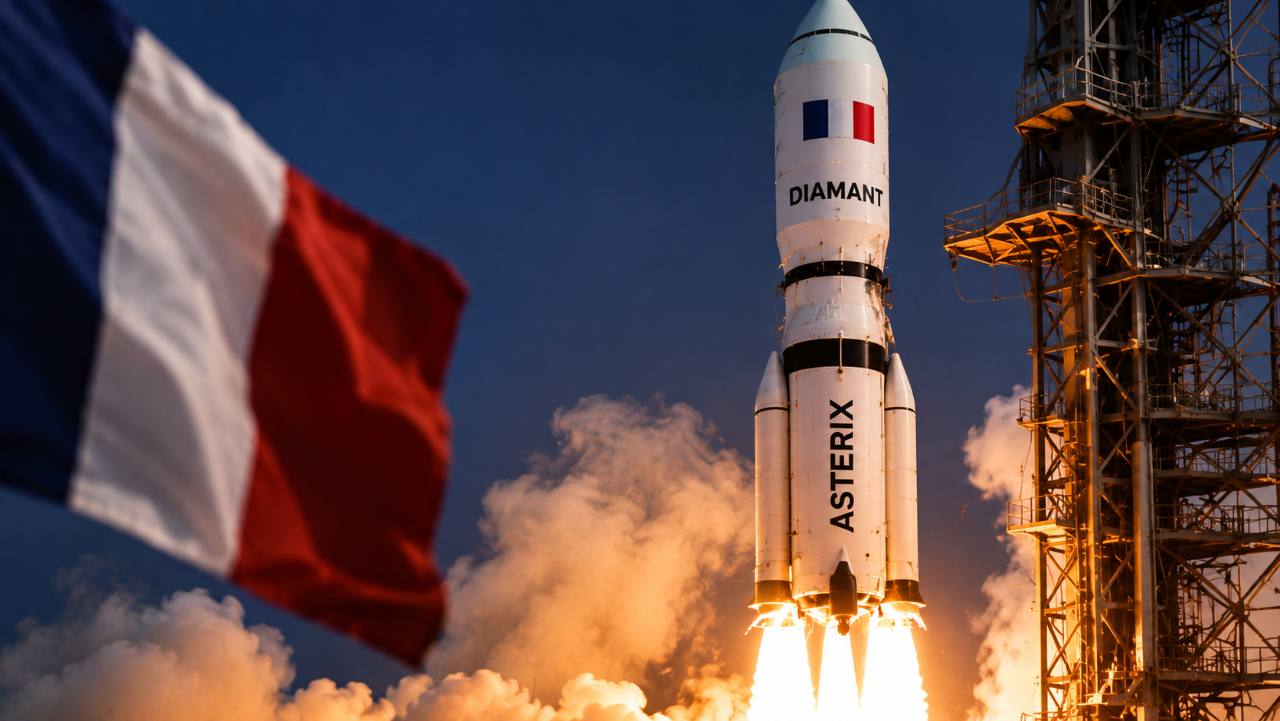
Supplied AI-generated space-history illustration, preserved unchanged. It is not an archival photograph of the 1965 launch or an engineering diagram of Diamant and Astérix.
On November 26, 1965, a Diamant-A rocket launched the satellite A-1, nicknamed Astérix, from Hammaguir in Algeria. France became the third country, after the Soviet Union and the United States, to place a satellite in orbit with its own launcher. The precise achievement was independent launch capability, not being only the third nation to possess a satellite. CNES: sixty years of French space history CNES: when Diamant launched Astérix, technical and institutional history
The distinction is the heart of the anniversary. A country can design a satellite yet depend on another country to carry it into orbit. In 1965, France demonstrated that it could supply the launcher as well as the payload. The small object at the top of Diamant represented a much larger industrial and political system beneath it.
What Astérix was designed to prove
CNES describes A-1 as a technological capsule built by Matra under a military contract. It did not carry a scientific experiment programme. Its principal job was to demonstrate that Diamant could inject a payload into orbit. The Guiana Space Centre gives its mass as approximately forty-two kilograms, tiny beside many later spacecraft but sufficient for this specific test. CNES: when Diamant launched Astérix, technical and institutional history Guiana Space Centre: Diamant programme
| Key fact | Verified detail |
|---|---|
| Launch date | November 26, 1965 |
| Launch site | Hammaguir, Algeria |
| Launcher and payload | Diamant-A; A-1, nicknamed Astérix |
| Satellite mass | About 42 kg, according to the Guiana Space Centre |
| Milestone | Third country to orbit a satellite with its own launcher |
That limited objective should not be confused with a lack of significance. A successful launcher must complete a sequence of propulsion, guidance, staging and payload delivery. Sending even a modest demonstrator to orbit validates capabilities that a ground test or a short upward rocket flight cannot establish on its own. The mission was deliberately about the transport system.
Reaching space and entering orbit are not the same
A sounding rocket can rise above the atmosphere and fall back. An orbital launch must also provide the motion needed for a satellite to keep falling around Earth rather than returning immediately to the ground. Astérix’s importance therefore cannot be measured from a dramatic launch photograph alone. Its destination and trajectory made the demonstration meaningful.
Why France’s third-place claim needs a qualifier
The Canadian Space Agency records the launch of Alouette-1 on September 29, 1962. Canada had designed and built that scientific satellite, which flew on a Thor-Agena rocket. This earlier achievement is compatible with France’s 1965 milestone because the two claims measure different things: building a satellite and independently launching one. Canadian Space Agency: Alouette I and II
Describing France simply as the third country in space can erase that distinction. The more accurate formulation is the third country to orbit a satellite with a nationally developed launcher. It identifies the accomplishment without denying the work of other space programmes or turning every possible first into the same contest. CNES: sixty years of French space history Canadian Space Agency: Alouette I and II
Diamant’s military roots and the civil space agency
The launcher grew from the Pierres précieuses programme, a sequence of French experimental vehicles developed in the early 1960s. CNES’ historical account places it within the military-led effort to establish independent strategic capability under Charles de Gaulle. The orbital success emerged from accumulated testing and industrial coordination, rather than a rocket suddenly invented for one celebratory launch. CNES: Diamant and Astérix, the emergence of French space capability
CNES was established by law in December 1961 and began its activities in 1962. The agency’s history distinguishes its coordinating role from the military and industrial organizations already active in rockets. In the Astérix mission, CNES contributed orbital tracking expertise. It is inaccurate to credit a single institution with every part of the programme. CNES: sixty years of French space history CNES: when Diamant launched Astérix, technical and institutional history
Three stages, one orbital objective
Diamant-A used a liquid-propellant first stage and solid-propellant upper stages. Different stages performed successive parts of the acceleration task. Its design drew on work already done in experimental rockets. The Guiana Space Centre describes an approximately nineteen-meter launcher, a compact vehicle compared with the heavy launchers associated with later space programmes. Guiana Space Centre: Diamant programme
The satellite and the launch vehicle also need separate names. Astérix was the payload’s nickname; Diamant was the rocket. The supplied illustration places a large Astérix inscription on the vehicle, but that artistic choice is not evidence of the historical paint scheme or the satellite’s external position. The actual mission should be understood from technical records. CNES: when Diamant launched Astérix, technical and institutional history
Hammaguir, not Kourou
The first launch took place in Algeria, which had become independent in 1962. CNES explains that the arrangements following the Évian agreements allowed French activity at the Saharan range to continue until 1967. Calling the 1965 site French territory would confuse operation of a facility with the sovereignty of the country in which it stood. CNES: Diamant and Astérix, the emergence of French space capability
Kourou in French Guiana belongs to the later chapter. CNES selected a replacement launch location and developed the Guiana Space Centre. Diamant subsequently flew there from 1970. Moving the launch base was an institutional and geographic change, not merely shifting the same photograph to a new caption. Astérix’s November 26 mission remained a Hammaguir launch. CNES: sixty years of French space history Guiana Space Centre: Diamant programme
A silent satellite and a successful launch
CNES attributes Astérix’s inability to transmit to antenna damage during fairing separation. The protective fairing and the satellite’s communications equipment had different functions, and a problem in one phase did not prevent the vehicle from reaching its principal orbital objective. Ground tracking confirmed the payload’s path even though the intended radio performance was compromised. CNES: when Diamant launched Astérix, technical and institutional history CNES: Diamant and Astérix, the emergence of French space capability
The episode is a useful lesson in defining success. A scientific observatory that cannot return measurements may lose its primary purpose. A launch demonstrator can establish orbital delivery while suffering a payload-system defect. Neither pretending everything worked perfectly nor calling the mission a total failure reflects the objective CNES describes. CNES: when Diamant launched Astérix, technical and institutional history
Science followed a distinct path
CNES notes that France’s scientific satellite FR-1 reached orbit in December 1965 using an American rocket, shortly after Astérix. Independent launch ambition and international cooperation were therefore already coexisting. Using a foreign vehicle for a particular scientific mission did not cancel the national launcher achievement; the missions were designed to answer different needs. CNES: Diamant and Astérix, the emergence of French space capability
From Diamant to a European approach
The Guiana Space Centre records ten successes in twelve launches across the Diamant programme. Those totals describe the programme as a whole, not twelve Astérix missions. They also show that the first orbital success began a sequence of operations rather than completing every launcher problem for all time. Reliability was built through repeated work. Guiana Space Centre: Diamant programme
The European Ariane programme took the ambition into a different institutional framework. ESA dates Ariane 1’s first launch from Kourou to December 24, 1979. French experience was important, but Ariane was a European collaboration rather than simply Diamant renamed. Shared industrial contributions and common decisions changed the scale of the undertaking. CNES: Ariane 1 to 4 European Space Agency: forty years of Ariane
Timeline of an independent launch capability
December 1961: CNES is legally established. Its activities begin in 1962. November 26, 1965: Diamant-A launches Astérix from Hammaguir. Diamant later operates from Kourou, beginning in 1970. December 24, 1979: Ariane 1 makes its first launch, carrying the independent-access ambition into a European programme. CNES: sixty years of French space history CNES: when Diamant launched Astérix, technical and institutional history Guiana Space Centre: Diamant programme European Space Agency: forty years of Ariane
Reading the anniversary beyond the launch image
The supplied hero is an AI-generated illustration, not a 1965 archival photograph or an engineering diagram. Its dramatic exhaust, lettering and proportions cannot establish the historical configuration. The CNES histories include authenticated archival material for readers who want to compare the actual vehicle and payload with their later cultural representations.
For another national engineering project, see PRESDA’s Concorde history. Our 1783 balloon flight feature explores an earlier boundary crossed above France, while Webb’s stellar-merger observations illustrate how scientific missions differ from a launcher test. Astérix’s achievement was precise: France had demonstrated a route of its own into orbit.
FAQ
Frequently Asked Questions
Was France only the third country to have a satellite?
No. It was the third to put a satellite in orbit using its own launcher. Other countries had already built or operated satellites launched by foreign rockets.
Was Astérix launched from Kourou?
No. It launched from Hammaguir in Algeria. Diamant later operated from the Guiana Space Centre.
Did Astérix carry a scientific observatory?
No. A-1 was a technological demonstrator intended to validate the launcher’s ability to place a payload in orbit.
Did the antenna problem make the launch a failure?
CNES says the antenna damage prevented transmission, but the satellite reached orbit and could be tracked. That met the central launch-demonstration objective.
PRESDA Dispatch
Stay Informed. Stay Aware.
A sharp briefing across AI, gaming, sport, business, world affairs, paparazzi, and lifestyle.