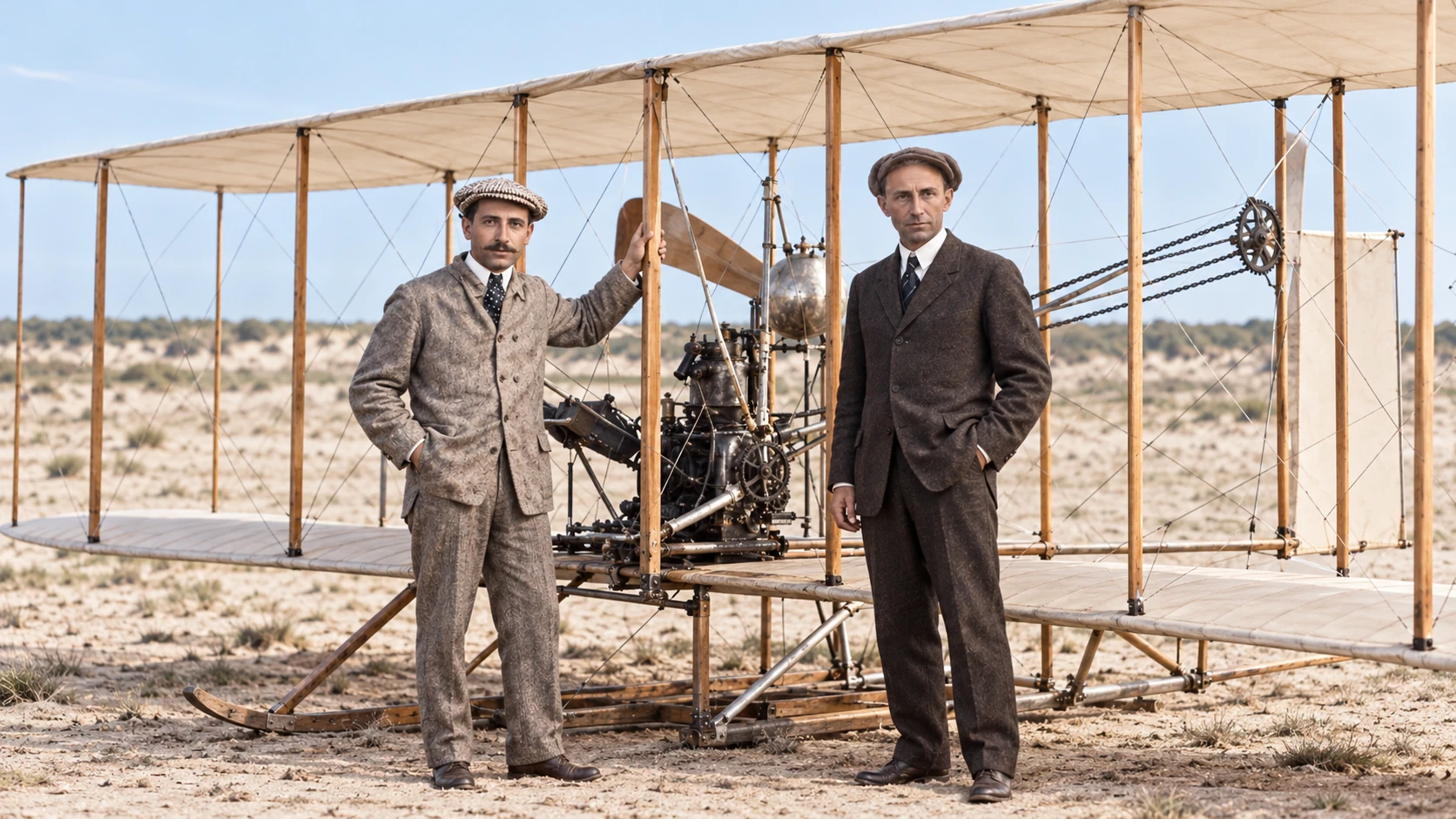
CONCORDE: THE FINAL FLIGHT OF A SUPERSONIC LEGEND
Why Concorde’s final flight on November 26, 2003 differed from its last passenger service, and what its retirement reveals about aviation’s economics.
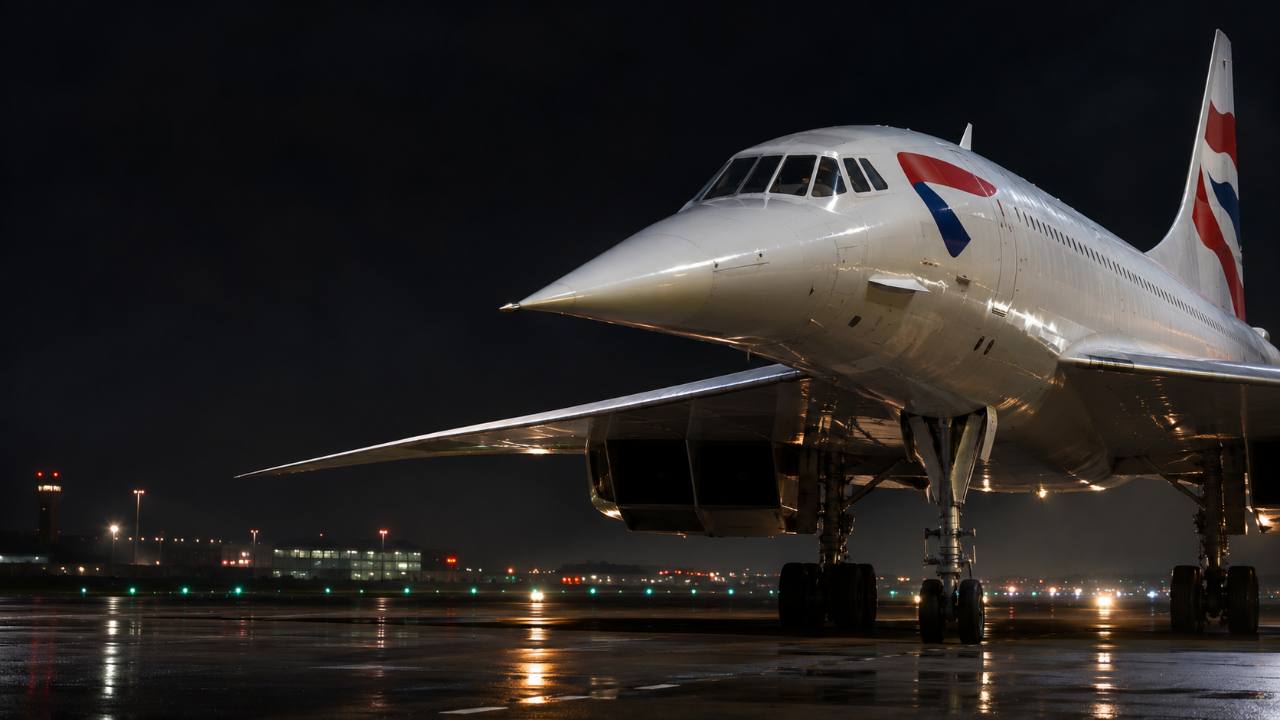
Supplied AI-generated aviation illustration, preserved unchanged. It is not an archival photograph of G-BOAF’s daytime final flight on November 26, 2003.
The last flight of any Concorde took place on November 26, 2003. British Airways G-BOAF, known as Alpha Foxtrot, departed London Heathrow and landed at Filton, near Bristol, where it had been built. This was the aircraft’s journey into preservation, not the final scheduled passenger service, which British Airways had operated a month earlier. Aerospace Bristol: the last Concorde British Airways: Concorde history and specifications
That distinction changes the anniversary. October 24 marked the end of a commercial product: a supersonic seat sold to a traveler. November 26 marked the end of a flying aircraft type. Between the two lay a carefully managed transition from airline operation to museum object, with the last landing returning a remarkable machine to its industrial birthplace.
What happened on the final flight?
Aerospace Bristol records a route from Heathrow over the Bay of Biscay, followed by a flight above the Clifton Suspension Bridge and a landing at Filton. Captain Les Brodie commanded the flight. The final journey connected the aircraft’s international identity with the city whose workforce had helped build the British Concordes. It was a farewell with a specific destination, not an unplanned grounding. Aerospace Bristol: anniversary of the final flight
| Key fact | Verified detail |
|---|---|
| Final flight of any Concorde | G-BOAF, Heathrow to Filton, November 26, 2003 |
| Last scheduled BA commercial flight | JFK to Heathrow, October 24, 2003 |
| BA seating | 100 passengers |
| Cruise | Around Mach 2, at up to 60,000 feet |
| Aircraft built | 20, including development aircraft |
G-BOAF was Concorde 216, the last example built as well as the last to fly. It is now the central exhibit at Aerospace Bristol. Its later move into a purpose-built hangar in 2017 happened on the ground. A museum relocation, however spectacular, must not be mistaken for a return to flight. Aerospace Bristol: the last Concorde
The two dates often confused
British Airways identifies October 24, 2003 as the date of its last scheduled commercial Concorde flight, BA002 from New York JFK to Heathrow, flown by G-BOAG. That aircraft is preserved at Seattle’s Museum of Flight. Alpha Foxtrot’s November journey came after the commercial farewell and involved a different registration. Substituting one for the other creates a plausible but incorrect account. British Airways: Concorde history and specifications The Museum of Flight: Concorde aircraft history
Service retirement did not mean every aircraft stopped that day
Aircraft being retired can still need positioning flights to their final homes. Those movements do not reopen the route network or restore ticket sales. Concorde’s last weeks illustrate why historians distinguish the last revenue service, the last operation by a particular airline and the final flight of the entire type. Each describes a different milestone.
How Concorde changed the passenger experience
The Anglo-French aircraft turned speed into its defining proposition. British Airways’ published specification describes a 100-seat cabin, cruise at approximately Mach 2 and operation at altitudes up to 60,000 feet. Four Rolls-Royce/SNECMA Olympus engines powered a slender fuselage and delta wing. These were specifications of an integrated design, not independent features that could simply be attached to a conventional airliner. British Airways: Concorde history and specifications
The airline’s configuration had forty seats in the forward cabin and sixty behind. The business proposition depended on time saved and a distinctive service rather than the huge capacity of a widebody. The passenger cabin could feel exclusive without being physically spacious. Fast transport and generous floor area were different forms of luxury. British Airways: Concorde history and specifications
A technical achievement with a limited production run
The Museum of Flight records twenty Concordes built between 1969 and 1979, including development aircraft. French prototype 001 first flew in March 1969; British prototype 002 followed a month later. Twenty built does not mean twenty aircraft available for regular airline schedules. A programme’s prototypes, test aircraft and operational fleet serve different purposes. The Museum of Flight: Concorde aircraft history
Commercial service began on January 21, 1976. The inaugural British Airways route was Heathrow to Bahrain, while Air France began Paris to Rio de Janeiro via Dakar. The later association with New York is so strong that it can obscure those initial destinations. Concorde entered service as a joint industrial project seeking an international market, not as a machine designed only for one famous city pair. British Airways: Concorde history and specifications Brooklands Museum: Concorde timeline
Why a celebrated aircraft stopped making commercial sense
The most useful account is the airline’s contemporary statement rather than a retrospective slogan about failure. In its April 10, 2003 announcement, filed with the US Securities and Exchange Commission, British Airways cited declining passenger revenue and rising maintenance costs. Discussions with Airbus had identified the need for a more extensive maintenance programme in coming years. British Airways, April 10, 2003: retirement announcement filed with the SEC
The carrier said it could not justify that investment against weaker demand for premium travel. This was a forward-looking decision about future spending and future revenue. It does not prove that every past flight lost money, nor that the engineering lacked value. Development cost, an individual service’s operating result and the business case for extending an aging fleet are different financial questions. British Airways, April 10, 2003: retirement announcement filed with the SEC
Reputation could not replace a sustainable network
A prestigious product still needs customers, support capacity and a viable maintenance plan. The retirement statement shows these pressures converging. Speed remained the aircraft’s attraction, but that attraction did not automatically guarantee the revenue needed for its next phase. The contemporary filing is more informative than invented lifetime profit totals or an unsupported claim that one event alone ended the programme. British Airways, April 10, 2003: retirement announcement filed with the SEC
The 2000 accident and the return to service
On July 25, 2000, an Air France Concorde crashed near Gonesse shortly after takeoff from Paris Charles de Gaulle. The BEA investigation documents a chain involving runway debris, tire damage, fuel leakage and fire. It was a catastrophic event, killing 109 people aboard and four on the ground, and requires a precise technical account rather than a simplistic explanation based on the aircraft’s age. BEA: final investigation report, Air France Concorde accident
The aircraft’s story did not end on that date. Aerospace Bristol records the resumption of commercial service on November 7, 2001. The return followed modification and recertification work. Retirement two years later should therefore be explained as a later decision in a changed commercial environment, while recognizing the accident’s profound place in the programme’s final years. Aerospace Bristol: the last Concorde
Timeline: from partnership to preservation
March and April 1969 brought the first flights of the French and British prototypes. January 21, 1976 brought commercial service. July 25, 2000 brought the fatal accident; November 7, 2001 the return of services. British Airways’ commercial farewell came on October 24, 2003, followed by G-BOAF’s final landing at Filton on November 26. Aerospace Bristol: the last Concorde British Airways: Concorde history and specifications The Museum of Flight: Concorde aircraft history Brooklands Museum: Concorde timeline BEA: final investigation report, Air France Concorde accident
What remains after the final landing
A preserved Concorde offers something a speed figure cannot: a chance to see the physical compromises of supersonic travel. The cabin, engines, wing and cockpit belonged to a particular industrial system. Interpreting that system alongside the business records gives a fuller picture than treating the aircraft as either an uncomplicated triumph or a commercial joke.
The supplied night scene is an AI-generated illustration, not a photograph of the daytime farewell. For the earlier pursuit of flight, explore PRESDA’s 1783 balloon anniversary and history of airplanes. Our Astérix satellite feature examines another November 26 milestone where technical capability and national ambition became inseparable.
FAQ
Frequently Asked Questions
Was November 26 Concorde’s last passenger service?
No. British Airways ended scheduled commercial service on October 24, 2003. November 26 was the final flight of any Concorde, to Filton.
Which aircraft made the last flight?
British Airways G-BOAF, known as Alpha Foxtrot and also as Concorde 216. It is preserved at Aerospace Bristol.
Did the 2000 accident immediately end Concorde?
No. Commercial services resumed in November 2001. Retirement in 2003 also reflected demand, revenue and rising maintenance requirements.
Was Concorde the first aircraft to fly supersonically?
No. Its achievement was sustained supersonic passenger transport. Earlier research and military aircraft had already exceeded the speed of sound.
PRESDA Dispatch
Stay Informed. Stay Aware.
A sharp briefing across AI, gaming, sport, business, world affairs, paparazzi, and lifestyle.