AYE-AYE: THE STRANGEST PRIMATE IN MADAGASCAR
Meet Madagascar’s aye-aye: a nocturnal lemur with specialised fingers, growing incisors and a remarkable way of finding food inside wood.
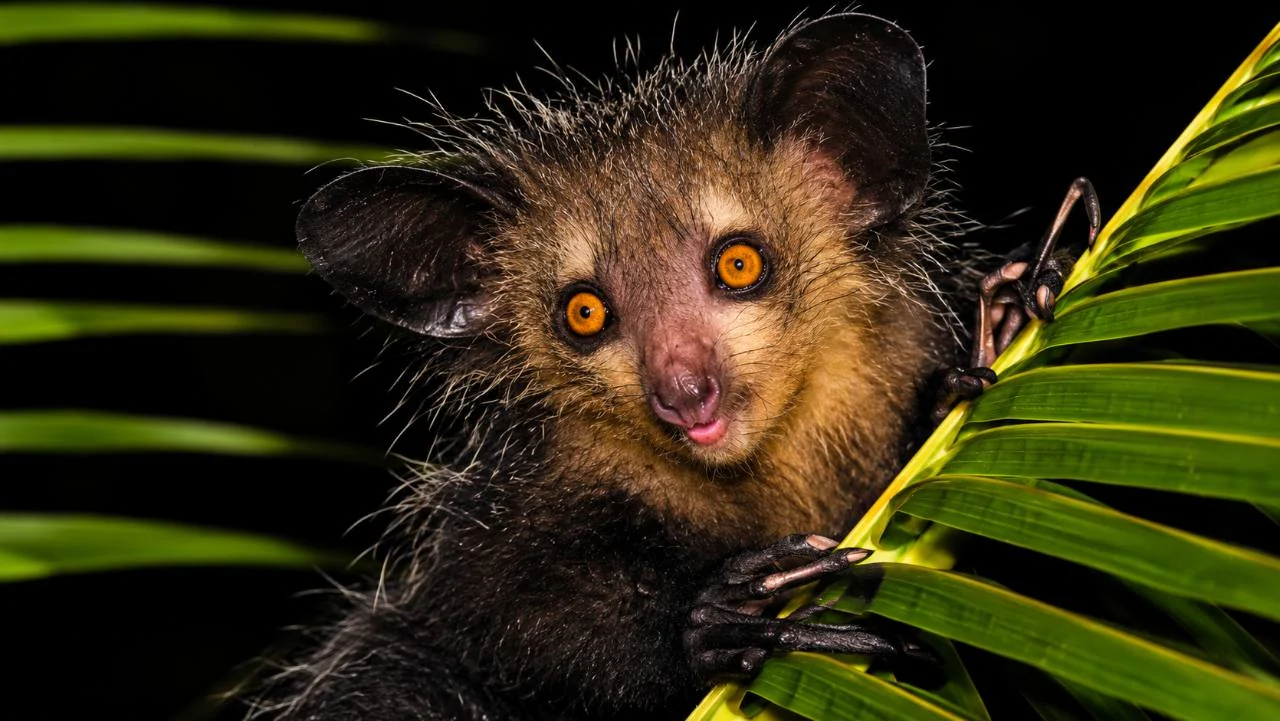
Editorial depiction of an aye-aye. Photographer, capture date and location were not supplied; this image does not identify a particular wild population or prove a feeding event. Editorial image supplied for PRESDA. Original creator and reuse licence not provided.
An aye-aye can look like several animals assembled into one: large ears, bright eyes, prominent incisors and a hand with an extraordinarily thin middle finger. Yet Daubentonia madagascariensis is not an evolutionary mistake. It is a lemur, and therefore a primate, native to Madagascar. Calling it the strangest is an editorial invitation to look closer, not a scientific ranking of which animal is most unusual.
A nocturnal life in the trees
The Duke Lemur Center describes aye-ayes as nocturnal foragers distributed in forests of eastern and western Madagascar. Their appearance is more understandable in that setting than in a brightly lit portrait. Large mobile ears and specialised hands belong to a feeding system that gathers information and extracts food in darkness. The animal is not a rodent simply because its incisors resemble a rodent’s. Duke Lemur Center, aye-aye species account
Tap, listen, open and extract
The feeding sequence is a fine example of anatomy working as a coordinated tool kit. An aye-aye taps wood and listens for differences associated with spaces inside it. Its incisors help open access to food, and its long, flexible middle finger can probe and extract insect larvae. The American Museum of Natural History also notes the digit’s use in getting coconut flesh. It is specialised feeding, not a supernatural power or an ability to see through trees. American Museum of Natural History, aye-aye account
This is often called tap foraging or percussive foraging. The useful idea is that a food source hidden from ordinary view can still leave detectable information. The aye-aye combines several actions rather than relying on one magic finger. A static photograph can show a slender digit, but a documented behavioural sequence is needed to demonstrate how that digit is being used.
The extra structure hidden in its hand
A 2019 anatomical study, published online before its 2020 journal issue, described a pseudothumb. Researchers examined seven individuals using dissection and digital imaging. They found a structure involving an enlarged wrist sesamoid and cartilage, with muscular attachments and a distinct palm pad. The proposed function is to help compensate for fingers specialised for tasks other than gripping. This is an anatomical finding with a functional interpretation, not proof that the aye-aye has a second ordinary thumb. Hartstone-Rose and colleagues, pseudothumb anatomy (2019/2020)
An unusual animal with familiar conservation pressures
The Lemur Conservation Foundation lists the aye-aye as Endangered, citing the 2020 IUCN assessment. Forest loss and persecution matter more to its future than whether people find its face appealing. Negative beliefs about aye-ayes occur in some communities, but it would be inaccurate to attribute one belief to every person in Madagascar. Conservation depends on local knowledge and relationships as well as protecting the habitat that supports feeding and movement. Lemur Conservation Foundation, aye-aye conservation account
The hero is an editorial depiction; its photographer, date and capture location were not supplied. It should not be used to identify a particular wild population or prove an observed feeding event. The richer story is the living system behind the portrait: an animal whose apparently odd parts make sense when we ask what they do.
Related reading: How scientists identify a wild-cat species.
FAQ
Frequently Asked Questions
Is the aye-aye a rodent or a primate?
It is a lemur and therefore a primate. Its rodent-like incisors do not make it a rodent.
What is its long middle finger used for?
It participates in tap foraging and can probe openings to extract insect larvae. The complete feeding system also involves hearing and incisors.
What is an aye-aye pseudothumb?
A specialised wrist-associated structure with bone, cartilage and a palm pad, described anatomically in research published online in 2019. It is not a second ordinary thumb.
PRESDA Dispatch
Stay Informed. Stay Aware.
A sharp briefing across AI, gaming, sport, business, world affairs, paparazzi, and lifestyle.