BANGLADESH'S FLOATING SCHOOLS: CLASSROOMS THAT SAIL DURING FLOODS
How Shidhulai’s school boats collect children, run lessons, use solar electricity and keep education within reach during monsoon flooding.
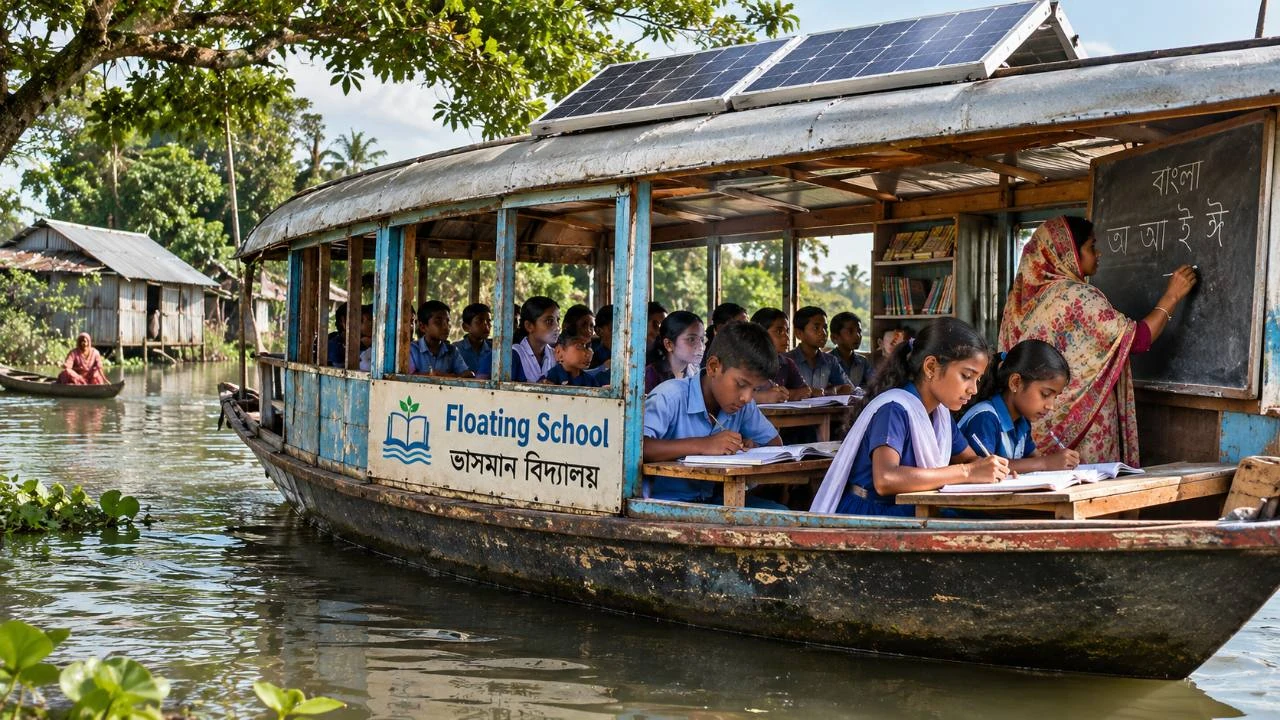
Editorial illustration supplied for PRESDA.
In Bangladesh’s flood-prone wetlands, some children reach class because their classroom comes to them. Shidhulai Swanirvar Sangstha’s school boats collect pupils at riverside stops, then dock for lessons. The organisation began operating school boats in 2002 and combines local boatbuilding with classrooms, teachers and solar electricity. The innovation is a way to keep education accessible when the road to a conventional school disappears under water. Shidhulai programme description Shidhulai boat design and innovations
Where do the floating schools work?
| Date or measure | Recorded detail | How to interpret it |
|---|---|---|
| 2002 | First Shidhulai school boat began operating | Programme milestone reported by the operator |
| 2015 UNICEF account | 54 mixed-use vessels | A historical fleet snapshot |
| July 2026 UNESCO update | 56 vessels, including 26 classrooms | Total fleet and school boats are different counts |
| Operator’s class description | 30 places and three classes per day | Capacity and sessions do not establish annual enrolment |
The programme is associated with the Chalan Beel wetlands in northwestern Bangladesh. Seasonal rises in water can connect waterways while submerging earthen roads and disrupting ordinary journeys. A village may remain inhabited while its usual school route becomes difficult. Moving the service by boat responds to that particular geography. UNESCO’s 2026 account describes a locally developed system drawing on the knowledge of communities who already build and use boats. It should not be read as a description of every school in Bangladesh. UNESCO 2025 literacy prize announcement
What problem does the boat actually solve?
A school building can survive a flood while its pupils still cannot reach it. Access involves the whole route between home and the classroom, including crossings and places where a child can board safely. The boat changes that route by collecting children closer to home. It does not make distance, weather or supervision disappear. Its value lies in adapting the location of a service to the movement of water and the people who need it.
How does a school day operate?
The organisation describes a boat that first acts as a school bus, making scheduled collection stops. It then docks and becomes a classroom. Lessons are therefore not simply conducted while a vessel sails through a flood. Teachers and pupils need a stable setting in which to read, write and use equipment. The same boat can organise three classes in a day, serving successive groups rather than requiring one group to remain aboard throughout all its movements. Shidhulai programme description
Thirty seats are not the same as thirty annual pupils
Shidhulai describes classroom space for 30 students and primary education through grade V. That is a capacity statement about a class. The number of children served over a year requires enrolment and attendance records. Likewise, three daily classes do not automatically prove that every seat is occupied each time. Distinguishing classroom size, class sessions and enrolled pupils makes it possible to discuss reach without inflating the programme’s scale. Shidhulai programme description
How is the boat designed for teaching?
The operator describes metal beams that support an open interior, wooden floors, a higher ceiling and a waterproof roof carrying solar panels. Classroom design has to work within a hull that can move and dock. Books, writing space and room for a teacher remain essential. Large openings can bring in daylight and air, while a usable roof shelters the learning space. These features show the meeting of boatbuilding and educational design. A classroom has to be both transportable and workable after arrival. Shidhulai boat design and innovations
Why local repair knowledge matters
Timber, joints, roofing and equipment all need care under wet conditions. A useful design is one that can be maintained, not only launched. Local builders’ familiarity with materials and waterways can help connect a new service to an existing repair economy. UNESCO emphasises that knowledge in its account of the initiative. The practical question extends beyond whether a boat floats: it must remain available on the days when pupils and teachers expect it. UNESCO 2025 literacy prize announcement
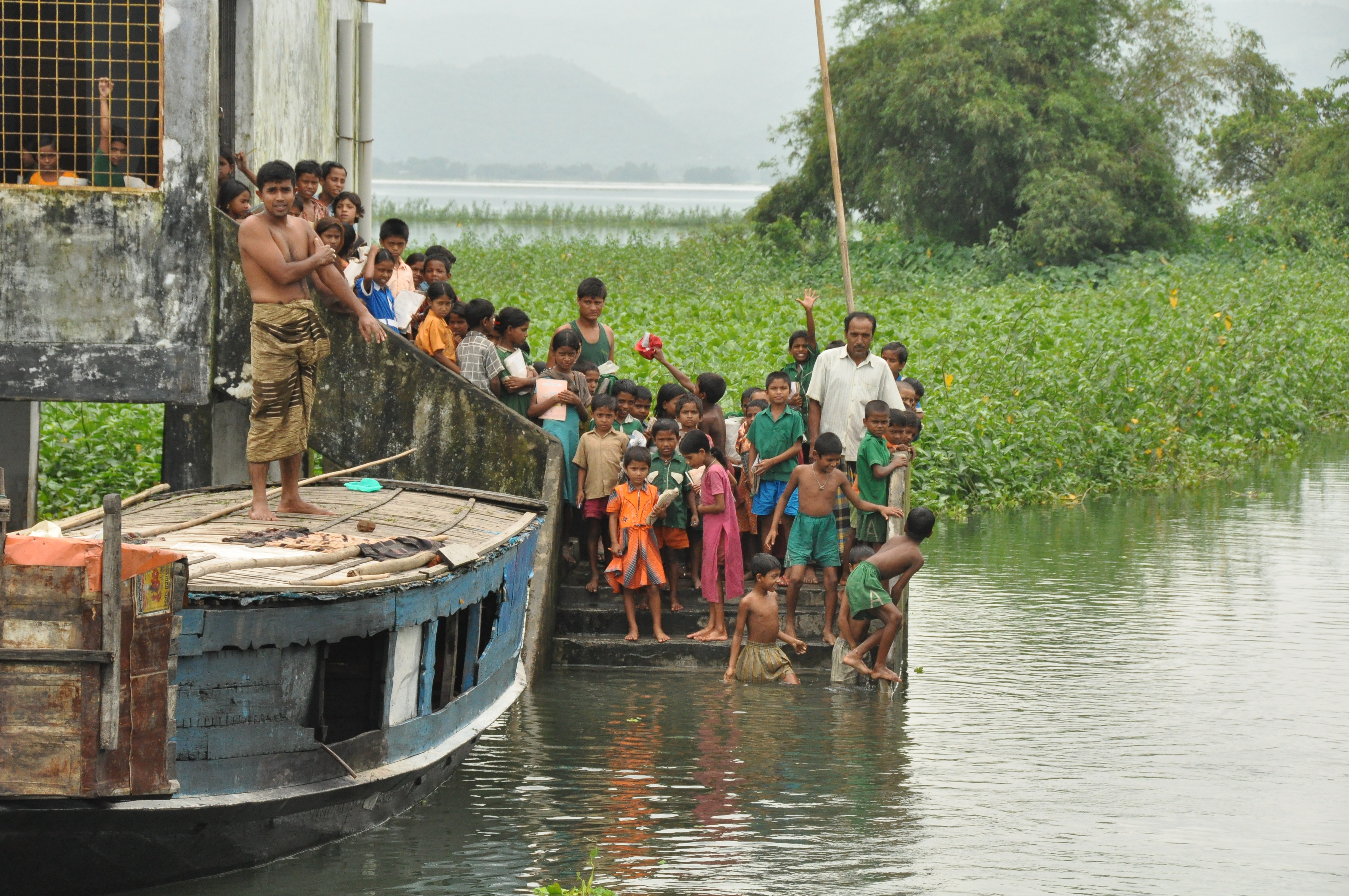
A floating school at Tanguar Haor, photographed in August 2009. This is a separate regional example; Shidhulai’s fleet figures in this article refer to its Chalan Beel programme.
What does solar power do on board?
Solar electricity supports lighting, computers and other learning equipment. Shidhulai also describes solar lanterns and evening activities. The panels generate electricity from sunlight, which can be stored and used according to the equipment installed. Describing a boat as “solar-powered” does not by itself establish that its propulsion is entirely solar. Classroom electricity and the energy needed to move the hull are different uses, and the equipment’s specifications determine which is being supplied. Shidhulai programme description Shidhulai boat design and innovations
Electricity helps, but teachers still organise the lesson
A laptop can make resources available where a fixed connection or grid supply is difficult. It does not establish how often the device is usable, what pupils learn from it or whether every lesson requires it. Books and teacher-led activities remain part of the classroom described by the operator. For broader context on the difference between electricity supply and total energy use, see PRESDA’s article on Uruguay’s renewable electricity system.
How many school boats are there?
UNESCO’s article, updated in July 2026, reports 56 vessels in Shidhulai’s wider fleet. It identifies 26 as classrooms, 10 as libraries and computer laboratories, and eight as training centres. Other boats serve healthcare, play and transportation. The important distinction is between the full fleet and its school component. Calling all 56 vessels schools would erase the roles assigned to other services and exaggerate the number of classrooms. UNESCO 2025 literacy prize announcement
Why older sources give different numbers
UNICEF’s 2015 summary describes 54 mixed-use vessels. An earlier UNDP study also describes a fleet of 54, with 20 school boats in that account. Those figures belong to their reporting periods and classifications. They are useful records of the programme’s development, but they should not replace a dated 2026 description. Nor should figures from different years be added together, since many vessels could be counted repeatedly. Current fleet size, cumulative pupils reached and daily attendance answer different questions. UNICEF State of the World’s Children 2015 summary UNDP Equator Prize programme study
Why access matters especially for girls
The operator identifies distance and restrictions on girls’ travel as barriers that a nearby collection route can reduce. Keeping education close to a community can also make the service more acceptable to families. The programme connects schooling with information about rights and opportunities for women and girls. These are the organisation’s stated aims and explanations. To establish how much any outcome changed, an evaluation would still need attendance, progression and comparison data, together with the views of the families involved. Shidhulai programme description
What recognition can and cannot establish
The initiative was selected for the UNESCO Confucius Literacy Prize 2025, with the formal presentation described in UNESCO’s 2026 report. The recognition concerns innovation and educational access in difficult geography. It is evidence of institutional recognition, while a claim about examination results or a reduction in dropout requires its own data. Keeping those measures distinct makes the achievement easier to assess. A programme can be valuable and still require careful measurement of what it delivers over time. UNESCO 2025 literacy prize announcement
What else does the wider fleet provide?
The organisation describes library boats with books and digital resources, training facilities and floating health services. UNDP’s study places these activities within outreach to communities isolated by seasonal water. A school boat is therefore one element in a wider service network. A family may need information about agriculture or healthcare as well as a child’s lessons. Sharing a water-based approach across those tasks can make local navigation and docking knowledge useful for more than one public need. Shidhulai programme description UNDP Equator Prize programme study
Shared infrastructure has coordination costs
Several services using waterways still need timetables, staff and suitable equipment. A place convenient for a classroom might have different requirements from a clinic. A boat assigned to one purpose cannot simply be assumed available for another. This is why a fleet breakdown matters to planning as well as to statistics. The design challenge includes distributing services and keeping commitments, rather than treating every floating building as interchangeable.
What are the limitations of the model?
The boat has to be built, maintained and staffed; collection points and routes have to remain usable. Conditions that permit an ordinary school day may differ from those during an extreme storm. A floating classroom cannot compensate for every interruption, and it does not replace the need for safe buildings, transport planning and educational investment on land. The model is best understood as a response to a specific access problem. Its transfer elsewhere would depend on local waterways, distances, maintenance and the education system it is meant to support.
Flood adaptation can take very different forms
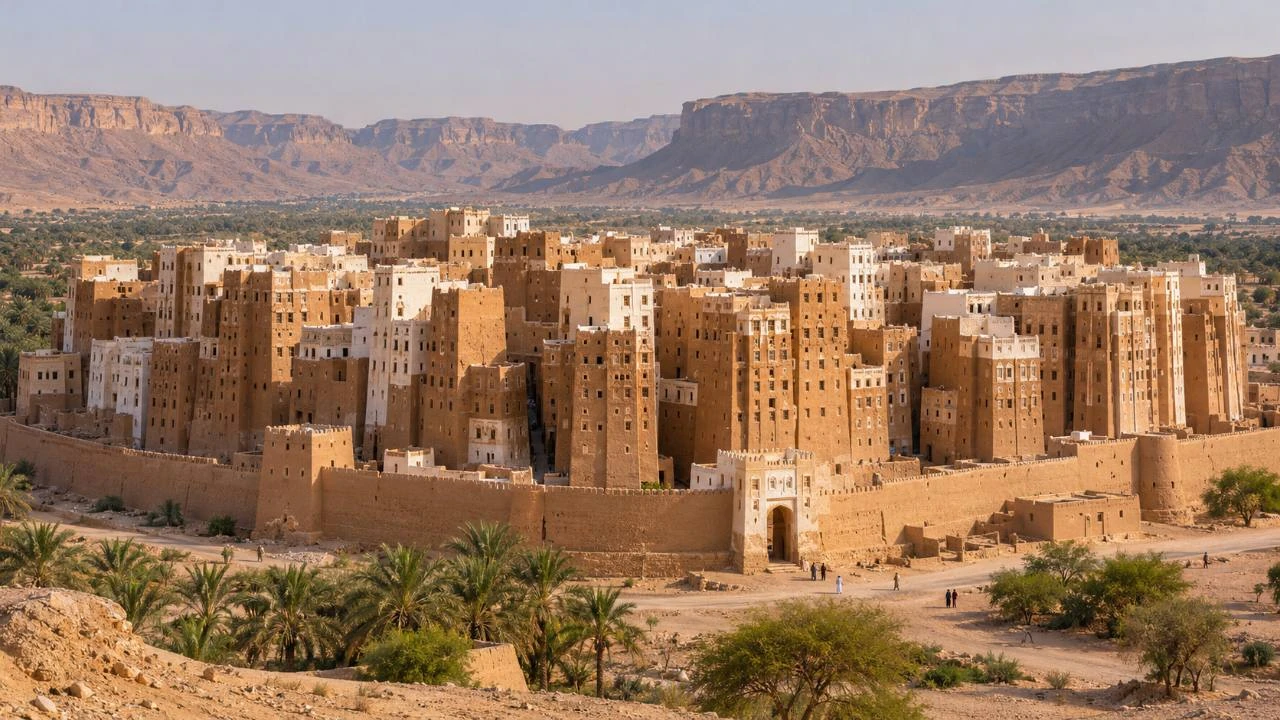
Some communities move a service with the water; others need to protect buildings that remain fixed. PRESDA’s account of Shibam’s earthen tower houses explores the maintenance of a settlement in a flood-prone landscape. The materials and institutions differ, but both stories show why understanding the local environment is central to keeping a community’s services and buildings usable.
FAQ
Frequently Asked Questions
How do Bangladesh’s floating schools work?
The boats collect children at riverside stops, then dock for lessons. The vessel combines transport and classroom functions.
Who operates the programme described here?
Shidhulai Swanirvar Sangstha, led by architect Mohammed Rezwan, has operated school boats since 2002.
How many of its boats are classrooms?
UNESCO’s July 2026 update identifies 26 classrooms in a wider fleet of 56 vessels.
Do the solar panels propel the boats?
The programme describes solar electricity for learning equipment and lighting. That description alone does not establish the energy source for propulsion.
Do floating schools replace ordinary schools?
They address access in particular water-based communities. Their usefulness depends on local conditions and the wider education system.
PRESDA Dispatch
Stay Informed. Stay Aware.
A sharp briefing across AI, gaming, sport, business, world affairs, paparazzi, and lifestyle.