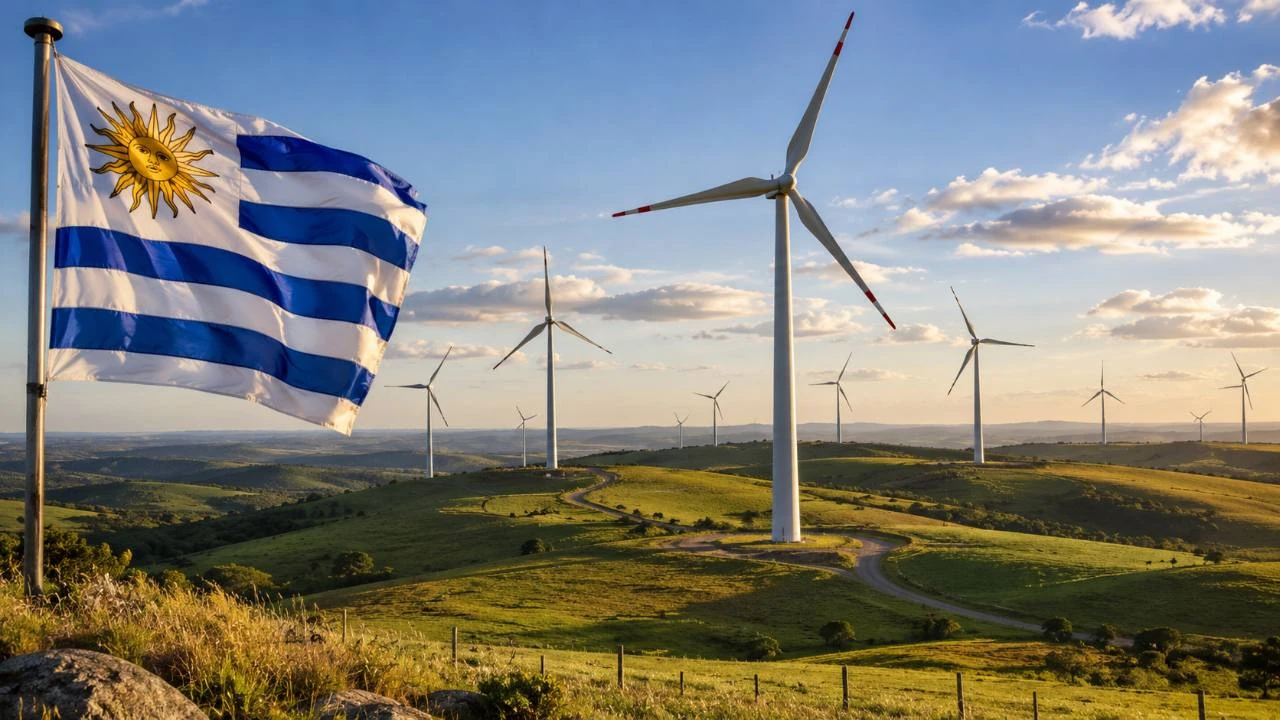
URUGUAY: THE COUNTRY POWERED BY 98% RENEWABLE ELECTRICITY
Uruguay generated 98% of its grid electricity from renewables in 2025. How hydro, wind and long-term power contracts shaped the result.
Editorial illustration supplied for PRESDA.
Uruguay supplied 13,040 gigawatt-hours to its interconnected electricity system in 2025. According to the government’s annual figures, 98% of that generation came from renewable sources. Hydropower accounted for 46%, wind for 34%, biomass for 14% and solar for 4%. Fossil sources supplied the remaining 2%. The result is striking because it describes an entire national power system over a year, covering periods of strong and weak output. The year and the denominator are essential to reading the figure. Presidency of Uruguay electricity report Presidency of Uruguay energy briefing
What the 98% figure covers
| Source | Share |
|---|---|
| Hydropower | 46% |
| Wind | 34% |
| Biomass | 14% |
| Solar | 4% |
| Fossil sources | 2% |
The percentage measures the origin of electricity generated for the interconnected system in 2025. It does not measure all energy used in Uruguay. Fuel burned directly in cars, ships, factories or buildings belongs to a wider energy balance. Electricity generated within the country is also different from electricity consumed within it. Uruguay exported 8% of the electricity it generated that year, according to the presidency. Imports and exports are separate quantities when calculating what was available to domestic consumers. Presidency of Uruguay electricity report
A gigawatt is different from a gigawatt-hour
A gigawatt describes a rate of output or an installed capability. A gigawatt-hour describes how much electricity was generated or used over time. A wind site can have the same turbine capacity in two years and produce different amounts of electricity depending on wind conditions and downtime. The same is true of hydroelectric capacity when reservoirs have different inflows. That is why the generation table cannot tell readers the shares of installed equipment, and an announcement about a new wind farm cannot by itself tell readers what share it will generate next year.
How Uruguay changed its power system
Uruguay’s modern transition built on existing hydroelectric assets. The national energy policy adopted in 2008 set a long-term direction and promoted domestic renewable resources. The country’s energy regulator identifies competitively awarded power purchase agreements as an important part of that approach. UTE, the public utility, contracted with producers, giving projects a buyer over a longer horizon than the day-to-day electricity market. The IEA notes that a 2009 decree opened an auction for 150 MW of wind, with a further phase envisaged. These are historical procurement figures, not the capacity of Uruguay’s wind fleet today. Uruguay energy and water regulator International Energy Agency wind power policy
Why contracts often determine whether turbines get built
A wind developer needs finance years before its first electricity sale. A long-term contract can make the likely income easier for a lender to assess. Competition helps a buyer compare offers against the same terms, and a winning bidder can make decisions about land, equipment and construction with more certainty. The agreement still has to specify how prices work and who takes particular risks. For example, a contract’s success depends on a buyer that can honour its obligations and a grid that can accept the power at the location and time it is generated. A cheap bid does not build transmission lines.
Why several technologies are useful together
Hydropower had the largest share of Uruguay’s 2025 generation, while wind was the largest of the other renewable sources. Wind turbines produce when weather allows. Solar panels follow the daily cycle and cloud conditions. Some hydro facilities can shift output by holding water for later, subject to storage, river and operating limits. Biomass facilities can generate from available feedstock and may operate on a different schedule from wind and solar. The important question is what the technologies can do together across hours and seasons, not which one wins a single annual ranking. Presidency of Uruguay electricity report
The grid still has to balance hour by hour
Operators have to match demand and supply continuously. A day with useful wind and ample water can look very different from a calm dry spell. Trading with neighbours can help when surpluses and deficits do not occur at the same time. Domestic thermal generation can provide another option, which explains why a power system can maintain fossil equipment while using it for only a small share of annual output. The options are complementary, and none is unlimited. Interconnectors have capacities and neighbouring systems can experience their own shortages.
What a repeat of 98% would depend on
One year’s results reflect demand, rain, wind, plant maintenance and trading conditions. The government itself reported substantial variation in monthly emissions per unit of electricity in 2025. That is consistent with a power mix that changes over time. A dry period can reduce hydro output even though the dams are still there. When demand grows, meeting it with a high renewable share can require new generation, stronger networks or changes in when electricity is used. The yearly percentage is a useful record, but an evaluation of reliability needs hourly information, including what happens during periods with the least output. Presidency of Uruguay electricity report
Does biomass make the total carbon-free?
Renewable is a source category. It does not mean that every technology in that category has no emissions. Biomass can emit carbon dioxide during combustion, and its net climate effects depend on the feedstock, what would otherwise have happened to it, land use and the time considered. Hydropower and wind also have material and environmental impacts that do not appear in an annual fossil generation percentage. A generation share is therefore one part of the evidence on climate and environmental performance.
The next challenge is outside the power station
Electricity can help replace oil products if vehicles, buildings or industrial processes can use it efficiently. That involves charging sites, suitable equipment, finance and an electricity network ready for new loads. Electrification can shift energy demand rather than simply remove it. A depot charging vehicles at the same time every evening, for example, creates a different grid need from a site that can charge overnight in stages. Uruguay’s energy regulator presents the extension of the transition beyond the power sector as a separate challenge. For another case where power availability shapes investment, see PRESDA’s coverage of Samsung’s data-centre plans. Uruguay energy and water regulator
What other countries can take from Uruguay
The country’s experience is easier to use as a set of decisions than as a target to copy. A system with little reservoir storage may need a different mix of flexibility, and a country without strong links to its neighbours may have to handle longer matching problems internally. A public utility must have the capacity to plan transmission and run credible tenders. It must also coordinate when new generators and grid upgrades go into service. Each choice depends on the existing network and on the buyer’s ability to keep commitments over many years. Uruguay energy and water regulator
The results also give readers a way to assess competing claims about clean power. First ask whether the figure is for energy or electricity. Then ask whether it describes production or consumption and which year it covers. Finally, check whether the mix reflects a normal year of water and wind or a particularly favourable one. A system can make durable progress even if the percentage fluctuates. Likewise, one especially strong year does not tell us how the system will respond under pressure.
FAQ
Frequently Asked Questions
Did renewables provide 98% of all Uruguay’s energy?
The figure covers 2025 electricity generation for the interconnected power system. The broader energy balance also includes direct fuel use.
What was Uruguay’s largest source of renewable electricity in 2025?
Hydropower supplied 46% of generation, ahead of wind at 34%.
Can the figure change in another year?
Yes. Hydrology, weather, demand, maintenance and power trading change the annual generation mix.
PRESDA Dispatch
Stay Informed. Stay Aware.
A sharp briefing across AI, gaming, sport, business, world affairs, paparazzi, and lifestyle.