THE BLACK DEATH: THE PANDEMIC THAT TRANSFORMED EUROPE
From plague-era graves in Kyrgyzstan to labor laws in England, the Black Death remade communities across Eurasia. Ancient DNA has sharpened its origin story, while the famous Caffa account remains contested.
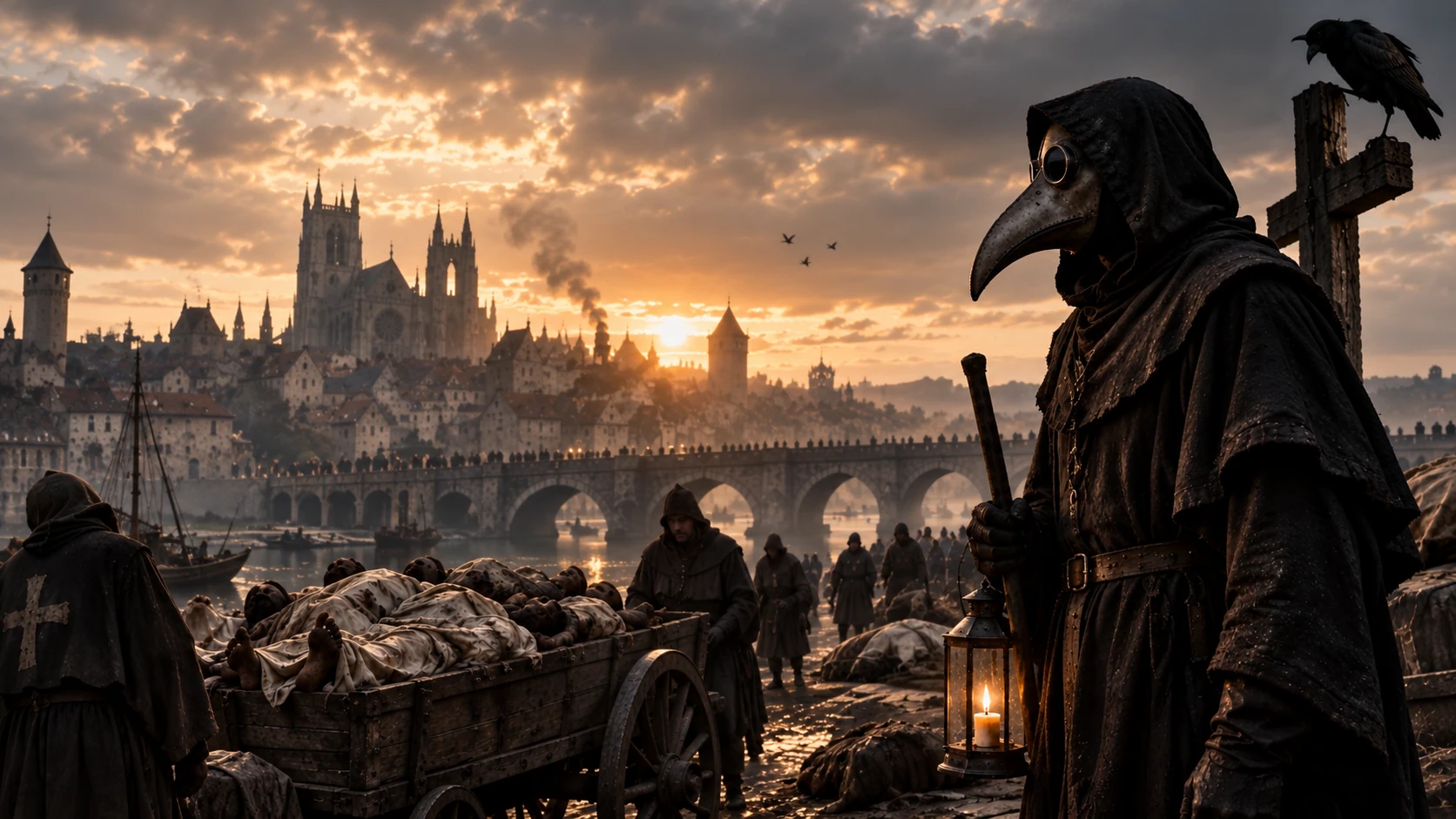
AI-generated artistic illustration of a plague-era port. The beaked mask is anachronistic: this design appeared in Europe centuries after the Black Death.
In 1348, a stranger arriving by sea could bring more than cargo. Across Europe, ships, roads and river routes connected crowded ports to market towns and villages. Then came fever, swollen lymph nodes, breathlessness and death. The pandemic later called the Black Death swept through the continent during the mid-fourteenth century, killing a devastating share of the population. Ancient DNA has now tied its pathogen to a Central Asian outbreak recorded in 1338–1339. Yet one of the most famous stories about how plague entered the Mediterranean, the siege of Caffa, remains a question of evidence, not settled fact.
What was the Black Death?
The Black Death was the first catastrophic wave of the second plague pandemic, whose outbreaks recurred across Eurasia and North Africa for centuries. Its main pathogen was Yersinia pestis, a bacterium also responsible for plague today. Medieval writers described sudden illness, darkened skin, painful swellings and deaths that overwhelmed households. The word “Black” became attached to the catastrophe in later usage; it is not a precise clinical description of one uniform illness. The World Health Organization distinguishes bubonic, pneumonic and septicaemic plague.
In bubonic plague, infection commonly follows a bite from an infected flea and causes fever and painful, enlarged lymph nodes called buboes. Pneumonic plague infects the lungs and can pass between people through respiratory droplets. Septicaemic plague affects the bloodstream. These forms can overlap as infection progresses. The medieval pandemic likely included more than one clinical presentation, but surviving descriptions cannot always identify which form a particular person had. Modern categories help explain the biology; they cannot turn every chronicler's phrase into a retrospective diagnosis.
Plague is not simply a story of rats carrying fleas from one city to another. The bacterium circulates in animal reservoirs, and transmission depends on ecology, climate, human movement and vectors. Historians and biologists debate the roles of fleas, lice and respiratory transmission in the medieval pandemic. Seaborne trade and overland exchange moved people, goods and pathogens. The CDC's account of plague at Caffa reviews the medical and historical questions around these routes.
A clue preserved in Kyrgyzstan
For centuries, the pandemic's distant beginnings were difficult to locate. In 2022, researchers examined human remains from cemeteries at Kara-Djigach and Burana in the Chüy Valley of present-day Kyrgyzstan. Some gravestones marked deaths in 1338 and 1339 and used a word translated as “pestilence.” Ancient DNA from two individuals revealed Y. pestis genomes closely related to the ancestral population from which the major lineages associated with the later Black Death diversified. The Nature study by Spyrou and colleagues made this a landmark finding.
The result points to a Tian Shan outbreak shortly before the pandemic expanded west. It does not prove these two people were patient zero, establish every transmission route, or identify a single caravan to Europe. The researchers also connected the strain to rapid bacterial diversification sometimes called a “big bang.” Ancient genomes are a crucial biological anchor, but must be read alongside inscriptions, trade history, climate evidence and archaeological limits.
This discovery changes the map of the question, not the nature of the catastrophe. Central Asia was not an empty corridor between Europe and China. It contained towns, pastoral communities and trade networks linking the Tian Shan with wider Eurasian markets. The medieval Mongol Empire and its commercial networks formed part of the wider historical setting, though the empire itself had fragmented by the fourteenth century. Connections could accelerate movement; they do not make a whole population responsible for a bacterium's spread.
The route west: ships, ports and the Caffa story
The disease appears in Black Sea and Mediterranean records in the late 1340s. In 1347, plague reached Constantinople and ports including Messina in Sicily; by the following year it was reported in Marseille, Avignon, Florence, Paris and other centers. It moved through both coastal shipping and inland networks. The chronology differed by place, and local records are uneven. A route map is therefore a reconstruction from scattered reports, not a minute-by-minute trail. Cambridge's chapter on the Black Death's spread describes the importance of maritime connections and rapid leaps between ports.
Caffa, today's Feodosia in Crimea, was a Genoese trading settlement besieged by forces of the Golden Horde. The often-repeated account says that during the siege of 1346, attackers suffering from plague hurled corpses over the city walls. Gabriele de' Mussi, a notary from Piacenza, described the episode in a Latin narrative. His account is vivid and consequential, but he was not an eyewitness at Caffa. It is one testimony composed away from the scene, not a corroborated operational report from both sides.
Some historians have considered the corpse story plausible, and medical historian Mark Wheelis argued that it could explain how plague entered the city. Other scholars challenge the claim that this episode triggered Europe's pandemic. Hannah Barker's study of grain, embargoes and Black Sea trade argues that the story rests on a single non-eyewitness text and that the timing and broader commercial evidence complicate the standard account. A critical review by Ole Jørgen Benedictow also questions the common transmission narrative. Barker's article in Speculum and the transmission review show why Caffa remains debated.
Even if infected bodies were thrown into Caffa, the act alone cannot explain plague's arrival in Mediterranean Europe. Its harbor connected ships, merchants and food supplies. Whether Genoese ships carried plague from the siege, whether the disease was already nearby, and how it reached individual ports are separate questions. The evidence links the siege and plague in one medieval account, but the catapult story's role in transmission is disputed. Trade routes offer a broader framework.
How far did it spread, and how many died?
Between 1347 and 1353, plague traveled across much of Europe, North Africa and western Asia. Sicily and the Italian peninsula were among the first European regions affected; then the disease moved through France, Iberia, the British Isles, central Europe and Scandinavia. Some areas were struck repeatedly, while others appear less affected or are poorly documented. It is misleading to imagine a single synchronized wave that touched every town with equal force. Seasonal movement, local ecology, shipping schedules and the availability of records shaped what can be reconstructed.
No reliable continent-wide death register survives. Estimates vary, but historians commonly describe losses on the order of one-third to one-half of Europe's population, with substantial local variation and continuing debate. Some towns lost a very large share; elsewhere the evidence suggests lower mortality or remains uncertain. Figures such as 25 million or 50 million deaths are estimates, not counted totals. They depend on assumptions about the population before plague, which sources were recorded, and what geographical area and years are included. Cambridge scholarship reassesses medieval mortality evidence.
Cities saw households collapse, workshops empty and burial systems come under pressure. Rural communities lost workers, tenants and officials. Priests and physicians died too, while survivors cared for children and relatives. Without knowing how infection worked, observers invoked religion, astrology and corrupted air. Yet people also quarantined, restricted movement, changed burial practices and sought remedies, with uneven results. The evidence does not support the caricature that medieval society simply surrendered to superstition.
Fear, faith and persecution
Religious responses varied. Some prayed, gave alms or joined processions; others withdrew or fled. Flagellant movements appeared in parts of Europe, but were not universal and church authorities later condemned them. Many interpreted the epidemic through beliefs about sin and divine judgment. Ritual could restore a sense of order when ordinary explanations failed, but could not identify Y. pestis or stop transmission.
A particularly violent response targeted Jewish communities. Rumors falsely accused Jews of poisoning wells, and torture was used to extract confessions. Massacres, expulsions and destruction of communities followed in parts of the Rhineland and other regions, sometimes before plague reached a town. Jewish people also suffered from the disease; the conspiracy accusation had no evidentiary basis. Pope Clement VI issued protections and condemned attacks in 1348, though papal statements could not reliably shield communities from local rulers, mobs or opportunistic violence. Fordham University's source collection preserves contemporary documents.
The pogroms were not an inevitable reaction to disease. They drew force from older antisemitism, political conflict, debt and the ability of authorities either to protect or abandon their neighbors. This matters because epidemics do not create prejudice from nothing; they can make existing structures of scapegoating more deadly. Describing these killings as a consequence of panic alone would obscure the choices of perpetrators and the institutions that permitted violence. It would also reduce Jewish victims to a footnote in a European crisis that affected their lives and communities directly.
A labor crisis reshapes the economy
When so many people died, labor became scarce in many regions. Landowners needed tenants and workers; artisans and agricultural laborers could sometimes bargain for better pay, move to new employers or lease land on improved terms. But gains were not immediate or universal. Demand also collapsed, farms were abandoned, and prices and wages moved differently depending on occupation and location. Women took on new work in some settings, while customary and legal restrictions continued to shape what they could earn and own.
In England, the government responded with the Ordinance of Labourers in 1349 and the Statute of Labourers in 1351, attempting to hold wages near earlier levels and restrict workers' movement. The laws reveal elite anxiety about bargaining power. Their enactment did not mean that every worker received higher pay, or that authorities could fully enforce the rules. Economic historians emphasize that effects unfolded over decades and differed across Europe. Mark Bailey's research traces both the legislation and labor-market changes, warning against a simple formula in which plague instantly abolished feudalism. His 2025 study in Economic History Review documents the uneven response.
The population shock weakened some manorial arrangements and altered the balance between land and labor. In parts of western Europe, serfdom declined over time; in other regions coercive labor systems endured or evolved differently. Rents, inheritance, land use and consumption shifted. Religious institutions lost personnel and income, but their authority did not simply vanish. The pandemic accelerated pressures already in motion, and later outbreaks repeatedly changed the calculations. A more accurate story is transformation through conflict and adaptation, not a single plague-born revolution with the same outcome everywhere.
What the plague changed, and what it did not
The catastrophe left marks in art, literature and memory. Images of death became more prominent, and writers described the fragility of social bonds. Yet art was not a direct thermometer of collective despair, and religious life did not uniformly collapse. Survivors rebuilt households, founded institutions and resumed trade. New labor patterns, shifts in wealth and changes in the use of land helped shape later European economies, though scholars debate how much the Black Death alone explains. Economic research links the shock to long-term structural changes while emphasizing interactions with politics, geography and institutions. A Journal of Economic Literature review surveys these effects.
The Black Death also affected North African and Middle Eastern societies whose politics, labor systems and religious responses differed from Latin Christian Europe. Calling it a European turning point does not make Europe the whole world. The plague changed longer histories, but did not directly cause the Renaissance, end feudalism or create modern capitalism.
The mask belongs to a later plague history
The bird-beaked doctor does not belong to the first Black Death wave. Evidence for this European costume dates from the mid-seventeenth century, centuries later. Doctors believed aromatic substances in the beak could protect them from corrupt air. It reflects later medical ideas, not what a physician in 1348 would have worn. This AI-generated hero is an artistic illustration, not a documentary image; its mask is intentionally anachronistic. A study of the mask's museum history traces the evidence.
The Black Death was not only a disease event. It was a biological catastrophe carried through human and ecological networks, a demographic shock whose effects were filtered through class and law, and a test of how communities treated vulnerable neighbors. Ancient DNA can now illuminate its origin more precisely. Medieval testimony still requires close reading, especially when one vivid story becomes a tidy explanation. The dead cannot be reduced to a single number or a dramatic siege. Their history asks us to hold scientific evidence, human experience and uncertainty together.
Sources and further reading
This feature draws on ancient DNA research, plague science, medieval source criticism and economic history. Key references include Spyrou et al., Nature, 2022; World Health Organization, Plague; Cambridge University Press, The Complete History of the Black Death; Wheelis, Emerging Infectious Diseases, 2002; Barker, Speculum, 2021; and Bailey, Economic History Review, 2025.
Further studies include Benedictow's review of western European transmission, Cambridge research on mortality, the American Economic Association review of economic impacts, Fordham's medieval Jewish history sourcebook, and the study of the plague doctor's mask. These sources disagree on some mechanisms and consequences; the article identifies those debates rather than hiding them.
FAQ
Frequently Asked Questions
What caused the Black Death?
The Black Death was caused by Yersinia pestis. Bubonic plague commonly spreads through infected flea bites; pneumonic plague can spread through respiratory droplets. Ancient DNA from Kyrgyzstan dated 1338–1339 identifies an outbreak with a strain closely related to the ancestry of the pandemic lineages.
Did Mongols catapult plague victims into Caffa?
Gabriele de' Mussi described attackers hurling corpses into Caffa during its siege, but he was not an eyewitness. Historians disagree about the account's reliability and whether the episode transmitted plague into the Mediterranean. Trade routes and regional outbreaks provide a broader context.
How many people died in the Black Death?
Exact totals are unknown. Historians often estimate that roughly one-third to one-half of Europe's population died during the first wave, but losses varied greatly by place and the underlying population figures are uncertain.
Did the Black Death end feudalism?
No single event ended feudalism. Labor scarcity strengthened some workers' bargaining position and changed land and labor relations, but the effects varied across regions and unfolded over generations.
Did medieval plague doctors wear beaked masks?
The familiar beaked mask is associated with plague doctors from the mid-seventeenth century, centuries after the Black Death's first wave in 1347–1353.
PRESDA Dispatch
Stay Informed. Stay Aware.
A sharp briefing across AI, gaming, sport, business, world affairs, paparazzi, and lifestyle.