Black Friday: How the Global Shopping Event Works
Black Friday is November 27, 2026. Explore its Philadelphia origins, retail economics, online spending and how to assess a discount beyond its headline.
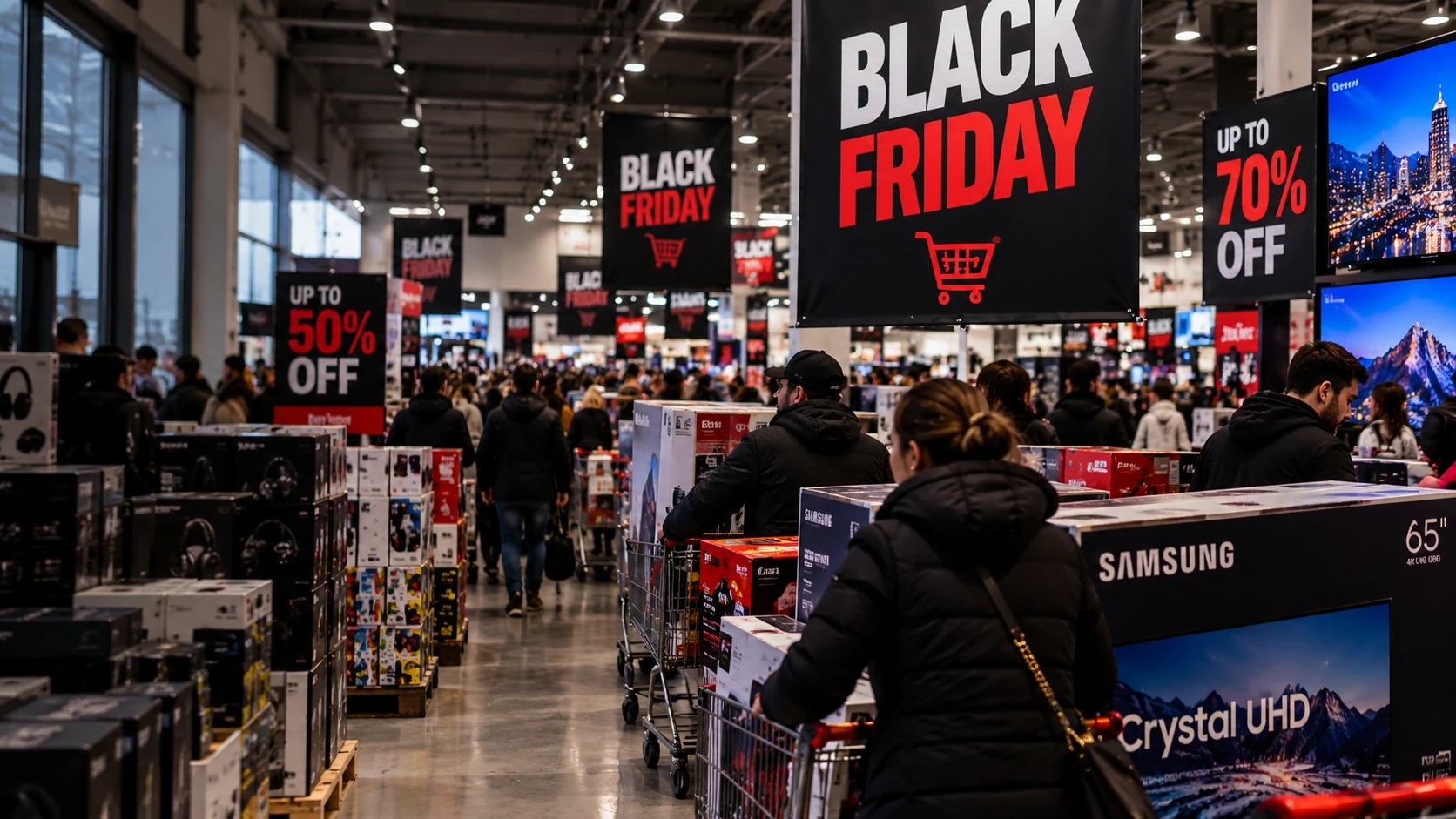
PRESDA AI-generated editorial illustration. The store, crowd and advertised discounts are illustrative, not evidence of a real retailer's offers or 2026 sales.
The most powerful number on a Black Friday page is often not the price. It is the price crossed out above it. That comparison invites a shopper to see a purchase as a saving, while a countdown suggests the decision cannot wait. Some offers deliver genuine value. Others work mainly because the presentation makes an ordinary buying decision feel like an opportunity about to disappear.
Black Friday falls on November 27, 2026, the day after U.S. Thanksgiving on November 26. Cyber Monday follows on November 30. Retail campaigns may start well before those dates and continue afterward. As of this article's publication on October 26, the 2026 event has not happened: any claim about its eventual sales must be a forecast, not a reported outcome.
Why this Friday became black
The shopping name is associated with mid-twentieth-century Philadelphia, where police used it for the difficult traffic and crowds after Thanksgiving, also ahead of the Army-Navy football game. Public broadcaster WHYY describes these local roots. The familiar story that retailers suddenly moved from losses in red ink to profits in black ink is a later, more flattering explanation, not a complete account of the name's origin. WHYY: Black Friday's Philadelphia roots
GBH's historical account notes an unsuccessful 1961 attempt to rehabilitate the name as Big Friday. That episode captures the change in perspective: what city workers experienced as congestion, merchants wanted to present as commercial opportunity. The phrase ultimately became an asset. Its darker associations were repackaged into a promise of bargains. GBH: how Black Friday got its name
From one American day to an international sales season
The day after Thanksgiving offered a recognizable point at which to begin holiday shopping. As retailers competed for attention, the event expanded beyond a single opening time or storefront. Online shops could serve buyers who never joined a queue, while established stores combined websites, deliveries and collection counters. The label became portable even in countries without an American Thanksgiving holiday.
What travels is the promotional format, not necessarily the original calendar's cultural meaning. A retailer elsewhere can use the same name for a weekend, a week or a month. That makes it important to read the actual offer dates. A Black Friday banner does not tell a customer whether a particular price will last an hour, return next week or remain available throughout November.
Is it really the world's biggest shopping event?
There is no meaningful universal ranking without a defined measure. One could compare a single day's online spending, several days of total retail sales, the number of shoppers or the geographical reach of a promotion. Those are different quantities. Other major events, including Singles' Day campaigns, use different periods and reporting methods. Calling Black Friday a global retail phenomenon is defensible; declaring it the largest in every sense is not.
Even within the United States, Black Friday and Cyber Monday do not lead every measure simultaneously. Adobe reported $11.8 billion in U.S. online spending on Black Friday 2025 and $14.25 billion on Cyber Monday. These are nominal online-spending estimates for a defined market, not worldwide sales and not a count of people entering stores. Adobe: 2025 Cyber Week results
What the headline statistics actually measure
The National Retail Federation and Prosper Insights & Analytics estimated that 202.9 million consumers shopped over the five days from Thanksgiving through Cyber Monday in 2025. That was a consumer-survey result for a holiday weekend, not 202.9 million Black Friday transactions or a global customer total. Its scope differs from Adobe's online expenditure estimates. NRF: 2025 holiday-weekend shopper survey
A useful statistical checklist asks four questions: which country, which dates, which sales channels and which method? Spending can rise because of prices, quantities or a different product mix; revenue growth alone does not prove every household is better off. Survey estimates, payment records and website analytics can illuminate different parts of the market without being interchangeable.
Why a retailer discounts
A promotion can clear stock, attract new customers, encourage an additional purchase or bring forward demand from a later period. These motives can overlap. A store might accept a smaller margin on a widely advertised item while expecting profit from accessories or other products in the same basket. The economics depend on what customers actually buy, not only on the size of the headline reduction.
Consider a hypothetical item sold for 100 units of currency, with an acquisition cost of 60. Before other expenses, the difference is 40. Cutting the selling price to 80 reduces that difference to 20, even though the customer sees a 20% discount. The example is arithmetic, not a claim about any retailer's accounts. Advertising, delivery, returns and staffing can narrow the remaining contribution further.
The crossed-out price and the clock
A reference price anchors the comparison. If it represents a price rarely paid, the apparent saving may overstate what a customer gains against ordinary alternatives. A countdown can create urgency even when the buyer has not checked the model, delivery charge or seller. The U.S. Federal Trade Commission has documented misleading timers and hidden terms among digital dark patterns. That does not make every countdown deceptive, but it makes the design worth examining. FTC: report on digital dark patterns
The sensible comparison is the total price of the exact product against credible alternatives over time. A television with a similar name may have different specifications; a bundle may include accessories you do not need. A percentage cannot answer those questions. The product identifier, normal selling history and final checkout amount are often more useful than the largest number on the page.
A practical method for evaluating an offer
Start with a need and a spending limit before browsing. Record the model or specification that satisfies it, then compare several sellers. Check delivery, installation, required subscriptions and any other necessary costs. Save the offer and order details. A genuine saving on an unnecessary purchase still leaves less money available for something you actually value.
Read the seller's return and warranty information before paying, especially when the merchant is an unfamiliar marketplace seller rather than the platform itself. Consumer rights differ by jurisdiction and transaction; a promotional label does not explain them. Use the seller's official terms and the relevant local consumer authority for the rules that apply to your purchase. Do not assume a deadline or return entitlement from another country.
Installments do not change the total price
Buy-now-pay-later and other installment options make the immediate payment look smaller. They do not make the remaining installments disappear. The relevant questions include the total payable, payment dates, possible charges and how several simultaneous purchases fit into the same budget. A product that seems affordable in isolation can become burdensome when multiple repayment schedules overlap.
The same principle applies to subscriptions sold alongside a discount. A low introductory period may be followed by a recurring payment. Check what continues automatically and how cancellation works. The FTC's work on hidden terms and difficult cancellation shows why the purchase decision should include the relationship that follows the first checkout, not only the first advertised amount.
The less visible side of the bargain
Fast delivery and easy returns are services with operational costs. Warehousing, packing, transport and customer support continue after the sale banner disappears. A consumer may not see those costs itemized, but they remain part of the retailer's economics. High sales therefore do not automatically mean high profits, and a busy shop is not a complete financial statement.
There is also a material consequence to buying goods that are quickly discarded. Repairability, durability and the likelihood of actually using a product deserve a place beside the sale price. Combining necessary orders or choosing a suitable delivery option may make more sense than chasing several small discounts. The purpose is to improve the purchase, not to assume that every bargain is wasteful.
What to watch in November 2026
The verified dates are November 27 for Black Friday and November 30 for Cyber Monday. Compare announcements with their stated coverage and distinguish forecasts from results published after the event. A retailer's claim about its own sales cannot automatically describe the whole industry; an online estimate cannot stand in for all shops. Those distinctions will matter when the first record-breaking headlines arrive.
Our features on Halloween and Diwali examine other ways that calendars, cultural practices and commerce meet. Black Friday makes that relationship unusually explicit. Its most useful lesson is not that shoppers should always buy or always abstain, but that a good deal must survive a calm comparison after the countdown has lost its power.
FAQ
Frequently Asked Questions
What is this PRESDA article about?
Black Friday is November 27, 2026. Explore its Philadelphia origins, retail economics, online spending and how to assess a discount beyond its headline.
Which category does this story belong to?
This story is part of PRESDA's Business coverage.
Who published this article?
Black Friday: How the Global Shopping Event Works was published by PRESDA Editorial on PRESDA.
PRESDA Dispatch
Stay Informed. Stay Aware.
A sharp briefing across AI, gaming, sport, business, world affairs, paparazzi, and lifestyle.