BYZANTINE GOLD: THE SHIPWRECK REVEALING A LOST WORLD
Gold belts, coins and an imperial signet ring from a Byzantine wreck off Croatia offer clues to elite travel. What archaeologists know and what remains uncertain.
Off Croatia’s island of Mljet, gold has turned a shipwreck into a question about power. Ornamental belts, coins and a signet ring suggest that someone with exceptional connections may have travelled aboard a vessel lost around 1,300 years ago. Researchers presented new results in July 2026. The wreck itself was known much earlier. Culturenet / Hina: research presentation Reuters: archaeologists interviewed
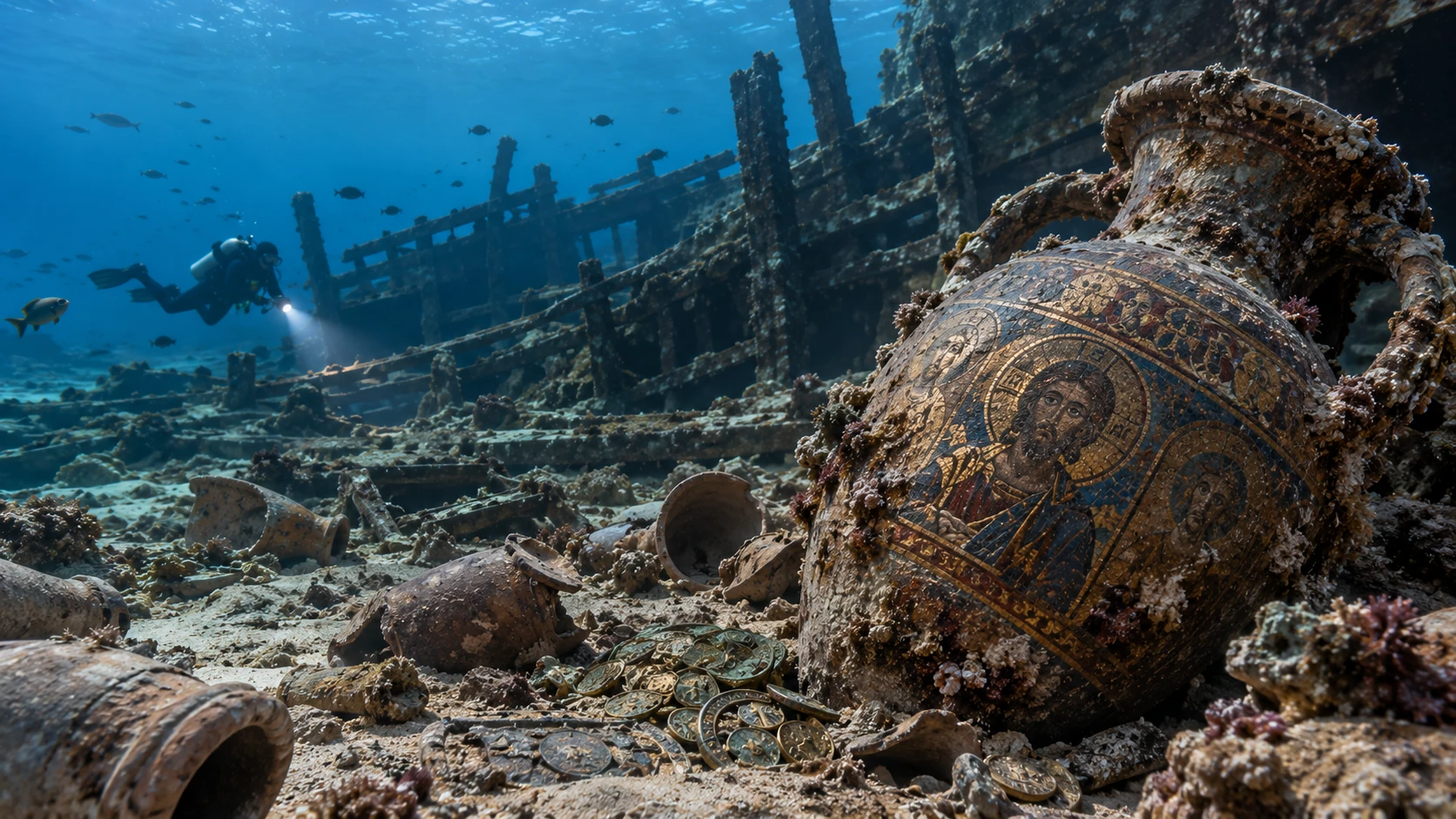
Image note: the hero is an AI-generated conceptual reconstruction. Its decorated amphora, scattered treasure and standing hull are artistic choices, not documentation of the site or its recovered objects.
A DISCOVERY YEARS IN THE MAKING
The site is called Tatinica–Maharac, near Polače on Mljet in southern Croatia. The Croatian Conservation Institute’s 2021 account records discovery in 2015, on a sandy slope between rocks at depths of 32 to 40 metres, and underwater investigations beginning in 2017. Its July 2026 release dates the research programme from 2015 and reports nine campaigns. National Geographic’s account places initial encounters in 2014. These accounts differ in their starting points; this is not a wreck newly found in 2026. Croatian Conservation Institute: site record Croatian Conservation Institute: July 2026 research National Geographic: investigation
WHAT HAS ACTUALLY BEEN FOUND?
The institute documents four gold belt sets, decorated buckles and strap ends, coins issued under four emperors of the Heraclian dynasty, and a gold ring bearing an emperor’s image. Emeralds, rubies and pearls appear among the belt ornaments. At the July presentation, researchers reported more than 40 gold objects weighing about 600 grams altogether. That is a reported archaeological total, not an estimate of the site’s market value. Croatian Conservation Institute: July 2026 research Culturenet / Hina: research presentation
Less spectacular finds matter too. The institute’s 2022 field report lists amphorae, a balance and weight, lead ingots, bronze vessels and surviving ship timbers. Later reporting also describes ceramic dishes and ivory gaming pieces. These objects connect luxury possessions with the practical business of carrying, measuring, eating and passing time at sea. Croatian Conservation Institute: 2022 fieldwork Culturenet / Hina: research presentation
AN IMPORTANT PASSENGER, BUT NO IDENTIFIED OWNER
Archaeologists interviewed by Reuters interpret the unusual collection as evidence of a senior official or another politically important traveller and an entourage. A signet ring with an imperial portrait strengthens that possibility. It does not establish that an emperor sailed aboard, identify the wearer or reveal a passenger list. Reuters: archaeologists interviewed
The institute proposes that the ring could have been an official’s personal possession or a diplomatic gift. Those possibilities give the voyage very different meanings. Expensive objects can move as belongings, merchandise or gifts; recovering them together cannot by itself settle their purpose. We therefore describe the ring as bearing an imperial image without treating a specific emperor’s identification as certain. Croatian Conservation Institute: July 2026 research
A SHIP ON THE BYZANTINE ADRIATIC
The current institutional description dates the wreck to the seventh or eighth century, with the July presentation favouring the late seventh or early eighth. Roughly 1,300 years old is an appropriate shorthand, not an exact sinking date. Coins and object styles help narrow the period, but an older coin can remain in circulation. Croatian Conservation Institute: July 2026 research Culturenet / Hina: research presentation
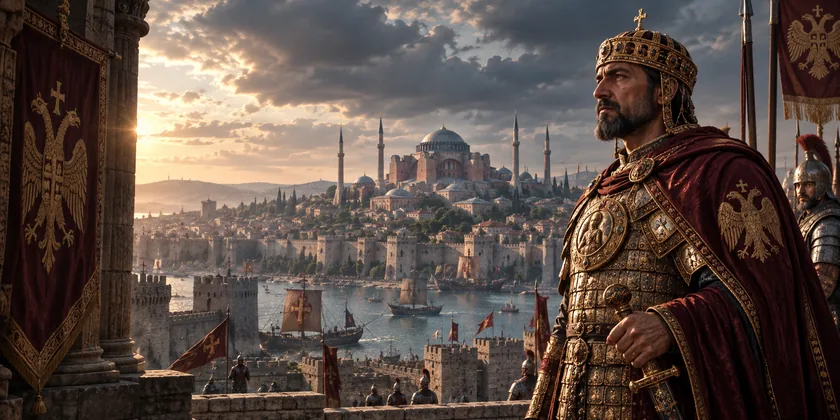
Byzantium was the continuation of the Eastern Roman Empire. Around this period, warfare and territorial losses were reshaping its Mediterranean connections. Mljet lay beside maritime routes between the eastern and western Mediterranean. The finds show people and valuable objects moving through that world, without proving that trade everywhere remained equally strong. For the broader chronology, read our history of the Byzantine Empire. National Geographic: investigation Croatian Conservation Institute: July 2026 research
National Geographic reports a tentative reconstruction of a medium-sized cargo vessel about 18 metres long. A journey from Constantinople towards Ravenna is a hypothesis, not an established itinerary. The institute suggests the ship may have been seeking shelter in Polače bay. Neither its departure port, destination nor precise cause of sinking has been demonstrated conclusively. National Geographic: investigation Croatian Conservation Institute: July 2026 research
HOW THE SEABED BECOMES EVIDENCE
Igor Miholjek leads the investigation, with Pavle Dugonjić heading the institute’s underwater archaeology department. The 2026 work includes Justin Leidwanger’s Stanford team studying amphorae and ceramics, and specialists examining coins and belt-making techniques. NavArchos contributes to the study of wooden remains. The research presentation describes 3D scanning and photogrammetry among the documentation methods. Croatian Conservation Institute: July 2026 research Culturenet / Hina: research presentation
The task is to preserve relationships as well as objects: where a find lay, what surrounded it and how it relates to the surviving vessel. National Geographic describes careful sediment removal, recording positions and conservation after recovery. A beautiful cleaned buckle is the visible endpoint of work that continues far beyond a dive. National Geographic: investigation
WHAT REMAINS UNKNOWN, AND WHY IT MATTERS
The travellers’ names, the purpose of the gold, a secure sailing route and the exact circumstances of the loss remain unresolved. Reuters’ interviews emphasise how few comparable wrecks from around 700 have been thoroughly investigated. This makes the site valuable for studying mobility and connections during the transition from the late Roman to the medieval Mediterranean. Reuters: archaeologists interviewed
The discovery’s importance lies in the questions it allows researchers to test. Ceramics can be compared with production centres; timbers can illuminate construction; objects of status can be studied alongside ordinary equipment. Gold attracts attention, but the associations between those finds may tell the deeper story. This feature reviews the July 2026 findings, not a newly announced October discovery.
FAQ
Frequently Asked Questions
When was the Mljet wreck discovered?
The institute records discovery in 2015; National Geographic describes initial encounters in 2014. The widely reported gold findings were presented in July 2026.
Did the ship carry a Byzantine emperor?
No identified passenger list establishes that. Researchers infer a high-status traveller from the luxury objects and imperial signet ring.
Is the hero a real photograph?
No. It is an AI-generated conceptual reconstruction, not a record of the wreck or its artifacts.
PRESDA Dispatch
Stay Informed. Stay Aware.
A sharp briefing across AI, gaming, sport, business, world affairs, paparazzi, and lifestyle.