THE CADAVER SYNOD: WHEN A DEAD POPE WAS PUT ON TRIAL
In 897, Pope Stephen VI had his predecessor Formosus exhumed and tried. The verdict threatened the standing of clergy ordained by Formosus.
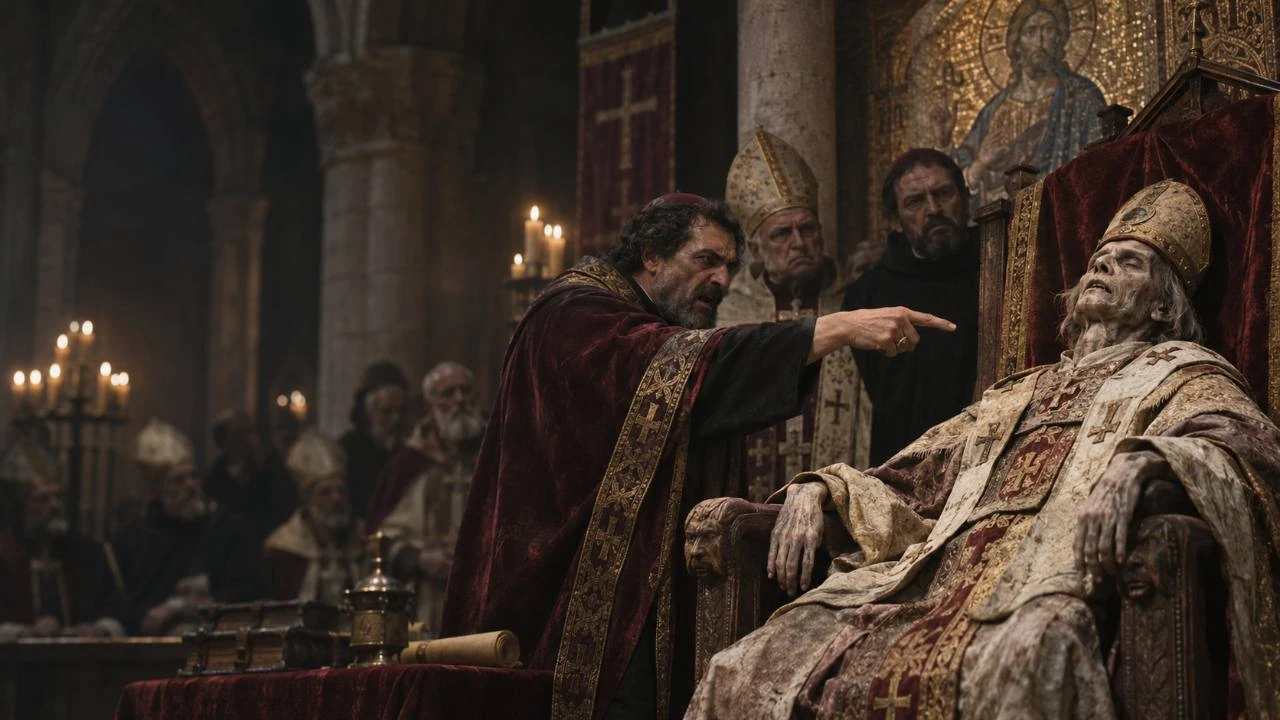
AI-generated historical illustration. The faces, vestments and setting are imagined.
In Rome in 897, a church council put Pope Formosus on trial after his death. Stephen VI ordered the body exhumed and brought before the assembly. The accused had held the papacy from 891 until his death in 896. The extraordinary procedure served a practical purpose for his opponents: a verdict against the dead pope could reach the living people whose authority depended on him. National Geographic: the trial of Formosus
Why the papacy was contested
The trial followed a struggle over imperial power in Italy. Formosus crowned Lambert of Spoleto and later crowned Arnulf of Carinthia, whose intervention he had sought. Arnulf’s position in Italy did not hold. Those reversals make the trial intelligible as an effort to undo a predecessor’s choices, but the surviving evidence does not establish a single motive or show exactly who decided on the exhumation. Catholic Encyclopedia: Formosus
What the charges meant
Formosus had been bishop of Porto before becoming pope. His opponents treated his move to the see of Rome as an unlawful transfer and challenged his right to have held office. The assembly condemned him and voided his acts, including ordinations. For clergy whose standing rested on those ordinations, the verdict turned an argument over one man’s career into a question about their own right to serve. National Geographic: the trial of Formosus
What the accounts leave uncertain
The body was stripped of its vestments after the verdict. Accounts connect its subsequent mistreatment with the Tiber, but differ over who threw it into the river and when. The story of a fisherman who recovered it belongs to the uncertain part of the record. Later retellings also supply courtroom dialogue that cannot be treated as a transcript. A lurid detail can travel through many books without acquiring a second independent witness. Ernst Dümmler: Auxilius and Vulgarius
How the verdict was reversed
Stephen lost office and died in prison later in 897. Theodore II overturned the synod’s decision and restored Formosus to honorable burial. John IX upheld the rehabilitation in 898, but the dispute over ordinations resurfaced under Sergius III. The reversals show how uncertain a cleric’s position could become when rival popes claimed the power to invalidate each other’s acts. The corpse made the council infamous. Its attempt to erase a chain of authority explains why the case outlasted the spectacle. Catholic Encyclopedia: Formosus
A trial preserved by its opponents
Auxilius, a cleric who defended the validity of Formosus’s ordinations, is among the near-contemporary voices behind the story. His argument tells us why the verdict mattered to people at the time, while his position in the dispute gives us a reason to read his account critically. The controversy continued long enough for writers to argue over whether a bishop’s status could depend on later judgments about the man who ordained him. Ernst Dümmler: Auxilius and Vulgarius
Related reading · Giordano Bruno’s trial · The fall of Constantinople
FAQ
Frequently Asked Questions
When did the Cadaver Synod take place?
It took place in Rome in 897, the year after Formosus died.
Who put Formosus on trial?
Pope Stephen VI convened the council. Some older works number him Stephen VII.
Did the verdict stand?
Theodore II overturned it, and John IX upheld the rehabilitation. The ordination dispute later resurfaced.
PRESDA Dispatch
Stay Informed. Stay Aware.
A sharp briefing across AI, gaming, sport, business, world affairs, paparazzi, and lifestyle.