How Chinese Billboards Are Putting Scientists in the Spotlight
Some Chinese malls have given advertising space to scientists. Explore the verified 2026 examples, the people celebrated and the limits of the viral claim.
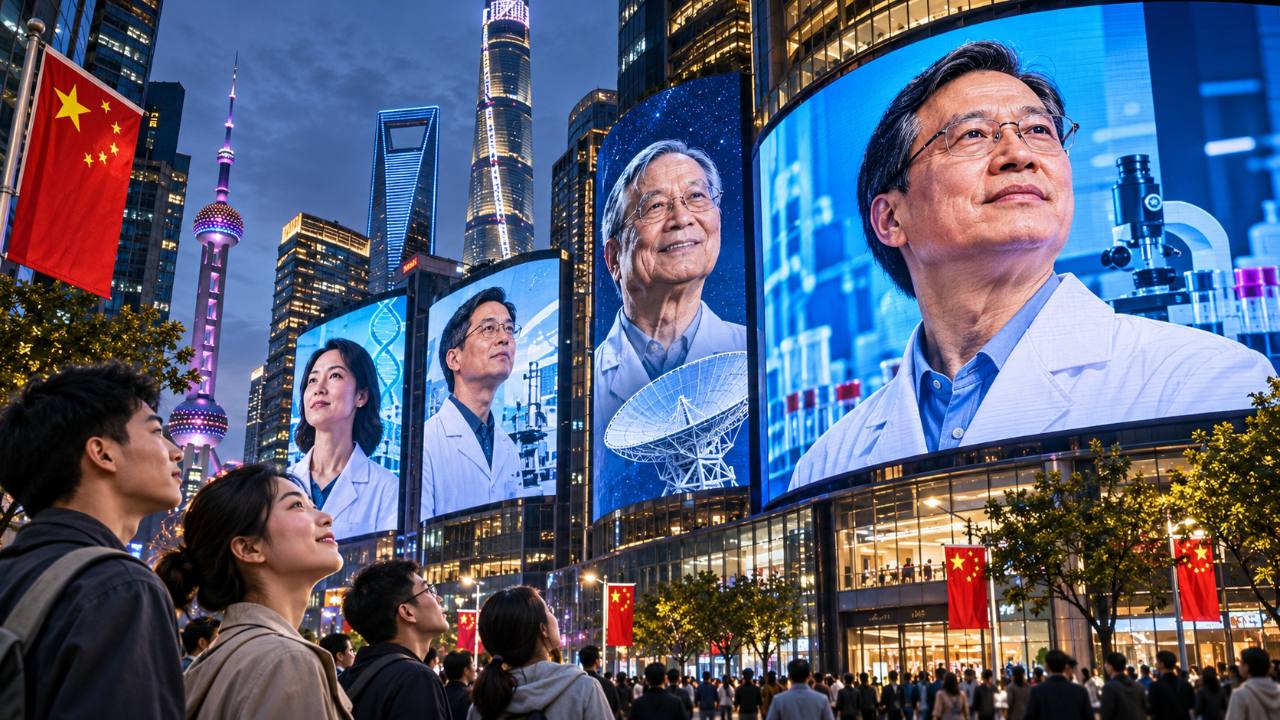
AI-generated editorial illustration supplied for PRESDA. The cityscape and portraits are imagined, not photographs of the documented malls or identified scientists.
Some Chinese shopping centers have given prominent advertising positions to scientists, placing research achievements in spaces normally used to sell products. The displays are real, but the sweeping version of the story is misleading: the verified 2026 reporting describes local initiatives, not a national order replacing all advertising or removing every celebrity image. The Paper, August 17, 2026: verified scientist displays in several cities Haibao News, August 14, 2026: Shanxian mall’s public-interest project
The narrower story is worth attention. A commercial façade briefly changes its invitation to the passerby. Instead of asking what to buy, it asks whom to remember. That switch raises a cultural question larger than the screen itself: how does a society make the people behind scientific advances recognizable outside laboratories and textbooks?
The mall poster behind the viral story
On August 7, 2026, the Inzone mall in Shanxian, part of Heze in Shandong, installed a public-interest portrait of Qian Xuesen on an exterior advertising position. Local reporting records a poster 7.8 meters high and 5.6 meters wide. It was a specific physical installation, not evidence that an entire national advertising market had changed. China Shandong Net, August 11, 2026: Shanxian billboard reporting
| Date or place | Documented evidence |
|---|---|
| August 7, Shanxian, Shandong | A Qian Xuesen public-interest poster occupies a mall advertising position |
| August 14 | Mall representative describes a locally prepared initiative |
| August 17, Hailar and Feixi | The Paper reports additional scientist displays |
| Nationwide policy | The cited reporting does not establish an order replacing all commercial advertising |
A mall representative told contemporary reporters that preparation had begun in June. This detail places agency with a local commercial venue. The choice was deliberate public messaging, but the cited account does not establish a compulsory national scheme, a common budget or a permanent end to paid advertising. Haibao News, August 14, 2026: Shanxian mall’s public-interest project
More locations, without a nationwide total
The Paper subsequently documented scientist displays beyond Shandong, including a shopping center in Hailar, Inner Mongolia, and another in Feixi, Anhui. Staff in Hailar confirmed the material was genuinely being shown, while its duration was uncertain. Those checks strengthen the evidence for individual displays without establishing how many screens across China participated. The Paper, August 17, 2026: verified scientist displays in several cities
Online circulation can compress such a sequence into a single dramatic sentence. A local decision becomes a countrywide policy; several examples become all billboards. Keeping the scale accurate preserves what is genuinely unusual: commercial venues lending valuable visibility to public recognition rather than a conventional sales message.
Why these scientists are recognizable figures
Qian Xuesen was an aerodynamicist whose career connected research in the United States with the development of China’s space and missile programs. Caltech’s account situates his technical work and return to China in 1955. Remembering that engineering background is more informative than treating him merely as a face on a patriotic poster. Caltech: Qian Xuesen’s aerospace biography
Tu Youyou represents a different scientific field. Her Nobel biography describes the research that led to artemisinin and an important advance against malaria; she shared the 2015 Nobel Prize in Physiology or Medicine. Her story links laboratory work, collaboration and medicine, rather than implying that a celebrated individual worked without a team. Nobel Prize: Tu Youyou’s research biography
Rice research and an everyday connection
Yuan Longping’s association with hybrid rice makes scientific work legible through something as familiar as food. A research tribute in the journal Rice documents his contributions to breeding and the collaborative development of hybrid rice. It supports an account of sustained agricultural research, not a convenient but unsupported calculation of how many lives one person single-handedly saved. Rice, December 2021: Yuan Longping and hybrid rice research
Together, these examples connect science with transportation into space, treatment of disease and food production. Their achievements are different and should remain so. Combining them into a display creates a shared message about contribution, while understanding the work requires more than recognition of a name.
Scientific fame has a history of its own
Public celebration of researchers did not begin with the 2026 mall displays. A 2025 study in the British Journal for the History of Science examines how Qian became a prominent public symbol over decades. The authors distinguish technical achievement from the later construction and circulation of a scientific public persona. British Journal for the History of Science, 2025: The celebrification of Qian Xuesen
That distinction helps explain why a scientist can become a cultural figure without appearing in advertisements for a product. Museums, biographies, education and public commemoration all contribute to visibility. The billboard adds another setting to an existing history of recognition, rather than inventing the relationship between science and national identity.
Recognition is also a choice about public space
A large display cannot offer the depth of a classroom or a museum. It can make a selection visible: these are people a venue has chosen to honor. Such choices communicate values, while also inviting questions about which disciplines, colleagues and less famous contributors remain outside the frame.
This does not require dismissing the gesture. Public recognition can acknowledge work whose benefits are easier to use than to understand. At the same time, scientific progress depends on institutions and teams, including technicians and researchers who are unlikely to receive a monumental portrait.
What social impact can actually be claimed?
The reporting establishes installations, named venues and public attention. It does not establish that a particular number of children entered science courses because they saw a poster, or that the displays raised research productivity. Those are different questions requiring educational or institutional evidence.
The plausible cultural effect is an invitation to notice. A student can encounter an unfamiliar name; a parent can start a conversation; a passerby can remember a contribution outside entertainment. These are possible uses of the display, not measured outcomes that should be reported as completed social transformation.
The image is an illustration, not the evidence
The hero supplied for this feature imagines scientist portraits in a Shanghai-inspired cityscape. It is an AI-generated editorial illustration, not a photograph of the verified mall locations. Its faces are not used here to identify the real scientists mentioned in the reporting.
The distinction matters because a striking visual can otherwise appear to prove the exaggerated version of a claim. The documented story rests on the dated accounts from specific venues. It is a story about selected spaces and decisions, not evidence that ordinary commercial advertising has disappeared from Chinese cities.
A modest gesture with a larger question
The appeal of the initiative lies in a familiar imbalance: the achievements that shape daily life can be less visible than the people who sell or entertain. Giving a scientist a prominent public position briefly rearranges that hierarchy. Its meaning need not depend on pretending that every city followed one order.
These displays offer a useful case study in public recognition. They show how a commercial setting can carry a civic message, while leaving open the harder work of education, research support and explaining discovery. The accurate story is smaller than the viral slogan, but richer in the choices it reveals.
FAQ
Frequently Asked Questions
Did China replace all advertising with scientists?
No. The verified reporting describes particular malls and local initiatives, not a nationwide replacement of all commercial or celebrity advertising.
Where was the widely reported Qian Xuesen poster?
At the Inzone mall in Shanxian, Heze, Shandong. Contemporary reporting dates its installation to August 7, 2026.
Which scientists appeared in the reported displays?
The Paper names figures including Qian Xuesen, Tu Youyou and Yuan Longping, among others. Displays differed by location.
Do the billboards prove more children choose scientific careers?
No measured causal result is established by the cited reporting. Recognition may encourage interest, but that is different from documented educational outcomes.
PRESDA Dispatch
Stay Informed. Stay Aware.
A sharp briefing across AI, gaming, sport, business, world affairs, paparazzi, and lifestyle.