Why Japanese Students Clean Their Own Schools
School cleaning in Japan is more than a chore. Explore its educational purpose, Tokkatsu, shared responsibility and the limits of familiar stereotypes.
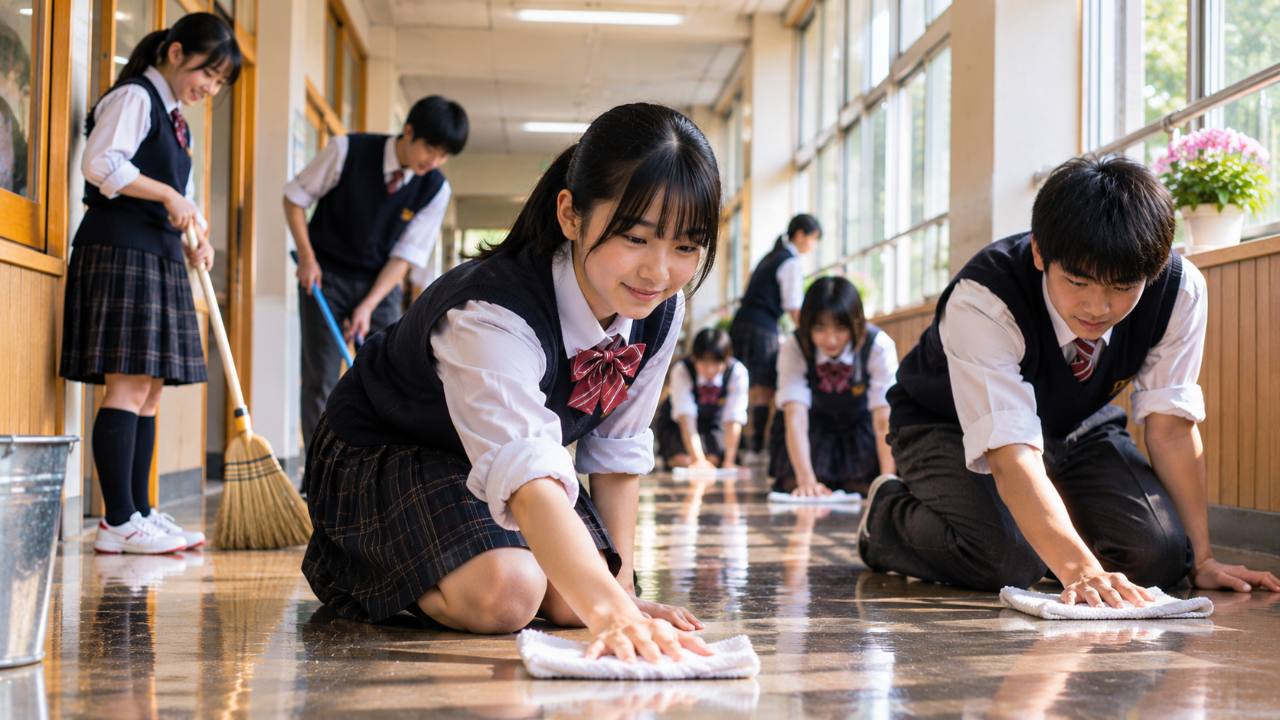
AI-generated editorial illustration supplied for PRESDA. The pupils and school are imagined, not a photograph of a named institution or research participants.
Japanese students clean their schools as part of learning how to live and work together. Sweeping, wiping and putting shared spaces in order are not simply practical tasks: they create opportunities to contribute to a group and notice the needs of the next person using a room. The OECD places teacher-supervised cleaning within Japan’s broader approach to whole-child education. OECD, 2018: Education Policy in Japan
The familiar image of pupils with brooms is therefore only the visible part of a larger idea. A school is not just a place where services are delivered to children. It can also be a small community in which children learn, with adult guidance, to take a share of responsibility for everyday life.
Cleaning is connected to Tokkatsu, but is not the whole of it
Tokkatsu is the Japanese term associated with Special Activities. JICA describes practices such as rotating classroom responsibilities and non-academic group activities alongside lessons in core subjects. Cleaning belongs in that wider educational setting, rather than standing alone as a national test of obedience or tidiness. JICA: basic education and Special Activities
| Practice | Educational purpose | Important distinction |
|---|---|---|
| Shared cleaning | Care for spaces used by others | Not simply punishment or a saving on labor |
| Rotating responsibilities | Experience contributing and coordinating | Not permanent jobs assigned by status |
| Class discussion | Agree how to improve common life | Tokkatsu includes more than cleaning |
| Teacher participation | Guidance, reflection and recognition | Student involvement does not remove adult responsibility |
The distinction matters. A class discussion about a shared problem, a pupil’s turn coordinating a task and a group caring for a classroom are different activities. Together, they offer repeated occasions to listen, make decisions and contribute. Finishing the chore is one result; learning how to cooperate is the educational ambition.
A modern curriculum history, not a simple origin myth
In a November 2025 interview for Japan’s official educational travel site, curriculum specialist Kyoko Abe explains that Special Activities have appeared in curriculum guidelines since 1958. She also places the importance of cleaning within the 2017 guidelines’ emphasis on work and social participation. These are identifiable educational milestones, not a single invention date for cleaning schools. Japan National Tourism Organization, November 5, 2025: cleaning and education
It is tempting to explain a national practice through one ancient religious influence or an unchanging cultural trait. The documented curriculum offers a more useful account. Modern educators have made choices about how collective activities support development, and schools put those choices into practice in particular settings.
What students are meant to learn
The Japanese government’s account of Special Activities emphasizes participation, contribution and a sense of efficacy within groups. Cleaning makes those ideas tangible: a common space is visibly different after a group has worked on it. The task provides a result children can recognize without reducing the lesson to an examination score. Japanese government, December 2025: Special Activities and whole-child education
Consider the difference between being told to respect a shared room and helping prepare it for other people. The second situation creates practical questions. Has the group divided the work fairly? Is anything being left for someone else? Can a pupil help a classmate who has not finished? These are examples of the decisions the practice can invite, not a transcript of one observed classroom.
The teacher’s role does not disappear
The OECD describes teachers supervising such activities. Participation is not equivalent to leaving children alone with responsibility for an entire building. Adults still shape the task, provide guidance and connect the activity with learning. The educational value depends on how the experience is organized, not merely on the presence of a broom. OECD, 2018: Education Policy in Japan
Recognition also matters. A quiet child may contribute carefully to a group task without being the first to speak in class. Shared activity can make different strengths visible. Treating every turn as mechanical compliance would miss the wider purpose of learning to contribute and to recognize contribution.
Why the “no janitors” slogan is too simple
Photographs of children cleaning do not establish staffing arrangements in every Japanese school. They cannot prove that professionals are absent, that all maintenance is done by pupils or that every school follows the same daily schedule. None of those universal claims is necessary to explain the practice.
The more useful distinction is between educational participation and responsibility for a safe, functioning institution. Age, ability, the task and the environment all affect what participation can reasonably mean. A school’s duty of care remains an adult responsibility; student contribution should not be treated as an excuse to disregard it.
Cooperation is different from punishment
A task intended to help a community has a different meaning from a task used to stigmatize one child. The educational principle concerns shared contribution, not the idea that cleaning is degrading work assigned to somebody who has failed. That principle is relevant well beyond Japan.
Nor should a tidy classroom be used to claim that every student enjoys the routine or that national character has been measured. A practice can have a clear educational rationale while differing in execution and individual experience. Respecting that complexity makes the story more informative than a flattering stereotype.
A real example: restoring a school garden
Abe’s 2025 account describes a Kyoto elementary school where sixth graders helped reclaim a neglected garden. The effort developed into a shared space with flowers and benches, involving families and the community. It is a reported example of participation, not a controlled study proving that cleaning alone transformed a school. Japan National Tourism Organization, November 5, 2025: cleaning and education
The example expands the meaning of care. Once a group helps improve a place, the next question can become how to use and maintain it. The connection between a physical task and discussion about common life is what makes the activity educational rather than simply a substitute for a service.
How the approach traveled to Egypt
Japan’s educational cooperation with Egypt provides an example outside its original setting. JICA records the Egypt-Japan Education Partnership announced in February 2016 and its support for whole-child development through Tokkatsu. The project concerns educational methods and institutional cooperation, not merely exporting cleaning equipment. JICA: Egypt-Japan Education Partnership
MEXT’s EDU-Port account, published in December 2025, describes Egyptian-Japanese Schools and activities such as rotating coordination and class discussions. A JICA placement description records 69 such schools as of July 2026. That is a dated count of a particular school network, not the number of all Egyptian schools or proof of a uniform national outcome. MEXT EDU-Port, December 23, 2025: Tokkatsu in Egyptian schools JICA, July 2026 context: Egyptian-Japanese schools and cleaning activities
What the practice shows, and what it does not
The cross-border example is valuable because it makes the practice a subject of learning and adaptation, rather than an innate quality that only one nationality can possess. Teachers, families and institutions have to decide how an activity fits their circumstances. A successful idea does not arrive fully implemented simply because its name travels.
The hero for this feature is an AI-generated editorial illustration of imagined pupils and a school corridor. It does not document a named school, establish the age of participants or serve as evidence of research findings. The explanation rests on the educational sources cited here.
A lesson in noticing shared work
The most durable idea behind school cleaning is that common spaces depend on work that somebody has to do. Bringing that work into education can help make responsibility visible. Its value is not a universal claim that one country is clean and others are not.
Japan’s example asks a practical question that schools elsewhere can also consider: how can children learn to care for a place together? The answer depends on guidance, inclusion and purpose. The cloth and broom are tools; the broader lesson is participation in a community.
FAQ
Frequently Asked Questions
Why do Japanese students clean their schools?
The educational aim is to practice cooperation, contribution and care for shared spaces, rather than treating cleanliness only as somebody else’s job.
What is Tokkatsu?
It is the Japanese term for Special Activities, a wider educational approach involving class life, discussion, responsibilities and collective participation. Cleaning can put those lessons into practice.
Does every school follow the same daily timetable?
No uniform duration or identical routine is established here. Schools organize cleaning within their own educational arrangements.
Does the practice prove Japan has no school cleaning staff?
No. Student participation does not justify a universal claim about staffing or mean adults are relieved of responsibility for hygiene, maintenance and safety.
PRESDA Dispatch
Stay Informed. Stay Aware.
A sharp briefing across AI, gaming, sport, business, world affairs, paparazzi, and lifestyle.