Luxembourg: The Country That Made Public Transport Free
Luxembourg removed standard domestic transport fares in 2020. Discover who benefits, which journeys still cost money and what the ridership figures show.
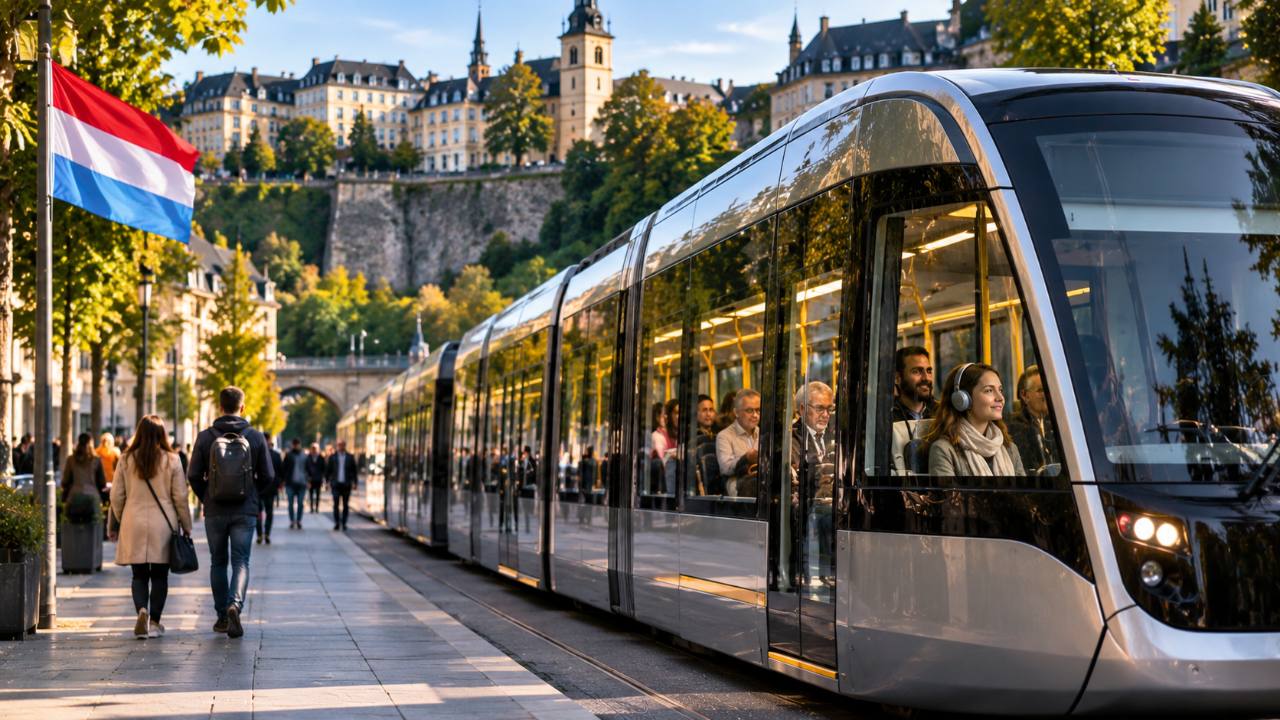
AI-generated editorial illustration supplied for PRESDA. The tram, passengers and setting are imagined, not a photograph of a particular service, stop or route.
Luxembourg made ordinary domestic public transport free in 2020, allowing residents and visitors to use public buses, the tram and second-class trains without a standard fare. It became a widely recognized national experiment in removing the price of boarding. The important qualification is that first-class rail and applicable cross-border charges did not simply disappear. Luxembourg national portal: free domestic transport and first-class exception European Commission Urban Mobility Observatory, March 9, 2020: launch
The appeal is immediate: a traveler can move between services without deciding whether a short journey justifies another ticket. Yet a free fare is not the same thing as transport without costs. Vehicles, staff, infrastructure and maintenance still have to be funded, and a useful service still has to reach the places people need.
The leap-day launch and the dates readers may see
Luxembourg’s national information portal and the European Commission’s contemporary account identify February 29, 2020 as the day standard fares stopped. Some government anniversary communications refer to March 1. Both concern the same launch weekend; the earlier date is supported by reporting from the first day itself. Luxembourg national portal: free domestic transport and first-class exception European Commission Urban Mobility Observatory, March 9, 2020: launch RTL, February 29, 2020: first day, implementation and forgone fare revenue
| Journey or traveler | General position |
|---|---|
| Domestic public buses and tram | No standard fare |
| Domestic rail, second class | No standard fare |
| Domestic rail, first class | Paid tickets or subscriptions remain |
| Residents and visitors | Nationality or tourist status does not exclude a traveler from the domestic offer |
| Cross-border journey | Check the applicable ticket for paid segments; the whole international trip is not automatically free |
| Taxis and unrelated private services | Not made free by the public-transport reform |
This matters when a simple story becomes a historical reference. The reform was not an isolated free-travel day or an offer reserved for a narrow group. It changed the ordinary domestic fare system across a country, while retaining defined exceptions.
Who can travel without the ordinary fare?
The national portal explicitly includes tourists as well as residents. The benefit is therefore not dependent on being a citizen or presenting a local residency card simply to qualify for the ordinary domestic offer. This openness is part of what made the reform internationally recognizable. Luxembourg national portal: free domestic transport and first-class exception
The policy also simplifies transfers in principle: choosing a bus, tram or second-class train does not create a new standard domestic fare decision. That does not guarantee a convenient connection at every hour. Price and service quality are related to a traveler’s experience but remain different questions.
What still requires a ticket
First-class rail remains paid. The reform should not be presented as free access to every seat, every service marketed as transport or every international journey. Taxis and unrelated private services are not made free by the existence of a national public-transport offer.
Cross-border journeys need particular care. Luxembourg is closely connected with France, Belgium and Germany, and many workers travel from those countries. A free domestic segment does not automatically make the foreign part of the journey free. The official cross-border information directs travelers toward the relevant connections and ticket arrangements. Luxembourg national portal: cross-border mobility
A current check matters for paid categories
The Public Transport Administration records changes from January 1, 2026 affecting RegioZone cross-border bus tickets and first-class subscriptions. The update concerns paid categories alongside the free domestic network. It illustrates why an old travel tip or ticket format should not be treated as permanently current. Public Transport Administration: cross-border and first-class ticket changes in 2026
For a specific international itinerary, the appropriate question is which segments and services are covered, not whether the country has a free-transport headline. A traveler can understand the broad policy while still checking the current fare rules for a particular route.
Why remove fares in the first place?
The European Commission’s launch account places congestion, air pollution and support for people on low incomes among the reasons for the policy. These are connected but distinct ambitions. Making a necessary journey cheaper can help a household even when it does not cause a driver to abandon a car. European Commission Urban Mobility Observatory, March 9, 2020: launch
Removing payment also removes a small point of friction. There is less need to choose the right ordinary domestic ticket before a spontaneous trip. For visitors, that can make an unfamiliar network easier to approach; for regular users, it changes a repeated expense into a public service financed through other arrangements.
Free to the passenger does not mean costless
At the launch in February 2020, RTL reported roughly EUR 41 million in annual ticket income being forgone. That historical figure describes fare revenue at the time, not the full cost of operating the network or a current annual bill. Calling it the entire price of free transport would be misleading. RTL, February 29, 2020: first day, implementation and forgone fare revenue
The broader economic question is where costs are paid and what service is provided in return. A fare-free system still needs a budget for operations and investment. Its value cannot be evaluated from the price printed on a ticket alone, whether that price is positive or zero.
What the passenger figures show
The government’s July 2026 transport statement records 31.4 million rail passenger journeys and 35.2 million tram journeys in 2025. These are recorded uses of services, including repeat travel, not counts of different individuals. They describe substantial use of the network without proving the effect of fares in isolation. Luxembourg government, July 21, 2026: 2025 ridership and service context
The government’s five-year review had already noted that growth also reflected the tram’s successive extensions. The reform was followed almost immediately by the COVID-19 pandemic, complicating simple before-and-after comparisons. Network reach, service availability and changing travel conditions have to remain in the explanation. Luxembourg government, February 28, 2025: five-year review
Ridership is not the same as fewer car journeys
A rise in boardings can include trips previously made on foot, journeys made more often or travel enabled by a new connection. Establishing a reduction in car use requires evidence about travel choices, not merely a larger passenger total. The environmental ambition is meaningful, but an ambition is not a measured emissions saving.
This is why free fares should be considered alongside capacity, reliability and access. A zero-priced service that is badly timed for someone’s workday may not replace a car. Conversely, an improved connection can make public transport attractive even before the price question is considered.
The cross-border dimension
Luxembourg’s official mobility information describes the importance of connections with neighboring regions and the pressure on some commuter routes. The country’s transport problem does not stop at its political boundary. A national fare reform therefore operates inside a wider regional system. Luxembourg national portal: cross-border mobility
That context makes the experiment more interesting than a tourism novelty. It concerns how a small country organizes movement for residents, visitors and workers whose homes may be elsewhere. Domestic simplicity and international complexity coexist.
An idea supported by continuing service
The supplied hero is an AI-generated editorial illustration of an imagined tram, passengers and Luxembourg-inspired setting. It is not a photograph of a verified stop or proof that a particular route serves the depicted location. The policy and figures are established by the sources, not the illustration.
Luxembourg’s example demonstrates that a country can remove ordinary domestic fares while continuing to face the practical work of transport. The strongest lesson is not that price alone solves congestion. It is that funding, access, service quality and public priorities can be discussed together, with a clear distinction between free boarding and a costless system.
FAQ
Frequently Asked Questions
Is public transport free for tourists in Luxembourg?
Yes, the ordinary domestic public-transport offer includes visitors as well as residents. First-class rail and applicable cross-border fares remain exceptions.
When did free travel begin?
The national public-information portal and contemporary EU reporting identify February 29, 2020 as the first day standard fares stopped. Some anniversary documents refer to March 1.
Is a journey from France, Belgium or Germany automatically free?
No. The domestic policy does not automatically remove charges for the entire cross-border journey. Check the route and applicable ticket.
Did free fares alone cause ridership to grow?
That conclusion is not established. Network extensions, capacity, service changes and the pandemic also affect comparisons over time.
PRESDA Dispatch
Stay Informed. Stay Aware.
A sharp briefing across AI, gaming, sport, business, world affairs, paparazzi, and lifestyle.