Why Taiwan’s Garbage Trucks Play Beethoven
Taiwan’s musical garbage trucks signal collection time. Discover the two familiar melodies, their documented history and the recycling system behind them.
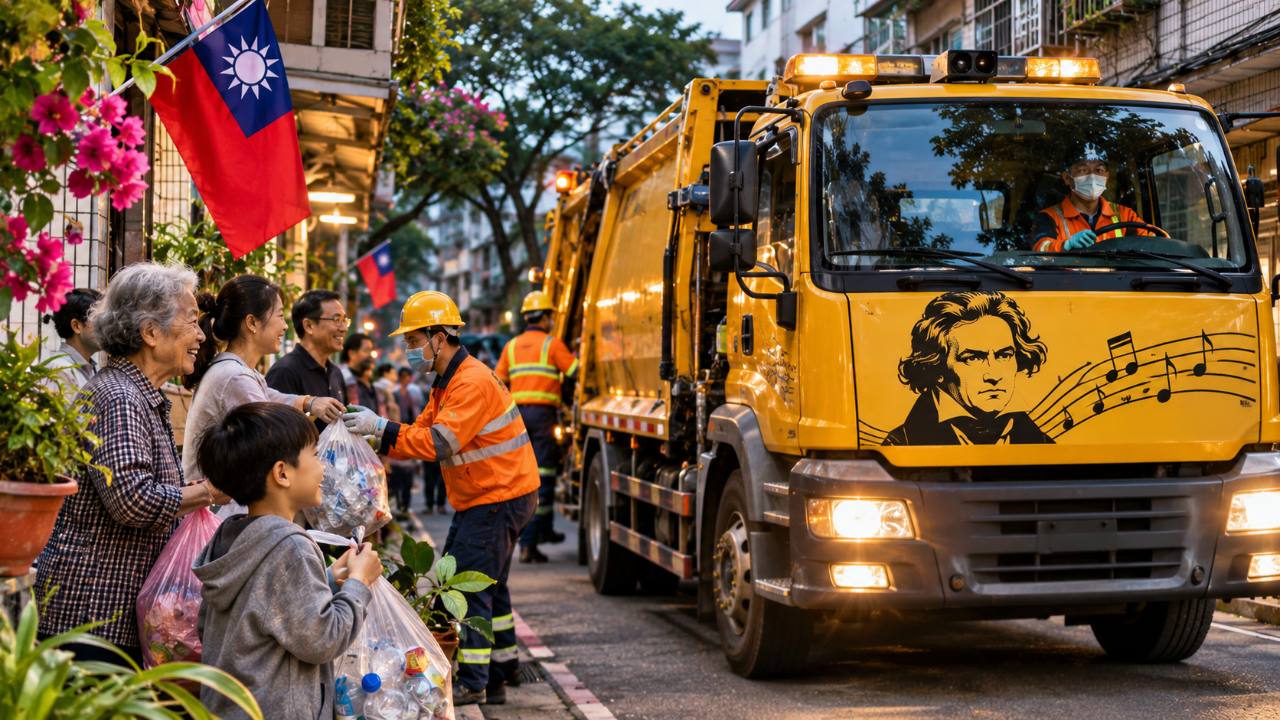
AI-generated editorial illustration supplied for PRESDA. The truck artwork, workers and neighborhood are imagined, not a documented route or standard municipal vehicle design.
Taiwan’s garbage trucks play familiar melodies to tell residents that collection time is approaching. Beethoven’s Für Elise is one of the best-known signals, alongside Maiden’s Prayer by the Polish composer Tekla Bądarzewska-Baranowska. The music is a practical announcement embedded in everyday neighborhood life, not a concert staged by the sanitation service. AFP via Taipei Times, July 29, 2025: musical collection and city recycling Taiwan National Cultural Memory Bank: January 18, 1968 truck introduction
The sound makes more sense once the collection system is understood. In many neighborhoods, people meet the truck with household waste rather than leaving bags outside for an indefinite period. A recognizable tune brings the schedule into the street and helps residents coordinate with a moving public service.
Why the truck needs a recognizable signal
A collection vehicle cannot wait at every stop indefinitely. Music gives people time to bring out their bags, while the route and timetable tell them where to go. Taipei’s official route-lookup service makes that organization visible: the system depends on scheduled places as well as a familiar sound. Taipei Department of Environmental Protection: collection-route lookup
| Element | What it does | What it does not prove |
|---|---|---|
| Für Elise | A familiar arrival signal associated with Beethoven | Not the only tune used |
| Maiden’s Prayer | Another standard melody, by Bądarzewska-Baranowska | Not a Beethoven composition |
| Scheduled collection | Coordinates residents and sanitation crews | Not the same timetable in every locality |
| Sorting and designated bags | Support waste management, including Taipei’s volume-based fee | Music alone does not explain recycling results |
The melody also changes an otherwise impersonal service into a recurring social moment. People may recognize neighbors while waiting, but participation is first a practical requirement. The pleasant association some residents describe should not erase the work, timing pressures and responsibility carried by sanitation crews.
Beethoven is only half the familiar repertoire
The two titles are often confused in international retellings. Für Elise belongs to Beethoven; Maiden’s Prayer does not. Attributing both to him obscures the Polish composer whose tune has become deeply associated with collection in Taiwan. The existence of two familiar standards also helps explain why residents in different places may remember different sounds. AFP via Taipei Times, July 29, 2025: musical collection and city recycling
Neither title should be treated as a legal rule requiring every truck to play the same recording. Equipment and local choices can vary. The important feature is recognition: a tune works as a public signal because people have learned what it means.
What the historical record establishes
Taiwan’s National Cultural Memory Bank preserves a record of new Taipei garbage trucks entering service on January 18, 1968. Its description identifies 21 sealed trucks and their mechanized collection equipment. The archival film’s damaged soundtrack means it should not be presented here as audio proof of the exact melody heard that day. Taiwan National Cultural Memory Bank: January 18, 1968 truck introduction
Music scholar Nancy Guy’s archival research traces the early vehicles to a 1967 purchase from Japan and identifies Maiden’s Prayer with their installed sound systems. Her account also cautions that the precise timing of Für Elise entering the repertoire is not directly established. That history is stronger than a charming but unverified story about one official hearing a daughter at the piano. Nancy Guy, Taiwan Insight, December 5, 2025: archival research on musical trucks
A useful distinction between a fleet and a song
The arrival of musical vehicles and the arrival of every later tune are separate historical questions. A dated fleet record does not settle which recording each vehicle used across subsequent decades. Keeping those questions apart prevents a precise date from lending false certainty to a different claim.
What is clear is the durability of the association. A short piece of instrumental music can acquire a new public meaning through repeated use. Listeners do not need to know a composer’s biography to recognize the instruction carried by the tune: collection is near.
The policy behind the sound
Music does not sort a bag of waste. Taipei’s system also depends on decisions inside households and rules about disposal. The city introduced its per-bag trash collection fee on July 1, 2000, replacing the earlier charge linked to water use. Its official account explains the incentive: produce less general waste and the required bag purchases fall. Taipei government: per-bag collection policy and historical data
The distinction between general waste and separated recyclables matters. Under the described Taipei policy, recyclables are exempt from the designated-bag requirement. The financial signal and the collection routine therefore work together, while the melody helps make the handover happen. A visitor who notices only the music misses the institutional design.
Results need their place and date
In AFP’s July 2025 reporting, a Taipei official put the city’s recycling rate at nearly 67 percent. That is an attributed municipal figure, not a single interchangeable statistic for every locality, every waste stream or the whole of Taiwan. It should not be used as proof that Beethoven caused recycling to rise. AFP via Taipei Times, July 29, 2025: musical collection and city recycling
Public Television Service’s account of the bag program’s twentieth anniversary also places waste reduction within a longer policy history. The intervention was not a musical novelty: it changed the relationship between the amount discarded and the cost borne by households. Public Television Service, December 2020: twenty years of Taipei’s bag policy
A neighborhood routine with real demands
Meeting a truck requires time. A routine that is convenient for someone already at home may be more difficult for a person working late or managing limited mobility. That does not invalidate the system, but it is part of understanding a public service as something experienced differently by different residents.
The appropriate practical source is the local authority’s current collection information. A general feature cannot supply one schedule for an entire island or assume that every apartment building uses the same arrangement. Taipei’s lookup service is a starting point for that city, rather than a universal timetable. Taipei Department of Environmental Protection: collection-route lookup
Social contact without a romanticized script
Waiting at a collection point can create repeated encounters. The social possibility comes from sharing a place and time, not from a guarantee that every neighbor becomes a friend. Nor should a resident’s habit be reduced to a picturesque scene for visitors.
For crews, the event remains work. The sound that some people associate with childhood memories also belongs to a vehicle, a route and a team managing material safely and efficiently. A balanced account keeps both the cultural familiarity and the labor in view.
Local variation is part of the story
In July 2025, Taiwan News reported Keelung’s plan to repaint an 80-truck fleet in an ocean theme and rearrange its familiar melodies. The example shows a locality making choices about the sound and appearance of collection. It is not evidence that the entire island adopted a new tune at once. Taiwan News, July 11, 2025: Keelung fleet and melody plans
Such changes illustrate how a public signal can be both functional and cultural. Familiarity helps coordination, while local identity can influence how a community wants its service to sound. Neither the classical repertoire nor the visual design is frozen forever.
A melody supported by a system
The hero image imagines a truck with Beethoven artwork, residents and workers. It is an AI-generated editorial illustration, not a photograph of a particular route or proof that this portrait is standard municipal livery. The real evidence lies in the archival records, reporting and local service information.
Taiwan’s musical trucks endure as an unusually recognizable meeting point between infrastructure and daily life. The tune catches attention; schedules, crews, sorting and policy do the continuing work. Explaining both makes the story more revealing than the idea of a garbage truck that happens to like Beethoven.
FAQ
Frequently Asked Questions
Why do Taiwan’s garbage trucks play music?
The melody alerts residents that the collection vehicle is approaching, helping coordinate direct handover of household waste at scheduled stops.
Do they all play Beethoven?
No. Für Elise is familiar, but Maiden’s Prayer by Tekla Bądarzewska-Baranowska is another important tune, and local alternatives exist.
When did musical garbage trucks arrive?
Taipei’s cultural archive records a new fleet entering service on January 18, 1968. That does not establish the exact date Für Elise joined the repertoire.
Did the music create Taiwan’s recycling results?
No single-cause conclusion is justified. Sorting rules, collection systems, fees and public participation are important parts of the explanation.
PRESDA Dispatch
Stay Informed. Stay Aware.
A sharp briefing across AI, gaming, sport, business, world affairs, paparazzi, and lifestyle.