Istanbul’s Machines That Exchange Recyclable Bottles for Animal Food
How Pugedon links recycling with feeding animals: the real mechanism, Istanbul examples, current product specifications and limits of the viral story.
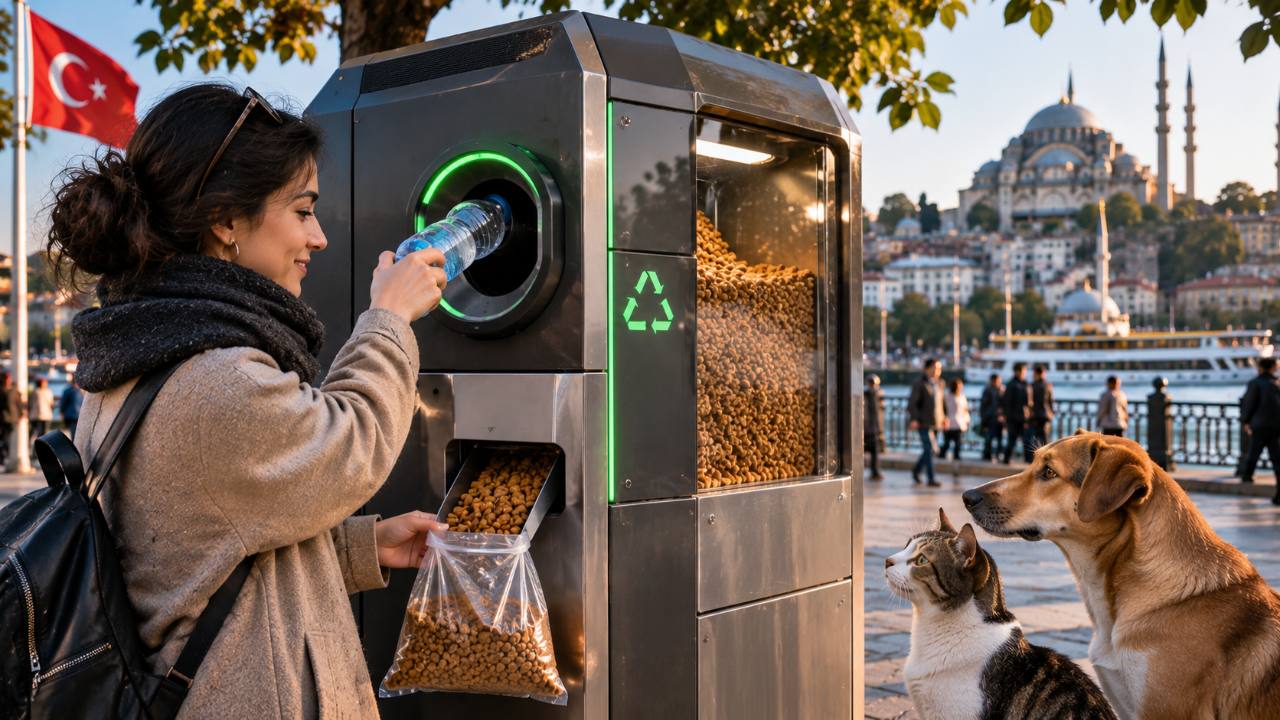
AI-generated editorial illustration supplied for PRESDA. The machine, exchange and waterfront setting are imagined, not a documented installation or an exact Pugedon design.
Istanbul’s bottle-for-food machines connect two visible urban concerns: discarded packaging and animals needing care. The Pugedon concept collects recyclable containers and dispenses dry animal food. It does not turn plastic into something edible. A bottle triggers an exchange, while the food comes from a separate supply already stored in the machine. Fast Company, July 31, 2014: Istanbul’s recycling and feeding machines Pugedon: official description of the recycling and feeding mechanism
That simple distinction makes the idea more interesting, not less. The invention gives a small act of recycling an immediate, visible consequence. A person who might overlook an empty bottle has another reason to return it, while the equipment links that action with a feeding point.
The real mechanism behind the headline
The manufacturer describes an opening for recyclable packaging, a controlled food dispenser and a separate arrangement through which unused water can enter an animals’ water container. Early reporting also described food and water at the bottom of the unit. There is no process in which plastic is processed into feed inside the box. Pugedon: official description of the recycling and feeding mechanism TIME, July 23, 2014: food dispenser and separate water dish
| Period | Evidence | Scope |
|---|---|---|
| July 2014 | International reports describe Istanbul recycling feeders | Historical reporting |
| 2019 | Beyoğlu records six installation points | One district’s annual report |
| March 2022 | Yalova announces more machines | A separate municipality outside Istanbul |
| Current TA-301 listing | Manufacturer specifies a 30 kg food hopper | One model’s storage capacity, not food produced from plastic |
The machine therefore contains two material flows. Packaging is collected for subsequent handling; dry food is supplied, stored and released. Recycling still requires collection and processing elsewhere. Feeding still requires replenishment. Neither task disappears because the two are brought together in one enclosure.
A stored supply, with model-specific settings
Pugedon’s current TA-301 listing specifies a 30-kilogram food hopper. It also describes adjustable portions and settings. These are manufacturer specifications for one model, not a universal promise that every discarded bottle always produces an identical quantity of food. Pugedon: current TA-301 manufacturer specifications
The same listing specifically describes feeding unowned cats, while the early Istanbul reports discussed street dogs and cats. That difference is worth retaining. A brand’s models and installations can change; an old photograph should not be used to define every product currently offered.
How the idea reached international attention
TIME and Fast Company covered the Istanbul machines in July 2014. Those contemporary reports establish that the concept was already attracting attention then. They do not establish a new 2026 launch or justify presenting every circulated video as a newly installed municipal service. TIME, July 23, 2014: food dispenser and separate water dish Fast Company, July 31, 2014: Istanbul’s recycling and feeding machines
Pugedon belongs to Timtaş Yönetim, whose company account identifies Mehmet Akay and dates the parent company to 1994. That corporate date is distinct from the date a particular feeder was introduced or installed. Mixing them would create an invented single origin story. Timtaş and Pugedon: company history and different machine models
A city practice involving more than an invention
The concept fits a public space where residents, local authorities and businesses can all play a role. A machine can make an exchange easy to recognize, but somebody must choose the location, maintain access and handle the collected material. The civic dimension lies as much in those arrangements as in the device itself.
It also changes how an incentive is seen. Instead of receiving a personal reward, a participant can see an action connected with support for animals. That is the design’s appeal. It does not by itself establish how many people changed their long-term disposal habits.
Documented examples beyond a viral image
Beyoğlu Municipality’s 2019 activity report records six installation points for Pugedon machines in the district. This is a useful Istanbul example because it identifies an administrative source and reporting year. It is not a current total for all districts or proof that each location remains operational today. Beyoğlu Municipality: 2019 activity report, six installation points
On March 10, 2022, Yalova Municipality announced an expansion of its own installations. Yalova is a separate city, so its equipment should not be added casually to an Istanbul count. The example does show the concept being used beyond the place through which many international readers first encountered it. Yalova Municipality, March 10, 2022: expansion of Pugedon installations
Why old counts cannot become present-day statistics
A dated installation record and a live operating inventory answer different questions. Units can move, need repairs or be replaced by another model. A credible current total would require a maintained register with a defined geographical scope. This feature does not invent one.
The same applies to animal numbers. Widely repeated estimates attached to 2014 stories are not a current census of Istanbul’s cats or dogs. The mechanism can be explained without importing an old population estimate into the present or claiming that a machine ended hunger across the city.
Who pays for the food and the work?
Early reporting described the resale value of collected plastic as a way to offset food costs. That is an account of the proposed model, not an independently audited guarantee that every unit finances every expense forever. Installation, servicing and consumables still have costs, whoever bears them. Fast Company, July 31, 2014: Istanbul’s recycling and feeding machines
The operator’s present materials also describe a coin-operated feeding model, distinct from the recycling-triggered version. A brand name alone therefore does not tell a visitor which exchange applies. It is important to understand a particular unit’s design rather than assume every animal feeder accepts bottles. Timtaş and Pugedon: company history and different machine models
Making two responsibilities visible
The recycling and feeding sides can reinforce one another as a public message. Packaging has a value beyond litter, and animals’ needs require continuing attention. Yet the visible act is only part of both systems: collection and downstream processing remain necessary on one side, while responsible maintenance remains necessary on the other.
Those practical requirements are not defects to hide behind an uplifting headline. They explain how an attractive idea becomes a service. A clean, stocked and attended installation tells a different story from an unattended box, regardless of how compelling the original concept appeared online.
A contribution, not an entire welfare system
Food and water address immediate needs, but a feeder is not a complete animal-welfare program. It does not replace the people and institutions responsible for care, public-space management or decisions about how local services should operate. The equipment should be judged as a component, rather than a solution to every question involving unowned animals.
Its social value is also more specific than a claim to transform a whole city. It offers a recognizable way to connect recycling with concern for another living creature. Measuring lasting effects would require records about use, collected material, maintenance and outcomes, not merely views of a popular video.
What the illustration does not show
The supplied hero imagines a waterfront machine, a participant, a cat and a dog. It is an AI-generated editorial illustration, not a photograph of a particular installation. Its human-held bag and the imagined equipment do not establish the exact dispensing arrangement of a real Pugedon model.
The enduring story is an inventive incentive, supported by real reporting and municipal examples. A bottle is collected, stored food is dispensed and a public action becomes visible. That is enough to explain the appeal without claiming that plastic becomes food or that one device has solved urban animal care.
FAQ
Frequently Asked Questions
Do these machines turn plastic into food?
No. They collect recyclable packaging and release a portion of dry food already stored inside. The exchange is an incentive, not a chemical conversion.
Are all Pugedon models identical?
No. The maker describes recycling-triggered and coin-operated models. Food portions and accepted items can depend on the model and configuration.
Are they for dogs or cats?
Early Istanbul reporting discussed street dogs and cats. The current TA-301 product page specifically describes feeding unowned cats. Do not assume every model has identical arrangements.
How many are operating in Istanbul today?
A defensible current citywide total is not established here. The six points in Beyoğlu’s 2019 report are a historical district count, not today’s Istanbul inventory.
PRESDA Dispatch
Stay Informed. Stay Aware.
A sharp briefing across AI, gaming, sport, business, world affairs, paparazzi, and lifestyle.