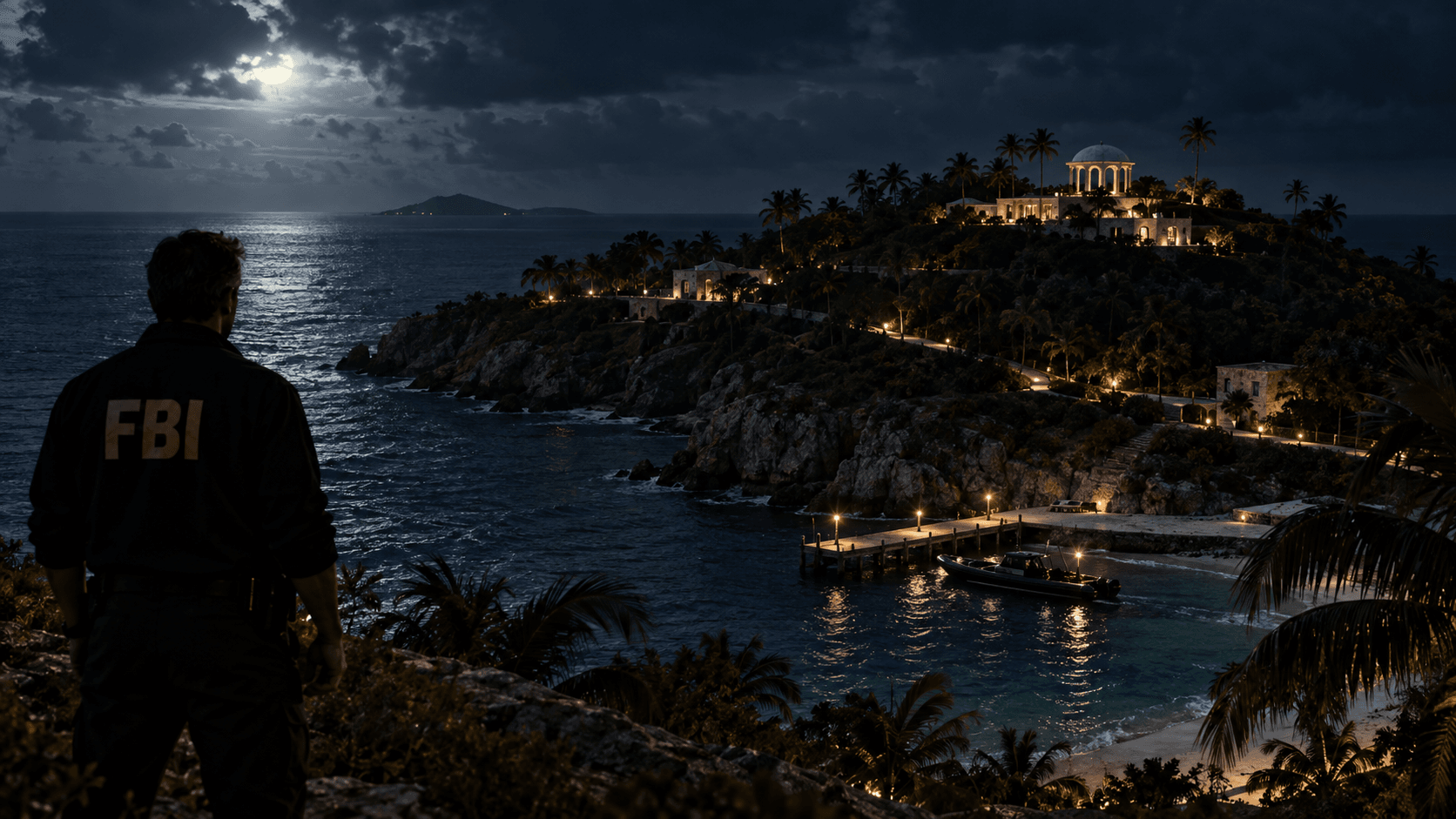
EPSTEIN ISLAND: WHAT REALLY HAPPENED ON LITTLE ST. JAMES?
Behind the rumors surrounding Jeffrey Epstein's private island lies a documented story of abuse, trafficking allegations, investigations and unanswered questions.
The internet turned Little St. James into a symbol before most people understood the evidence.
It became Epstein Island: a private Caribbean property surrounded by rumor, flight logs, photographs, powerful names, court records, victim testimony and conspiracy theories.
The documented crimes and allegations are serious enough without inventing conspiracies.
This article separates four categories: confirmed facts, court allegations, testimony, and unverified internet claims. Those categories matter. A court filing is not the same as a conviction. A contact book entry is not proof of abuse. A photograph is not proof of criminal conduct.
The question is not whether the story is disturbing. It is how to reconstruct it from evidence.
For PRESDA context on power, institutions and criminal systems, read Mafia: How Crime Became an Organized Empire and Good vs Evil.
Who Was Jeffrey Epstein?
Jeffrey Epstein was an American financier and convicted sex offender who built relationships with wealthy, influential and famous people across finance, politics, science, academia and entertainment.
The origins and scale of his wealth have been the subject of reporting and speculation. What is clear is that he presented himself as a money manager for ultra-wealthy clients, cultivated elite social circles and used wealth to acquire extraordinary privacy.
That privacy became central to later investigations.
Epstein's network was not only social. Prosecutors and victims described a recruitment and abuse system involving young women and girls, payments, assistants, travel and private residences.
Little St. James And Great St. James
Epstein purchased Little St. James in the U.S. Virgin Islands in 1998.
The island offered unusual privacy and control. It was physically isolated, privately owned, accessible by boat or helicopter, and outside the ordinary visibility of city life.
In 2016, Epstein purchased nearby Great St. James.
The islands became central to public fascination because they suggested a world where wealth could create distance from scrutiny. But isolation itself is not evidence of a crime. The relevant evidence comes from court filings, witness testimony, law-enforcement actions and settlements.
The 2005 Palm Beach Investigation
The modern legal history began in Palm Beach, Florida.
In 2005, police began investigating allegations that Epstein had sexually abused a minor. The investigation expanded, and federal prosecutors later examined broader allegations involving minors and recruitment.
The case ended in a highly controversial 2008 non-prosecution agreement and plea deal. Epstein pleaded guilty in Florida state court to prostitution-related charges involving a minor and became a registered sex offender.
Victims and later critics argued that the agreement was far too lenient and that victims were not properly informed. The deal became one of the most criticized prosecutorial decisions in modern American criminal justice.
Confirmed fact: Epstein was a convicted sex offender after the 2008 Florida case.
What Prosecutors Said About The Recruitment Network
Federal prosecutors later described a pattern in which girls were recruited to provide massages that became sexual abuse.
Court records and victim accounts alleged that Epstein and associates used payments, promises, travel, gifts and social pressure to recruit vulnerable young women and minors.
The alleged network mattered because it shifted the story from isolated acts to a system.
The charges and lawsuits described abuse not only in Florida and New York, but also at other Epstein properties, including Little St. James.
What Court Filings Allege Happened On Little St. James
Court filings and victim testimony allege that Epstein sexually abused girls and young women on Little St. James and used the island as part of a broader trafficking and abuse network.
Some filings allege that victims were transported to the island, abused there, and pressured into recruiting others.
Those are allegations and testimony unless resolved by conviction, settlement admission, or judicial finding. Many Epstein-related civil matters ended through settlements that did not create public criminal trials on every claim.
The careful wording is important: Little St. James is not famous merely because it was private. It is famous because multiple legal proceedings and victim accounts connected it to alleged abuse.
Ghislaine Maxwell's Documented Role
Ghislaine Maxwell, a longtime Epstein associate, was prosecuted in federal court and convicted in 2021 on charges related to helping Epstein recruit and abuse underage girls.
In 2022, she was sentenced to 20 years in prison.
Her conviction is one of the clearest legal anchors in the Epstein story because it moved from allegation to jury verdict.
Maxwell's documented role does not prove every internet claim about Epstein's circle. It does show that federal prosecutors convinced a jury she participated in a criminal scheme involving minors.
Epstein's 2019 Arrest And Death
On July 6, 2019, Epstein was arrested on federal sex-trafficking charges after arriving in New Jersey from Paris.
Federal prosecutors accused him of exploiting and abusing dozens of girls from at least 2002 to 2005, with allegations connected to his New York and Florida homes.
On August 10, 2019, Epstein died in federal custody at the Metropolitan Correctional Center in New York. The New York City medical examiner ruled the death a suicide by hanging.
His death produced intense public distrust because he died before trial, inside federal custody, while facing charges that involved powerful social connections.
That distrust is understandable. It is not the same as proof of every theory about his death.
The FBI Search Of Little St. James
On August 12, 2019, federal agents searched Little St. James.
News footage and reporting showed FBI personnel on the island days after Epstein's death.
Only officially documented recoveries should be treated as confirmed. Public knowledge of what investigators collected remains limited compared with the volume of online speculation.
Confirmed fact: the FBI searched Little St. James. Unverified claim: any specific object, tunnel, recording system or secret evidence exists unless supported by official records or reliable reporting.
The U.S. Virgin Islands Lawsuits
The U.S. Virgin Islands brought civil claims against Epstein's estate and later against financial institutions connected to Epstein.
The territory alleged that Epstein used the Virgin Islands as a base for sex trafficking and that institutions enabled or benefited from his activities.
Epstein's estate reached a settlement with the U.S. Virgin Islands. JPMorgan Chase also reached a settlement with the territory while denying liability.
Civil settlements can compensate, resolve claims and expose documents, but they are not the same as criminal convictions of every person named in a complaint.
Victim Compensation And Settlements
After Epstein's death, compensation programs and civil settlements distributed money to survivors who alleged abuse.
Those processes mattered because Epstein's death prevented a federal criminal trial against him in 2019.
Settlements can never fully answer every public question. They can, however, acknowledge harm, compensate victims and resolve legal claims.
The existence of settlements also underscores why evidence-based language matters. Survivors' allegations deserve seriousness, not conspiracy-theory noise that turns abuse into entertainment.
What Happened To The Islands?
After years of lawsuits and public scrutiny, Little St. James and Great St. James were sold.
The sale was reported in the 2020s, with proceeds tied in part to legal settlements and estate obligations.
The islands' later ownership does not erase their history. It does mark the end of Epstein's personal control over the properties.
They remain symbols because they condense the entire scandal into a physical place: wealth, isolation, allegations, secrecy and the question of who knew what.
The Epstein Files: What Does A Name Actually Prove?
A name in a contact book, email, photograph, flight log, calendar or court document does not by itself prove criminal conduct.
This is one of the most important facts in the entire case.
Epstein knew, contacted, photographed, hosted or flew with many people for many reasons. Some may have been close associates. Some may have been casual contacts. Some may have had business, academic, charity, political or social interactions. Some may have had no meaningful relationship at all beyond an address-book entry.
Never accuse a public figure based only on association with Epstein.
The legal question is evidence of conduct: what someone did, knew, facilitated, witnessed, concealed or participated in. Association is a lead. It is not a verdict.
Flight Logs And The Client List Myth
Flight logs can show travel on aircraft connected to Epstein. They do not automatically show why a person traveled, what happened before or after, or whether any crime occurred.
The phrase client list is often used online as if there is one official list of proven abusers. Public releases do not establish that.
There are documents, contact lists, depositions, court filings, exhibits, flight records and testimony. They vary in meaning and reliability.
A responsible investigation asks what each record actually is before claiming what it proves.
The Temple, Cameras, Tunnels And Blackmail Claims
CONFIRMED: Little St. James had unusual buildings, including a blue-and-white striped structure often called the temple online.
CONFIRMED: Epstein had properties associated with privacy, security and controlled access.
ALLEGED: Some witnesses and lawsuits described surveillance concerns or coercive systems connected to Epstein's properties.
DISPUTED OR UNVERIFIED: Internet claims about elaborate tunnel systems, hidden global blackmail archives, or specific secret recording operations on the island should not be treated as fact without documentary evidence.
Blackmail theories persist because Epstein's elite associations invite suspicion. But suspicion is not proof.
If evidence exists, it should be evaluated through records, sworn testimony, forensic findings and court proceedings, not viral diagrams.
Epstein Island: Myth Vs Reality
MYTH: Everyone named in Epstein records was a criminal client.
REALITY: A name in records does not by itself prove abuse or criminal conduct.
MYTH: There is one public master client list proving everything.
REALITY: Public materials include many kinds of records, not one definitive list of proven offenders.
MYTH: The island search confirmed every online theory.
REALITY: The FBI search is confirmed, but many claims about what was found remain unverified.
MYTH: Epstein's death makes every conspiracy true.
REALITY: His death in custody created legitimate distrust, but claims still require evidence.
MYTH: The island story is only internet rumor.
REALITY: Court filings, victim testimony, lawsuits and investigations connect Little St. James to serious allegations.
Timeline
1998: Epstein purchased Little St. James in the U.S. Virgin Islands.
2005: Palm Beach police began investigating allegations involving Epstein and a minor.
2008: Epstein pleaded guilty in Florida state court to prostitution-related charges involving a minor and became a registered sex offender.
2016: Epstein purchased nearby Great St. James.
July 2019: Epstein was arrested on federal sex-trafficking charges.
August 10, 2019: Epstein died in federal custody in New York; the medical examiner ruled suicide.
August 12, 2019: FBI agents searched Little St. James.
2020s: Maxwell was prosecuted and convicted, Epstein-related documents continued to be released, civil lawsuits and settlements proceeded, and the islands were sold.
2026: Public debate continues around document releases, associations, accountability and the difference between evidence and speculation.
What Is Still Unanswered?
Many questions remain legitimate.
Who enabled Epstein despite warning signs? Which institutions failed? Why was the Florida deal so lenient? Who ignored victims? What did associates know? Were financial institutions sufficiently diligent? Did government systems protect wealth and status too readily?
Those questions do not require invented tunnels or viral lists.
The strongest unanswered questions are institutional: how did a convicted sex offender with known allegations continue moving through elite networks for so long?
Evidence, Not Fame
The Epstein case attracts attention partly because famous names orbit the record.
But fame can distort investigation. It can make people assume guilt by association, or focus more on celebrity scandal than survivor testimony.
The documented abuse and allegations should remain the center.
What happened on Little St. James should be reconstructed from evidence, not from the fame of the people whose names happen to appear in a file.
FAQ
Frequently Asked Questions
What was Epstein Island?
Epstein Island usually refers to Little St. James, the private U.S. Virgin Islands island Jeffrey Epstein purchased in 1998 and later connected in court filings and testimony to abuse allegations.
Does a name in the Epstein files prove criminal conduct?
No. A name in a contact book, email, photograph, flight log, calendar or court document does not by itself prove criminal conduct.
When did the FBI search Little St. James?
Federal agents searched Little St. James on August 12, 2019, two days after Epstein died in federal custody.
Was Ghislaine Maxwell convicted?
Yes. Maxwell was convicted in federal court in 2021 on charges related to helping Epstein recruit and abuse underage girls, and she was sentenced in 2022.
Is there a proven public Epstein client list?
Public records include many kinds of documents, but no single appearance in released records proves that someone was a client or committed abuse.
PRESDA Dispatch
Stay Informed. Stay Aware.
A sharp briefing across AI, gaming, sport, business, world affairs, paparazzi, and lifestyle.