THE FIRST GIRAFFE IN CHINA: A GIFT THAT AMAZED AN EMPIRE
An African animal, a Bengali embassy and a Chinese emperor: in 1414, a giraffe crossed more than an ocean. It crossed the boundary between natural history and imperial myth.
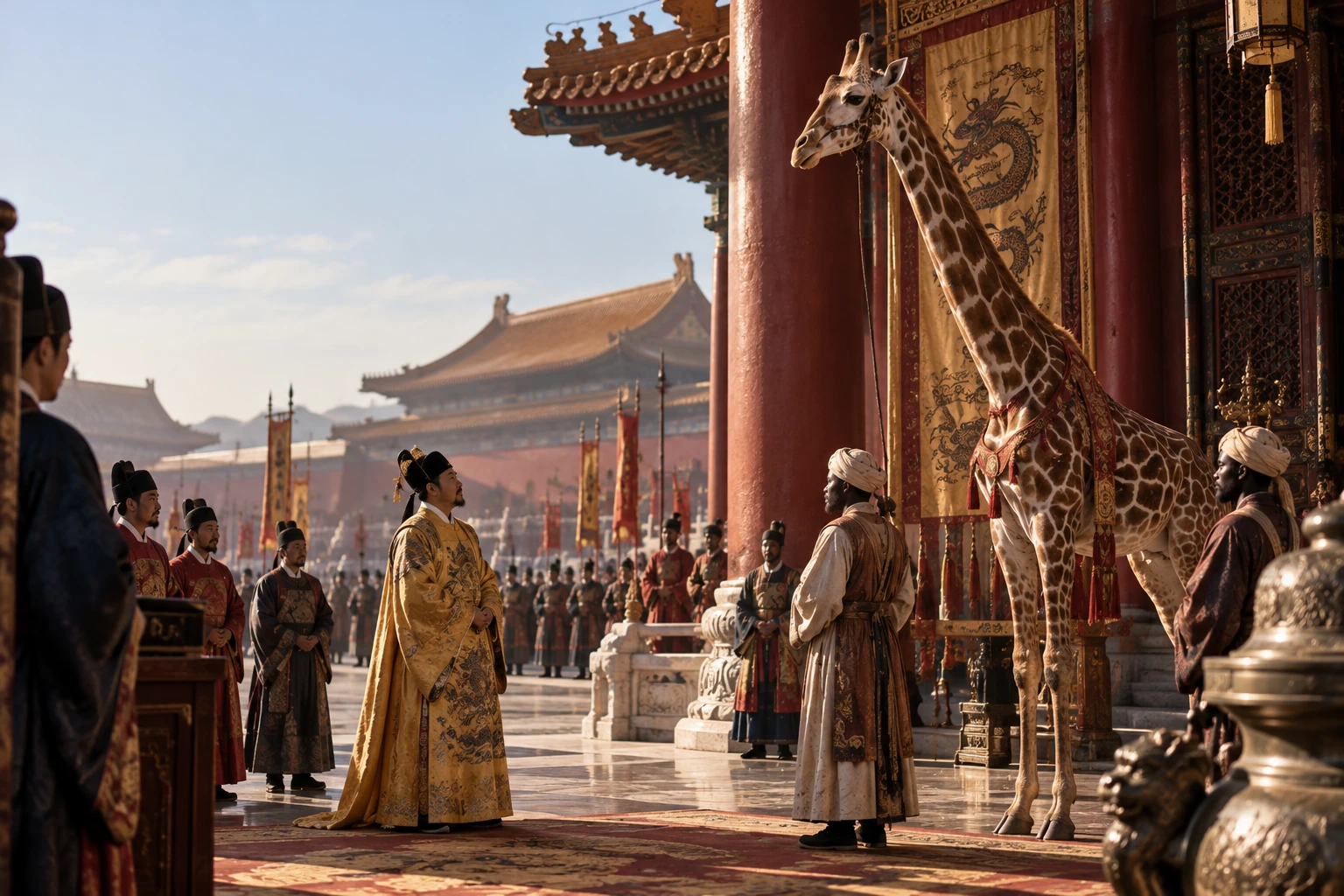
AI artistic reconstruction supplied for this feature. The palace, people and ceremony are imagined, not documentary evidence of the 1414 presentation.
The animal was real. The meaning attached to it was extraordinary. In 1414, an embassy from Bengal presented a giraffe to China's Yongle emperor. Its towering neck and unfamiliar outline supplied the court with something rarer than treasure: an apparent encounter with a creature already known through legend. Courtiers identified it with the qilin, an auspicious being associated with virtuous government. A diplomatic gift could therefore become evidence that the order of heaven and the authority of an emperor were aligned. The Met: Giraffe with Two Keepers
It is often called China's first giraffe. More precisely, it is the celebrated, documented 1414 presentation of a live giraffe to the Ming court. That wording leaves room for an important distinction: knowledge of a foreign animal can travel in descriptions long before the animal itself arrives. The story is not simply one of astonished people mistaking zoology for magic. It concerns how knowledge, diplomacy and political ambition made an unfamiliar creature intelligible, and how images kept that encounter alive long after the animal disappeared from the record.
A gift from Bengal, an animal from Africa
Bengal was the diplomatic sender, not the giraffe's natural homeland. Giraffes are African animals, and this one probably reached Bengal through Indian Ocean connections with East Africa. The precise capture site, earlier owners and sequence of crossings remain uncertain. Historian Sally K. Church treats Malindi as a plausible link, not a demonstrated itinerary. Calling it a gift from Bengal describes its final diplomatic passage; calling it African describes its biological origin. Both statements can be true without filling the intervening journey with invented detail. Church, 2004
The ocean already connected societies that European-centered discovery narratives sometimes leave out. African suppliers, Arabian ports, South Asian courts and Chinese envoys belonged to overlapping worlds of exchange. Berthold Laufer's 1928 museum study gathers evidence of giraffes moving through Arab and Persian networks and appearing at other courts. His older scholarship requires critical reading, especially where chronology has been revised, but its documentary range makes one point vivid: the giraffe did not enter history only when a Chinese emperor saw it. Field Museum: The Giraffe in History and Art
A living gift also carried a burden that a chest of jewels did not. Someone had to keep it alive through unfamiliar environments and transfers between vessels and shore. Water, food, space and human attention were necessities, although the surviving evidence does not supply a reliable daily account of this animal's care. We should resist furnishing its ship with imagined stalls or describing a crossing as if a passenger diary survived. The gaps are revealing: court records preserve the diplomatic achievement more clearly than the labor that made it possible.
Zheng He's era, beyond a single admiral
The giraffe belongs to the maritime world associated with Zheng He. Between 1405 and 1433, seven major Ming expeditions linked China with ports across Southeast Asia and the Indian Ocean, eventually reaching East Africa. Yongle sponsored the opening of this extraordinary chapter. The chronology of Edward L. Dreyer's study, catalogued by Smithsonian Libraries, separates these voyages and their changing destinations. That sequence matters more than spectacular but disputed claims about the exact dimensions of the largest treasure ships. Smithsonian Libraries: Dreyer's Zheng He
Yet the convenient phrase 'Zheng He brought China's first giraffe from Africa' compresses separate events. Church's reconstruction places the Bengal mission's return in 1414, while Zheng He's fourth major expedition returned in 1415. The Bengal exchange therefore belongs within the broader imperial maritime program without proving that the admiral personally escorted this particular animal. Distinguishing a famous commander from the network around him gives envoys, merchants and lesser-known missions their historical place. Church: diplomatic chronology
Nor did these routes begin as empty lines waiting to be drawn by an empire. The fleets moved within an existing maritime world. Their arrivals could amplify diplomatic relationships and project power, but they depended on places where people already traded, interpreted and negotiated. Viewed from Bengal, the episode was an opportunity to address another court. Viewed from China, it could be recorded as tribute. The same exchange could carry different meanings at its two ends, without either side understanding itself as a supporting actor in the other's story.
Why Yongle needed more than wonder
Yongle seized the throne from his nephew in 1402 and ruled until 1424. His authority was formidable, but the circumstances of his accession made legitimacy a serious political question. The Met's account of his imperial arts connects ambitious campaigns, maritime expeditions and court production. A rare animal arriving from overseas could be understood within that wider display of reach. It suggested that distant rulers knew the emperor and considered a relationship with him worth cultivating. The Met: Defining Yongle
His ambition extended to knowledge. The Yongle encyclopedia was compiled between 1403 and 1408 under imperial order, drawing together an enormous body of earlier writing. The Library of Congress preserves volumes from its later manuscript transmission. An encyclopedia and a giraffe are very different things, but together they illuminate a court interested in gathering a world around the throne: texts through compilation, objects through workshops, and foreign marvels through diplomacy. This is an interpretation of the pattern, not a claim that the animal caused the encyclopedia or followed a single master plan. Library of Congress: Yongle Da Dian
How a giraffe became a qilin
The qilin was not a recently invented explanation for a long neck. It belonged to older Chinese traditions of auspicious creatures and moral rulership. Identifying the newcomer with it connected an unprecedented sight to a familiar intellectual framework. Natural description and symbolic interpretation could coexist: an observer could notice an animal's body and still ask what its arrival signified. The category offered a way to read the event, rather than a modern biological classification. Metropolitan Museum Journal: the giraffe and the qilin
Art historian Kathlyn Liscomb approaches the gift as an encounter between cultural systems. Her study argues that meanings circulating in Persian-Islamic settings and Chinese ideas about tribute animals could appear to converge. This makes the episode richer than a tale of innocent credulity. Bengal's court and the Ming court could each recognize a prestigious gift while attaching different histories and expectations to it. Translation was happening through an animal as well as through language. Liscomb: How the Giraffe Became a Qilin
There is also a complication for anyone imagining an emperor eagerly accepting every compliment. Accounts discussed by Laufer record Yongle declining proposed formal congratulations over the auspicious animal. Such restraint could itself conform to ideals of a ruler who valued government over favorable omens. It does not reveal his private thoughts. Neither complete belief nor cynical disbelief can safely be reconstructed from a ceremonial response. The public language of a court is evidence of political behavior, not a transparent window into an individual's mind. Laufer: Chinese records and art
The museum painting: history after the event
The historical reproduction shown here is Giraffe with Two Keepers, an ink-and-color painting on silk by an unidentified Chinese artist. The Metropolitan Museum of Art assigns it to the Qing dynasty and describes the artist as seventeenth century or later. It is therefore a later rendering of the famous subject, not an eyewitness painting securely dated to 1414. The museum identifies its image as public domain and makes it available through its Open Access program. Artwork and collection record The Met: Open Access
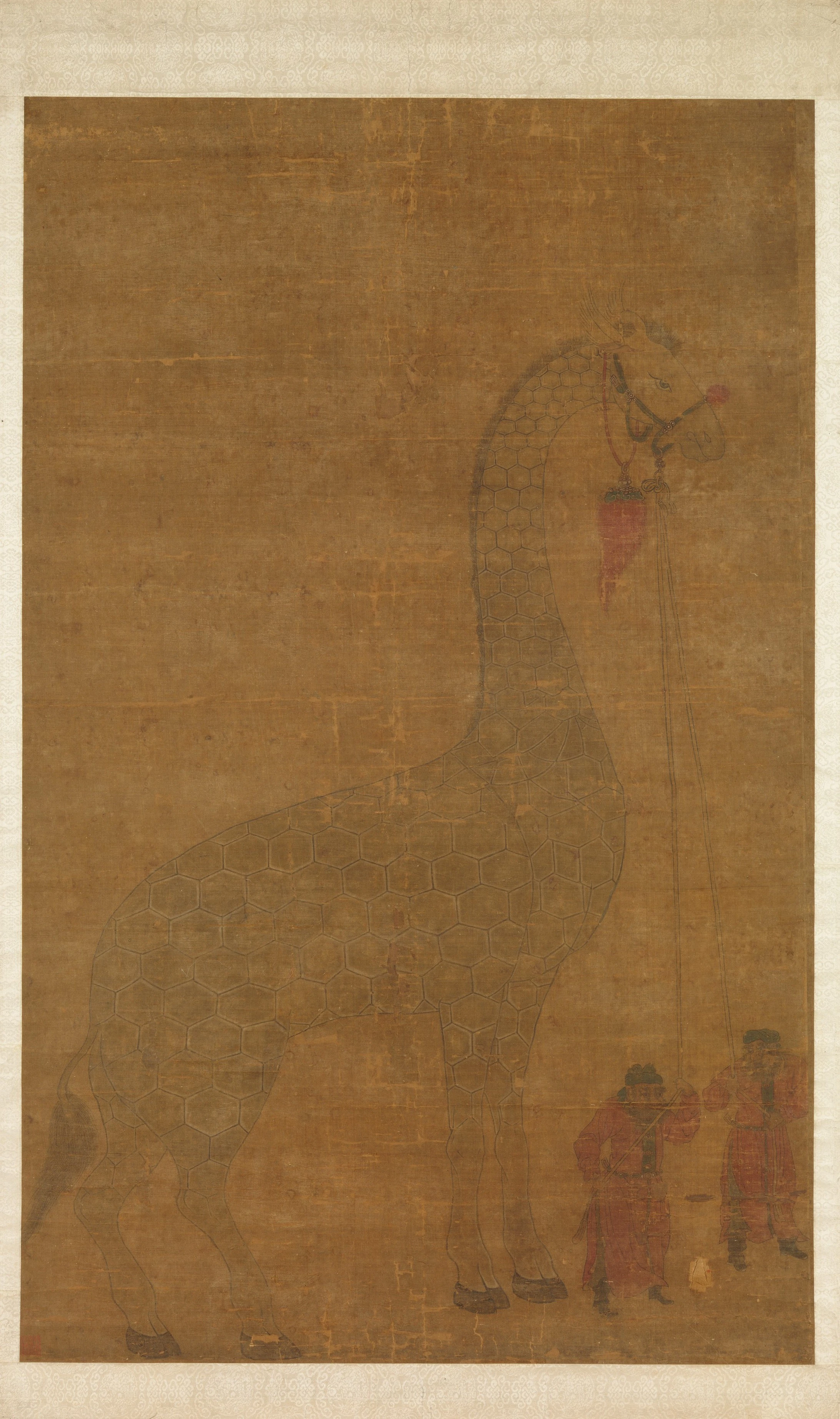
Giraffe with Two Keepers. Unidentified Chinese artist, seventeenth century or later; Qing dynasty. Ink and color on silk. A later depiction of the subject, not an eyewitness image from 1414.
The Metropolitan Museum of Art, 47.18.21. From the Collection of A. W. Bahr, Purchase, Fletcher Fund, 1947.
Public domain / CC0, The Met Open Access. Resized and converted to WebP without cropping or color alteration.
Look at how much of the composition belongs to the animal: the rising neck, patterned body and small human attendants. These visual relationships make foreignness and scale immediately legible. Looking closely is also a reminder that a painting selects. Costume, proportion, pose and empty space form an artistic statement; they cannot automatically establish the appearance of the original handlers or a precise ceremony. A later image may be excellent evidence of how an event was remembered while being limited evidence of how it actually looked.
Scholarship on the qilin-giraffe connects the animal's image with the development of rank-badge designs. The transformation from court marvel into repeatable motif is important. Once an image can circulate on another surface, its life no longer depends on access to the living creature. Painters and craftspeople can adapt it to established conventions. The result is not simply copying an animal, but placing it within a vocabulary of status and auspicious power. Metropolitan Museum Journal: visual afterlives
That vocabulary occupied a sophisticated material setting. Smithsonian's National Museum of Asian Art has examined Ming court taste through lacquer and porcelain, including white wares favored under Yongle. The giraffe story sits beside those crafted expressions of authority, even though it should not be treated as the explanation for them. The palace was a place where materials, forms and associations mattered. A marvelous animal could become part of that visual culture without ceasing to be a creature with ordinary physical needs. Smithsonian: Ming court visual culture
More giraffes, and the limits of the record
The 1414 presentation was not the end. Records describe another giraffe offered from Malindi in 1415. Zheng He's 1431 Changle inscription, in translation, also associates a giraffe gift from Aden with the fifth voyage, which began in 1417. These later episodes must not be folded into the Bengal animal's biography. They show a continuing traffic in prestige and living rarities, rather than a single voyage that can explain every surviving giraffe image. Laufer: later arrivals Translated historical accounts of Zheng He
A concise timeline keeps the strands separate: Yongle took power in 1402; the first major Zheng He expedition departed in 1405; Bengal's celebrated gift arrived in 1414; a Malindi presentation followed in 1415; the major maritime series concluded in 1433. Those anchors are stronger than a continuous, scene-by-scene narrative. We do not have secure answers for every practical question, including the first animal's exact age, individual identity or lifespan after arrival. An honest history does not need those blanks filled to remain remarkable.
The empire in the eye of the beholder
The most revealing journey was not only from Africa through Bengal to China. It was from animal to argument. The giraffe could be a diplomatic asset, a sign of favorable rule, a painter's subject and a later museum object, depending on who looked at it. None of those meanings exhausted what it was. This distinction matters whenever an empire's accounts turn a living being into proof of its own importance.
We can admire the connections that made the encounter possible while refusing to give one court ownership of the entire story. Africa supplied the animal's world; Bengal gave the diplomatic gift; Ming institutions gave it a particular public meaning. The museum painting preserves an afterlife, and modern research restores uncertainty where legend prefers a smooth adventure. For more histories of power and exchange, explore PRESDA's History features and World coverage. The giraffe amazed an empire. Its longer story asks us to look beyond that empire, toward the people and routes that brought it into view.
FAQ
Frequently Asked Questions
When did the first famous giraffe arrive in China?
The documented presentation from Bengal to the Ming court took place in 1414, during Yongle's reign. It is commonly described as China's first giraffe, though descriptions of foreign animals could circulate earlier.
Was the giraffe originally from Bengal?
Bengal sent the diplomatic gift, but the animal was African. An East African route, possibly involving Malindi, is plausible; its precise earlier journey is not securely documented.
Did Zheng He personally bring the 1414 giraffe?
The gift belongs to his maritime era, but the Bengal mission's 1414 return was separate from the return of his fourth major expedition in 1415. Personal escort should not be asserted as established fact.
Why was it called a qilin?
The court associated the unfamiliar animal with an auspicious creature in Chinese tradition. This interpretation linked its arrival to virtuous rulership and imperial prestige.
Is the museum painting a picture made in 1414?
No. The Met's Giraffe with Two Keepers is a later Qing-dynasty painting by an unidentified artist, described as seventeenth century or later. The cinematic hero is an AI artistic reconstruction.
PRESDA Dispatch
Stay Informed. Stay Aware.
A sharp briefing across AI, gaming, sport, business, world affairs, paparazzi, and lifestyle.