THE POWER OF RESISTANCE: HOW GANDHI, MANDELA AND MLK CHANGED HISTORY
Gandhi, Mandela and Martin Luther King Jr. challenged systems that seemed permanent. Their connected histories reveal the power of organized resistance, the limits of heroic myths and the difficult choices behind political change.
An empire can appear permanent until people withdraw their cooperation. A segregation law can look immovable until ordinary journeys to work become a collective refusal. A prison can remove a leader from public life without removing the political demand that put him there. The histories of Gandhi, Mandela and Martin Luther King Jr. turn on these gaps between the appearance of power and the conditions that sustain it.
They are often placed together as symbols of peaceful resistance. The association captures a real connection, but it can also conceal the most important differences. Gandhi helped transform Indian nationalism into mass noncooperation. King joined Christian ethics to organized direct action against American racial injustice. Mandela moved from civil disobedience to supporting sabotage, then helped negotiate a democratic settlement.
None accomplished these changes alone. None was beyond criticism. Their achievements become more intelligible when the camera moves beyond the famous face to include organizers, families, workers, rival leaders, courts, donors and people who kept a campaign alive after the speeches ended.
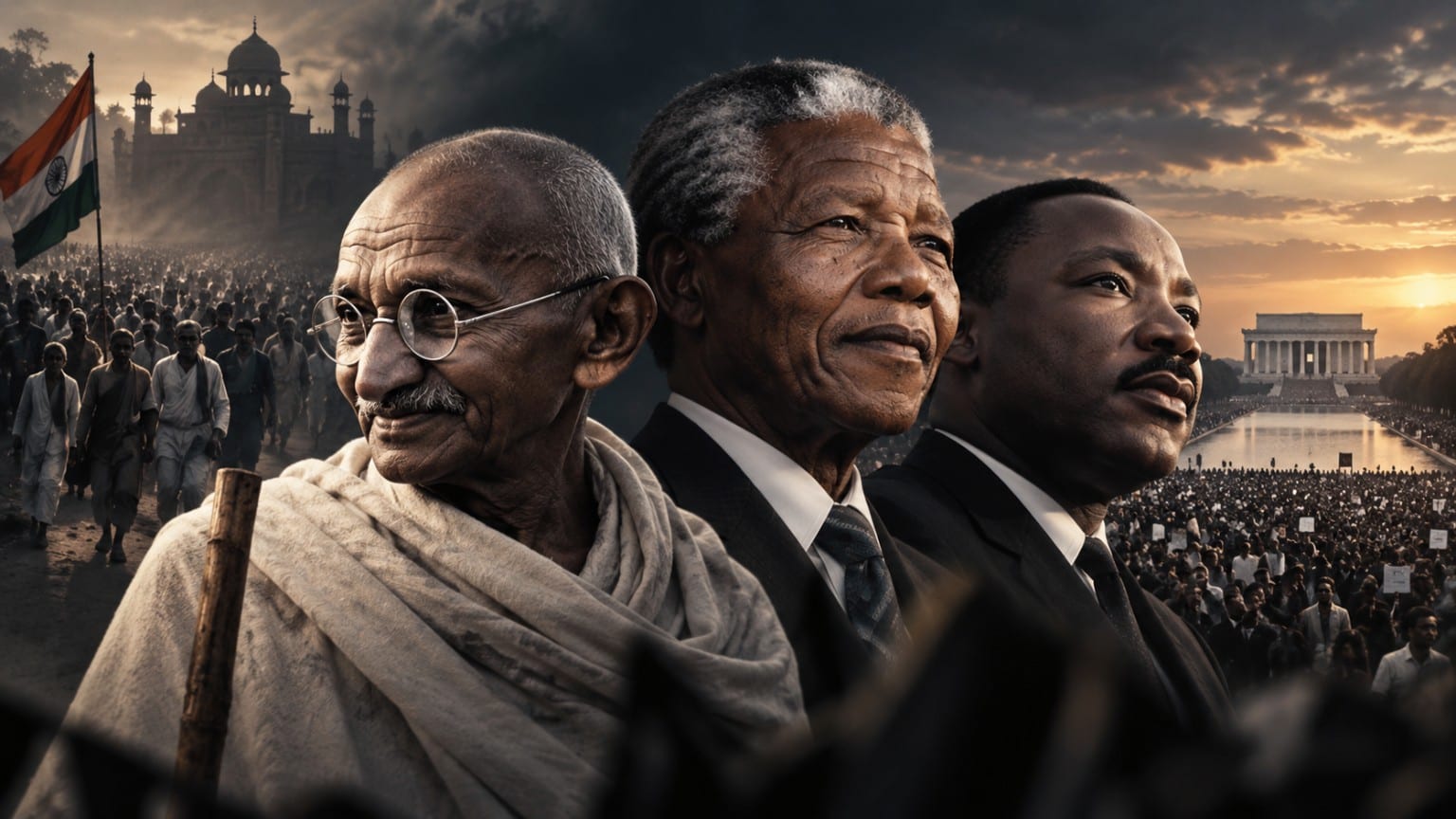
Historical evidence reviewed September 19, 2026. The supplied hero is an illustrative composite, not a photograph of the three men together. Dates refer to the historical events described. Primary speeches are treated as evidence of the speakers’ arguments, not as impartial accounts of every event.
THREE MEN BORN INTO UNEQUAL WORLDS
Mohandas Karamchand Gandhi was born in Porbandar in 1869, into a family connected to the administration of a princely state. He grew up within the British imperial order, whose authority operated through both direct rule and Indian rulers. His later legal training in London and work in South Africa placed him inside the institutions and racial hierarchies he would challenge. Gandhi’s life chronology.
Colonial India was not a single community waiting for one leader to speak. Religion, caste, region, class and competing visions of self-government shaped its politics. The broader setting matters: the history of the British Empire shows how imperial rule depended on local institutions and cooperation as well as military force.
Nelson Mandela was born in Mvezo in 1918, into the Thembu royal milieu. White domination in South Africa already restricted Black life before the National Party’s 1948 election victory gave apartheid its more systematic form. Land dispossession, restricted movement and political exclusion had deeper roots. Mandela’s struggle confronted a settler state in which the Black majority was denied equal national political power. Mandela’s biography; The political background to apartheid resistance.
Martin Luther King Jr. was born in Atlanta in 1929, within an established Black church and business community. Economic security and education did not remove the barriers of segregation. His world combined constitutional promises of citizenship with Jim Crow laws and racial exclusion. The question was how to make those promises enforceable in everyday life. King’s early Atlanta environment.
These were different political problems. India sought freedom from imperial rule. Black Americans demanded equal rights and protection within an existing republic. South Africa’s liberation movement sought to replace minority rule with a nonracial democracy. A shared language of dignity did not make their routes to change interchangeable.
GANDHI: MAKING BRITISH RULE DIFFICULT TO SUSTAIN
Gandhi developed his approach to organized resistance among Indians in South Africa before returning to India in 1915. In Hind Swaraj, first published in 1909, he argued that political subordination depended partly on the cooperation of the governed. His idea of swaraj, or self-rule, also involved personal and social transformation. Replacing foreign officials with Indian officials was not, by itself, the whole of freedom. Chronology; Gandhi’s Hind Swaraj.
Satyagraha is commonly translated as truth-force or holding firmly to truth. It joined resistance to injustice with a demand for discipline from the resister. Refusing compliance was meant to challenge domination without treating the opponent’s destruction as the objective. It could involve breaking a law openly and accepting punishment, which made it considerably more demanding than simply expressing disapproval.
The Non-Cooperation movement of 1920-1922 encouraged withdrawals from colonial institutions and the boycott of foreign goods. Homespun cloth gave the campaign a daily material expression. Yet Gandhi suspended mass action in 1922 after protesters killed policemen at Chauri Chaura. That decision exposed a recurring tension: a mass movement could grow faster than its leader’s ability to control its conduct. Noncooperation and the 1922 suspension.
Salt made that political imagination visible again. Gandhi began walking from Sabarmati on March 12, 1930, and broke the salt law at Dandi on April 6. A government monopoly on an everyday necessity provided a target people could understand and imitate. The campaign connected a simple act with a larger claim that colonial authority lacked legitimacy. NCERT’s account of the Salt March.
The importance of salt was not that one symbolic handful could bankrupt an empire. It created an accessible point of entry into collective disobedience. A person who could not attend elite political negotiations could still participate in a campaign whose meaning was immediately recognizable.
Gandhi’s 1942 Quit India call brought another confrontation and the imprisonment of Congress leaders. Independence followed in 1947, but not as the uncomplicated fulfillment of his hopes. Partition created India and Pakistan amid forced movement and communal violence. Britain’s postwar position, negotiations among political leaders and incompatible constitutional demands also shaped the outcome. Gandhi neither single-handedly caused independence nor controlled its final form. Quit India chronology; Independence and Partition.
KING: NONVIOLENCE AS ORGANIZED PRESSURE
The Montgomery bus boycott began on December 5, 1955, after Rosa Parks’s arrest. Its foundations included the Women’s Political Council, Jo Ann Robinson’s organizing, E. D. Nixon’s work and earlier challenges to segregated buses. King became president of the Montgomery Improvement Association, but he did not create that community’s resistance from nothing. Montgomery’s organizing history.
Participants sustained the boycott through walking, shared transport, meetings and fundraising. Litigation mattered too: the federal case Browder v. Gayle challenged bus segregation, and the boycott ended in December 1956 after the desegregation ruling became enforceable. Economic refusal and legal action worked together. The familiar story of one arrest followed by one inspiring speech leaves out the machinery of persistence. Boycott, transport networks and litigation.
Birmingham in 1963 showed the same effort to create pressure, with far greater public confrontation. King’s Southern Christian Leadership Conference worked with Fred Shuttlesworth’s local movement. Demonstrations, economic pressure and arrests challenged segregation, while police attacks on demonstrators, including young people, drew national attention. The campaign also raised difficult questions about risk and who was being asked to bear it. Birmingham campaign history.
In his Letter from Birmingham Jail, dated April 16, 1963, King defended direct action against the demand to wait. His argument was that negotiation often required a crisis that authorities could no longer ignore. Nonviolence was an active means of creating political pressure, not a promise to keep everyone comfortable. The letter and its historical setting.
The Civil Rights Act was signed on July 2, 1964. It attacked discrimination in areas including public accommodations and employment. The Voting Rights Act followed on August 6, 1965, strengthening federal action against racial barriers to voting. These were victories of a broad movement, made into law through congressional and presidential action. They were not gifts produced by a speech alone. Civil Rights Act; Voting Rights Act.
The distinction between legal change and lived equality is essential. Ending a formal barrier does not immediately redistribute wealth, desegregate housing or remove fear. The long aftermath of slavery and emancipation helps explain why King’s demands extended beyond access to a bus seat or lunch counter.
HOW GANDHI INFLUENCED MLK
King encountered Gandhian ideas through reading and a network of Black religious leaders and organizers. Howard Thurman, Benjamin Mays, Mordecai Johnson, Bayard Rustin and James Lawson helped connect Indian experience with African American freedom struggles in different ways. King visited India in 1959, after the Montgomery boycott, not before it. Gandhi had died in 1948, so the two never met. Stanford’s account of the connection.
King’s own 1958 tribute to Gandhi explained his synthesis: Gandhian methods of nonviolent action combined with the Christian ethic of love. That was an adaptation to American institutions and Black religious life. It was not a decision to reproduce Indian nationalism in another country. King’s contemporary tribute.
Influence travels through people who teach, translate, debate and organize. The connection is stronger when these intermediaries are visible. Treating it as a mysterious transfer of inspiration from one exceptional man to another makes practical political learning disappear.
MANDELA: WHY THE STRUGGLE TURNED TOWARD SABOTAGE
Mandela was a leading organizer of the 1952 Defiance Campaign, which challenged apartheid laws through deliberately breaking them. The African National Congress and South African Indian Congress worked together. Arrests and restrictions on leaders were already central features of the contest between the state and its opponents. The Defiance Campaign and Mandela’s political development.
On March 21, 1960, police opened fire on protesters at Sharpeville during an anti-pass campaign organized by the Pan Africanist Congress. The massacre and the subsequent banning of the ANC and PAC transformed the political situation. Remembering that the PAC organized the protest also prevents the ANC’s later prominence from swallowing the history of its rivals. Sharpeville and the anti-pass campaign; Repression and the turn to armed struggle.
In 1961 Mandela helped establish Umkhonto we Sizwe, or MK, which became the ANC’s armed wing. Its first coordinated sabotage attacks took place on December 16, 1961. In his Rivonia Trial statement of April 20, 1964, Mandela acknowledged planning sabotage and explained why he believed exclusive nonviolence had become inadequate under escalating repression. Mandela’s statement from the dock.
He described the initial choice as attacks on property and infrastructure intended to avoid killing people. The aim was to impose costs and pressure the government while limiting the damage to future relations between communities. That describes his stated strategy at the time. It does not establish that every later action by MK avoided civilian harm, or that the wider conflict remained within those boundaries. The sabotage rationale and its limits.
This is the decisive difference between Mandela and the other two figures. It is historically misleading to describe all three as lifelong practitioners of the same nonviolent doctrine. It is equally misleading to reduce Mandela to armed resistance and erase the negotiations, mass politics and coalition-building that occupied so much of his life.
Mandela himself drew the distinction in his 1999 essay The Sacred Warrior. He credited Gandhi’s influence while explaining why his own movement had added a military dimension. The essay is valuable testimony about how Mandela understood that inheritance. Its admiration for Gandhi should not be mistaken for a neutral assessment of Gandhi’s entire record. Mandela on Gandhi and their different choices.
THE SIMILARITIES AND DIFFERENCES AT A GLANCE
The comparison below describes the dominant goals and strategies of their best-known campaigns. Each movement contained disagreements, changing tactics and participants whose politics differed from those of its famous leader. The source discussions above provide the historical basis.
| Leader and setting | Central political goal | Methods | Essential distinction |
|---|---|---|---|
| Gandhi; colonial India | Self-rule and an end to British domination | Noncooperation, boycotts, civil disobedience and constructive social work | Nonviolence was tied to personal ethics as well as mass politics |
| King; United States | Equal citizenship, enforceable civil rights and economic justice | Boycotts, marches, direct action and pressure for legal reform | Worked within a wider movement that combined protest, litigation and legislation |
| Mandela; South Africa | End apartheid and establish a nonracial democracy | Civil disobedience, support for sabotage, mass politics and negotiation | Did not maintain an absolute commitment to nonviolent methods |
Civil disobedience deliberately breaches a law regarded as unjust. A boycott withdraws purchases, services or participation. Mass protest makes a collective demand visible. Nonviolent resistance can combine these with strikes and other forms of noncooperation. These methods overlap, but they are not synonyms, and a march is not automatically a strategy for winning a particular demand.
PRISON, REPRESSION AND THE WORLD OUTSIDE
Mandela was imprisoned from 1962 until his release on February 11, 1990. His 1964 life sentence followed the Rivonia Trial. The familiar description of 27 years in prison covers incarceration at several facilities, not 27 years entirely on Robben Island. His release opened a further struggle over negotiations and political power. It did not immediately end apartheid or make him president. Prison chronology and release.
King faced arrests, threats and an FBI campaign to undermine his standing. Stanford’s King Institute documents surveillance and efforts to discredit him, including an anonymous package he understood as an attempt to drive him toward suicide. These were actions against an activist challenging American institutions from within the United States. FBI surveillance and harassment.
Imprisonment could give a cause symbolic force, but prison was not a machine that automatically produced victory. It separated families, disrupted organizing and exposed people to severe physical and psychological costs. Political prisoners needed networks outside the walls to keep demands alive.
The movements also spoke to one another while their struggles were unfinished. In an August 21, 1962 letter, King and ANC leader Albert Luthuli invited Bertrand Russell to support an international appeal against apartheid. It sought boycotts and economic sanctions. The American civil rights movement and South African liberation were connected by active solidarity, not simply by later memorials. King and Luthuli’s letter.
International anti-apartheid action included campaigns against trade, investment, sporting ties and cultural normalization. The UN Security Council made its arms embargo mandatory in 1977. Such pressure worked alongside internal resistance, rather than replacing it. UN chronology of anti-apartheid action.
The end of apartheid also reflected economic strain, sustained domestic mobilization, diplomatic pressure and the changing Cold War environment. Mandela and F. W. de Klerk were important negotiating figures, but a settlement cannot be explained by their personal relationship alone. The negotiations occurred amid continuing political violence and hard bargaining. Historical account of apartheid’s end.
South Africa held its first national democratic election with universal adult suffrage in April 1994. Mandela was inaugurated on May 10. The achievement was a transformation of the basis of political authority: the majority could participate in choosing the national government. It was not the completion of social and economic equality. The democratic transition.
GANDHI’S ACHIEVEMENTS DO NOT ERASE HIS CONTRADICTIONS
Gandhi’s opposition to untouchability did not make his position identical to B. R. Ambedkar’s demand to dismantle caste. Their published exchange around Annihilation of Caste reveals a fundamental disagreement about religious authority, inherited social roles and the route to equality. Ambedkar challenged the idea that reform could succeed without confronting the structure that reproduced exclusion. Ambedkar, Gandhi and the caste debate.
Gandhi’s South African years also included racist descriptions of Africans and efforts to distinguish Indian claims from those of Black Africans. Scholarship by Ashwin Desai and Goolam Vahed challenges the retrospective image of an already fully formed advocate of racial equality. Historians debate the development of his views, but later influence cannot make the earlier hierarchy disappear. Academic assessment of The South African Gandhi.
His late experiments in celibacy, including sleeping naked alongside his young grandniece Manu, raise serious questions about power and the burdens imposed on female followers. Historical research examines the women’s writings as well as Gandhi’s self-understanding. A claim of spiritual discipline does not settle the ethical questions about such unequal relationships. Research on Gandhi, Manu and nonviolent selfhood.
The myth of Gandhi as a flawless saint is therefore inadequate. So is an account that treats his failures as proof that mass civil resistance achieved nothing. His political importance and the need to criticize him belong in the same history.
KING WAS MORE DEMANDING, AND MORE CONTESTED, THAN THE MEMORIAL IMAGE
Ella Baker challenged the concentration of authority in charismatic leadership and encouraged organizing that developed local participants’ capacity. Her conflicts within the male-dominated Southern Christian Leadership Conference also expose the gap between women’s essential work and their access to formal power. This was criticism from within the freedom struggle, not simply opposition from segregationists. Ella Baker’s alternative approach.
King’s scholarship also requires an honest reckoning. The King Papers project identified substantial unattributed borrowing in some of his academic work, including his doctoral dissertation. Recognizing that plagiarism is compatible with recognizing the importance of his public leadership. Historical evaluation does not require either concealment or the erasure of everything else he did. King Institute scholarly introduction.
The comforting myth that King only asked Americans to be kinder obscures his later politics. His April 4, 1967 speech Beyond Vietnam condemned the war and connected militarism with racial and economic injustice. The position brought criticism from people who had supported his civil rights work. Beyond Vietnam and the response.
His final campaigns addressed poverty and workers’ dignity. He was assassinated in Memphis on April 4, 1968, while supporting striking sanitation workers. A national memory centered exclusively on the 1963 March on Washington can leave this broader economic agenda out of view. Chronology of King’s later campaigns.
Our history of Muhammad Ali’s life beyond boxing explores another figure whose opposition to the Vietnam War complicates a later, more comfortable public image. Their positions were not identical, but remembering the controversy matters in both cases.
MANDELA’S RECONCILIATION WAS AN ACHIEVEMENT, NOT AN ABSOLUTION
The liberation movement’s cause did not make every action by its members defensible. South Africa’s Truth and Reconciliation Commission found gross human rights violations in ANC camps involving suspected agents and mutineers. These findings concern the movement’s conduct and cannot simply be converted into a claim that Mandela personally ordered every abuse, especially during his imprisonment. They nevertheless rule out an innocent, frictionless picture of the struggle. TRC findings quoted in an amnesty decision.
The negotiated transition also left a contested economic inheritance. The Nelson Mandela Foundation acknowledges debates over whether the government’s choices did enough to alter entrenched poverty, ownership and inequality. Defenders emphasize the instability and constraints of the transition; critics argue that political inclusion moved further than economic transformation. Mandela’s presidency must be assessed within that argument, not protected from it by his status as a symbol. The debate over Mandela’s economic legacy.
Reconciliation required political judgment and helped build a shared democratic future. It did not mean victims had to regard every wound as healed. Nor does criticism of the settlement establish that a less compromising alternative would have succeeded without different and potentially grave costs. The historical task is to examine those choices rather than pretend there were none.
HOW THEIR EXAMPLE TRAVELLED
The influence can be traced in concrete practices. César Chávez drew on Gandhi’s fasting as part of his commitment to nonviolence in the American farmworker movement. Boycotts and disciplined collective action moved into a different struggle over labour, livelihood and dignity. National Park Service history of Chávez’s organizing places.
In accepting the Nobel Peace Prize on December 10, 1989, the Dalai Lama explicitly credited Gandhi as an inspiration. That is direct evidence of intellectual influence within the Tibetan nonviolent cause. It is not evidence that an admired strategy guarantees achievement of its political goals. The Dalai Lama’s acceptance speech.
Mandela’s example offered a related but different lesson: an enemy could become a negotiating partner without requiring the oppressed to abandon the demand for equal citizenship. King’s example connected moral language with disruptive pressure. Gandhi’s showed how everyday conduct could become political action. Later movements have selected and adapted parts of these traditions rather than inherited a single complete formula.
Comparative research also cautions against treating famous victories as a universal law. Erica Chenoweth’s 2020 analysis found that nonviolent resistance had become more common while its effectiveness was declining, pointing both to state responses and to movements’ organizational weaknesses. Crowds, visibility and moral conviction do not remove the need for sustained coordination and a workable strategy. Research on civil resistance and its limits.
WHAT THEIR LIVES REVEAL ABOUT POLITICAL CHANGE
Political change needs people who can connect a large injustice to an action others can take. Salt production, a bus journey and refusal to obey apartheid restrictions were not minor details beneath the grand ideas. They were ways to make participation possible.
It also needs institutions that carry action beyond a moment of attention. A boycott requires transport and money. A legal challenge requires plaintiffs and lawyers. A negotiated transition requires people able to make commitments and persuade others to accept them. The charisma of a leader cannot perform all those jobs.
Pressure and negotiation are often linked. A campaign changes the costs of refusing a demand; negotiation can translate that altered balance into an agreement. Law then needs enforcement, and an election needs institutions capable of protecting those who lose as well as those who win.
Finally, a movement must remain open to criticism from the people it claims to represent. Ambedkar’s challenge to Gandhi, Baker’s challenge to concentrated leadership and criticism of post-apartheid inequality all ask a difficult question: whose freedom is being achieved, and who still has to wait?
Gandhi, Mandela and King changed history because they helped people act together against systems presented as inevitable. Their lives also show the limits of any one leader’s control. The most useful inheritance is the work of organizing, arguing, learning and building institutions through which dignity becomes more than a promise.
SOURCES AND HISTORICAL NOTES
The sources combine contemporary writings and speeches, official documents, institutional chronologies and academic interpretations. Speeches explain what their authors argued; they do not independently verify every claim made in a political defence. Critical scholarship is identified as interpretation where appropriate. Precise crowd sizes, contested casualty totals and sweeping claims about the success rate of resistance are omitted where they would add uncertainty without improving the account.
The comparison distinguishes Gandhi’s Indian campaigns, King’s U.S. civil rights work and Mandela’s changing role in the South African struggle. It does not imply that any movement was internally uniform. The title’s three names are an entry point into collective histories, not a claim that three men alone produced independence or equal rights.
Gandhi Smriti and Darshan Samiti, Government of India: Gandhi chronology.
M. K. Gandhi: Hind Swaraj or Indian Home Rule, original work published in 1909.
NCERT, hosted by IIT Kanpur: Mahatma Gandhi and the Nationalist Movement.
National Army Museum: Independence and Partition, 1947.
National Park Service: Martin Luther King Jr., from youth to leadership in Atlanta.
Stanford King Institute: Montgomery Bus Boycott.
Stanford King Institute: Birmingham Campaign.
Stanford King Institute: Letter from Birmingham Jail, April 16, 1963.
National Archives: Civil Rights Act, July 2, 1964.
National Archives: Voting Rights Act, August 6, 1965.
Stanford King Institute: Gandhi and his influence on King.
Martin Luther King Jr. (1958): His Influence Speaks to World Conscience.
Nelson Mandela Foundation: biography and imprisonment chronology.
Nelson Mandela Foundation: Life and Times exhibition, Defiance Campaign and MK.
South African History Online: genesis of the armed struggle, 1960-1966.
South African History Online: Sharpeville Massacre, March 21, 1960.
Nelson Mandela (1964): Rivonia Trial statement, O’Malley Archives.
Nelson Mandela (1999): The Sacred Warrior, Asia Society copy of TIME essay.
King and Albert Luthuli: letter to Bertrand Russell, August 21, 1962.
Stanford King Institute: FBI surveillance and efforts to discredit King.
United Nations: campaign against apartheid and international pressure.
U.S. Office of the Historian: the end of apartheid.
B. R. Ambedkar: Annihilation of Caste, including the Gandhi exchange, Columbia University edition.
Journal of British Studies (2018): review of Desai and Vahed’s The South African Gandhi.
Nikita Arora, History Workshop Journal (2022): Sustaining a Nonviolent Self.
Stanford King Institute: Ella Baker and criticism of leader-centered organizing.
Stanford King Institute: scholarly introduction, including King’s academic plagiarism.
Stanford King Institute: Beyond Vietnam, April 4, 1967.
South African Truth and Reconciliation Commission: amnesty decision quoting findings on ANC camps.
Nelson Mandela Foundation (2017): Mandela’s economic legacy.
National Park Service: Places of César Chávez and Gandhian fasting.
Dalai Lama: Nobel Peace Prize acceptance speech, December 10, 1989.
Erica Chenoweth (2020), Harvard Kennedy School: The Future of Nonviolent Resistance.
Stanford King Institute: chronology of King’s life and campaigns.
FAQ
Frequently Asked Questions
Were Gandhi, Mandela and MLK all committed to the same nonviolent strategy?
No. Gandhi and King made nonviolent resistance central to their political and moral programmes. Mandela participated in nonviolent campaigns but later helped establish MK and defended sabotage before helping negotiate a democratic transition.
Did Martin Luther King Jr. meet Gandhi?
No. Gandhi died in 1948. King’s visit to India took place in 1959. His knowledge came through writings, teachers, organizers and conversations with people connected to Gandhi’s work.
Did Mandela spend all 27 years in prison on Robben Island?
No. His imprisonment from 1962 to 1990 included several facilities. Robben Island was a major part of that period, but it was not the only prison in which he was held.
Did these three leaders achieve political change alone?
No. Their influence depended on wider movements, local organizers, legal and political institutions, economic pressure and changing historical conditions. Their achievements cannot be understood without those collective efforts.
PRESDA Dispatch
Stay Informed. Stay Aware.
A sharp briefing across AI, gaming, sport, business, world affairs, paparazzi, and lifestyle.