GHANA'S FANTASY COFFINS: WHEN FUNERALS BECOME ART
How Ga carpenters in Ghana turn fish, cars and other forms into personal coffins, and how the practice moved from funerals to museum collections.
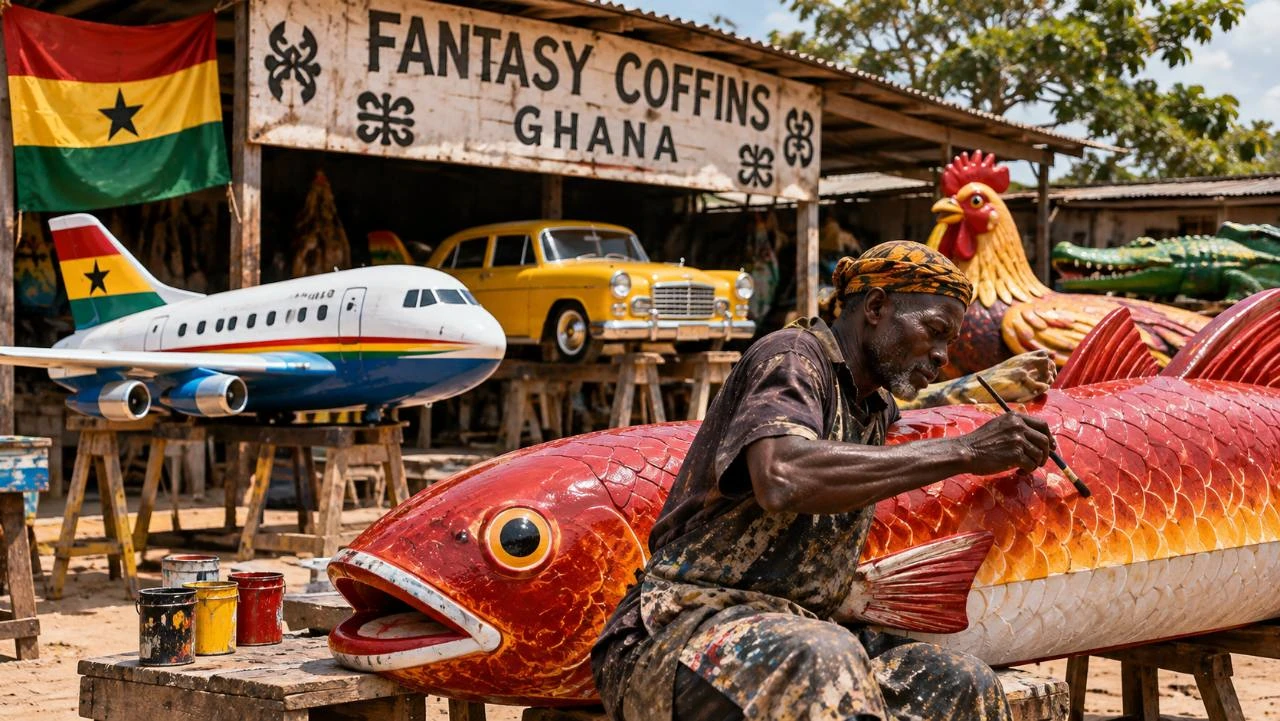
Editorial illustration supplied for PRESDA.
At the University of Cambridge’s Museum of Archaeology and Anthropology, a coffin by the Ghanaian carpenter and sculptor Paa Joe takes the shape of a lion. Its form does something an ordinary rectangular casket rarely asks of a visitor: it invites a question about the relationship between an object and a person. In the coastal towns of Greater Accra, where specialist carpenters make figurative coffins, an animal, a vehicle or a work tool can speak to a family’s memory of the deceased. The design is recognisable from across a room, but its significance may be much more particular than its silhouette. University of Cambridge Museum of Archaeology and Anthropology
The Ga term often given for these coffins, abebuu adekai, is commonly translated as “boxes with proverbs.” The term is a better guide to what they can do than the English label “fantasy coffin” on its own. A wooden fish might refer to an occupation, for example, while another design might express a family association or an aspiration. Neither the craft nor its meanings can be reduced to a fixed menu of occupations. The decisions behind an object belong to the people who commission and make it. University of Cambridge Museum of Archaeology and Anthropology Glasgow Museums
| Documented example | What it helps establish |
|---|---|
| Teshie workshop histories | Kane Kwei and Ajetey appear in an early account |
| 1989 Paris exhibition | Work by Kane Kwei and Paa Joe reaches an international museum audience |
| 2018 collection donation | The Museum for Sepulchral Culture receives 28 coffins |
Why a coffin might look like a fish or a car
Among the Ga communities most closely associated with the practice, fishing, trade and the movement of people and goods have long shaped life on the coast. Some of the best-known coffin forms draw on those familiar worlds. A carpenter can make a vehicle with the outline of a particular make or era, a fruit with a recognisable skin, or a fish whose fins and scales give it away immediately. The point of choosing a familiar form can be to say something particular about the deceased in a language that others understand. University of Cambridge Museum of Archaeology and Anthropology Glasgow Museums Associated Press interviews with Ghanaian coffin makers
Why the same shape can mean different things
A fish can be an obvious reference when mourners know someone made a living on the water. In another setting, the same animal might evoke a place or something that happened to a family. A car might refer to driving as work, the importance of a vehicle to a household or a wish linked to travel. A museum label can propose an interpretation, especially when it has a record of a commission. A viewer who has only the object in front of them should leave room for what the label cannot establish. University of Cambridge Museum of Archaeology and Anthropology Glasgow Museums
This is also why translation matters. A proverb does not always mean what its individual words suggest. The title someone gives to a coffin and an explanation offered by a mourner may tell a reader more than the type of animal or object alone. Workshops can reuse popular shapes, yet an association made at one funeral does not carry over automatically to the next. Even an object that seems humorous to a visitor may be part of a serious act of remembrance.
Who started making figurative coffins?
The safest answer is that several carpenters helped establish the modern practice in the mid-20th century. The Cambridge museum records a widely circulated account in which Seth Kane Kwei and his brother Ajetey made an airplane-shaped coffin for their grandmother in Teshie in the early 1950s. The Smithsonian credits Kane Kwei with helping develop and popularise the form. The Museum for Sepulchral Culture also documents Ataa Oko Addo, a carpenter and palanquin maker whose work complicates the idea of a single inventor. These accounts record different parts of a workshop tradition that was already developing before it became an international art story. University of Cambridge Museum of Archaeology and Anthropology Smithsonian National Museum of African Art Museum for Sepulchral Culture
What palanquins add to the history
A palanquin is a conveyance carried by people. Figurative examples in Ga history help show that sculpting a full-scale shape to carry a body had precedents in local woodworking, ceremony and public display. The relationship between the two forms matters more than the search for an exact birthday for a tradition. Cabinetmakers and other carpenters worked with existing ways of shaping wood, producing recognisable figures and giving objects a role in collective life. Museum for Sepulchral Culture
What the carpenter has to solve
A recognisable object is only one part of the commission. A coffin has to open and close, accommodate the deceased, and be strong enough to move. An exaggerated fin or an aircraft’s wing can give the design away instantly while complicating transport. A maker has to decide where to place a join and how to distribute the weight, as well as how to paint the piece so its identity reads from a distance. The craft sits at the intersection of sculpture and practical carpentry. Museum object records offer clues to construction and materials. A funeral adds a set of practical constraints that an exhibition never has to reproduce. University of Cambridge Museum of Archaeology and Anthropology Smithsonian National Museum of African Art Glasgow Museums
What apprentices learn from commissions
The Cambridge museum identifies Paa Joe as an apprentice of Kane Kwei. In a workshop, an apprentice has to learn how to choose stock, construct the box, fit a lid and finish surfaces, as well as how to listen when a customer describes a person. A workshop that has made a form before may still need to alter its scale or details. This helps explain the tension between assigning an object to a celebrated artist and recognising the contributions of trained assistants and relatives. Collection records may give one name even where the object emerged from several hands. University of Cambridge Museum of Archaeology and Anthropology Glasgow Museums
How the coffins travelled from funerals into museums
The 1989 exhibition Magiciens de la Terre in Paris documented work attributed to Kane Kwei and Paa Joe, including a Mercedes-shaped example. The exhibition is a useful landmark in international reception. Local clients and carpenters had already given the practice a history of its own. Works made for a curator, a collector or a gallery can remain available for study long after a funeral commission would have been buried. That difference affects what researchers can see and what stories they can tell from the surviving objects. Smithsonian National Museum of African Art Centre Pompidou exhibition archive
A museum commission has a different afterlife
The Museum for Sepulchral Culture received 28 figurative coffins associated with Paa Joe’s workshop in a 2018 donation. This is a count of the objects in that donation. It offers a sense of what collecting can preserve while telling us little about the number used in Ghanaian funerals. A curator can display two similarly shaped pieces side by side and record differences in paint and construction. A family choosing one for a burial may care more about a particular person’s connection with the form. Both settings have much to teach, provided the account identifies which one it describes. Museum for Sepulchral Culture
International attention can change how an object is priced, made and described. It can give artists audiences and allow them to develop work for display. It can also lead distant viewers to assume the museum piece describes the use of every comparable object at home. An exhibition record, then, is evidence of a work and of the terms on which it entered an exhibition. It cannot by itself replace a history of the community that uses the form. Museum for Sepulchral Culture Centre Pompidou exhibition archive
What the form still tells us about remembrance
A funeral can bring together people who know quite different parts of a life. Neighbours may remember someone’s work, while relatives recall the habits or stories that mattered at home. A single chosen object offers those people a common point of reference. The trade and museum market have made the designs familiar far beyond Ghana, and recent reporting records how individual Ghanaian carpenters continue to understand them in relation to their customers. Associated Press interviews with Ghanaian coffin makers
The most useful questions are specific. Ask who made the coffin, who commissioned it and where it was intended to go. Ask whether the explanation comes from a family, a carver or a collector. Those answers can explain why one impressive piece is evidence of a funeral tradition and another reveals the development of a sculptor’s work. For another account of how outwardly visible practices depend on materials, skills and family choices, see PRESDA’s feature on the Himba of Namibia.
Why so few early commissions are available to compare
A coffin intended for burial usually leaves a different record from something bought by a collector. Its life outside the workshop may be short, and a photograph may show only the exterior. Family memory can preserve who ordered it and what it meant, even when a researcher cannot inspect the original. The Cambridge lion, by contrast, can be examined for its hinge, lining and paint. Those differences in what survives help explain why accounts of the early workshops can disagree without making either the craft or its local roots doubtful. University of Cambridge Museum of Archaeology and Anthropology Museum for Sepulchral Culture
FAQ
Frequently Asked Questions
What are Ghana’s fantasy coffins called?
The Ga term abebuu adekai is commonly translated as boxes with proverbs.
Who made the first fantasy coffin?
Kane Kwei, Ajetey and Ataa Oko appear in accounts of the early practice. Surviving evidence supports a history of multiple makers.
Are figurative coffins actually used at funerals?
Yes. Ga families have commissioned functional coffins for burial. Other examples have been made for display or collection.
PRESDA Dispatch
Stay Informed. Stay Aware.
A sharp briefing across AI, gaming, sport, business, world affairs, paparazzi, and lifestyle.