GRAFFITI: HOW CITY WALLS BECAME CANVASES
From Cornbread and New York’s subway writers to Banksy and Morocco’s murals: explore graffiti, street art, public space, permission and commercialization.
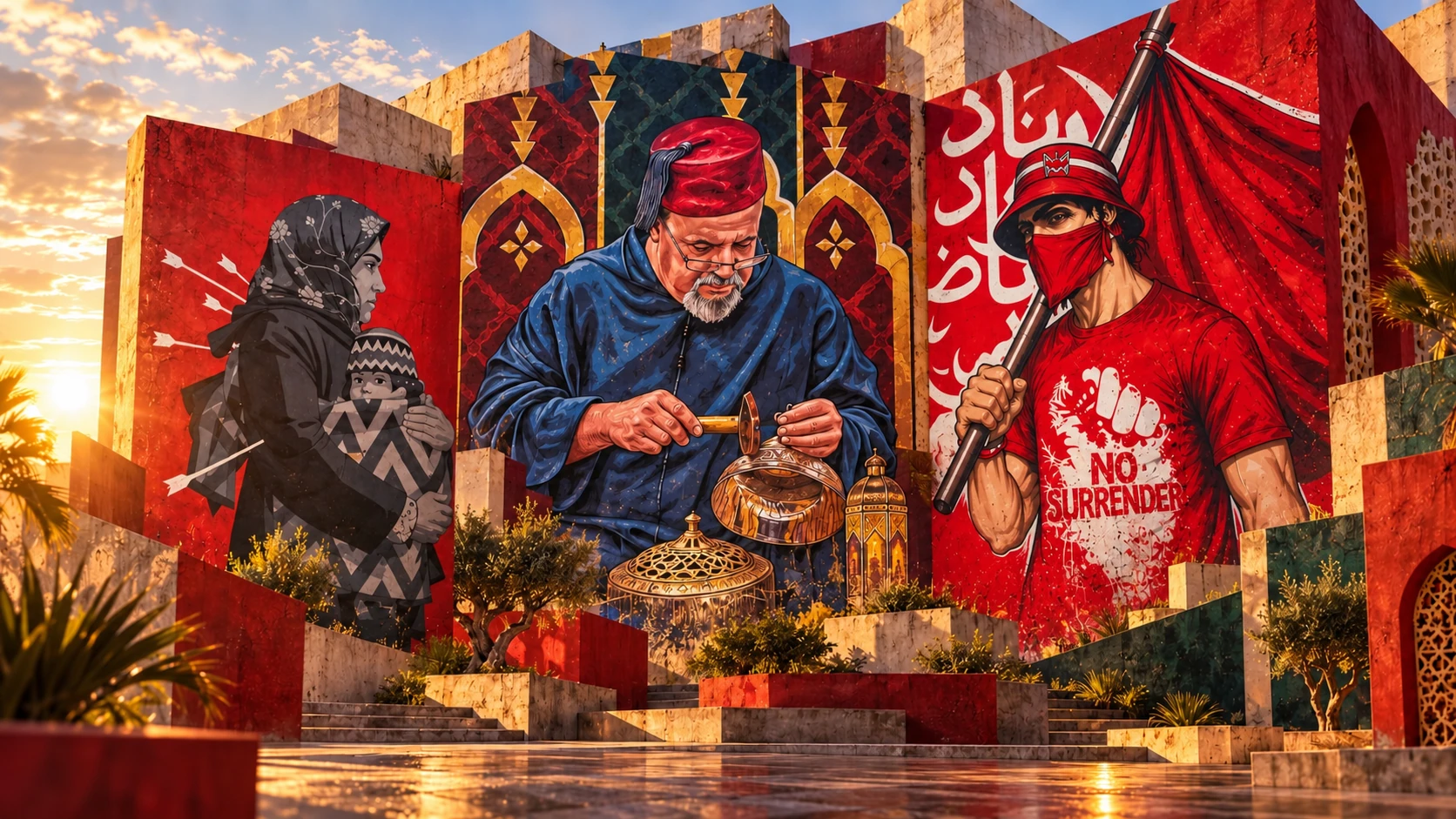
AI-generated editorial illustration supplied for PRESDA. The three murals and plaza are imagined; this is not a photograph of a real Moroccan location or authenticated artworks.
Graffiti turns a surface into a claim to be seen. In its modern name-writing tradition, a signature can be the work itself; in street art, a stencil, pasted image or mural may address anyone passing by. The boundaries overlap, but the terms are not interchangeable. A monumental commissioned painting and an unauthorized tag can share a city without sharing the same purpose, audience or legal status.
Look at a painted building and the ordinary city changes scale. A window becomes part of a face; a blank side wall becomes a landmark; a hurried journey acquires a reason to pause. That encounter explains the attraction of murals, but it also opens a harder question: who gets to decide what a shared streetscape says? The history of graffiti is a history of style and visibility, and of arguments about ownership, permission and belonging.
Philadelphia and New York: writing a name into the city
Writing on walls is ancient. The specific culture of modern graffiti writing developed much later, with Philadelphia and New York central to its emergence. Darryl McCray, known as Cornbread, was a pioneering Philadelphia name-writer in the 1960s. STRAAT Museum traces his practice to 1965. Calling him a pioneer of modern tagging is more accurate than claiming that he invented every form of graffiti. STRAAT Museum: Cornbread
In New York, TAKI 183 became a conspicuous early example of the name-and-number tag. A New York Times profile published on July 21, 1971 brought his writing to a wider public. Visibility was the point: the repeated name allowed an otherwise unknown young person to become recognizable across an enormous city. The attention helped make tagging a public conversation, but one celebrated writer should not stand in for all the people developing the culture. The 1971 TAKI 183 profile
Subway trains gave writing a moving audience. Competition encouraged larger letters, distinctive outlines, inventive colour combinations and elaborate compositions. Haverford College’s All Big Letters exhibition places photographs of 1970s train paintings alongside later Philadelphia writing, emphasizing a continuing practice rather than a vanished prehistory of gallery art. A tag is not simply an unfinished mural: economy, rhythm and recognizability can be its artistic goals. Haverford: All Big Letters
Graffiti, street art and murals: a useful distinction
A tag is a writer’s signature, often made with marker or spray paint. A throw-up generally uses quickly executed outlined or filled letters; a piece, shortened from masterpiece, develops lettering into a more elaborate composition. Wildstyle describes complex, interlocking letterforms that may be difficult for outsiders to decipher. These terms describe practices within a culture, not a universal ranking of artistic quality.
Street art is a broader and contested category that can include stencils, pasted posters, stickers, installations and figurative wall paintings. A mural is defined by its relationship to a wall or similar architectural surface; it need not originate in graffiti culture. Brushwork and rollers can matter as much as aerosols. A stencil repeats an image through cut openings, while freehand painting places more of the drawing directly in the artist’s movements. Neither technique determines whether the work was authorized.
The distinction also changes how we look. A writer may address other writers through a difficult letterform; a muralist may seek immediate recognition from a whole neighbourhood. Neither audience is inherently more legitimate. Treating every colourful wall as graffiti erases mural traditions, while treating only sanctioned pictures as art can erase the skills and history of writing.
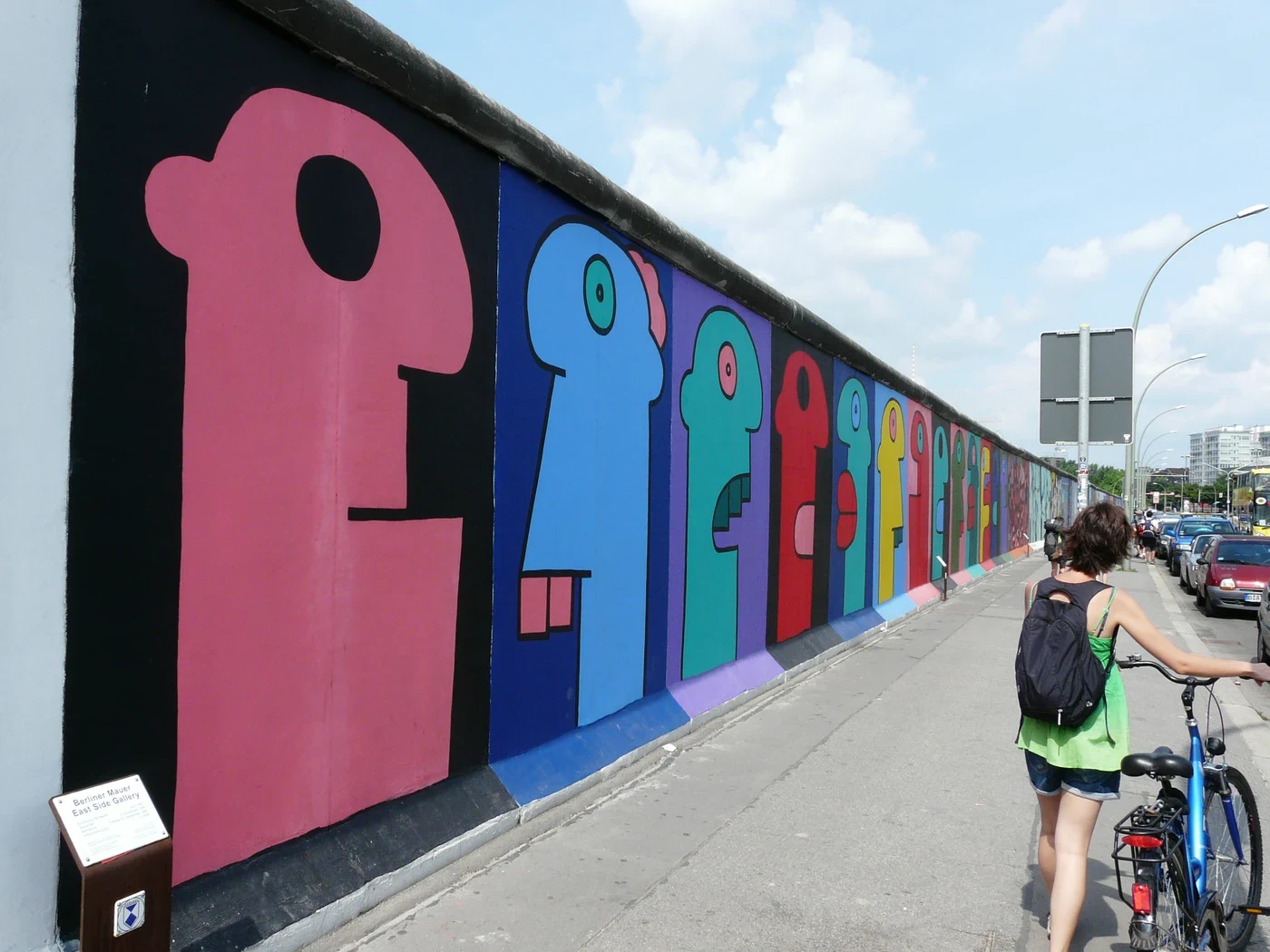
Thierry Noir’s Hommage to the Young Generation at Berlin’s East Side Gallery, photographed on July 28, 2010.
Artwork: Thierry Noir. Photograph: Gonzalo Malpartida
CC BY-SA 2.0. Resized and converted to WebP by PRESDA. Full composition preserved. Photo derivatives retain the stated license. Artwork reproduction: German UrhG §59.
Haring and Basquiat: parallel routes, not identical careers
Keith Haring began drawing in chalk on black paper covering unused New York subway advertising panels in 1980. His simplified figures and energetic lines brought drawing into commuters’ daily routines. This was not the same practice as painting a name across a train: the surface, audience and visual language were different. Arcadia University: Haring’s subway drawings
Jean-Michel Basquiat’s early public writing included SAMO, a collaboration with Al Diaz. The National Gallery of Victoria describes their politically charged and poetic texts on New York walls in 1978. Basquiat’s later painting cannot be reduced to a street tag; words, anatomy, history and power became parts of a much wider pictorial language. NGV: Haring and Basquiat exhibition research
Their careers complicate a convenient success story in which street work supposedly becomes valuable only after entering a gallery. Public visibility already had value. Museums changed the conditions of viewing and ownership, but did not retrospectively create the original encounter. Readers interested in another uneasy relationship between artistic reputation and recognition can explore our biography of Vincent van Gogh, whose very different career also resists a simple market-based definition of achievement.
Banksy and the problem of moving a wall into a museum
Banksy brought street imagery into an unusually visible relationship with museums and the art market. Bristol Museum & Art Gallery hosted Banksy versus Bristol Museum in 2009. Another work, the Grim Reaper painted on the Thekla ship, was removed for conservation after weathering and later displayed at M Shed. Its journey shows how a work attached to a particular site can become a protected, movable object. Bristol Museums: the Grim Reaper
That transformation is not neutral. Conservation can rescue a deteriorating painting, but removing a work also changes who encounters it and what surrounds it. A political image on a working street does not mean exactly the same thing behind a museum label. Attribution matters too: a familiar stencil aesthetic is not sufficient evidence that a picture is by Banksy, and this feature does not treat internet guesses about authorship as established facts.
When architecture becomes part of the picture
Monumental murals require a different kind of planning from a quick signature. Artists must consider the wall’s condition, access equipment, weather, the view from a distance and how windows or pipes interrupt a design. A successful composition can make these constraints feel intentional. Victor Ash’s astronaut mural in Berlin, photographed below, uses the scale of a building to turn a single figure into a striking urban presence. Photograph and artwork attribution
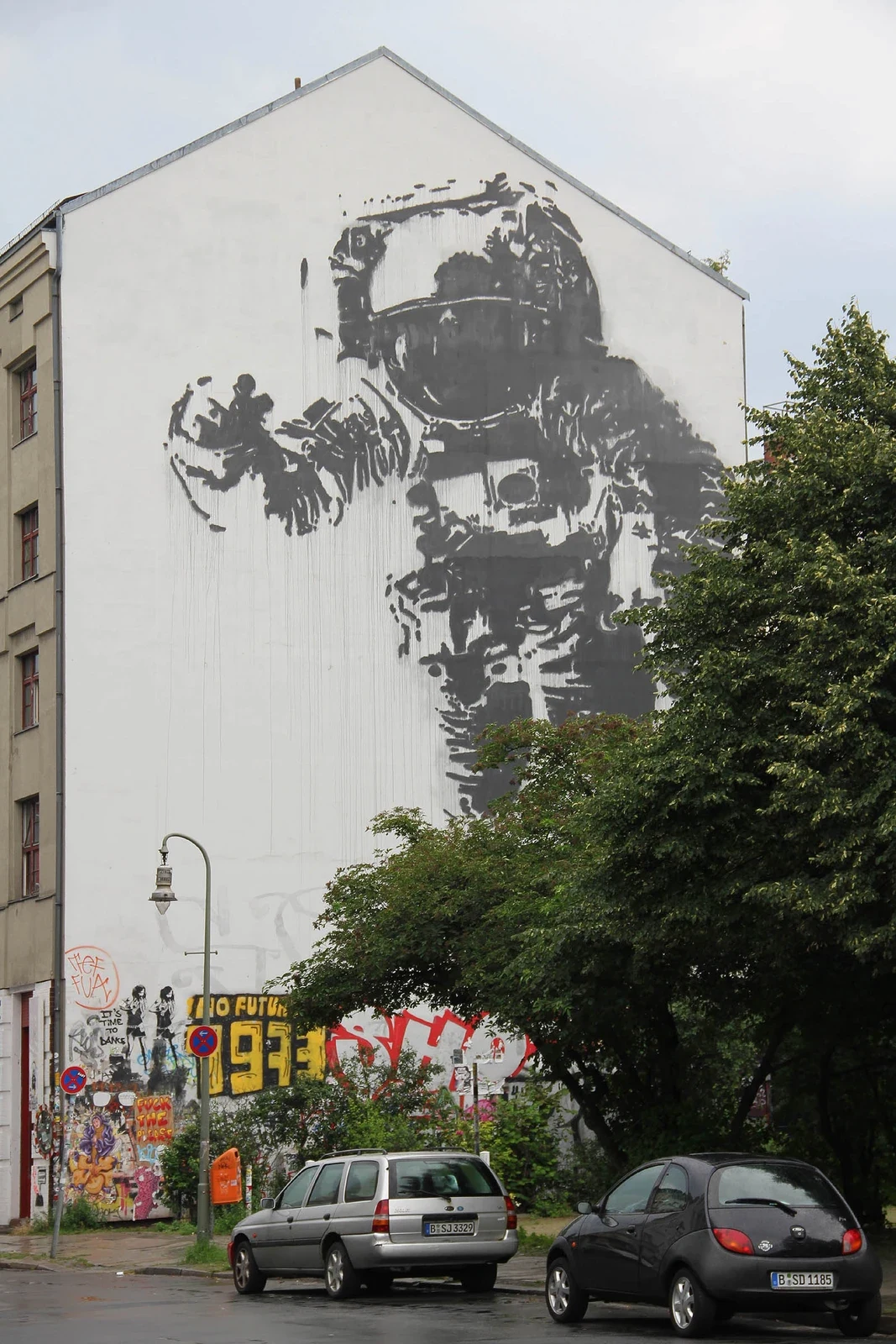
Victor Ash’s astronaut mural (2007) in Berlin-Kreuzberg, photographed on August 5, 2012. The surrounding building and street remain visible.
Artwork: Victor Ash. Photograph: Kamahele
CC BY-SA 3.0. Resized and converted to WebP by PRESDA. Full composition preserved. Photo derivatives retain the stated license. Artwork reproduction: German UrhG §59.
Changing appearance is not the same as solving a neighbourhood’s problems. A mural can help people recognize a place, remember a local figure or meet around a shared project. Claims that it automatically reduces crime, increases prosperity or represents every resident require evidence. Consultation, fair artist payment, maintenance and the ability to disagree matter as much as an attractive unveiling photograph.
Philadelphia offers a revealing institutional example. Its Anti-Graffiti Network began in 1984; Jane Golden joined an initiative that developed training and community art opportunities for young people. Mural Arts grew from that history. The relationship between graffiti removal and mural production was therefore intertwined, not simply a battle between two unrelated worlds. Mural Arts Philadelphia: institutional history
Morocco: Rabat’s walls and Casablanca’s creative networks
Morocco’s scene deserves more than the label of an imported trend. Rabat’s Jidar festival began in 2015 and brings Moroccan and international artists into the city’s architectural landscape. Its programme includes mural-making and ways for the public to encounter the works. The festival’s own account is useful evidence of its intentions; it is not independent proof that every resident experiences its effects identically. Jidar: the festival’s history and purpose
Casablanca has its own trajectory. Sbagha Bagha dates its activity to 2013 and describes a programme combining large murals with graffiti battles, workshops and other cultural events. The city’s official cultural material also documents the Casamouja initiative and artists including Rebel Spirit and Kalamour. Together these records show an ecosystem of local artists, organizers and public presentation, not a single uniform Moroccan style. Sbagha Bagha WeCasablanca: urban art
These projects invite questions about how contemporary painting speaks to local architecture, languages and everyday life. A neighbourhood portrait, abstract lettering and a visiting artist’s composition need not tell the same story. Nor should an editorial illustration be used as documentary evidence: the three-mural hero supplied for this article is an AI-generated imagined scene, not a photograph of Rabat, Casablanca or an authenticated set of Moroccan artworks. The supporting photographs are identified by their actual locations and artists.
Walls as political speech and public memory
A wall can carry an argument beyond the people who already agree with it. Images may commemorate a death, challenge authority, celebrate an identity or invite solidarity. Yet meaning depends on context: the same symbol can comfort one viewer and exclude another. Social commentary is an artistic possibility, not a quality automatically possessed by every piece of street art.
Berlin’s East Side Gallery makes the relationship between surface and history unusually visible. Artists painted the surviving Wall section in 1990, after the border opened. The Berlin Wall Foundation describes works addressing political transformation and memories of division. The material boundary itself participates in the meaning; this is not simply a row of pictures that would communicate identically on any wall. Berlin Wall Foundation: the outdoor exhibition
The photographs in this feature document later appearances of works by Thierry Noir and Birgit Kinder. They are not photographs of the artists painting in 1990. That distinction matters because outdoor works weather, are restored and sometimes repainted. A dated photograph records one condition of a work, not an eternal original state.
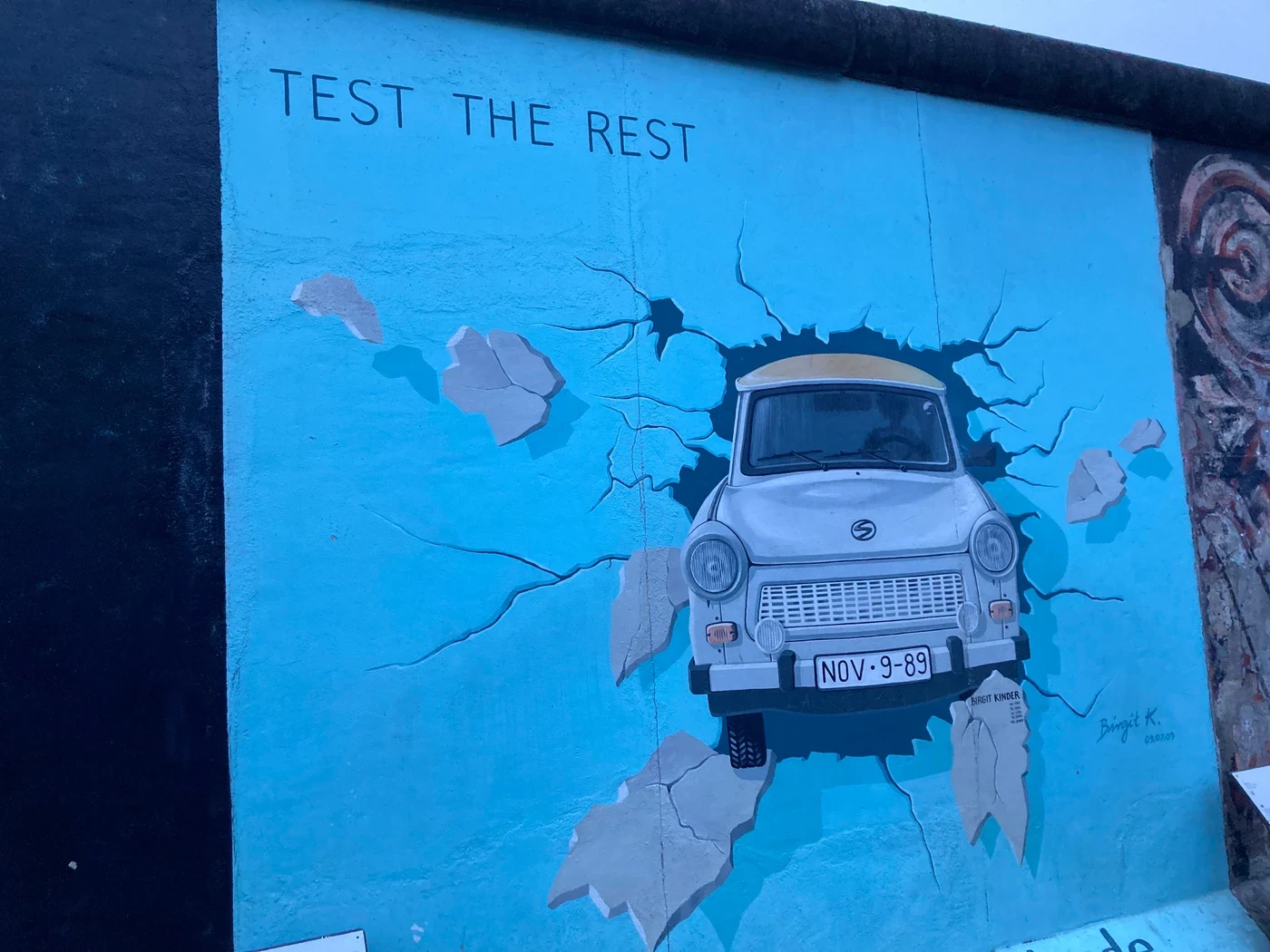
Birgit Kinder’s Test the Rest at Berlin’s East Side Gallery, photographed on December 27, 2023. This records a later appearance of the mural, not its original painting in 1990.
Artwork: Birgit Kinder. Photograph: Schokifaktor
CC BY 4.0. Resized and converted to WebP by PRESDA. Full composition preserved. Photo derivatives retain the stated license. Artwork reproduction: German UrhG §59.
Art or vandalism? Permission is a separate question
Artistic merit does not settle ownership or consent. A carefully painted image can still be unwanted by the person responsible for a building; an authorized mural can be artistically weak. Before painting, the relevant owner’s agreement and applicable local requirements need to be established. Rules differ between places, particularly for protected buildings, advertising and public infrastructure. A festival invitation should not be read as permission to paint nearby property.
The public debate also concerns unequal access to visibility. Advertising routinely purchases enormous surfaces, while unsponsored expression can be removed. That contrast is worth discussing without pretending that property damage has no cost. Residents, artists, businesses and authorities can disagree reasonably about which surfaces should change, who pays and whether an image should remain.
Reproducing a mural photograph introduces another distinction: rights in the photograph and rights in the depicted artwork are not necessarily the same. The credited photographs here have Creative Commons licenses; the permanent public works shown in Germany are also covered by Germany’s public-space reproduction provision. That combination should not be assumed for a photograph taken in another country. German Copyright Act, section 59
Galleries, festivals and the price of visibility
Commercialization is not a recent accident. Haring opened his New York Pop Shop in 1986, bringing his imagery to merchandise as well as exhibition spaces. The project made the tension between access and commerce explicit: affordable objects could circulate widely, while the artist’s images also became products. Keith Haring Foundation: Pop Shop
Today, commissions and festivals can provide materials, safe access and paid work. They can also favour images that suit sponsors or photographs over difficult local conversations. A gallery may preserve a writer’s work while changing its audience; a social platform may spread a mural globally while stripping away its location and creator’s name. The useful question is not whether money automatically corrupts art, but who controls the terms and receives the benefit.
What happens after the paint dries?
The future of street art will depend on stewardship as well as new images. Who repairs a damaged wall? Does the artist want a work restored or allowed to disappear? Can residents influence the next commission? Digital archives can preserve a record, but they cannot reproduce the scale, weather and chance encounters of the street. Artificially generated pictures make accurate dates, locations and authorship more important, not less.
City walls became canvases because people found audiences there that other spaces did not offer. Their continuing power lies in that direct encounter: something made by someone interrupts an ordinary route. Looking closely means appreciating the colour and skill while asking whose name is present, whose permission was given and whose city is being pictured.
FAQ
Frequently Asked Questions
What is this PRESDA article about?
From Cornbread and New York’s subway writers to Banksy and Morocco’s murals: explore graffiti, street art, public space, permission and commercialization.
Which category does this story belong to?
This story is part of PRESDA's Lifestyle coverage.
Who published this article?
GRAFFITI: HOW CITY WALLS BECAME CANVASES was published by PRESDA Editorial on PRESDA.
PRESDA Dispatch
Stay Informed. Stay Aware.
A sharp briefing across AI, gaming, sport, business, world affairs, paparazzi, and lifestyle.