VINCENT VAN GOGH: THE TORMENTED GENIUS WHO PAINTED HIS PAIN
Explore Van Gogh’s life, Theo’s support, six masterpieces and artistic legacy through museum records and letters, separating history from myth.
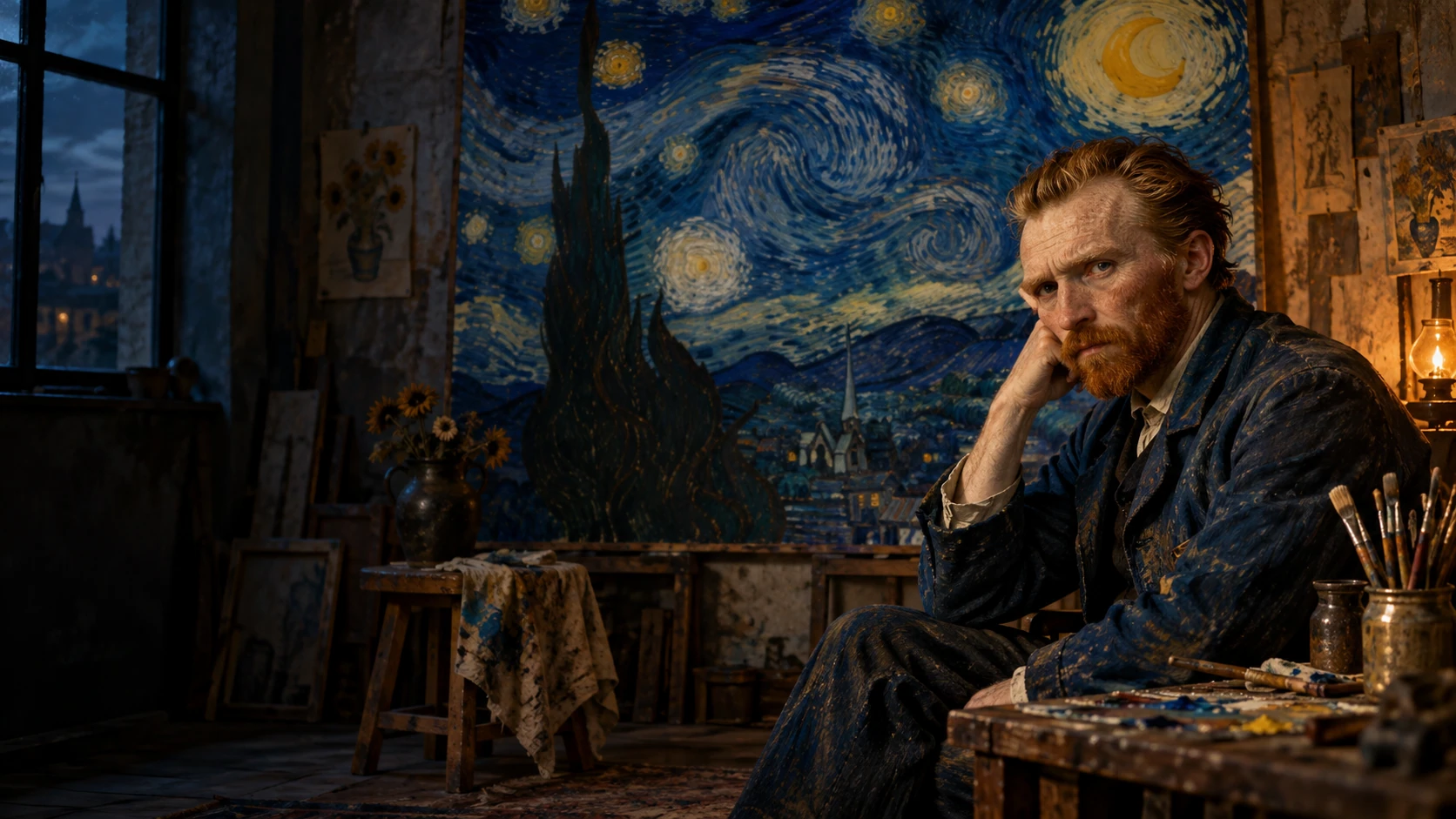
AI-generated artistic illustration supplied for PRESDA. The portrait, studio and presentation of The Starry Night are a reconstruction, not a historical photograph or a reproduction of the original painting. Authentic artworks appear below with individual credits.
In June 1889, while receiving psychiatric care at Saint-Paul-de-Mausole near Saint-Rémy-de-Provence, Vincent van Gogh painted a sky that seems unable to stand still. The stars expand into rings, the hills roll, and a cypress rises above a sleeping village. Yet The Starry Night was not a spontaneous transcription of a hallucination. Observation, memory and deliberate invention meet on its surface. The village was not the view directly outside his window. MoMA: The Starry Night
Van Gogh’s suffering is part of his history, but it is not an explanation sufficient for his art. He studied other painters, argued about colour, revised compositions and described his decisions in letters. To say that he painted his pain is to identify one strand of a much larger life: he also painted companionship, work, gratitude, seasons and the possibility of rest. Illness interrupted that life. It was not a qualification for greatness.
A childhood before the legend
Vincent Willem van Gogh was born on 30 March 1853 in Zundert, in the southern Netherlands, to Protestant minister Theodorus van Gogh and Anna Carbentus. He grew up in a family attentive to religion and nature. Boarding school brought unhappiness, but the museum’s biography cautions against imagining a conspicuous childhood prodigy. His emergence as an artist was neither early nor inevitable. Van Gogh Museum: childhood
At sixteen he entered the art trade with Goupil & Cie. Work took him from The Hague to London and Paris, exposing him to pictures and books long before he became a professional painter. Dismissed in 1876, he tried teaching, worked in a bookshop and pursued religious service. In Belgium’s Borinage mining district he lived among impoverished workers as a lay preacher. His appointment was not renewed. These reversals matter because they reveal a search for useful work, not a man born already inhabiting his final legend. Van Gogh Museum: searching for a direction
Theo, the brother behind the letters
Around 1880, encouraged by Theo, Vincent committed himself to art. Drawing became a discipline rather than an occasional accomplishment. He studied bodies, perspective and everyday labour; in The Hague, Anton Mauve helped him learn watercolour and oils. Theo’s financial support made sustained practice possible. Poverty was real, but the familiar picture of an entirely abandoned artist erases the person who paid for materials and living expenses. Van Gogh Museum: first steps
Their correspondence, beginning in the surviving record in 1872, carries requests for money alongside discussions of exhibitions, family, books and the behaviour of pigments. It records affection and strain, dependence and professional exchange. Theo was an art dealer with responsibilities of his own, not an inexhaustible resource. Reading the letters as working documents restores Vincent’s intellectual agency: he was thinking through what painting could do, not simply pouring undirected emotion onto canvas. Van Gogh Letters: scholarly edition
Learning to see in colour
The dark earth tones of his Dutch period suited an interest in rural labour. The Potato Eaters, completed in 1885, pursued the seriousness of working lives rather than polished elegance. Paris, where he joined Theo in 1886, changed his visual vocabulary. Encounters with Impressionism, Neo-Impressionism and Japanese prints encouraged brighter contrasts, shorter strokes and bolder arrangements. His mature style grew through looking, learning and experiment. Van Gogh Museum: from dark to light
A brushstroke in Van Gogh can describe both an object and the energy of looking at it. Parallel marks turn a field into a moving surface; curved strokes give a face or sky a rhythm. Thick paint, called impasto, catches actual light while representing imagined light. These are artistic choices, not symptoms that a viewer can diagnose. The intensity comes partly from a tension between recognizable things and the conspicuous material used to paint them.
Sunflowers: colour as hospitality
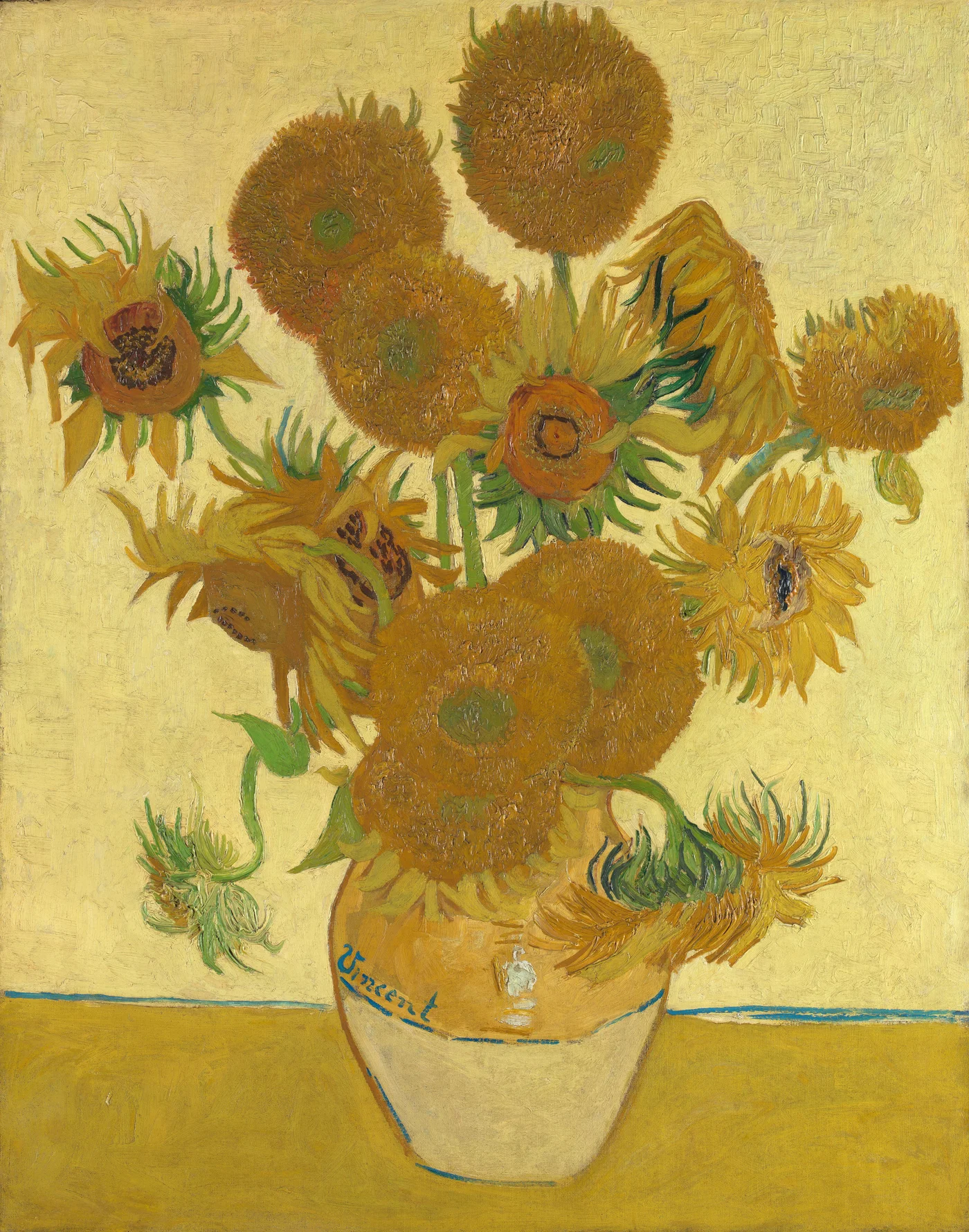
Sunflowers, August 1888. Oil on canvas. National Gallery, London, NG3863; bought, Courtauld Fund, 1924. This is the London version, not one of the later repetitions.
Vincent van Gogh / National Gallery, London / Wikimedia Commons
Public domain. Resized and converted to WebP by PRESDA. Full composition preserved. Reuse follows the individual license stated here.
In February 1888 he moved to Arles. He hoped the Yellow House would become a shared workplace for artists, with Theo helping to sell their work. The Sunflowers paintings belong to this ambition for company. The National Gallery’s version, painted in August 1888, turns a vase of flowers into an exploration of yellow against yellow, with differences in tone and texture preventing the image from dissolving into sameness. National Gallery: Sunflowers
Some heads stand open; others droop or have become seed-heavy. Their variety gives the bouquet duration without requiring every flower to stand for a secret tragedy. The series was associated with the rooms prepared for Paul Gauguin, and with the friendship Vincent hoped would flourish there. There is more than one Sunflowers: dates, versions and collections matter. The authentic painting reproduced here is the London canvas, not a modern imitation or a composite of the series.
The Bedroom: an image of intended rest
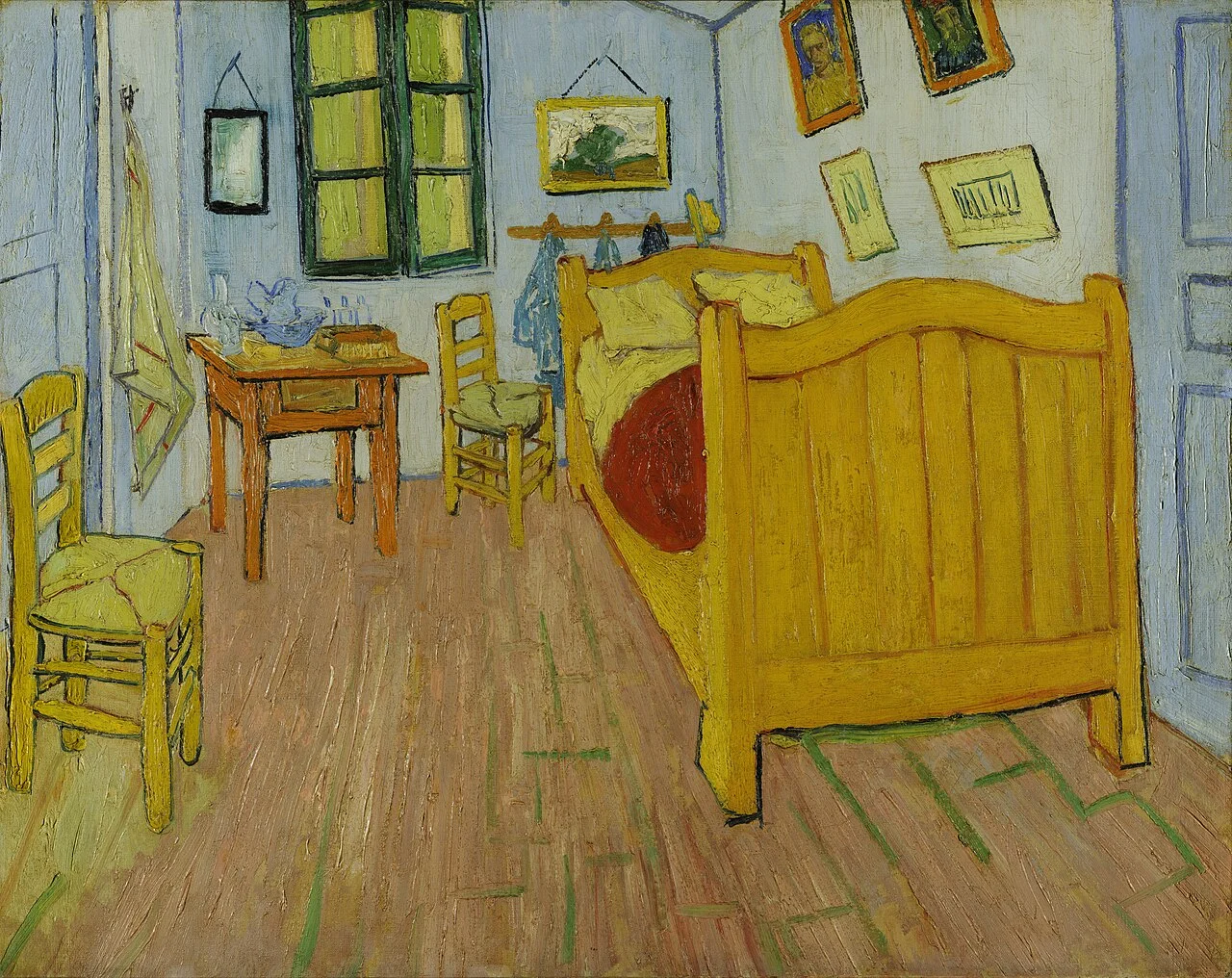
The Bedroom, October 1888, first version. Oil on canvas. Van Gogh Museum, Amsterdam (Vincent van Gogh Foundation), s0047V1962. The original Arles composition, reproduced without cropping.
Public domain. Resized and converted to WebP by PRESDA. Full composition preserved. Reuse follows the individual license stated here.
The Bedroom, painted in Arles in October 1888, makes an ordinary room almost monumental. Bed, chairs, pictures and washstand crowd a tilted space. Its perspective can look unsettled to a modern viewer, but the artist’s own explanation resists an automatic reading of psychological disturbance. In letter 705 to Theo, dated 16 October, he described simplified colour and solid furniture as ways to suggest sleep and repose. Van Gogh Letters: letter 705
That distinction is important: a viewer’s emotional response is not identical to the artist’s stated intention. The letter also describes pale violet walls and lilac doors, reminding us that reproductions and aged pigments do not provide a perfectly transparent window into original colour. The Amsterdam work is the first version; later repetitions should not be silently substituted for it. A small domestic interior can express a wish for stability even when the painter’s circumstances remain fragile. Van Gogh Museum: The Bedroom
Gauguin and the collapse of the shared studio
Gauguin arrived in October 1888. The two painters worked together, discussed admired artists and challenged each other’s methods. Gauguin placed greater weight on memory and invention, while Vincent often insisted on working from what he could see. This was a productive artistic encounter as well as a difficult household. Their disagreements became increasingly bitter; a collaboration intended to counter isolation instead broke down. Van Gogh Museum: Arles
On 23 December 1888, during a severe crisis, Vincent injured his left ear. He was hospitalized, and Gauguin left Arles. The broad event is documented, but reconstructions of every gesture, conversation and motive are not equally secure. It should not be staged as romantic sacrifice or explained by a single quarrel. The Van Gogh Museum notes that recurring attacks followed and that no all-encompassing diagnosis has been established. Van Gogh Museum: the ear incident
Saint-Rémy: painting during treatment
In May 1889 he voluntarily entered Saint-Paul-de-Mausole. He painted the garden, later worked beyond the grounds, and used an additional room as a studio. Periods of illness alternated with periods in which he could work. He also made paintings after prints of admired artists. The institution restricted his life, but it offered a setting in which treatment, routine and artistic activity sometimes coexisted. Van Gogh Museum: hospitalization
No responsible biography can convert this history into proof that mental illness creates artistic talent. Nor should it assign a modern diagnosis from a handful of dramatic episodes. Van Gogh sought relief and feared recurrence. His achievement depended on capacities he continued to exercise when able, with assistance from others. The distinction between suffering and creative work also matters in our exploration of Dostoevsky’s life and artistic achievement: biography illuminates a work without reducing it to a medical case.
Irises: the discipline of attention
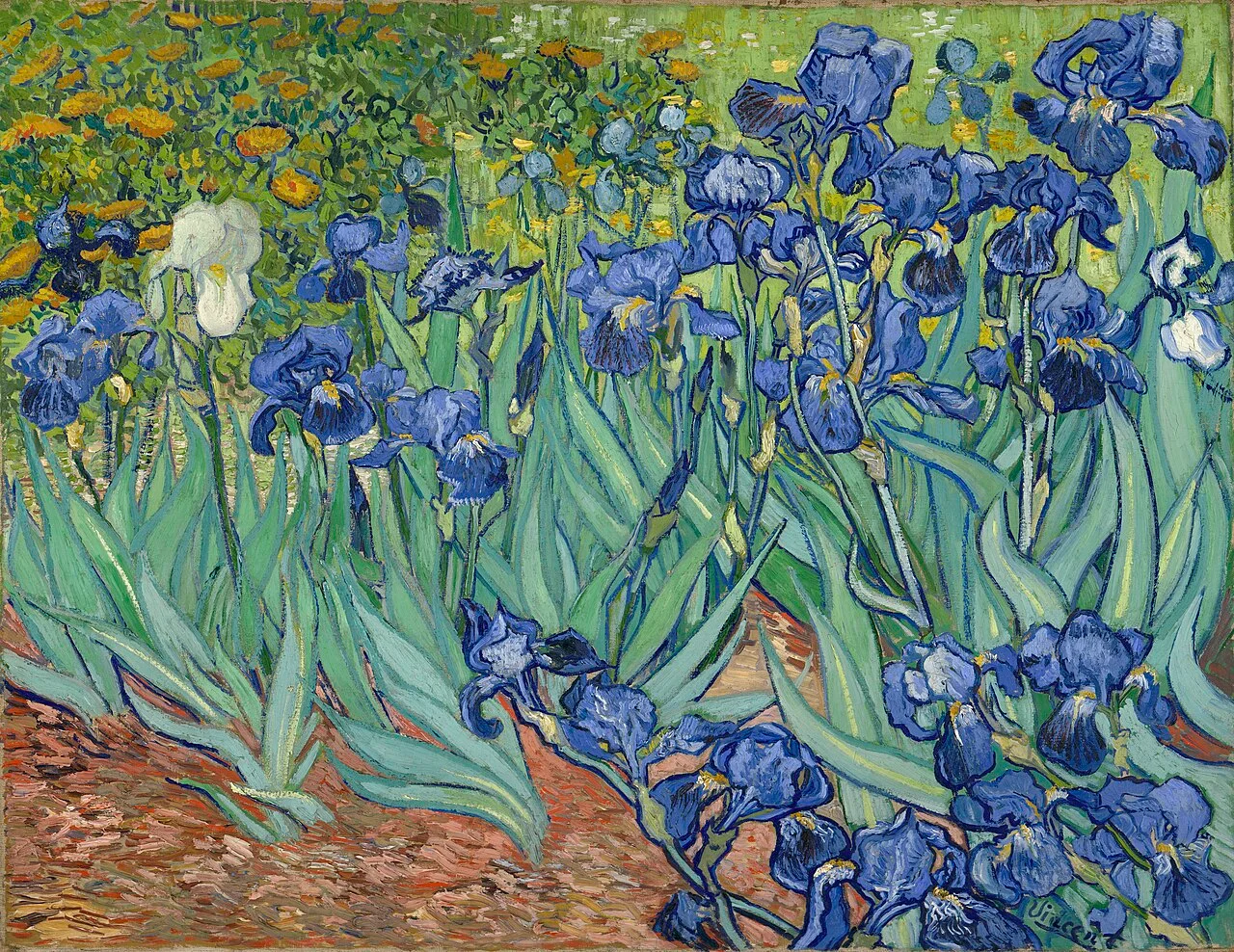
Irises, May 1889. Oil on canvas. J. Paul Getty Museum, Los Angeles, 90.PA.20. Painted at Saint-Rémy; pigment fading has altered some original violet tones.
Vincent van Gogh / J. Paul Getty Museum, Los Angeles / Wikimedia Commons
Public domain. Resized and converted to WebP by PRESDA. Full composition preserved. Reuse follows the individual license stated here.
Irises, painted in May 1889, begins with the hospital garden. Sword-like leaves cross and overlap beneath flowers with distinct shapes; a white bloom interrupts the blue-violet group. It rewards close attention to variety within repetition. The painting is an encounter with plants, space and colour, not evidence that every blossom encodes a particular psychiatric state. Getty: Irises
Getty’s technical research adds another layer. The flowers were originally more violet than their present blue appearance suggests, because some red pigment has faded. Art history therefore depends on chemistry as well as interpretation. A colour that seems to express a timeless emotion may also reflect a material change since 1889. The reproduction here shows the authentic painting as recorded, not a speculative recolouring or an AI-generated reconstruction. Getty: colour research
The Starry Night: invention, not a medical scan
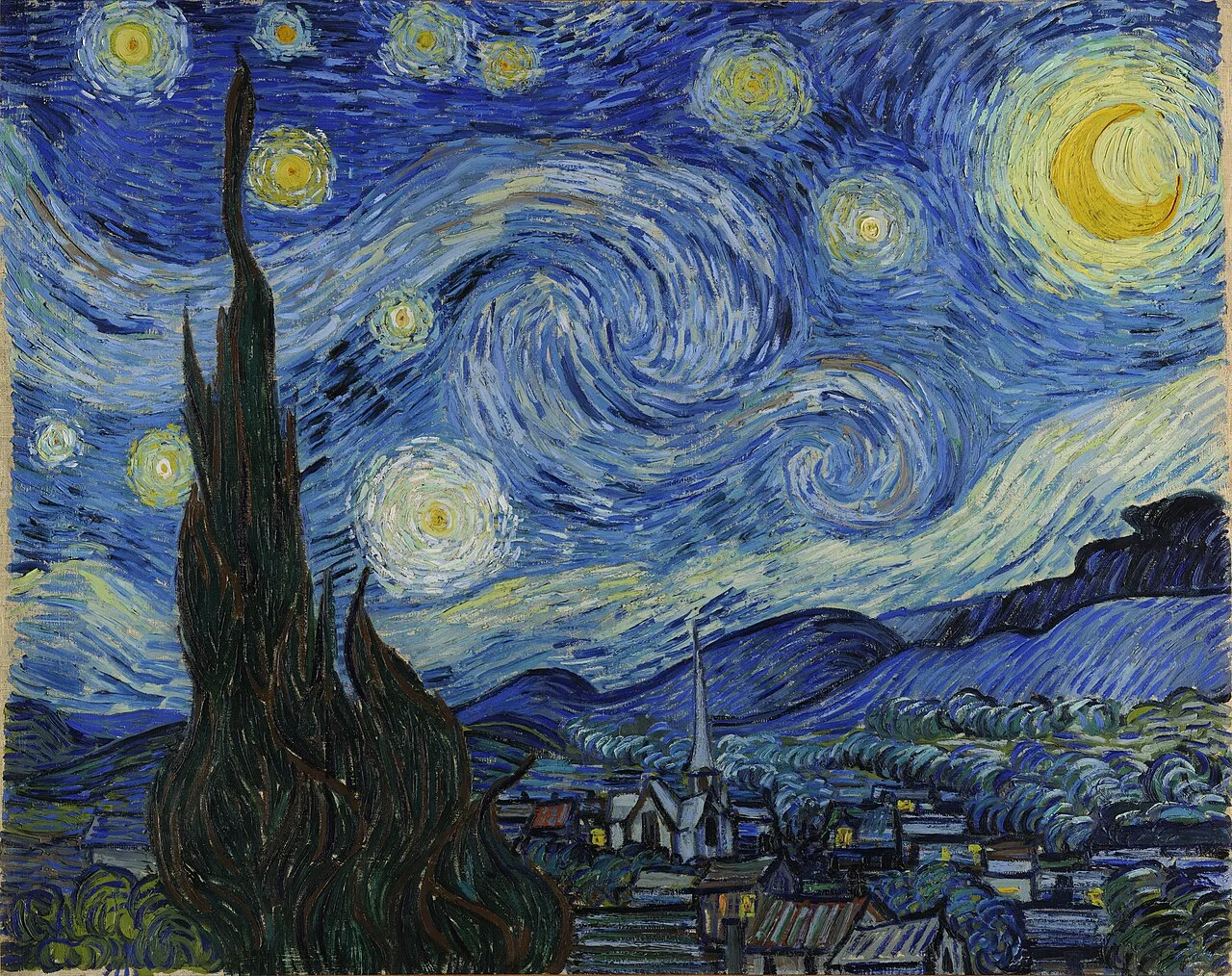
The Starry Night, June 1889. Oil on canvas. The Museum of Modern Art, New York, 472.1941; acquired through the Lillie P. Bliss Bequest (by exchange). Authentic artwork reproduction.
Vincent van Gogh / The Museum of Modern Art, New York / Google Art Project via Wikimedia Commons
Public domain. Resized and converted to WebP by PRESDA. Full composition preserved. Reuse follows the individual license stated here.
The Starry Night, made in June 1889 and now at the Museum of Modern Art in New York, combines a quiet settlement with an expansive, agitated sky. The tall cypress links ground and heavens; the church steeple answers it on a smaller scale. The rhythms make the surface feel mobile while the composition remains carefully organized. This is a reading of visible form, not a claim to know exactly what Van Gogh felt at each stroke.
He worked on the canvas during daylight, drawing on night observations and invention. The village and the enlarged presence of the cypress were compositional decisions rather than a literal record from his room. The painting’s authority lies partly in that transformation: a familiar world becomes strange without becoming unrecognizable. Its whorls cannot establish hallucination, and its beauty cannot make the distress of its maker desirable. MoMA: observation and imagination
Self-portraits: a painter making an image
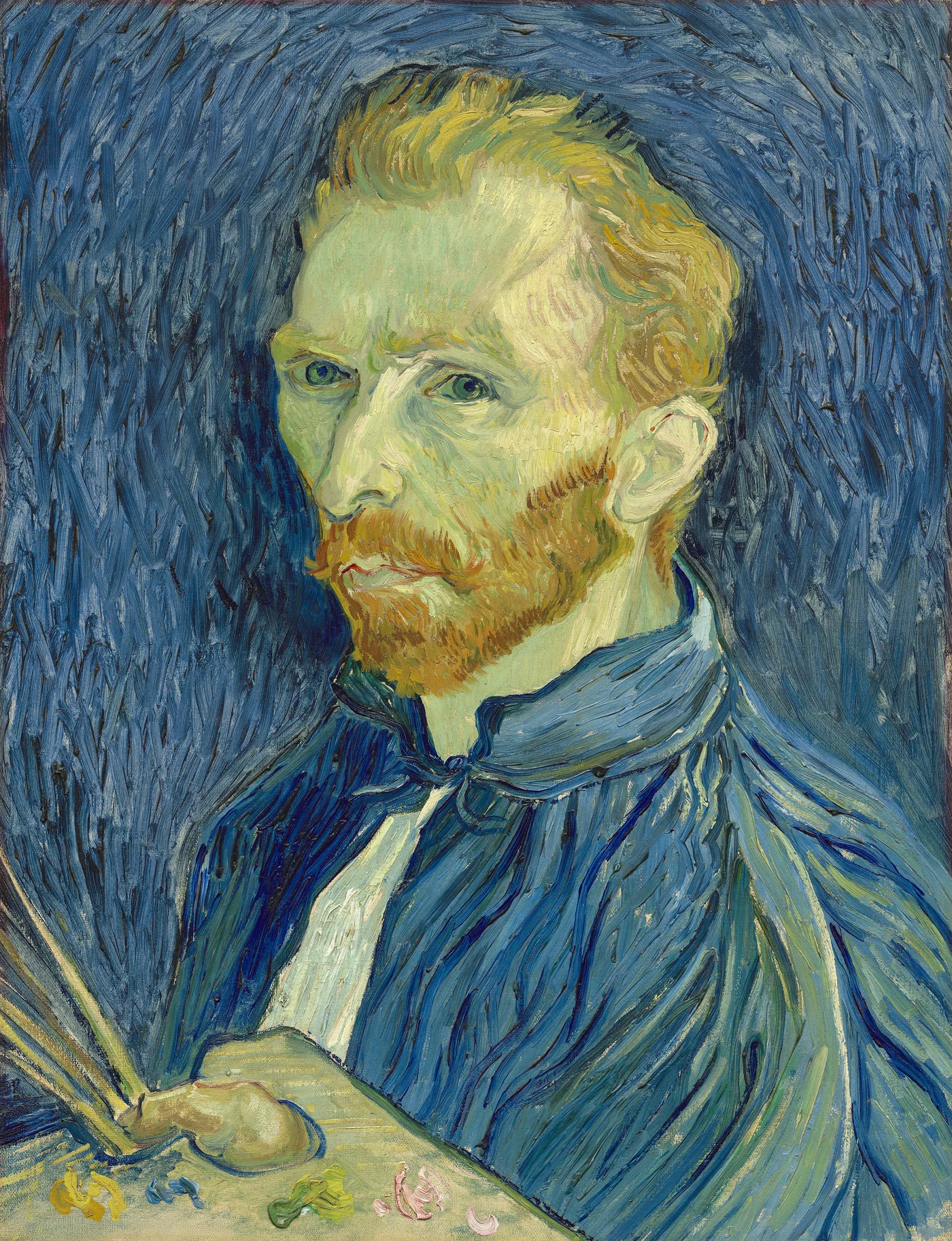
Self-Portrait, 1889. Oil on canvas. National Gallery of Art, Washington, Collection of Mr. and Mrs. John Hay Whitney, 1998.74.5. Van Gogh presents himself with the tools of his profession.
CC0 1.0. Resized and converted to WebP by PRESDA. Full composition preserved. Reuse follows the individual license stated here.
Van Gogh repeatedly used himself as a model, partly because hiring sitters was expensive. These paintings offered a readily available face on which to test colour, contour and brushwork. They are also acts of presentation. Hats, coats, backgrounds and the direction of a gaze change the encounter. A self-portrait is not an unfiltered confession simply because the painter and sitter are the same person.
In the National Gallery of Art’s Self-Portrait of 1889, he presents himself with palette and brushes. Warm beard and face stand against a blue-violet field; the tools insist on his identity as a working artist. The image belongs to his Saint-Rémy period. It can be discussed in relation to illness and recovery without treating its colours as a diagnostic code. Professional purpose is visible alongside vulnerability. National Gallery of Art: Self-Portrait
Auvers and Wheatfield with Crows
In May 1890 Van Gogh left Saint-Rémy for Auvers-sur-Oise, close enough to Paris for contact with Theo and his family. Dr Paul Gachet, who also made art, became involved in his care. Vincent painted houses, gardens, portraits and fields with extraordinary concentration. Productive work did not mean that every danger had passed. His letters and the museum’s chronology record continuing concerns about health and financial security. Van Gogh Museum: final months
Wheatfield with Crows, painted in July 1890, spreads across an unusually wide canvas. Dark birds punctuate a heavy blue sky; paths cut into yellow grain. It is often made to bear the entire burden of the artist’s death. Yet the Van Gogh Museum explicitly rejects the familiar claim that this was his last painting. He made other works afterward. A dramatic landscape is not a dated farewell note, and a crow is not proof of an intention. Van Gogh Museum: Wheatfield with Crows
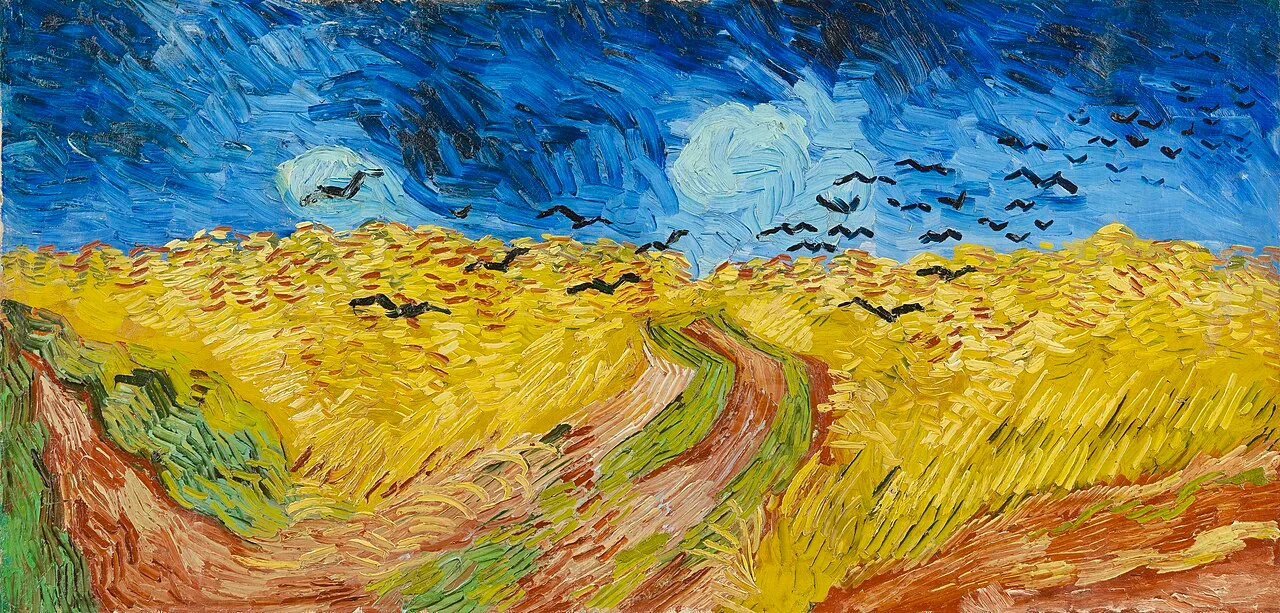
Wheatfield with Crows, July 1890. Oil on canvas. Van Gogh Museum, Amsterdam (Vincent van Gogh Foundation), s0149V1962. This was not Van Gogh’s last painting. Digital reproductions may differ in colour from the original.
Vincent van Gogh / Van Gogh Museum, Amsterdam (Vincent van Gogh Foundation) / Wikimedia Commons
Public domain. Resized and converted to WebP by PRESDA. Full composition preserved. Reuse follows the individual license stated here.
His own writing resists a single emotional label. In letter 898, around 10 July, he associated large wheatfield pictures with sadness and loneliness, but also described the countryside as strengthening. Despair and consolation could coexist in his account. Recognizing that complexity is more faithful to the evidence than turning every late canvas into a clue leading inevitably to death. Van Gogh Letters: letter 898
Death without the mythology
Van Gogh died in Auvers on 29 July 1890, aged thirty-seven, two days after a gunshot injury. Theo was with him at the end. The Van Gogh Museum’s account identifies his death as suicide. Alternative stories have attracted attention, but should not be reported as established corrections to the historical record. Nor can the full causes of his death be reduced to money, rejection, a painting or one relationship.
The tragedy is the loss of a person, not a necessary final act completing a masterpiece. His death did not validate his art, and the paintings do not justify the suffering he endured. An evergreen biography should leave space for uncertainty without turning uncertainty into conspiracy, and for grief without making an early death seem artistically inevitable.
How recognition was built
He was not wholly unknown while alive. Work appeared in exhibitions, the critic Albert Aurier praised him, and The Red Vineyard sold at the Brussels Les Vingt exhibition in 1890. That documented sale should not be inflated into a sweeping claim that no other transaction or commission ever occurred. His commercial success remained limited, but emerging recognition and financial hardship could exist at the same time. Van Gogh Museum: early appreciation
Theo died in January 1891. His widow, Jo van Gogh-Bonger, became central to preserving the collection, arranging loans and encouraging knowledge of Vincent’s work. Her edition of the brothers’ letters appeared in 1914. Later, her son Vincent Willem helped secure the collection’s institutional future; Amsterdam’s Van Gogh Museum opened in 1973. Fame was built through decisions, advocacy and access, not simply discovered by an anonymous world that suddenly changed its mind. Van Gogh Museum: after his death
A legacy larger than pain
Van Gogh helped expand what colour and a visible brushstroke could communicate. His example mattered to the expressive departures of twentieth-century painting, including Expressionism and Fauvism. Yet his work also remains rooted in recognizable subjects: a chair, a room, a worker, a flower. The Metropolitan Museum situates his career within this development of modern art, rather than treating him as an isolated exception outside history. The Met: Vincent van Gogh
The Kröller-Müller Museum’s Terrace of a Café at Night, painted in 1888, offers a useful counterweight to the tragic stereotype: artificial light, open-air sociability and night-time colour are also part of his world. Collections preserve many Vincents, not just the solitary figure popular culture selects. Looking across them reveals ambition, curiosity and a sustained effort to make ordinary things visually consequential. Kröller-Müller Museum: Café Terrace
The cinematic image at the top of this article is an artistic illustration, including its presentation of The Starry Night. The six supporting artworks are authentic reproductions, individually identified and credited. This distinction belongs to the broader question of photography and visual authenticity: an evocative image can introduce a story without serving as historical evidence for it.
To return to Van Gogh after the legend is to encounter a maker of pictures who wanted his work to mean something to other people. He painted suffering, but also the prospect of shelter, the dignity of labour and the persistence of growing things. His legacy asks us to look more carefully. It does not ask anyone to suffer in order to create.
FAQ
Frequently Asked Questions
What is this PRESDA article about?
Explore Van Gogh’s life, Theo’s support, six masterpieces and artistic legacy through museum records and letters, separating history from myth.
Which category does this story belong to?
This story is part of PRESDA's Lifestyle coverage.
Who published this article?
VINCENT VAN GOGH: THE TORMENTED GENIUS WHO PAINTED HIS PAIN was published by PRESDA Editorial on PRESDA.
PRESDA Dispatch
Stay Informed. Stay Aware.
A sharp briefing across AI, gaming, sport, business, world affairs, paparazzi, and lifestyle.