WHEN HIPPOS ROAMED SAUDI ARABIA 125,000 YEARS AGO
Fossils at ancient Lake Mundafan reveal a wetter Saudi Arabia about 125,000 years ago. Explore the hippos, human activity and limits of the new study.
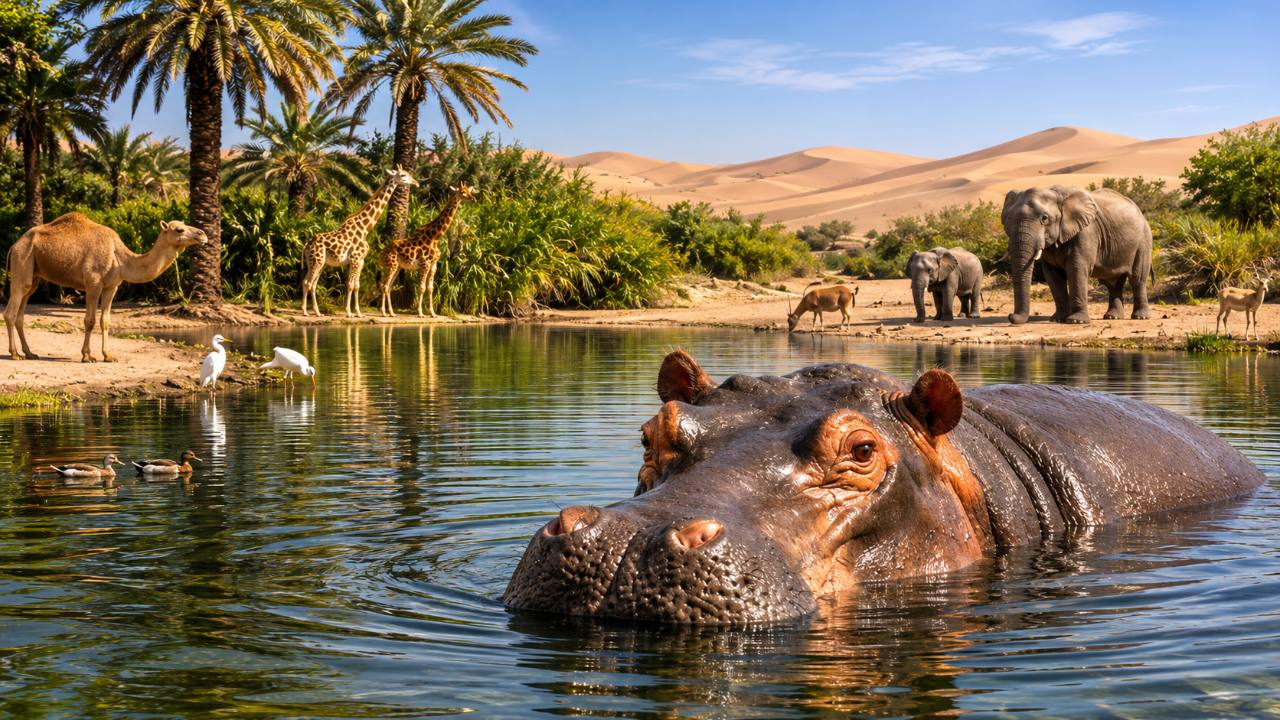
Supplied artistic reconstruction, preserved unchanged. The animals pictured are not a verified species inventory of the Mundafan site.
Hippos lived in the landscape that is now southern Saudi Arabia during a wetter period around 125,000 years ago. At Uruq Aljelibah, beside the vanished Lake Mundafan, fossils and lake deposits record freshwater and productive habitats where today’s Empty Quarter offers a radically different view. A new Science study published on November 12, 2026 places those animals alongside evidence of human activity. Clarkson and colleagues, Science, November 12, 2026: original Mundafan study Saudi Press Agency, November 13, 2026: Heritage Commission findings
The finding is not evidence that modern hippos have suddenly appeared in the Saudi desert. Nor does it turn the whole peninsula into one uninterrupted prehistoric jungle. Its significance is more precise: a dated lakeshore preserves an unusually rich combination of animals, plants, stoneworking and possible hunting technology. Read together, those traces reveal a living landscape rather than an isolated fossil curiosity. KAUST, November 13, 2026: the Mundafan lakeside reconstruction
The site and the scale of the evidence
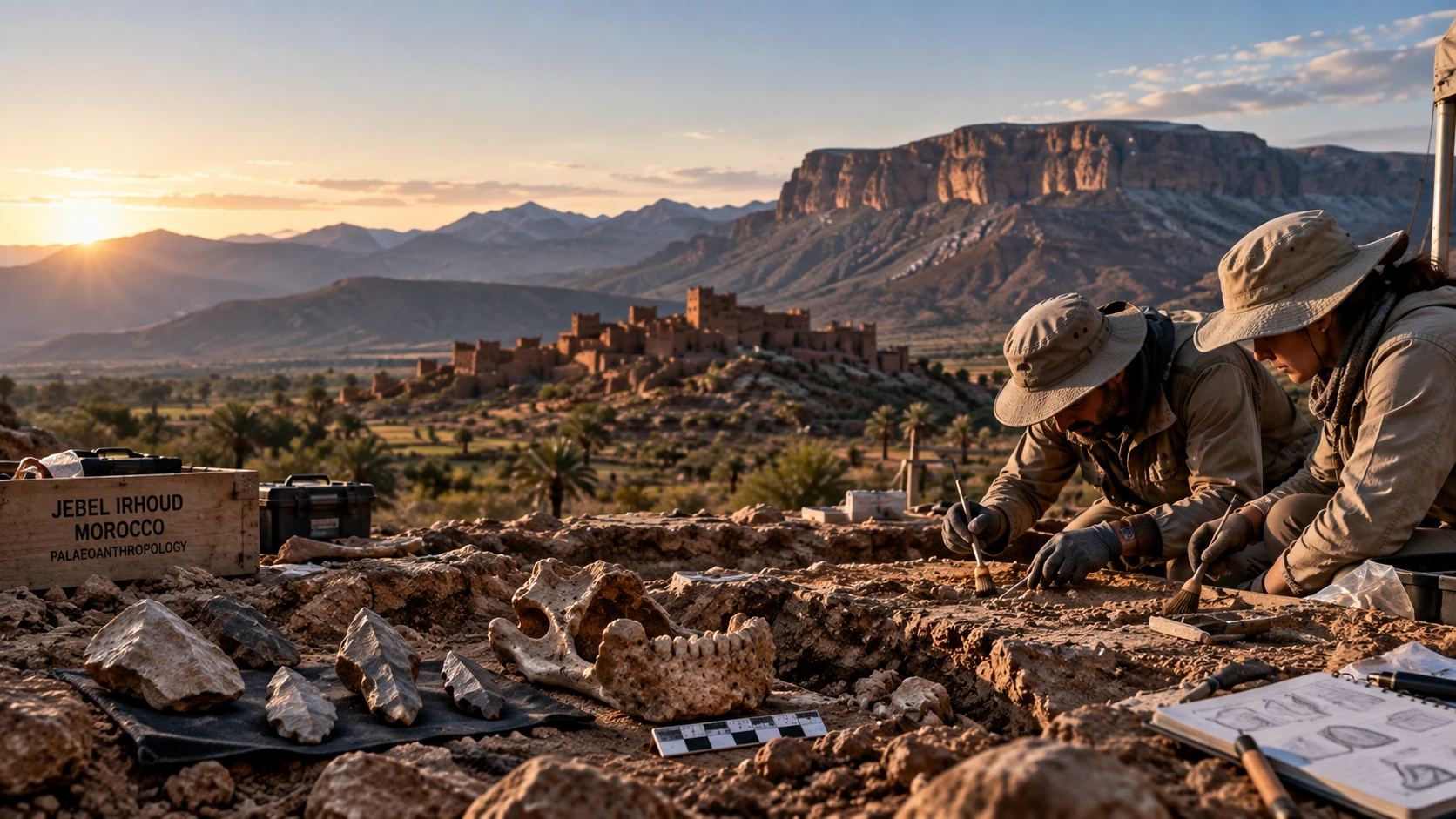
The Heritage Commission’s account locates the site in the Najran region and describes a multidisciplinary project with Griffith University, KAUST and other institutions. Its counts cover an entire assemblage, including small aquatic organisms and plant remains. More than 500 fossils does not mean more than 500 hippopotamuses, just as thousands of stone pieces do not represent thousands of individual toolmakers. Saudi Press Agency, November 13, 2026: Heritage Commission findings
| Evidence | What the study reports |
|---|---|
| Setting | Uruq Aljelibah on the former Mundafan lakeshore, southern Saudi Arabia |
| Age | Approximately 125,000 years; not an exact calendar date |
| Reconstructed lake | About 340 km², maximum depth about 29 m |
| Fossil record | More than 500 plant and animal fossils across over 130 locations |
| Stone assemblage | 5,511 artifacts larger than 2 cm in the primary study area |
A freshwater lake inside today’s Empty Quarter
The researchers reconstructed a lake of approximately 340 square kilometers with a maximum depth near 29 meters. These are estimates of an ancient basin at a particular lake phase, not measurements of water still present today. Shoreline geometry, sediment layers and freshwater organisms contribute different kinds of evidence. Their agreement is more informative than the dramatic contrast between a modern dune and an imagined oasis. University of Liège repository: full original Science paper Saudi Press Agency, November 13, 2026: Heritage Commission findings
Water changes the geography of opportunity. A dependable lake concentrates drinking places, grazing areas and useful plants within reach of a shoreline. For people, that can mean food, raw materials and a place to return rather than a barrier to cross as quickly as possible. The study authors’ explanation emphasizes this combination of resources. It does not require imagining a settled farming village or a modern-style permanent community. University of Queensland: study authors explain Green Arabia
Green Arabia was a mosaic, not a uniform rainforest
The paper situates Mundafan within alternating humid and arid phases of the Pleistocene. It also stresses that wetter conditions were geographically uneven. A lake basin depends on its catchment, topography and water supply; favorable conditions in one place do not prove identical conditions hundreds of kilometers away. Green Arabia is therefore a useful shorthand for changing habitats, not a claim that every desert surface became the same ecosystem at the same moment. University of Liège repository: full original Science paper
What the hippos and their neighbors reveal
Hippos are especially revealing because their presence belongs in a discussion of available water, not just unusual wildlife. The study reports Hippopotamus amphibius together with extinct long-horned buffalo, camel, oryx, gazelle and ostrich remains. That mixture links aquatic margins to open terrestrial habitats. A fossil assemblage can therefore describe connections between environments rather than one photograph-like scene in which every animal stood together. University of Liège repository: full original Science paper
The distinction matters when reading fossil counts. Several fragments may come from one animal, and a collection can accumulate over time. The presence of teeth, bones, shells and plant traces is not a ready-made population estimate. Researchers examine how material was deposited, moved, exposed and preserved before interpreting behavior. A headline about hippos is an entry point into that work, not a substitute for it.
How old is the lakeshore?
Approximately 125,000 years is a reconstructed chronology with uncertainty, not a date stamped on a fossil. The paper combines sediment dating by optically stimulated luminescence with other geological evidence. It also reports U-series and electron spin resonance results from two hippo teeth that agree with the wider chronology within methodological uncertainties. Multiple approaches can test the same reconstruction without producing an identical number for every sample. University of Liège repository: full original Science paper
Independent scrutiny is particularly important for the stone tools. In Live Science’s reporting, archaeologist Jeffrey Rose cautioned that surface-collected artifacts are not equivalent to tools excavated from a sealed dated layer. That qualification concerns how confidently individual objects can be assigned to a particular episode. It should neither be hidden nor distorted into a claim that all the environmental evidence has been disproved. Live Science, November 12, 2026: researchers and independent dating caveats
Stoneworking and the possibility of complex hunting
The Heritage Commission reports 5,511 stone artifacts larger than two centimeters in the main study area, overwhelmingly made from flint. The researchers identify Levallois methods, in which a core is prepared to control the form of the flake or point removed from it. Refitting pieces helps investigate production on site. These are traces of decisions and manufacture, not simply naturally broken stones counted for effect. Saudi Press Agency, November 13, 2026: Heritage Commission findings
Microscopic wear and chemical residues broaden the picture beyond the durable stone. The research identifies work with plant materials and indications of attaching points to handles or shafts. That combination is important because wood, fibers and adhesives often disappear while stone survives. A prehistoric toolkit was not necessarily made only of the material that happens to remain visible in an archaeological collection. KAUST, November 13, 2026: the Mundafan lakeside reconstruction University of Queensland: study authors explain Green Arabia
Poison residues are not a complete demonstration of a hunting system
Some points carried compounds associated with Acokanthera schimperi, a plant known for toxic substances. The Heritage Commission’s account describes possible composite hunting technology while acknowledging unresolved preparation, concentration and effectiveness. The study’s co-author also expressed caution in subsequent reporting. It would be premature to turn that into a certain world-first poison date, or to claim a particular hippo was killed with a particular coated point. Saudi Press Agency, November 13, 2026: Heritage Commission findings Live Science, November 12, 2026: researchers and independent dating caveats
Human movement through a changing Arabia
The authors writing through the University of Queensland place the site within repeated movements beyond Africa. Reliable water and useful habitats could allow people to stay and exploit resources, not merely pass through. No human skeleton was recovered in this study, so assigning every activity to a particular individual or reconstructing a complete migration route would exceed the evidence. Archaeology can illuminate occupation without supplying a named traveler or a single decisive crossing. University of Queensland: study authors explain Green Arabia
Mundafan should also be kept separate from Alathar, the better-known ancient lake site in the northern Nefud Desert. The 2020 Alathar study concerned footprints, including hominin and animal tracks, within a roughly 120,000-year-old context. It is another line of evidence for humid Arabia, not the location of the new southern study. Combining the two names into one discovery would obscure both their geography and their methods. Stewart and colleagues, 2020: separate Alathar footprint study
Small fossils help test the big landscape
The large mammals attract attention, but the water reconstruction also depends on small aquatic evidence. The paper describes freshwater mollusks and ostracods, tiny crustaceans whose remains help test the interpretation of the sediments. Evidence for a persistent, relatively low-salinity body of water is different from evidence for a brief flood across a dry basin. Reading those remains alongside shoreline geometry makes the environmental argument stronger than simply saying a hippo requires water. Each line can check assumptions made from another. University of Liège repository: full original Science paper
The authors also identify more than one lake phase. An approximately 125,000-year-old shoreline and evidence for a later highstand near 80,000 years ago do not establish continuous water throughout the interval, still less to the present. Basins can fill, shrink and refill as conditions change. That sequence helps explain why the same broad landscape may contain material from different episodes and why a single age should not be attached automatically to every fossil or tool encountered nearby. The story is about changing ecological opportunities, not an oasis frozen in time. University of Liège repository: full original Science paper
Reading a vanished landscape responsibly
The supplied hero offers an imaginative introduction to a wetter Arabia. It is not a field photograph, and every animal in it should not be treated as a confirmed Mundafan fossil. Scientific reconstructions are useful when their evidential boundaries remain visible. Here the authoritative reference is the published assemblage, its dating and the researchers’ account, rather than details added to create a compelling scene.
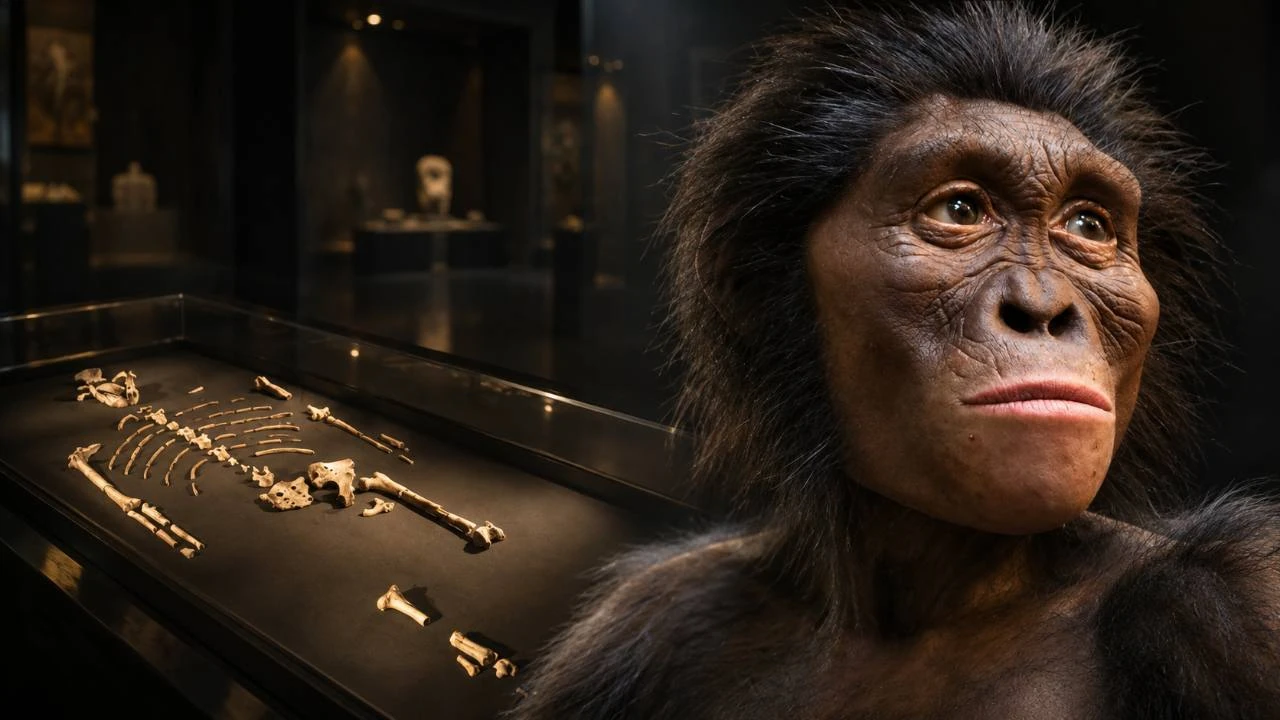
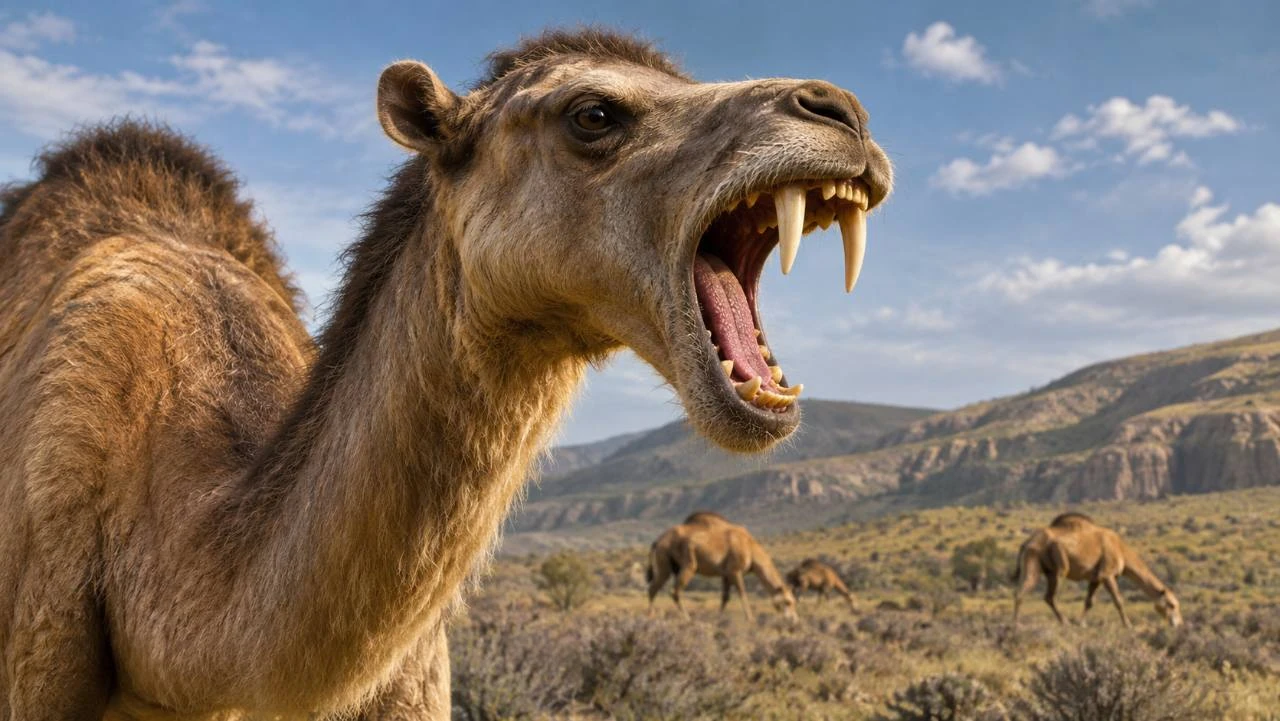
That is what makes the hippos scientifically important: they help recover an ecosystem and test ideas about how people used it. For a different fossil story, read PRESDA’s vampire camel investigation. Our account of Lucy’s discovery examines another case in which remarkable remains changed a larger historical argument without answering every question on their own.
FAQ
Frequently Asked Questions
Did hippos really live in what is now Saudi Arabia?
Yes. Fossil remains at Mundafan form part of a documented freshwater and grassland community from a wetter period around 125,000 years ago.
Was the whole Arabian Peninsula a tropical forest?
The study does not show that. Its evidence describes a local lake, vegetated margins and open habitats within a geographically uneven wetter phase.
Were the hippos directly dated?
The paper reports U-series and electron spin resonance work on two hippo teeth, consistent with the lake chronology within uncertainties. The approximate age is not an exact date for every object.
Were poisoned weapons conclusively proved?
The researchers report residues associated with a toxic plant and evidence for composite tools. Preparation, effectiveness and the exact age of surface tools require caution and further work.
PRESDA Dispatch
Stay Informed. Stay Aware.
A sharp briefing across AI, gaming, sport, business, world affairs, paparazzi, and lifestyle.