LUCY: THE 3.2-MILLION-YEAR-OLD FOSSIL THAT CHANGED HUMAN HISTORY
Discovered in Ethiopia on November 24, 1974, Lucy transformed human evolution research. Explore her anatomy, age and the questions still open.
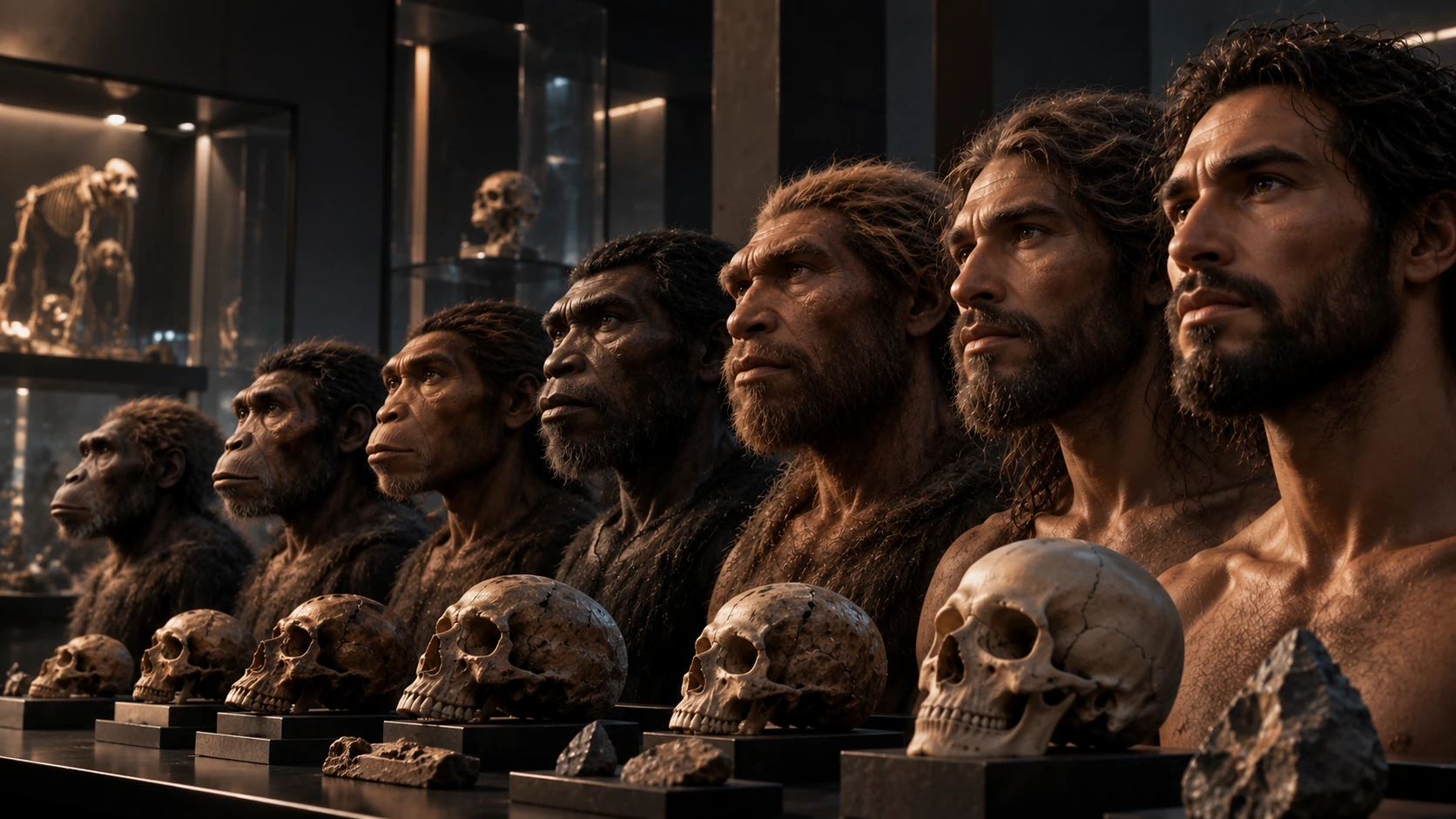
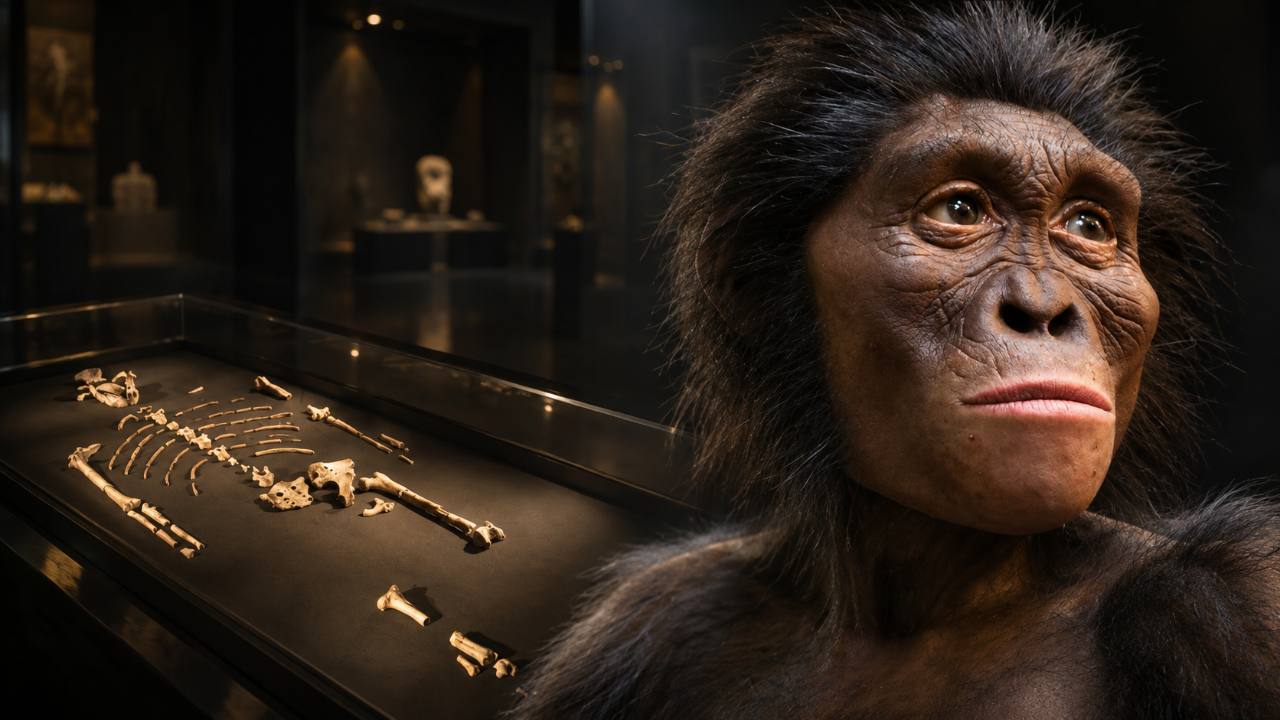
Supplied modern editorial reconstruction, preserved unchanged. The face and museum scene are illustrative, not an archival photograph or an authenticated display of the original bones.
Lucy was discovered at Hadar in Ethiopia on November 24, 1974. The roughly 3.2-million-year-old partial skeleton of Australopithecus afarensis helped establish that upright walking preceded the large brains of later humans. On the discovery’s 52nd anniversary, her importance rests on an extraordinary combination of bones, not on the claim that she was humanity’s single first ancestor. ASU Institute of Human Origins: discovery, anatomy, dating and custody Smithsonian: Lucy specimen AL 288-1
Few scientific names travel as far beyond the laboratory as Lucy’s. Yet the familiar face in a reconstruction can make the evidence seem more complete than it is. The fossil preserves a remarkable anatomical sample; it does not preserve her expression, a diary of her life or proof that everyone alive descends directly from this particular individual.
A November morning in Ethiopia
Donald Johanson and graduate student Tom Gray were returning from fieldwork when they investigated a gully at Hadar. Johanson recognized a forearm fragment, and further searching revealed pieces of a skull, jaw, pelvis and limbs. Excavation and sorting over the following two weeks recovered hundreds of fragments. The Institute of Human Origins describes 47 bones representing about 40 percent of one skeleton. ASU Institute of Human Origins: discovery, anatomy, dating and custody
That percentage is a reconstruction of skeletal completeness, not a statement that 40 percent of her original body mass survived. Teeth, duplicated left and right elements, broken pieces and absent bones all require careful identification. The find mattered because several anatomical regions could be studied together rather than inferred from an isolated jaw or tooth.
The expedition was also a collective undertaking. Johanson and Gray made the discovery in the field, within the International Afar Research Expedition associated with Johanson, geologist Maurice Taieb and paleoanthropologist Yves Coppens. ASU’s retrospective places the famous moment inside continuing geological and paleontological research, rather than a lone explorer’s accidental triumph. ASU, November 21, 2024: Lucy’s discovery and continuing research
A nickname with two histories
The Beatles recording Lucy in the Sky with Diamonds was playing during the camp’s celebration that evening. The nickname endured, although IHO says no one remembers exactly who first suggested it. In Ethiopia she is also known as Dinknesh, commonly translated as “you are marvelous.” The scientific specimen number, AL 288-1, remains the precise identifier used to distinguish her from other finds. ASU Institute of Human Origins: discovery, anatomy, dating and custody Smithsonian: Lucy specimen AL 288-1
What the bones changed
Lucy’s most consequential evidence lies below the skull. Her short, broad pelvis and the angle of the thigh bone helped show how body weight could be supported during upright movement. These are functional relationships: walking on two legs requires the trunk to remain balanced while the body repeatedly transfers its weight onto one supporting limb. Smithsonian: Lucy specimen AL 288-1
Walking came before a large brain
Her species combined a small brain with adaptations for regular bipedal walking. That combination challenged any simple scenario in which a large, recognizably human brain had to evolve before a human-like way of standing and moving. The Natural History Museum explains that the spine, pelvis, legs and feet carry evidence of upright locomotion, while cautioning that the gait was not necessarily identical to ours. Natural History Museum: Australopithecus afarensis
The result was not the discovery that Lucy was a small modern person. Her anatomy is valuable precisely because it combines features that today are distributed differently among living primates. She helps researchers test the order in which traits evolved, without assuming that brain size, locomotion, hand use and social behavior advanced together as a single package.
Trees did not disappear from the story
The shoulders, arms and hands of her species retained features associated with climbing. The Smithsonian describes a body capable of exploiting resources on the ground and in trees. Regular upright walking therefore need not mean that every part of daily life had moved out of the branches. How much time these hominins spent climbing remains a question, rather than something a reconstructed pose can settle. Smithsonian: Lucy specimen AL 288-1 Smithsonian: the wider fossil record of Australopithecus afarensis
How scientists know her age
The headline’s 3.2 million years is a rounded geological age. IHO places Lucy just below 3.18 million years, using the dated framework of the Hadar Formation. This is different from estimating how old she was when she died: her teeth and fused bones indicate a mature individual, not a lifespan measured in millions of years. ASU Institute of Human Origins: discovery, anatomy, dating and custody
Dating a fossil this old is not a carbon-dating exercise. Researchers establish the sequence of sedimentary layers, compare associated fossils and use radiometric dates from suitable volcanic material. The Smithsonian’s explanation of Lucy’s dating describes biostratigraphy alongside the geological techniques that progressively constrain an age. Several methods can check the same chronological framework. Smithsonian: dating the human fossil record
This distinction protects against false precision. An age estimate refers to a specimen’s position in an interpreted geological sequence, with the uncertainties of the measurements and correlations involved. Rounding to 3.2 million years communicates the scale appropriately; printing many decimal places would not automatically make the account more accurate.
Key dates
| Date | Milestone |
|---|---|
| 24 November 1974 | Lucy discovered at Hadar, Ethiopia |
| 1978 | Australopithecus afarensis formally named |
| 2016 | A study proposes a fatal fall, not a settled cause |
| 24 November 2026 | 52 years since the discovery |
The short chronology separates discovery from scientific naming. Lucy did not receive a formal species assignment at the instant the first fragment was spotted, and later discoveries have continued to change the comparisons available to researchers. Natural History Museum: Australopithecus afarensis
Was Lucy our direct ancestor?
Australopithecus afarensis is an important candidate in discussions of the ancestry of the genus Homo. But a species occupying a plausible position in an evolutionary tree is not the same thing as proving a direct genealogical line from one skeleton to every living human. Fossils preserve anatomical relationships much more readily than complete pedigrees. Smithsonian: the wider fossil record of Australopithecus afarensis
The broader record matters here. The Smithsonian documents remains from more than 300 individuals of Lucy’s species across eastern Africa. That comparative sample makes it possible to examine differences within a species instead of treating one unusually complete skeleton as the entire population. It also guards against mistaking an individual peculiarity for a universal characteristic. Smithsonian: the wider fossil record of Australopithecus afarensis
The Dikika child illustrates the danger of appealing labels. Sometimes called Lucy’s baby, the child belonged to the same species but lived about 100,000 years earlier. The nickname expresses scientific kinship, not a mother-daughter relationship. Separating those meanings helps readers understand what evolutionary “family” actually means. Smithsonian: the Dikika child, not Lucy’s daughter
PRESDA’s guide to the human family tree places these discoveries in the wider diversity of human relatives. Lucy is a particularly informative member of that history, not the bottom rung of a ladder destined to end with us.
Calling the discovery part of human history does not make Lucy a member of Homo sapiens. The scientific species name is essential: it identifies the extinct population being discussed and prevents an accessible headline from erasing the differences that make the skeleton scientifically informative. Human origins is a history of changing lineages, not a collection of modern people living at earlier dates. Smithsonian: the wider fossil record of Australopithecus afarensis
What remains uncertain about her death
A 2016 Nature paper proposed that fractures in Lucy’s skeleton were consistent with a fatal fall from a considerable height. The authors framed this as an interpretation of damage to the bones. IHO’s account states that no cause of death has been determined. A responsible account retains that difference between a proposed explanation and a settled conclusion. Kappelman and colleagues, Nature 2016: proposed fatal fall ASU Institute of Human Origins: discovery, anatomy, dating and custody
The same discipline applies to reconstructions of her face, hair and daily surroundings. Fossil anatomy can constrain a reconstruction, but artistic choices fill many of the gaps. Images can explain research effectively when the caption identifies what is evidence, what is modeled and what remains unknown. A vivid illustration is not an additional fossil.
Ethiopia’s fossil and a continuing scientific legacy
IHO identifies the original remains as held in the National Museum of Ethiopia’s paleoanthropology laboratories in Addis Ababa. Casts allow museums and researchers elsewhere to display and examine the anatomy without requiring constant handling of fragile originals. A visitor seeing a complete upright skeleton may therefore be looking at a reconstruction or cast, not the excavated bones themselves. ASU Institute of Human Origins: discovery, anatomy, dating and custody
The anniversary is consequently more than a celebration of one famous name. It recalls a research method: collect carefully, preserve geological context, compare specimens and distinguish observation from inference. Lucy changed the study of human origins because several lines of evidence could be made to speak to one another. Her continuing value lies in the questions that combination allows scientists to ask.
FAQ
Frequently Asked Questions
When and where was Lucy discovered?
Donald Johanson and Tom Gray found her at Hadar in Ethiopia on November 24, 1974. Excavation continued afterward; the discovery was not the recovery of an intact skeleton in one moment.
How old is the Lucy fossil?
About 3.2 million years. That is her geological age, not her age at death. The latter is assessed separately from teeth and skeletal development.
Did Lucy prove humans descended from modern chimpanzees?
No. Humans and chimpanzees share earlier ancestors. Lucy belongs to an extinct hominin species and helps researchers examine how human-lineage traits evolved.
Is the hero image an actual photograph of Lucy?
No. It is the supplied modern editorial reconstruction. It is preserved unchanged and labeled as an illustration, not photographic evidence of her original appearance.
PRESDA Dispatch
Stay Informed. Stay Aware.
A sharp briefing across AI, gaming, sport, business, world affairs, paparazzi, and lifestyle.