THE ILLUMINATI: THE SECRET SOCIETY THAT ACTUALLY EXISTED
A Bavarian professor founded a real secret society in 1776. Its later reputation for controlling the world is a different story, with a very different standard of evidence.
The Illuminati actually existed. That is the first fact to establish, and the point at which two very different histories begin. One concerns a secret society founded by a Bavarian professor in 1776. The other concerns a name that later became an explanation for revolutions, financial power, celebrity success and almost any event someone believed must have a hidden author.
The historical organization left letters, rules, disputes and records of suppression. The modern legend often offers a different kind of evidence: a triangle in a music video, a phrase in a political speech or a photograph of powerful people together. Those things can be investigated, but they do not carry the same meaning as an authenticated membership record.
The surviving evidence supports a short-lived Enlightenment order with ambitious goals and important limitations. It does not establish an unbroken organization directing the world today. Understanding how the first became the second requires taking the original Illuminati seriously enough to recover their actual history.
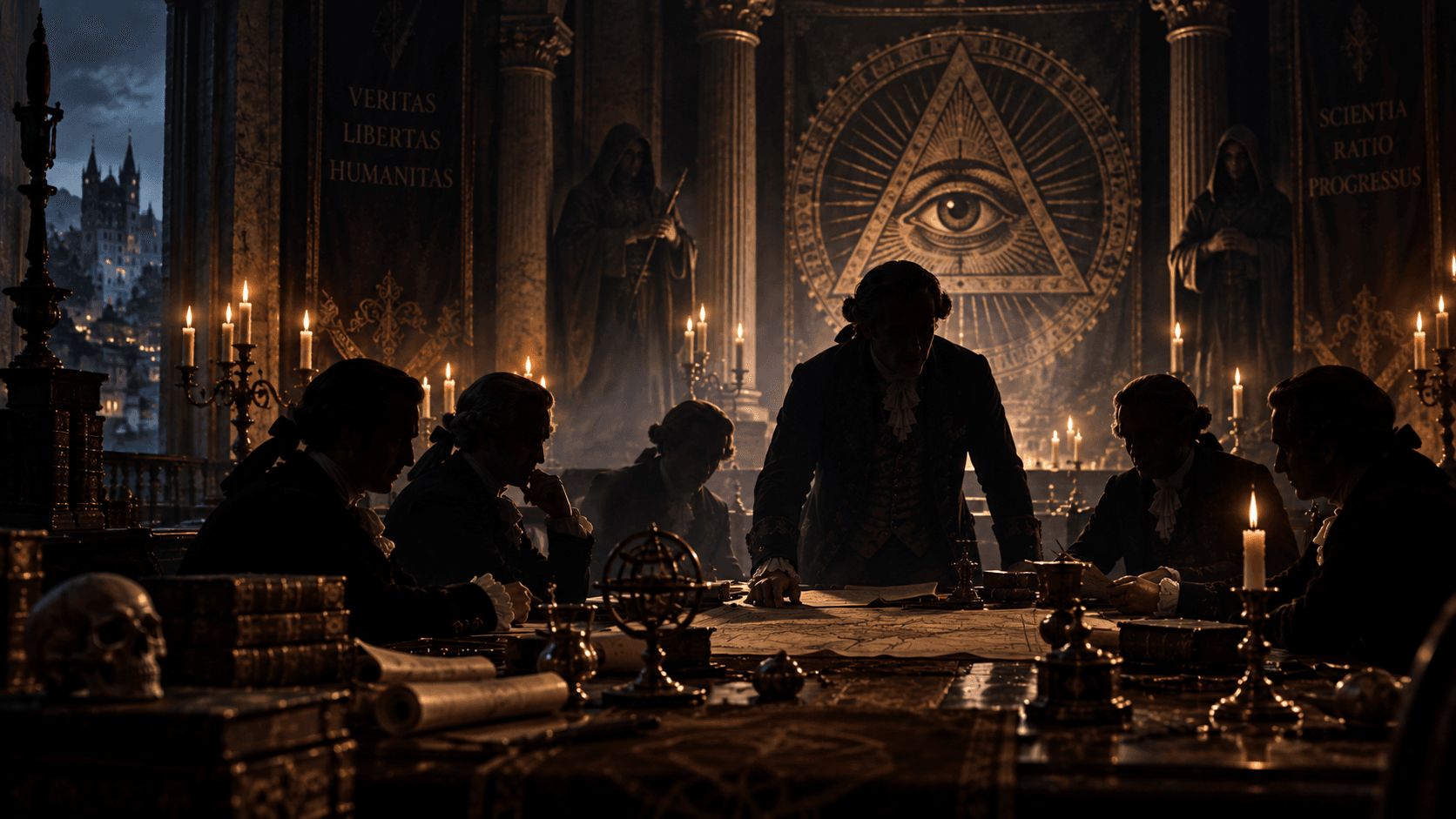
Illustration note: the supplied hero is an imagined secret-society scene. Its eye-and-pyramid imagery evokes modern Illuminati mythology; it is not documentary evidence of an eighteenth-century meeting, room or ritual.
ADAM WEISHAUPT AND THE WORLD OF BAVARIA
Adam Weishaupt was a professor of canon law at the University of Ingolstadt. He lived in the Electorate of Bavaria, within the politically fragmented Holy Roman Empire, rather than a modern unified German state. University life, religious authority and princely government were closely connected.
LMU Munich’s institutional history identifies his project as a radical Enlightenment secret society. Founded with older students in 1776, it was initially called the Perfectibilists before adopting the Illuminati name. The university account describes an ambition to educate an elite that would move into key state positions and gradually undermine princely rule. LMU Munich: The founding of the Illuminati in 1776
This was more than a private reading club. Yet describing it as a functioning world government would confuse aspiration with accomplishment. Weishaupt wanted a mechanism for changing society; the historical question is how far his mechanism actually worked.
The Enlightenment itself was not one organization or one doctrine. Debates about reason, education, religion and legitimate authority took many forms. The Illuminati represented a particular attempt to advance reform through a concealed network. They did not own those ideas, and everyone who shared an interest in reform was not therefore a member.
MAY 1, 1776: THE ORDER TAKES SHAPE
Bavaria’s Bavarikon heritage portal dates the founding to May 1, 1776, in Ingolstadt. The name Illuminati is commonly rendered as the enlightened ones. In this setting, illumination concerned the cultivation and transmission of knowledge, not evidence of supernatural powers. Bavarikon, Bavarian cultural heritage portal: Religious teaching and secret societies
The founding year happens to be the year of American independence. That coincidence later became useful to storytellers connecting the order with the United States. A shared year is not a documented relationship: connecting the two requires records of people, communications and actions, not matching numerals.
For a new secret society, practical questions quickly followed the grand ideals. Who could be trusted? How should members be trained? Which recruits could help the group expand? Who would decide what counted as enlightenment? The answers shaped an organization whose methods could sit uneasily beside its language of liberation.
GOALS: REASON, MORAL IMPROVEMENT AND INFLUENCE
The German Historical Institute’s German History Intersections project introduces the order as an effort to improve humanity and ultimately overcome the domination of people by other people. Its edition of Weishaupt’s early letters shows how that large ambition translated into recruiting instructions. German History Intersections: Two letters from Adam Weishaupt, 1776
The university history also highlights an educational and supervisory system. This creates a central tension: members were to become more enlightened through a structure in which leaders evaluated and directed them. An organization hoping to weaken arbitrary authority could reproduce strong authority inside its own ranks. LMU Munich: The founding of the Illuminati in 1776
Its religious position should not be flattened into a single slogan. The published correspondence, discussed by historian Michael Schaich, reveals disagreements about how far criticism of Christianity should go. Catholic and Protestant reformers did not always accept the same arguments as more radical participants. This was a contested intellectual project, not a room full of people who all believed exactly the same thing. Michael Schaich (2015): Scholarly review of the Illuminati correspondence, Volume 2
Nor should secretive methods automatically be romanticised as progressive. Educating a small group to exercise influence raises questions about accountability: who authorised that group to guide everybody else? The order is historically interesting partly because its aspirations and procedures did not fit together neatly.
RECRUITMENT: THE LETTERS BEHIND THE LEGEND
Two letters to Franz Anton von Massenhausen from 1776 are especially revealing. Weishaupt asks his confidant to observe potential recruits, cultivate useful connections and seek capable people with standing and resources. He comments on manners and personality as well as intellect. The instructions are practical, selective and sometimes sharply judgmental. German History Intersections: Two letters from Adam Weishaupt, 1776
The letters also use aliases and coded language. Weishaupt signs as Spartacus. A reader encounters an organizer trying to build a network through trusted intermediaries, not a supernatural fraternity recruiting through symbols left in public entertainment.
These documents are evidence of intention and method. They are not proof that every targeted person joined or that every plan succeeded. The distinction matters whenever a secret society’s ambitions are used to calculate its supposed power. An instruction to recruit influential people is not a receipt proving that the organization controls them.
Membership also needs more care than the word sometimes receives. Being approached, briefly joining, corresponding with a member and becoming an active leader are different relationships. A list of impressive names can conceal those differences rather than explain them.
HIERARCHY, DEGREES AND THE MANAGEMENT OF SECRETS
The order used graded membership, including novice and Minerval stages. Minerva, the Roman goddess associated with wisdom, supplied the intellectual reference. Later arrangements became more elaborate, with advancement offering access to additional instruction and responsibilities. National Geographic: Adam Weishaupt and the historical Illuminati, including editorial correction
That structure gave secrecy an internal dimension. A recruit did not necessarily know everything a senior member knew. Aliases and controlled disclosure made relationships harder for outsiders to reconstruct, but also made it harder for ordinary members to judge the whole enterprise.
It is misleading to imagine a finished organizational blueprint operating perfectly from the first meeting. Schaich’s review of the critical correspondence edition describes changing offices, jurisdictions and grades, alongside disputes about their purpose. His reading emphasises that the structure developed as the order expanded. Michael Schaich (2015): Scholarly review of the Illuminati correspondence, Volume 2
The 2013 edition, edited by Reinhard Markner, Monika Neugebauer-Wölk and Hermann Schüttler, identifies conflict over Freemasonry and the relationship between Weishaupt and Adolph von Knigge as major themes. The archive is full of negotiation because the organization was made by people with differing priorities. Markner, Neugebauer-Wölk and Schüttler, editors (2013): Illuminati correspondence, January 1782 to June 1783
That evidence cuts against two easy caricatures. The Illuminati were not merely innocent acquaintances unfairly mistaken for a secret society. They really did organize secretly. But their own paperwork does not depict the effortless unity and unlimited command attributed to them in later mythology.
FREEMASONRY: CONNECTION DOES NOT MEAN IDENTITY
Knigge became involved with the Illuminati in 1780 and used the order name Philo. His experience and organizing work helped it grow. Deutsche Biographie records his break with Weishaupt and departure in the summer of 1784. The partnership that helped expansion also produced serious conflict. Deutsche Biographie: Adolph Freiherr Knigge
Masonic networks offered places to meet potential recruits and models of initiation and organization. The Illuminati sought influence within that environment. But Freemasonry was not simply another name for the Illuminati, and a Masonic membership does not establish membership in Weishaupt’s order.
The scholarly correspondence edition describes a struggle for influence within German and European Freemasonry. That language matters: a struggle is evidence of competing projects and uncertain outcomes. It does not demonstrate that one group successfully controlled every lodge or every Mason. Markner, Neugebauer-Wölk and Schüttler, editors (2013): Illuminati correspondence, January 1782 to June 1783
A useful comparison is the difference between a political faction and the wider institution in which it operates. Overlapping membership may be important, but the smaller group and the larger network remain analytically distinct. Without that distinction, an association can be made to appear vastly larger than its actual organization.
EXPANSION, FRICTION AND GOVERNMENT SUPPRESSION
The Illuminati expanded beyond their initial university circle into wider German-speaking networks. The correspondence records efforts to establish branches, assess candidates and reorganize leadership. Expansion created more work and more disagreements, not simply more power. Michael Schaich (2015): Scholarly review of the Illuminati correspondence, Volume 2
Headcounts in popular histories vary, and the meaning of membership can differ between reconstructions. A precise-looking total is less useful here than identifying the people, locations and activities supported by documents. A broad network of contacts should not be counted as a disciplined army.
Elector Karl Theodor’s government moved against unauthorized associations in 1784 and expressly against the Illuminati in 1785. Bavarikon places the repression within fears that the order threatened the existing political and social system. The state treated its secret organization as a challenge, not merely an eccentric philosophical fashion. Bavarikon, Bavarian cultural heritage portal: Religious teaching and secret societies
Weishaupt lost his Ingolstadt professorship in 1785, according to LMU’s history. Personal careers and institutional protection were at stake. The order was also weakened by internal conflicts, so its dissolution should not be imagined as one perfect organization suddenly vanishing at the stroke of a pen. LMU Munich: The founding of the Illuminati in 1776
Authorities obtained correspondence and other papers, and seized material was published during the suppression. That creates a source problem historians must recognise: authentic documents can be selected and framed by an opponent. The right response is contextual reading, not assuming that everything published by the state was invented or that every accusation was established. Eberhard Weis (1987), Bavarian Academy of Sciences: The Illuminati order, its aims and alleged survival
DISAPPEARANCE WAS A PROCESS, NOT A MAGIC TRICK
Historian Eberhard Weis’s study for the Bavarian Academy of Sciences directly examines alleged survival. He distinguishes the collapse of the order from subsequent correspondence, assistance between former members and attempts to establish successor networks. He concludes that by about 1790 the order had ceased to function across Germany. Eberhard Weis (1987), Bavarian Academy of Sciences: The Illuminati order, its aims and alleged survival
That is more precise than claiming every relationship ended immediately in 1785. People who had met through the order could remain friends, recommend one another or continue careers in government, religion and scholarship. Their later decisions could also diverge. Shared membership in the past did not erase individual politics.
This is the crucial bridge between disappearance and legend. The persistence of people and ideas can easily be redescribed as the persistence of an organization. Historical proof requires more: continuing leadership, membership arrangements, communications and coordinated activity identifiable as the same institution.
HOW A SUPPRESSED ORDER BECAME A REVOLUTIONARY MASTER PLOT
The French Revolution gave European observers an urgent explanatory problem. How had a monarchy been overturned, established privileges challenged and political violence expanded so dramatically? A theory of hidden direction could make bewildering events appear to have a single author.
In 1797, Scottish scientist John Robison published Proofs of a Conspiracy, portraying the Illuminati and related networks as forces attacking Europe’s religious and political order. The French cleric Augustin Barruel developed a parallel conspiratorial interpretation in his writings on Jacobinism. These works helped turn a suppressed Bavarian society into a supposed engine of international revolution. Mike Jay (2014), The Public Domain Review: John Robison and the birth of the Illuminati conspiracy
Robison’s book is a primary source for what a contemporary polemicist argued. Its title is not a historian’s certification that its argument was proved. Reading the digitised text shows the scale of the accusations; testing those accusations requires evidence beyond the author’s conviction. John Robison, Proofs of a Conspiracy: Digitised historical polemic
The distinction is fundamental. Evidence that someone feared a conspiracy is evidence about that fear. It becomes evidence of the conspiracy itself only when the alleged relationships and actions can be independently established.
The story crossed the Atlantic. The Library of Congress preserves Seth Payson’s 1802 publication summarising arguments by Robison and Barruel. Its existence documents the transmission of anti-Illuminati literature to an American audience, not an American branch of the Bavarian order. Library of Congress: Seth Payson’s 1802 anti-Illuminati publication
Modern scholarship also studies the political and cultural work done by these narratives. Gordon Fraser’s Journal of American Studies article compares the American Illuminati scare of 1798–1800 with a much later conspiracy panic. That is a study of recurring forms of reaction, not a claim that the same secret organization operated behind both episodes. Gordon Fraser (online 2018; issue 2020): The recurrent aesthetics of the American Illuminati
THE ALL-SEEING EYE, THE PYRAMID AND THE DOLLAR
Few symbols are more readily labelled “Illuminati” online than an eye above a pyramid. Yet an image’s modern reputation does not establish who created it or what it originally meant.
The United States Great Seal has a documented design history. Congress adopted it on June 20, 1782, after several committees and a final design developed by Charles Thomson with revisions by William Barton. The National Archives preserves the relevant design and explains that both sides appear on the one-dollar bill. U.S. National Archives: Original design of the Great Seal, 1782
The State Department’s account explains the reverse through the unfinished pyramid, the Eye of Providence and accompanying Latin mottos. Novus ordo seclorum refers to a new order of the ages, associated with the new American era. It is not, by itself, a declaration that the Bavarian Illuminati govern the world. U.S. Department of State: The Great Seal of the United States
The currency chronology matters too. The Great Seal appeared on the reverse of the one-dollar silver certificate in 1935. A seal designed in the eighteenth century and its later use on money are separate events. Neither becomes evidence of Illuminati control simply because the image is familiar. U.S. Currency Education Program: History of U.S. currency
Eyes, triangles and pyramids can carry religious, national, artistic and commercial meanings. To establish organizational ownership, one needs a documented connection in the relevant context. Resemblance alone is weak evidence, particularly when the shapes are common and the supposed code is defined after the image is found.
CELEBRITIES, FICTION AND THE INTERNET’S SECRET-SOCIETY AESTHETIC
Modern audiences often meet the Illuminati through fiction before encountering Weishaupt. Robert Shea and Robert Anton Wilson’s Illuminatus! trilogy, first published in 1975, made conspiracy a subject of elaborate fictional play. Shea’s author website identifies the work and its publication history. Fiction can make a name culturally familiar without establishing its imagined events as history. Robert Shea’s author website: Illuminatus! and its publication history
BBC Ideas’ account of the conspiracy’s development specifically discusses its association with celebrities such as Beyoncé and Jay-Z. The existence of those accusations is not evidence that either belongs to a surviving Bavarian society. A gesture, costume or stage design cannot establish a chain of membership across centuries. BBC Ideas (2019): How the Illuminati conspiracy theory started
An artist may borrow an image for mystery, religious reference, provocation, humour or visual effect. Without evidence from the production, assigning an intention remains interpretation. Even a deliberate reference to Illuminati mythology would demonstrate use of the mythology, not membership in the original order.
The internet makes the interpretive loop easy to repeat. A symbol is called suspicious; another appearance of the same symbol is then treated as confirmation. The investigator can accumulate examples without ever establishing the first connection. More screenshots do not repair a missing premise.
Michael Barkun’s A Culture of Conspiracy examines how different conspiracy narratives combine and how newer media change their circulation. That broader framework helps explain why the Illuminati label can absorb unrelated stories rather than remain tied to one historical organization. Michael Barkun, University of California Press: A Culture of Conspiracy
POLITICS, BANKING AND THE “NEW WORLD ORDER”
The phrase “New World Order” needs context before interpretation. In his October 1, 1990 address to the United Nations General Assembly, President George H. W. Bush used it while discussing international cooperation, collective security and the end of Cold War confrontation. The presidential library preserves the speech. It is evidence of a public foreign-policy argument, not a disclosed Illuminati command structure. George H. W. Bush Presidential Library: Address to the UN General Assembly, October 1, 1990
That policy can be debated on its actual terms. Using the same phrase in a conspiracy narrative does not make every politician who says it a participant in the same hidden project. Words travel between contexts, and historical analysis has to follow the context rather than assume a password.
Banking claims require similar discipline. Wealth, lobbying, ownership and financial influence are legitimate subjects of investigation. They can be examined through transactions, appointments, legislation and documented relationships. The allegation that all these activities answer to an uninterrupted Bavarian order is a separate claim requiring separate proof.
One instructive example appears in National Geographic’s own correction to its Weishaupt article. The publication withdrew an assertion that Mayer Amschel Rothschild financed and belonged to the Bavarian Illuminati, stating that it found no historical evidence for it. Repetition in a reputable-looking article did not make the claim reliable. National Geographic: Adam Weishaupt and the historical Illuminati, including editorial correction
Some world-control narratives also incorporate antisemitic fabrications. The United States Holocaust Memorial Museum documents that The Protocols of the Elders of Zion is a forgery, not a record of a real Jewish leadership conspiracy. It cannot supply missing evidence for banking or Illuminati allegations. United States Holocaust Memorial Museum: The Protocols of the Elders of Zion and its fabricated conspiracy
PRESDA’s history of money offers a more productive starting point for questions about finance: identify institutions, incentives and changes over time. Scrutiny becomes stronger when it specifies how power works instead of assigning every outcome to one invisible actor.
MYTH VS REALITY
The central question is not whether a group with this name once existed. It did. The question is whether credible historical evidence connects that documented organization to the modern claim of continuing world control.
REALITY: THE BAVARIAN ILLUMINATI WERE AN ACTUAL SECRET SOCIETY
University records, contemporary correspondence and scholarly editions establish the order, its founder and its activity. Rejecting the modern legend does not require denying that history. The organization was secretive, selective and interested in influence.
REALITY: ITS AMBITIONS EXCEEDED ITS DEMONSTRATED REACH
A plan to shape government is not proof that the plan succeeded. Correspondence about expansion does not demonstrate universal coordination. Internal disagreement is part of the record, and descriptions of the group should not silently replace its contested activity with the omnipotence imagined by its enemies.
UNSUPPORTED CLAIM: THE ORIGINAL ORDER CONTINUED UNBROKEN TO TODAY
The historical evidence reviewed here does not establish that continuity. Weis’s study explicitly rejects treating continued contacts among former members as proof that the order survived. That distinction remains decisive: an enduring friendship, a successor attempt or a reused name is not an unbroken institution. Eberhard Weis (1987), Bavarian Academy of Sciences: The Illuminati order, its aims and alleged survival
This conclusion is not a claim that every private association everywhere has been catalogued. It is a judgment about a specific historical assertion. Someone proposing continuity must show the connecting evidence, rather than require everyone else to disprove every imaginable hidden link.
UNSUPPORTED CLAIM: MODERN GROUPS USING THE NAME PROVE SUCCESSION
A contemporary organization can call itself Illuminati, adopt ranks or sell membership. Those acts establish a contemporary use of the label. To demonstrate descent from Weishaupt’s order, it would need verifiable records bridging the intervening generations. Self-description is the claim to investigate, not independent confirmation.
MYTH: AN EYE, TRIANGLE OR FAMOUS NAME IS A MEMBERSHIP TEST
A symbol has to be understood in its own setting. A celebrity’s success is not evidence of secret initiation. A person’s Masonic connection is not automatically an Illuminati connection. These shortcuts create apparent certainty by skipping the very relationship that needs to be proved.
MYTH: NO EVIDENCE MEANS THE COVER-UP MUST BE PERFECT
A theory that counts both evidence and its absence as confirmation cannot be tested fairly. Genuine secrecy can make investigation difficult, but it does not remove the need for corroboration. The responsible answer to an undocumented claim is that it remains unsupported.
The same distinction appears in PRESDA’s investigation of Area 51: a real history of secrecy does not establish every later story attached to it. Recognising an authentic secret is the beginning of an inquiry, not permission to invent its contents.
WHAT THE ILLUMINATI’S HISTORY REALLY REVEALS
The historical order contains a revealing contradiction. Its members discussed enlightenment and improvement while constructing a hierarchy that depended on selective knowledge and supervision. They sought influence, argued over methods and faced a government determined to suppress them. Their story is one of limited people pursuing large ambitions.
The legend removes those limits. It turns the difficulty of understanding power into an image of a single hidden controller. That image can feel explanatory while leaving the actual mechanisms of institutions, conflict and social change unexamined.
The Illuminati’s most demonstrable survival is therefore cultural. Their name remains useful to storytellers, critics, entertainers and people looking for a pattern behind uncertainty. The Bavarian order belongs to documented history. The claim that it still rules the world has not crossed the same evidentiary threshold.
SOURCES AND EDITORIAL METHOD
This article distinguishes contemporary documents, later polemics, academic interpretation and modern media. Robison and Payson are cited as evidence of historical allegations and their circulation, not as verification of a world conspiracy. The critical correspondence edition is discussed through its publisher description and Michael Schaich’s scholarly review; no claim of a new archival discovery is made. German-language research is paraphrased in English. The supplied hero is an artistic illustration. Sources were checked in September 2026.
LMU Munich: The founding of the Illuminati in 1776
Bavarikon, Bavarian cultural heritage portal: Religious teaching and secret societies
German History Intersections: Two letters from Adam Weishaupt, 1776
Deutsche Biographie: Adolph Freiherr Knigge
Michael Schaich (2015): Scholarly review of the Illuminati correspondence, Volume 2
National Geographic: Adam Weishaupt and the historical Illuminati, including editorial correction
Mike Jay (2014), The Public Domain Review: John Robison and the birth of the Illuminati conspiracy
John Robison, Proofs of a Conspiracy: Digitised historical polemic
Library of Congress: Seth Payson’s 1802 anti-Illuminati publication
Gordon Fraser (online 2018; issue 2020): The recurrent aesthetics of the American Illuminati
U.S. National Archives: Original design of the Great Seal, 1782
U.S. Department of State: The Great Seal of the United States
U.S. Currency Education Program: History of U.S. currency
Robert Shea’s author website: Illuminatus! and its publication history
BBC Ideas (2019): How the Illuminati conspiracy theory started
Michael Barkun, University of California Press: A Culture of Conspiracy
George H. W. Bush Presidential Library: Address to the UN General Assembly, October 1, 1990
FAQ
Frequently Asked Questions
What is this PRESDA article about?
A Bavarian professor founded a real secret society in 1776. Its later reputation for controlling the world is a different story, with a very different standard of evidence.
Which category does this story belong to?
This story is part of PRESDA's World coverage.
Who published this article?
THE ILLUMINATI: THE SECRET SOCIETY THAT ACTUALLY EXISTED was published by PRESDA Editorial on PRESDA.
PRESDA Dispatch
Stay Informed. Stay Aware.
A sharp briefing across AI, gaming, sport, business, world affairs, paparazzi, and lifestyle.