KINDERTRANSPORT: THE TRAINS THAT SAVED 10,000 CHILDREN
How the Kindertransport worked, who organised the rescue, why parents stayed behind and what happened to children after reaching Britain.
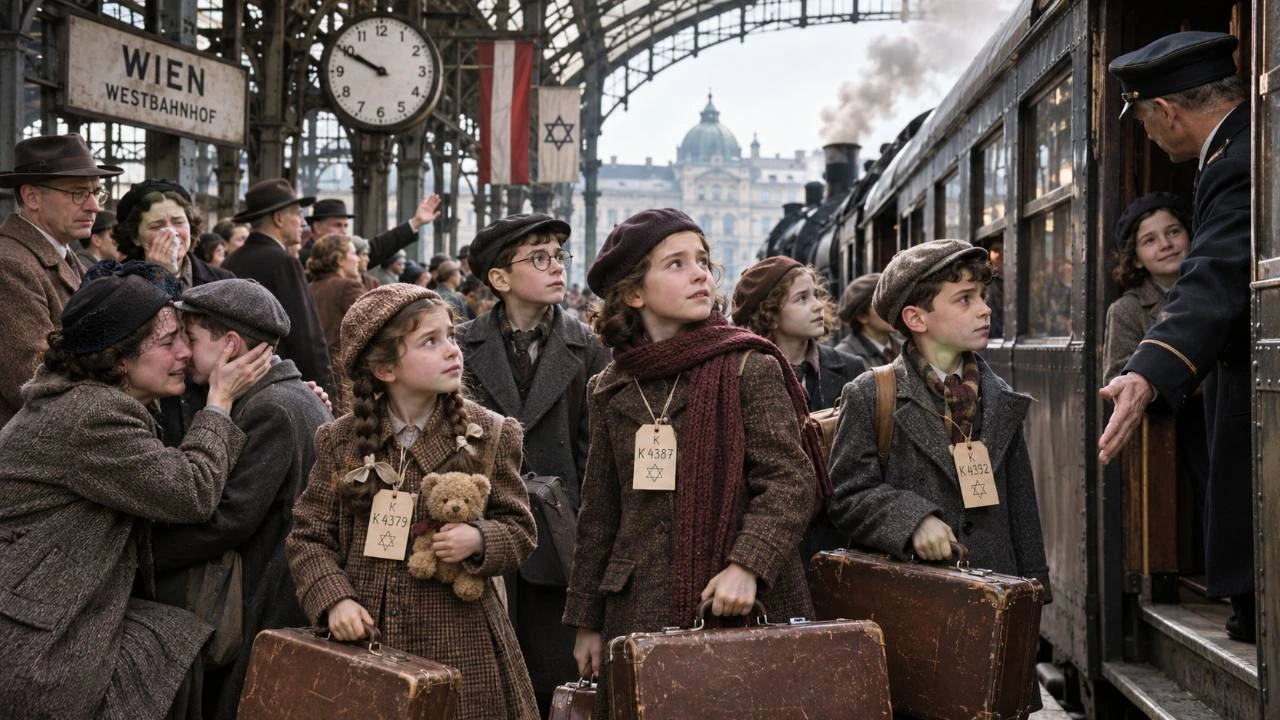
Editorial illustration supplied for PRESDA.
Between late 1938 and the outbreak of war in September 1939, the Kindertransport brought nearly 10,000 mostly Jewish children from Nazi-controlled Europe to Britain. Trains carried them across borders and ferries completed many journeys. Their arrival was a rescue, but it began a new life separated from parents whose own escape remained uncertain. The number in the title describes a collective effort assembled from thousands of individual decisions. United States Holocaust Memorial Museum overview Holocaust Memorial Day Trust history
Why did the rescue begin in 1938?
| Date | Milestone | Historical significance |
|---|---|---|
| 9–10 November 1938 | Anti-Jewish pogroms in Germany and annexed Austria | Pressure for a practical rescue route intensified |
| 2 December 1938 | First organised arrivals at Harwich | Rail and sea journeys brought children to Britain |
| September 1939 | War interrupted the main programme | Parents and children faced further separation |
| May 1940 | Exceptional evacuation of 74 children from the Netherlands | Explains the later endpoint used in some accounts |
On November 9–10, 1938, the Nazi regime unleashed anti-Jewish violence across Germany and annexed Austria. Synagogues, homes and businesses were attacked, and Jewish men were arrested and imprisoned. The November pogroms intensified a refugee crisis already shaped by years of persecution. Families who wanted to leave faced immigration restrictions, costs and the difficulty of finding a country willing to admit them. The British decision to admit children emerged from that emergency and from sustained lobbying by aid organisations. United States Holocaust Memorial Museum overview Imperial War Museums Holocaust galleries guide
What Britain agreed to do
The government temporarily relaxed entry requirements for children under 17. The arrangement depended on private guarantees and charitable support for their care and eventual onward travel. A £50 guarantee was required for each child. This was an immigration condition, rather than a sum handed to each arriving child. Parents did not gain admission through the same arrangement. The policy therefore opened a route to safety for a child while leaving the family’s reunion unresolved. United States Holocaust Memorial Museum overview
Who organised the Kindertransport?
Jewish community organisations in the countries of departure prepared applications and journeys. In Britain, Jewish and non-Jewish relief groups, volunteers and foster families arranged accommodation and support. The Movement for the Care of Children from Germany, later renamed the Refugee Children’s Movement, coordinated much of the receiving work. Calling the rescue a single train or one person’s project would hide the offices, donors, escorts and households on which it depended. United States Holocaust Memorial Museum overview Wiener Holocaust Library collection guide
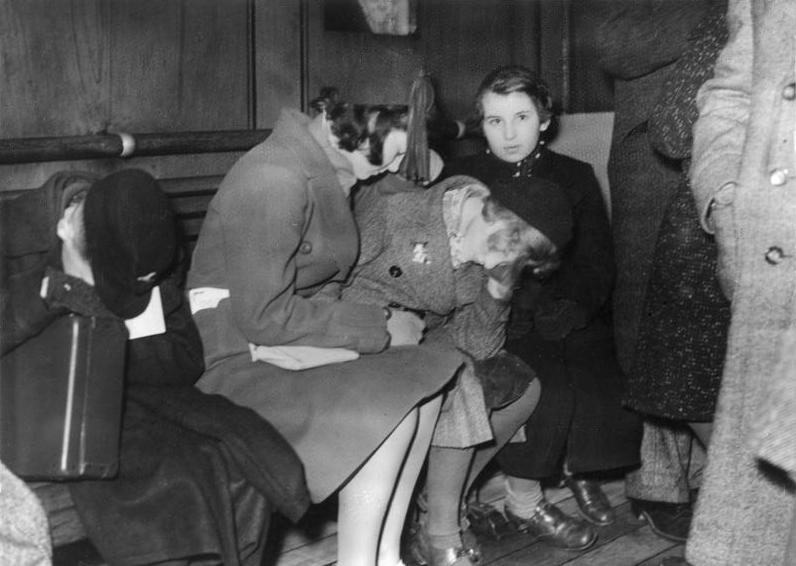
Refugee children arriving at Harwich in December 1938, in a documentary photograph preserved by the German Federal Archives.
Bundesarchiv, Bild 183-1987-0928-501 / photographer unknown / Wikimedia Commons · CC BY-SA 3.0 DE
The work in Vienna and Prague
Research on Vienna traces the involvement of the Jewish community’s welfare office and its correspondence with British organisers. Files had to connect a child’s identity, family situation, paperwork and prospective placement. In Czechoslovakia, Nicholas Winton became associated with the rescue of 669 children through a network that included people working locally and in Britain. The museum’s account also identifies the refugee relief context in which Doreen Wariner and Trevor Chadwick worked. Winton’s contribution belongs within that wider network. Vienna Kindertransport research, Jewish Historical Studies USHMM account of the Czechoslovak rescue
How did the journeys work?
The first organised group arrived at Harwich on December 2, 1938. A common route took children by rail through the Netherlands to the Hook of Holland, followed by a ferry to England. Some then continued to London or another receiving place. A ticket could describe only one stage in a journey that involved several authorities and languages. At each change of transport, escorts and receiving volunteers had to account for children travelling without their parents. United States Holocaust Memorial Museum overview Imperial War Museums Holocaust galleries guide
What the familiar labels meant
Identification labels and travel documents helped organisers match children with records and placements. A label was one practical element in a much larger system of lists, permissions and guarantees. It could not remove the fear of separation or explain a new language. The supplied hero reconstructs a departure scene. Its faces, flags and labels should be read as illustrative details, not evidence about a specific 1938 train or official procedure. The supporting archival photograph has its own date and provenance.
What happened after arrival?
Some children joined relatives or foster families; others stayed in hostels, schools and group homes. The earliest arrivals could spend time in reception camps while accommodation was found. Harwich was therefore a point of entry rather than the end of the story. Arranging a bed, education, food and care for an arriving group required continuing money and labour. A place on a transport did not ensure that siblings would remain together or that every placement would meet a child’s needs. United States Holocaust Memorial Museum overview Holocaust Memorial Day Trust history
Safety and belonging were separate challenges
Children had left familiar homes and people, often with little English. The transition could include affection and opportunity alongside loneliness, uncertainty and difficult relationships. Experiences differed by age, household and circumstances. A source describing a successful placement cannot stand for every child. For that reason, a fuller account puts institutional records beside individual testimony. The records can show where someone was sent; the person’s recollection can explain what living there felt like and how the experience changed over time. Wiener Holocaust Library collection guide
What does the figure of 10,000 mean?
Museums and memorial organisations generally use “about” or “nearly” 10,000 for the rescue to Britain. It is a rounded historical total for an organised movement, whose participants came from several territories. The Wiener Holocaust Library warns that it does not hold one comprehensive list of every child. Its collections include departure and arrival lists with different coverage. A name appearing in two records may describe one journey, while a missing name in one collection does not prove that a child never travelled. Wiener Holocaust Library collection guide Holocaust Memorial Day Trust history
Why the dates sometimes extend to 1940
The main programme ended when war began in September 1939 and disrupted the routes. A scheduled departure from Prague was cancelled. There was also an exceptional evacuation from the Netherlands in May 1940, when Gertruida Wijsmuller-Meijer helped bring 74 refugee children to Britain by sea. This helps explain why some historical descriptions use 1938–1939 and others 1938–1940. A concise chronology should define the main programme and retain the later exception, instead of making the two date ranges appear contradictory. United States Holocaust Memorial Museum overview
What did the war change for the children?
War made communication with families harder and altered conditions in Britain. Some older refugees were classified as enemy aliens and interned, despite having fled Nazi persecution. Others experienced evacuation or changing placements. The designation “enemy alien” arose from nationality-based wartime policy. It says nothing about a refugee child’s loyalties or the danger from which that child had escaped. This is one reason the story cannot end at a photograph of a welcoming station platform. United States Holocaust Memorial Museum overview
Parents and the search after the war
Many children later learned that their parents and other relatives had been murdered in the Holocaust. Others faced searches and reunions complicated by years apart. A child’s survival and a family’s survival are different measures of rescue. The relief effort saved lives while the exclusion of parents had devastating consequences. Both belong in an account of the policy. The emotional meaning of an old letter or photograph can also change after a family discovers what happened to the person who sent it. Holocaust Memorial Day Trust history
How historians recover individual stories
Passenger lists, immigration papers, placement files, letters and oral histories answer different questions. A contemporary list can establish a departure, while a later testimony may describe a farewell remembered decades afterward. Neither should be made to supply what it does not contain. The library’s guide points researchers towards several collections and countries, reflecting the international nature of the journeys. Responsible reconstruction follows those links and distinguishes documented details from later interpretation. Wiener Holocaust Library collection guide Vienna Kindertransport research, Jewish Historical Studies
Objects preserve the scale of childhood
Imperial War Museums uses children’s belongings, including a puppet carried by a young refugee, to bring the history back to ordinary life. A toy records something different from an official guarantee or passport. It can reveal what a child took from home and what was preserved through displacement. It cannot tell every part of the journey on its own. Read together, such objects and documents make the number of rescued children understandable as lives, relationships and interrupted childhoods. Imperial War Museums Holocaust galleries guide
Why the history remains difficult and important
The Kindertransport demonstrates what coordinated action made possible under restrictive conditions. It also requires attention to the people who were not admitted and to parents who made decisions under extreme pressure. Commemoration should preserve that complexity rather than treating rescue as an uncomplicated ending. For another aspect of the same war, PRESDA’s account of the Night Witches and Soviet night bombing examines military service on the Eastern Front. It concerns a different experience within a shared historical period.
FAQ
Frequently Asked Questions
What was the Kindertransport?
An organised rescue that brought nearly 10,000 mostly Jewish children from Nazi-controlled Europe to Britain, principally in 1938–1939.
Did all the children travel only by train?
Many journeys combined rail travel across Europe with a ferry crossing to England, followed by further travel to a placement.
Why did parents stay behind?
The special British admission arrangement covered children. It did not give their parents the same right to enter.
Did Nicholas Winton organise the whole operation?
He was an important figure in the Czechoslovak rescue, associated with 669 children. The wider movement depended on many organisations and individuals.
Why do some accounts end in 1940?
The principal programme ended in September 1939, but an exceptional evacuation from the Netherlands brought 74 children to Britain in May 1940.
PRESDA Dispatch
Stay Informed. Stay Aware.
A sharp briefing across AI, gaming, sport, business, world affairs, paparazzi, and lifestyle.