KUKUR TIHAR: NEPAL'S FESTIVAL HONORING DOGS
Why dogs receive garlands, tika and food during Nepal’s Tihar festival, and how the day fits into the wider celebration.
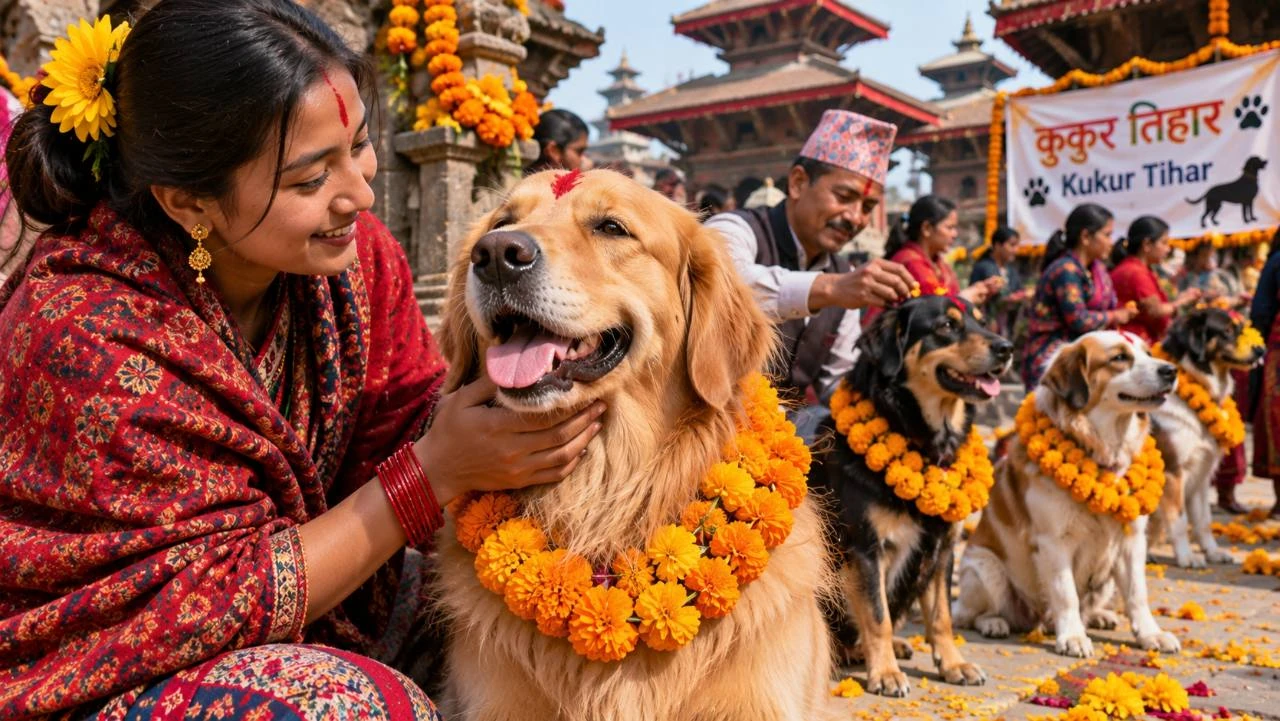
Editorial illustration supplied for PRESDA.
During Kukur Tihar in Nepal, dogs are honoured with flower garlands, a mark called tika and offerings of food. The celebration is part of Tihar, the festival of lights, and Nepal’s tourism board places it on the second day of the customary five-day sequence. The gesture can be intimate, as when a household honours an animal it knows, or public, as at ceremonies for police dogs. The encounter has a religious history as well as an immediate meaning for people whose lives include dogs. Nepal Tourism Board Lumbini Province visitor guide Kathmandu Post photographs from 2024
When Kukur Tihar takes place
| Element | What it means in context |
|---|---|
| Timing | Customarily the second day of Tihar |
| Garland and tika | Visible gestures used to honour dogs |
| Food offering | Part of the act of recognition |
| Police ceremonies | Public recognition of working dogs, separate from household observances |
Kukur Tihar falls during Tihar, which is also known as Yamapanchak in connection with Yama, the deity associated with death. The five-day sequence in the Nepal Tourism Board’s account begins with crows, then honours dogs. Other observances are centred on cattle, worship of Lakshmi, also written Laxmi, and relationships between siblings. Those themes are distinct parts of a wider festival. A picture of a garlanded dog can introduce one day, but a reader looking for the meaning of that day should also know what surrounds it. Nepal Tourism Board Lumbini Province visitor guide
Why a calendar date can move
The familiar Gregorian months do not determine the timing of the festival. Observances follow a traditional lunisolar calendar, whose dates shift when expressed in the Gregorian system. A second-day description gives the festival’s customary order. Anyone planning to attend in a particular year still needs that year’s published local dates and the timing of the specific event. A family’s celebration is also a different matter from a ceremony organised by an institution. The fact that both mark Kukur Tihar does not say when a visitor is welcome at either. Nepal Tourism Board Lumbini Province visitor guide
What the garland, tika and offering express
In photos and local accounts, a dog may wear a flower garland and have a coloured mark placed on its forehead. A food offering can accompany those gestures. They acknowledge an animal and set the occasion apart from an ordinary feeding or encounter. The exact flowers and food may differ. What makes the objects legible is the setting: people are making a deliberate gesture of recognition. A portrait isolated from the wider ceremony may capture the marks on a dog while losing the relationships that gave the act its meaning. Nepal Tourism Board Lumbini Province visitor guide Kathmandu Post photographs from 2024
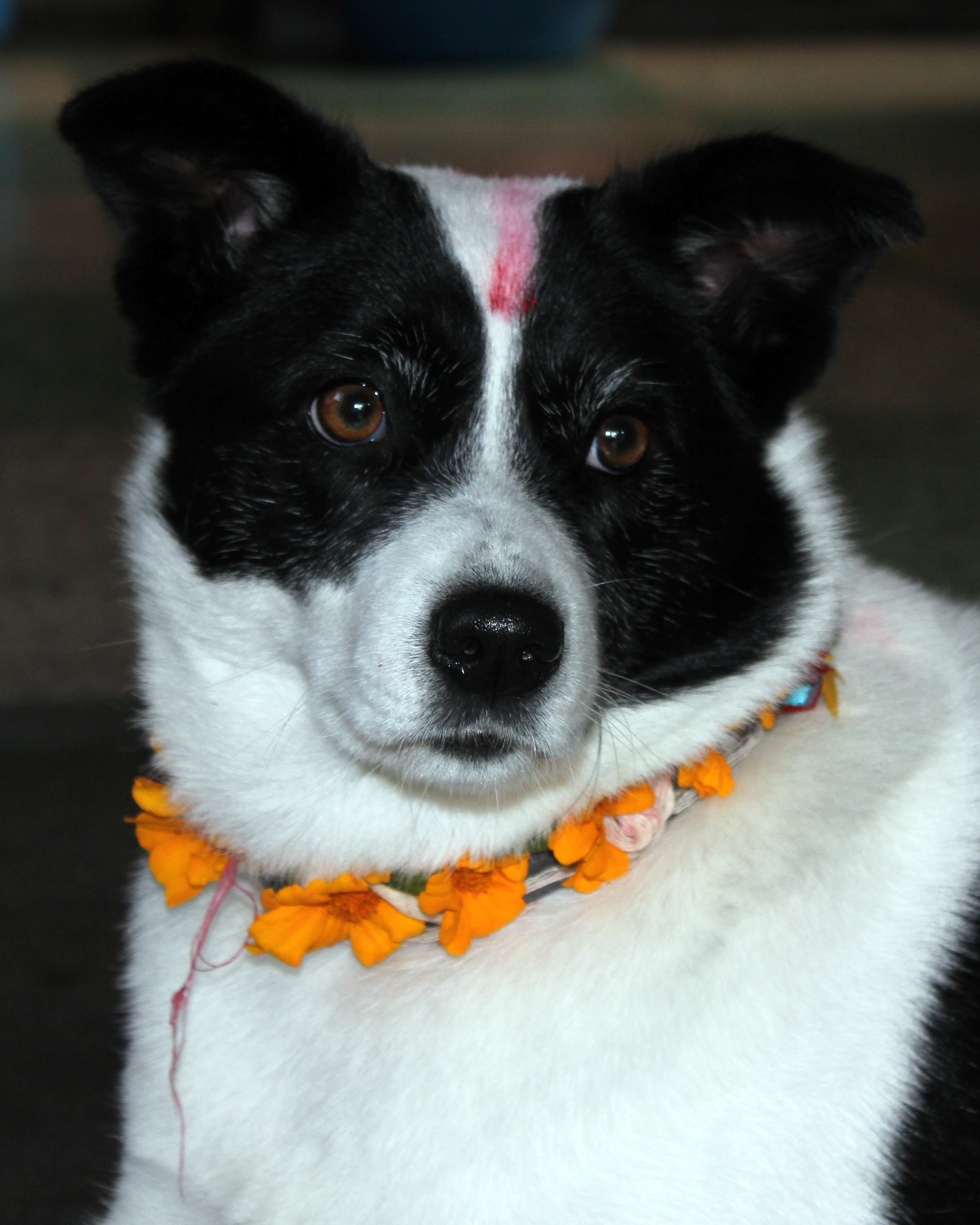
A black-and-white dog with a red tika and an orange flower garland during Kukur Tihar, photographed on November 2, 2013.
Why dogs are associated with Yama
The Nepal Tourism Board explains that dogs are honoured as agents of Yama. Different retellings can emphasise watchfulness, loyalty or the association with a threshold between life and death. It is useful to distinguish the religious explanation given by the tourism board from the reason a particular household chooses to participate. Families may describe a dog’s companionship or protection in everyday terms while taking part in a festival with a shared religious context. A good account leaves room for both. Nepal Tourism Board
From household dogs to police dogs
The practice can include dogs that live with families, dogs people meet in the street and working animals. Nepal Police has also marked the occasion publicly. A Kathmandu Post photo report documents the 2024 Kukur Tihar event at the Central Police Dog Training School. The event brought handlers and dogs together in a setting where their work could be recognised. Because it was organised by an institution, the ceremony also had an audience and a timetable different from those of a household ritual. Nepal Tourism Board Kathmandu Post photographs from 2024
What police dogs do outside festival day
In 2026, Kathmandu Post reporting described Nepal Police dogs trained for work that includes searching after floods and other disasters, and their role in criminal investigations. Search work and public demonstrations draw on different circumstances. A controlled demonstration allows people to watch a handler and dog together. A search can require dealing with unfamiliar places and the practical pressure of an emergency. A festival photograph records the moment of recognition, while the report about their work explains a reason people might choose to honour them. Kathmandu Post reporting on Nepal Police dogs Kathmandu Post photographs from 2024
How to understand the images without flattening the tradition
The festival is often represented by a close-up of one animal. The image is memorable, but the same camera angle could be used at a private gathering, in a neighbourhood or at a police event. Identifying the year, location and type of gathering makes the picture more useful as a historical record. It lets the reader distinguish a photograph taken by a reporter from an editorial illustration, and explains why an image from one city may not represent a whole country. Those distinctions also help us recognise the work of people who prepare the flowers and food, and others whose role is less visible in a finished photograph. Lumbini Province visitor guide Kathmandu Post photographs from 2024
One day of recognition and the rest of the year
Ceremony and care are different kinds of attention. The offering is visible. Everyday care includes a dependable supply of suitable food and clean water, and attention to the animal’s condition. An unfamiliar dog may avoid a crowd even when people mean well. For an observer, giving a dog space and asking before approaching someone else’s animal makes it easier to follow the occasion without turning it into a performance for a camera. This practical distinction also helps explain why a photograph taken on one day cannot establish how a dog was treated throughout the year.
What the other days add to the story
Tihar brings together multiple observances. The Nepal Tourism Board describes the worship of Lakshmi and the concluding Bhai Tika observance, when sisters traditionally bless brothers. The Lumbini visitor guide describes other steps in the sequence, including observances associated with cattle. Household and community variations should be understood in relation to this shared festival setting. A reader who knows only the dog day sees one distinctive part of a celebration that also concerns prosperity, kinship and relationships people recognise through ritual. Nepal Tourism Board Lumbini Province visitor guide
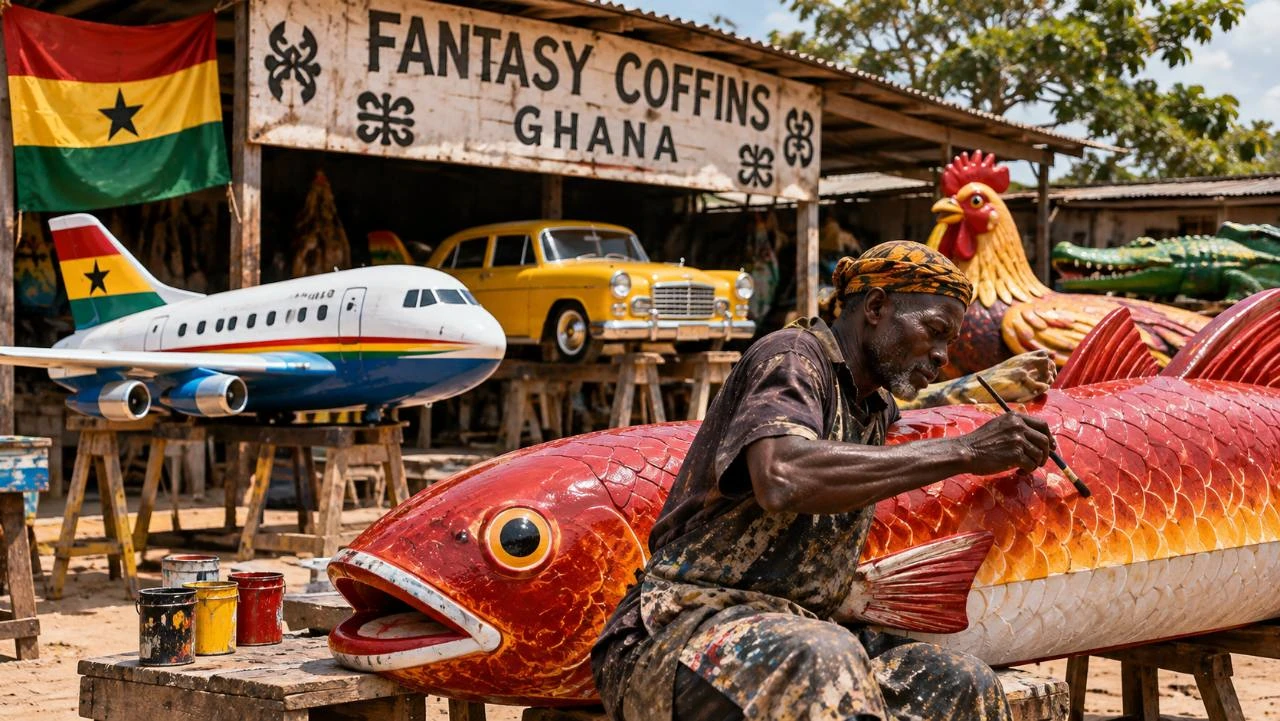
A festival can be both public and deeply local. Names, objects, local calendars and the accounts of participants help explain why a practice persists. For another example of how a familiar object gains meaning through the choices of those who use it, read PRESDA’s feature on Ghana’s figurative coffins. The practices are different. What they share is the need to ask whose interpretation we are hearing.
Why following the order matters
In accounts of the five-day sequence, the animal observances do not all carry the same meaning. Crows, dogs and cattle occupy different places. A visit organised around the dogs may therefore miss the context in which people have already begun preparing lights and decorations for other observances, or in which relatives are making plans to meet. The dog day is distinctive because the animal is the focus of the action in that moment. Keeping the wider sequence visible helps explain why that moment also belongs to a celebration with many other acts of hospitality, worship and recognition. Nepal Tourism Board Lumbini Province visitor guide
What a dated report adds
The 2024 report from the police dog school identifies where the ceremony took place, the institution involved and the year. This makes it possible to compare that occasion with reporting about the same institution in 2026. Accounts of the search roles give detail that a photograph of the ceremony cannot show. Conversely, the photograph confirms how a particular public event looked. Using both sources lets us describe the work and the recognition without presenting one year’s practices as a promise about the next. Kathmandu Post reporting on Nepal Police dogs Kathmandu Post photographs from 2024
What a visitor can identify in the sequence
Knowing which ceremony is taking place helps a visitor recognise the type of gathering. A public event can explain its schedule through announcements. A household may have its own arrangements. Seeing the mark, flowers and food together helps identify how that particular occasion expresses recognition. Nepal Tourism Board Lumbini Province visitor guide
The year matters when using a report to plan a visit. A ceremony and its location can be documented without establishing a permanent public timetable. Kathmandu Post photographs from 2024
FAQ
Frequently Asked Questions
What is Kukur Tihar?
A day of Nepal’s Tihar festival when dogs are honoured, often with flowers, tika and food.
Why does Nepal honour dogs during Tihar?
The Nepal Tourism Board associates the observance with dogs as agents of Yama. Families and institutions may also recognise companionship, protection or service.
Does it fall on the same date each year?
Its Gregorian date varies. Consult a current Nepalese festival calendar for a specific year.
PRESDA Dispatch
Stay Informed. Stay Aware.
A sharp briefing across AI, gaming, sport, business, world affairs, paparazzi, and lifestyle.