Las Bolas: Costa Rica’s stone spheres and the hunt for hidden gold
Banana plantation work exposed ancient stone spheres in the Diquís Delta. A rumor about gold reportedly cost some of them their original form.
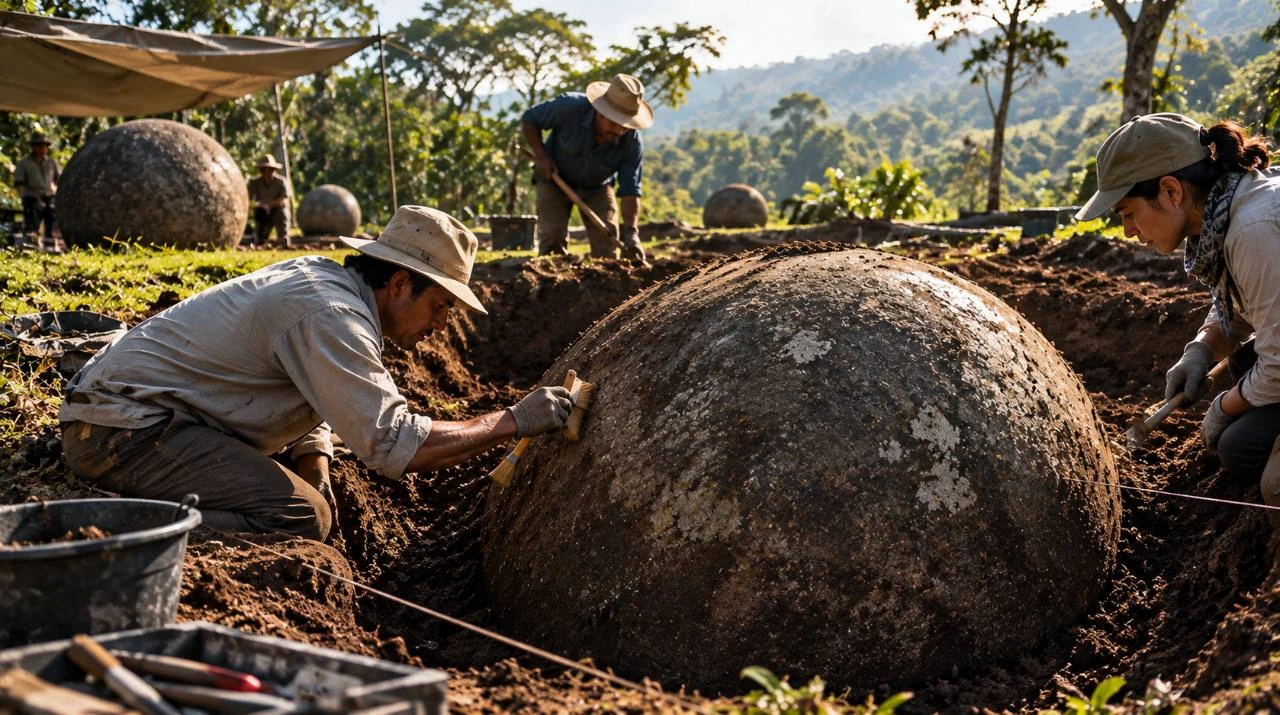
Editorial reconstruction of excavation work, supplied to PRESDA.
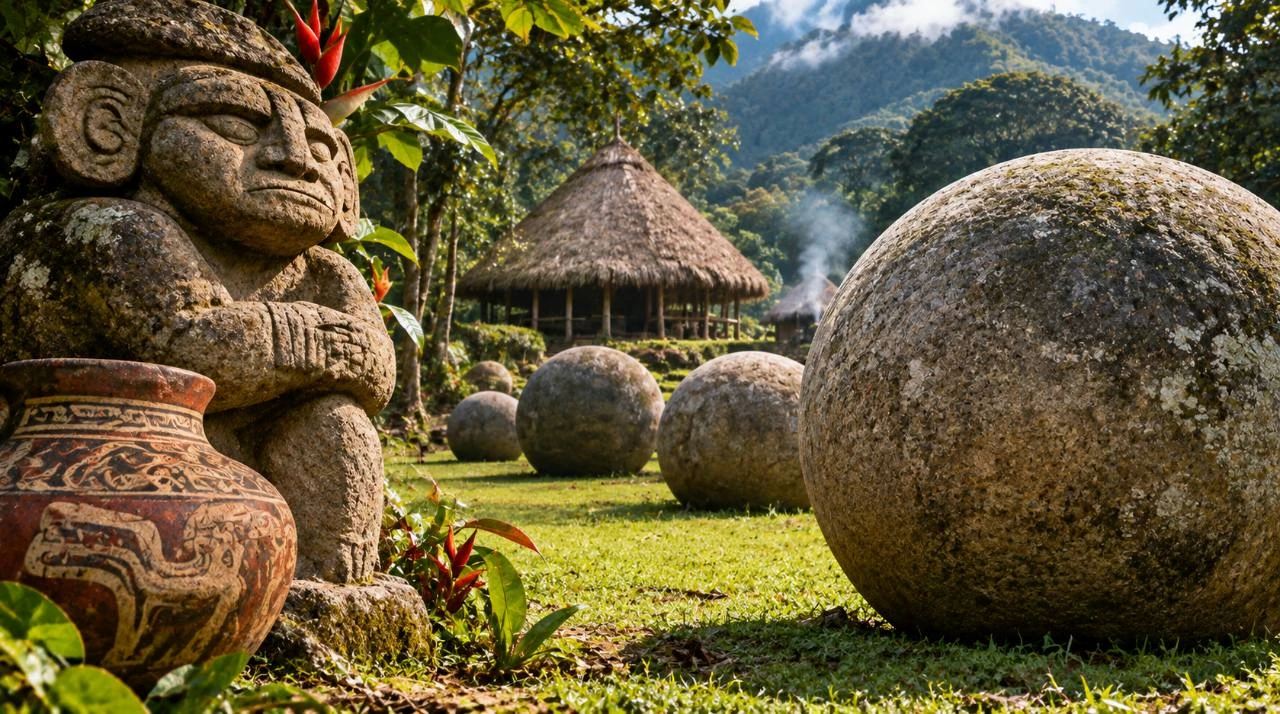
In the late 1930s, workers preparing land for banana plantations in southern Costa Rica exposed stone spheres in the Diquís Delta. Some had long been buried in floodplain sediment. Clearing land brought them to wider attention, but it also threatened the places where they had stood for centuries. The objects that made the delta famous were already starting to lose their archaeological context. Museo Nacional de Costa Rica
The rumor that some spheres contained gold
Accounts based on the early survey describe treasure seekers using explosives, often described as dynamite, to blast at least one sphere after hearing that gold lay inside. The reports establish a history of damage and rumor, with no reliable total for how many spheres were destroyed this way. Goldwork really does occur at archaeological sites in the region. That evidence concerns separate objects and offers no proof that the spheres were containers. Account of Lothrop’s sphere records
How plantation work turned a local find into an archaeological problem
The modern record begins with land clearance, and the conditions of that discovery matter. Earthmoving exposed objects that had been buried or left in the landscape for centuries. Fieldworkers reached some locations while alterations were already taking place. The National Museum’s later review says Doris Stone examined five sites with spheres between 1939 and 1941. Her plans sometimes recorded spheres near artificially raised mounds. When cultivation or looting changed those places, the old drawings became evidence for relationships that could no longer be observed directly. Source · Museo Nacional de Costa Rica, field report
Why the gold story travels farther than the records
There are three separate questions behind the familiar account: whether someone intentionally broke a sphere, what that person believed might be inside, and whether any metal was actually found there. An account of damage can support the first two without establishing the third. Goldworking in the region makes the rumor understandable, but gold objects and carved stone are different finds with different histories. Neither an illustrated feature about the spheres nor a dramatic retelling can supply a verified count of objects destroyed. The excavation materials and institutional records are stronger evidence for changes to specific sites. Source · Museo Nacional de Costa Rica, field report Source · Costa Rica’s World Heritage nomination dossier
How to read a sphere in a museum
The Metropolitan Museum’s catalogue describes a Diquís sphere made of andesite. A collection entry can document material and provide a stable record for comparing objects. A museum display answers a different question from a field plan, even when objects are shown in a row. The photograph here shows a modern arrangement in San José. It gives a sense of scale and variation, while the excavation records are what connect objects to their original buildings, routes or neighboring monuments. Source · The Metropolitan Museum of Art, object 2014.632 Source · Costa Rica’s World Heritage nomination dossier
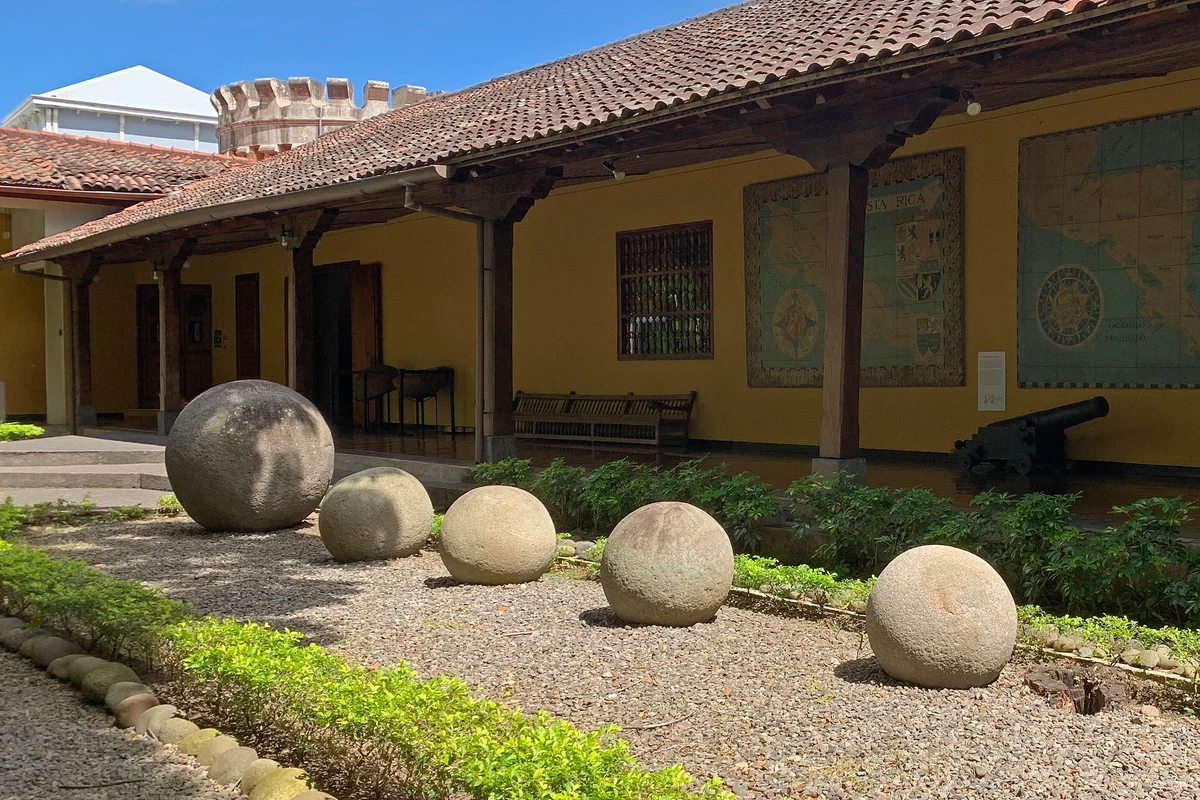
Diquís stone spheres of different sizes in a modern museum display in San José.
Mario Roberto Durán Ortiz
Resized and converted to WebP. This version is available under CC BY-SA 4.0.
What survives when the evidence has moved
Researchers can compare dimensions, rock types and working traces on a displaced object. For many questions, however, the most valuable measurement is a relationship: a distance to another sphere, a position next to an entrance or the connection to a deposit of pottery. Notes, plans and photographs can sometimes recover parts of that setting. That is why protecting the settlements of the Diquís safeguards more evidence than gathering loose spheres in a single place. Source · Museo Nacional de Costa Rica, field report Source · Costa Rica’s World Heritage nomination dossier
The cost of moving a sphere
Damage was only one way evidence disappeared. A sphere moved to a garden can still be measured, but its original alignment and relationship to a house platform or plaza may be impossible to reconstruct. That makes a sphere still in place more informative than an isolated specimen with a perfect surface. Costa Rica’s World Heritage nomination dossier
From plantation finds to archaeology
Doris Stone recorded groups and published her early work in 1943. Samuel Lothrop worked in the delta in 1948 and published a fuller study in 1963. Their records preserve details of alignments and locations that later landscaping and collecting sometimes erased. Years of National Museum research have since put the sculptures back into the study of entire settlements. Costa Rica’s World Heritage nomination dossier
What UNESCO protects
UNESCO inscribed four archaeological sites in 2014: Finca 6, Batambal, El Silencio and Grijalba-2. The designation covers pre-Columbian settlements and their relationships to the spheres. Finca 6 is especially valuable because alignments survive where people originally placed the stones. Their precise meanings remain open to study. UNESCO World Heritage Centre
The plantation records and the archaeological record
Banana development exposed spheres in the late 1930s. Later fieldwork by Doris Stone and Samuel Lothrop recorded features across several plantation plots. The National Museum’s study lists Fincas 1, 2, 4, 5, 6 and 7 among the areas with surface or buried structures. These records help archaeologists distinguish modern encounters with the stones from the ancient history of the settlements. Source · diquis.go.cr Source · museocostarica.go.cr
Why a findspot is as important as a sphere
An isolated sphere can still be measured and its stone studied. Its setting answers different questions. An undisturbed placement near a platform or in a row lets researchers compare architecture, orientation and the way people moved through a settlement. Once a sphere is removed, later researchers need a map, photograph or field record to reconstruct those relationships. Speculation about what might have been inside cannot recover that lost evidence. Source · museocostarica.go.cr Explore the settlements behind the stone spheres.
FAQ
Frequently Asked Questions
Was gold ever verified inside the stone spheres?
There is no reliable archaeological confirmation. Gold ornaments from the region are separate finds.
When did the sites gain World Heritage status?
UNESCO inscribed the four-site property in 2014.
PRESDA Dispatch
Stay Informed. Stay Aware.
A sharp briefing across AI, gaming, sport, business, world affairs, paparazzi, and lifestyle.