THE LORD OF SIPÁN: PERU’S EXTRAORDINARY ROYAL TOMB
The 1987 excavation at Huaca Rajada preserved a Moche ruler’s burial and the relationships between his regalia, companions and offerings.
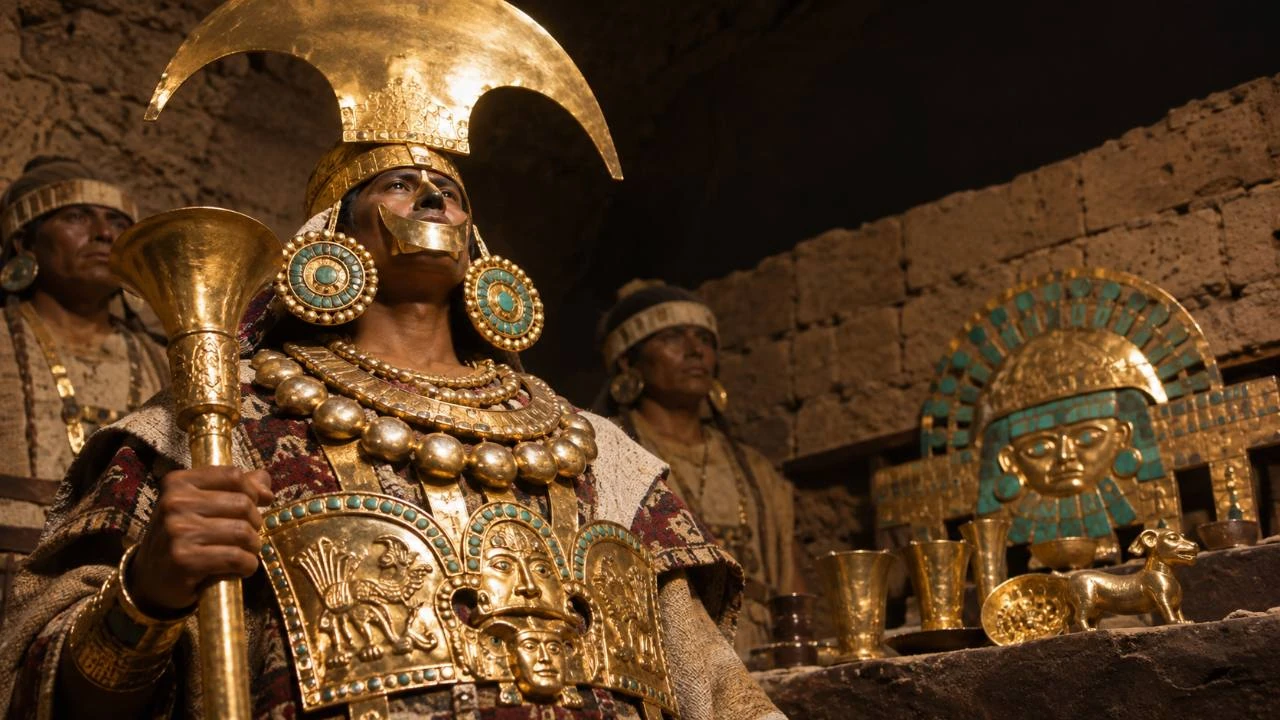
AI-generated historical illustration supplied for PRESDA. The face, dress and arrangement are imagined.
The most valuable thing recovered from the Lord of Sipán’s tomb was its context. At Huaca Rajada in Peru’s northern Lambayeque region, archaeologists could document the position of ornaments, offerings and human remains around the principal burial. Peru’s Ministry of Culture dates the discovery to July 20, 1987, and credits a Peruvian team led by Walter Alva, Susana Meneses and Luis Chero Zurita. Their work preserved evidence of how a Moche elite community staged a burial. Peru’s Ministry of Culture: the 1987 discovery
How a rescue excavation became a turning point
Looting brought the site to archaeological attention. Objects removed from a grave may survive in collections, but their positions and associations usually disappear. A pair of ear ornaments still beside a body can tell researchers who wore them and how they related to other objects. In isolation the same pair mainly preserves its workmanship. At Sipán the team could document an intact principal burial in a funerary complex that included other elite graves. Walter Alva and Christopher Donnan: Royal Tombs of Sipán
What the regalia says about power
The grave contained gold, silver and copper objects, ceramics and elaborate ornaments. A necklace with beads shaped like peanuts joined different metals in a single piece. Ear ornaments combined gold and turquoise in miniature images. These objects required specialized craft and access to materials, but their significance went beyond expense. Their placement on and around the body turned dress into a public statement of rank and ritual authority, preserved when the chamber was closed. The Met: Golden Kingdoms exhibition
Reading a ceremony through objects
Moche imagery shows richly dressed figures in formal ceremonies. Excavators and art historians compared details of that imagery with the regalia buried at Sipán. The parallels make a ceremonial role plausible. They cannot recover the individual’s name or turn every painted scene into a record of a particular event. The title Lord of Sipán is a modern designation for the central burial. Other people buried in the complex likewise have archaeological labels, including the Old Lord and the Priest. The Met: Golden Kingdoms exhibition
The museum and the site tell different parts of the story
The Museo Tumbas Reales de Sipán opened in Lambayeque in 2002 and presents objects from the royal tombs. Huaca Rajada is the excavation site, with its own site museum. Together they make it possible to study both the original setting and the conservation of fragile objects removed from it. The discovery matters because it allows archaeologists to put a society’s material choices back into relationship with the people who made, wore and buried them. Peruvian Ministry of Culture: the Royal Tombs Museum
The Moche world behind the tomb
The Moche flourished in several valleys along Peru’s north coast, where agriculture and Pacific resources supported regional centers. Sipán belongs to that landscape. Its richness reveals the power concentrated at this site, while a single grave cannot tell us how all Moche communities were governed. The different tombs at Huaca Rajada are valuable in part because comparing them can show which burial choices were shared and which belonged to particular people or occasions. The Met: Moche regional centers and material culture
Related reading · Caral and early urban Peru.
FAQ
Frequently Asked Questions
When was the tomb discovered?
Peru’s Ministry of Culture dates the discovery to July 20, 1987.
Was the Lord of Sipán an Inca ruler?
The burial belongs to the earlier Moche culture of northern Peru.
Where are the finds displayed?
The Museo Tumbas Reales de Sipán in Lambayeque displays finds from the royal tombs.
PRESDA Dispatch
Stay Informed. Stay Aware.
A sharp briefing across AI, gaming, sport, business, world affairs, paparazzi, and lifestyle.