Lula Wins Brazil's 2026 Presidential Election
Brazil's TSE confirms Lula's reelection with 51.79% to Flávio Bolsonaro's 48.21%. The final vote, political context and disputed aftermath explained.
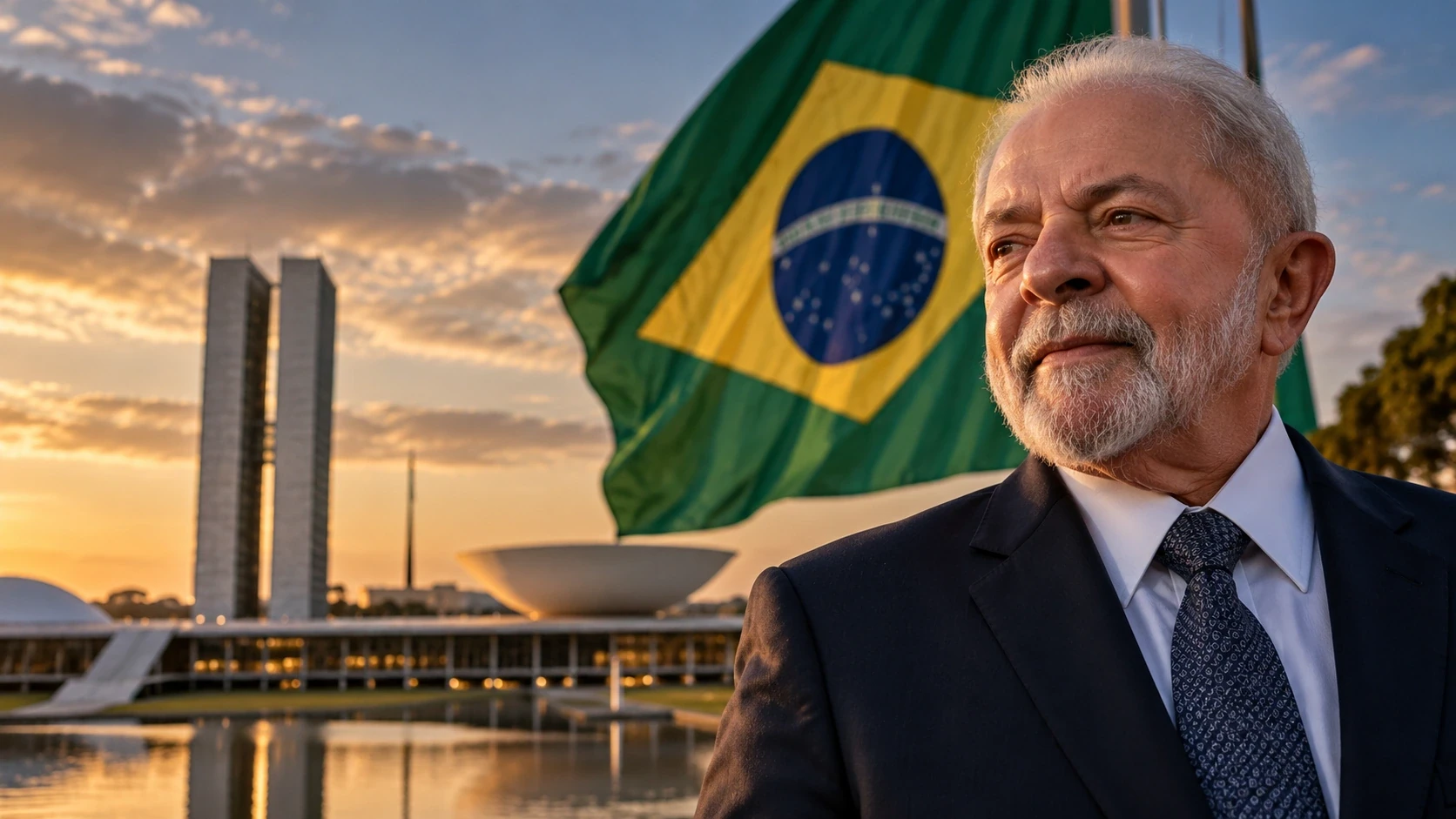
PRESDA AI-generated editorial illustration of Lula and Brasília. This is not an authentic campaign, election-night or victory photograph.
Luiz Inácio Lula da Silva has won Brazil's 2026 presidential election, securing a fourth term after a runoff that reversed his first-round deficit. The Superior Electoral Court, known as the TSE, announced his reelection following voting on Sunday, October 25. Its published final figures give Lula 51.79% of valid votes and Senator Flávio Bolsonaro 48.21%. The result settles who the electoral authority declared elected; it has not ended the political confrontation around the vote. TSE: announcement and runoff report
The official result, with the denominator explained
Lula, of the Workers' Party, received 64,256,232 votes. Flávio Bolsonaro, of the Liberal Party, received 59,826,041. Those totals produce a difference of 4,430,191 votes and a displayed margin of 3.58 percentage points. The percentages refer to valid presidential votes, not to every registered voter and not to ballots left blank or declared invalid. That distinction prevents an election result from being mistaken for a measure of support across the entire population.
The TSE reported turnout of about 128.2 million and abstention of roughly 19.2%, down from 21.08% in the first round. These are participation figures; they answer a different question from the candidates' shares of valid votes. Rounding also matters: subtracting the two displayed candidate percentages produces 3.58 points, while calculations using unrounded proportions can differ at the second decimal place.
A comeback between the two rounds
Brazil's Chamber of Deputies reported that Flávio Bolsonaro had led the first round with 47.03%, against Lula's 45.16%. Neither reached an outright majority of valid votes, sending the contest to a runoff. The chamber described Lula's reversal as the first time the runner-up in a first round had gone on to win Brazil's presidential runoff. Chamber of Deputies: election result and first-round context
The shift should not be read as a simple count of voters switching from one finalist to the other. People who chose eliminated candidates could select a finalist, abstainers could return, and previous voters could stay home or cast a blank or invalid ballot. Aggregate totals do not identify individual choices. Explaining the victory therefore requires more than subtracting two election-night percentages.
Why the fourth term matters
Lula previously served as president from 2003 to 2010 and returned to office in 2023. A further victory extends a political career that has shaped Brazil's debate over social policy, economic development and its role abroad. Reuters described the outcome as an unprecedented fourth presidential mandate. This is a fourth term overall, not four uninterrupted terms. Reuters: Lula's fourth-term victory
His opponent was Flávio Bolsonaro, the senator and son of former president Jair Bolsonaro. Keeping the two men distinct is essential when discussing campaign statements and objections to the 2026 result. The runoff offered voters a choice between Lula's continuation in office and a challenger associated with the political movement built around his father. It also produced a substantial losing electorate whose preferences remain part of Brazil's political life.
Victory, rejection and the dispute over voting arrangements
Associated Press reported that Lula thanked voters and pledged respect for Brazilians after the result. That conciliatory message faces an immediate test: a winning campaign must now deal with citizens who voted against it as well as those who made its victory possible. AP: election-night updates
Flávio Bolsonaro did not concede. Reuters reported his refusal to recognize the defeat, while AP reported that he intended to seek annulment following a disputed extension of voting. AP also reported that both candidates had requested an extension amid transport difficulties. An objection, an announced legal request and a judicial finding are different things: the reporting cited here does not establish that the election was invalidated or that fraud changed the result. Reuters: Bolsonaro refuses to concede AP: dispute and transport difficulties
Readers should judge subsequent developments by identifiable filings and court decisions, including their dates and scope. A claim that voting arrangements were unfair requires examination of the rule, the circumstances and the evidence. It cannot be resolved by repeating a campaign accusation as fact, or by pretending that the existence of a complaint changes the published count.
International reactions and the regional context
AP reported congratulations from regional and world leaders after Lula's reelection. The same agency situated the result against a recent sequence of conservative presidential victories in Latin America. That regional comparison gives the election diplomatic significance, but Brazil's voters were choosing their own government, not casting a single referendum on every neighboring administration. AP: international congratulations AP: regional political context
International approval and domestic electoral legitimacy also operate on different levels. Foreign congratulations acknowledge a result; they do not replace the TSE's count or Brazil's judicial procedures. Conversely, criticism from abroad is not evidence that ballots were miscounted. Keeping those categories separate is particularly important when political reactions circulate faster than the documents on which they claim to rely.
What the result does, and does not, tell us
The vote authorizes another presidential term; it does not by itself establish parliamentary support for every policy, explain every voter's motivation or guarantee economic outcomes. Governing will still involve institutions, budgets and negotiations. The narrowness of the contest is politically meaningful, but it should not be used to erase either the winner's official majority or the millions who preferred his opponent.
The immediate questions are concrete: what formal challenges are filed, how the relevant courts address them, and what the reelected administration sets out as its governing priorities. Predictions about unrest, diplomatic ruptures or market performance are not substitutes for verified developments. This report is dated October 26, 2026; subsequent court orders or official revisions would need to be assessed on their own evidence.
Reading election figures with care
Earlier reports can contain accurate partial counts that differ from the final result. Reuters' October 25 report cited 51.75% against 48.25% with 98.27% of polling sections counted. Those figures belong to that stage of the count. This article uses the later TSE totals of 51.79% and 48.21%, rather than mixing snapshots into one purported final result.
The same discipline applies beyond politics: a percentage needs a date, a denominator and a source. Our explanation of Black Friday's retail figures examines why spending, shopper surveys and forecasts cannot be treated as equivalent. In Brazil's election, the central fact is clear: the TSE declared Lula reelected. The contested aftermath must be reported with equally clear boundaries between evidence, allegation and analysis.
FAQ
Frequently Asked Questions
What is this PRESDA article about?
Brazil's TSE confirms Lula's reelection with 51.79% to Flávio Bolsonaro's 48.21%. The final vote, political context and disputed aftermath explained.
Which category does this story belong to?
This story is part of PRESDA's World coverage.
Who published this article?
Lula Wins Brazil's 2026 Presidential Election was published by PRESDA Editorial on PRESDA.
PRESDA Dispatch
Stay Informed. Stay Aware.
A sharp briefing across AI, gaming, sport, business, world affairs, paparazzi, and lifestyle.