Sudan's Famine Risk Deepens as War and Drought Collide
Sudan's October famine warning explained: Darfur, Kordofan, El Niño, displacement, child malnutrition and dated UN figures, with classifications kept distinct.
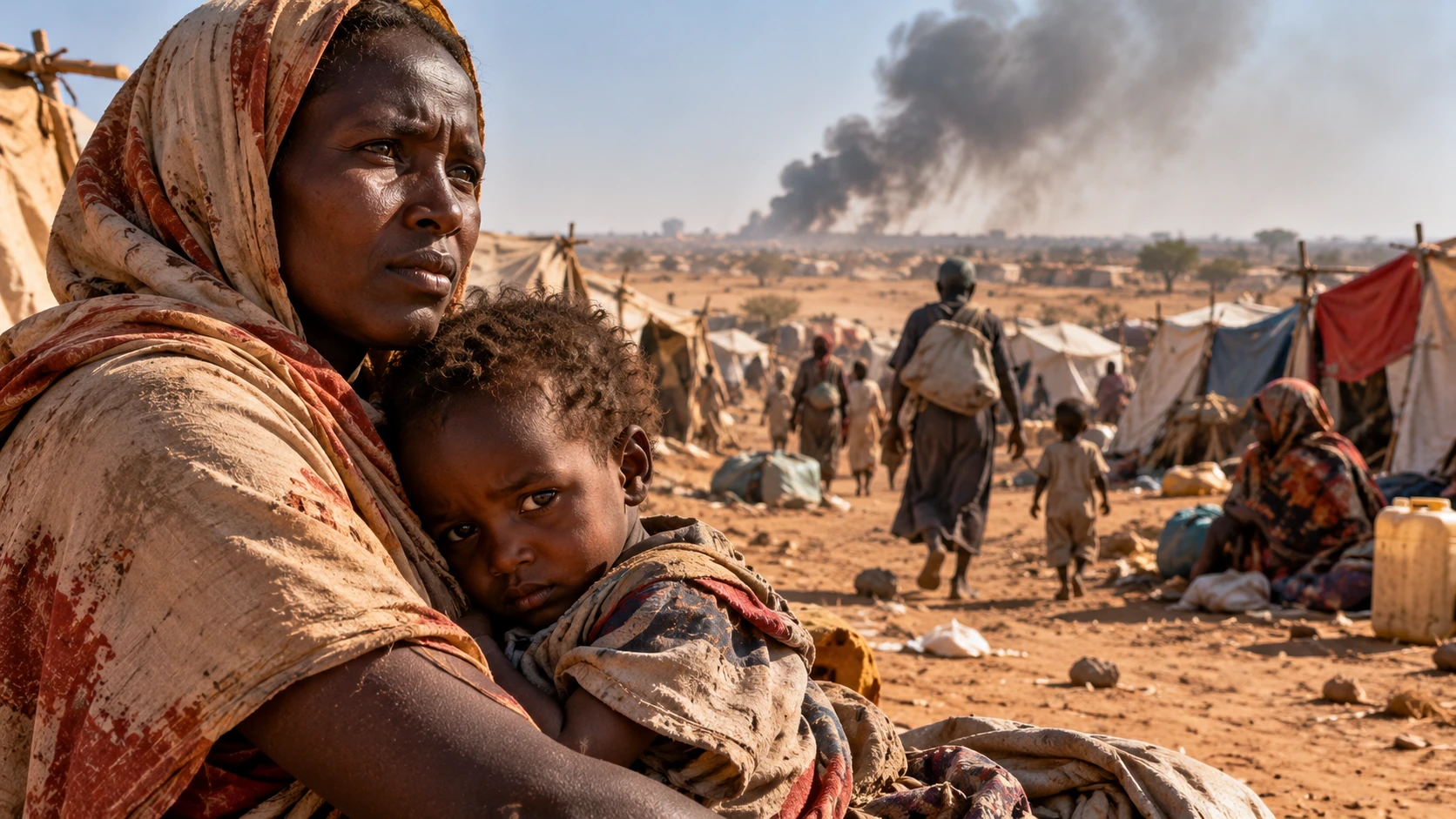
PRESDA AI-generated editorial illustration. The people, camp and background are imagined, not a documentary photograph of Sudan or identifiable victims.
Sudan's hunger crisis is entering another dangerous phase. War has stripped families of homes, income and access to essential services; drought is now weakening the harvests and livelihoods on which recovery depends. The immediate concern is not simply whether food exists somewhere in the country, but whether people can reach it, afford it and remain healthy enough to survive.
An October 12, 2026 alert from the Integrated Food Security Phase Classification, or IPC, warns of rapidly worsening conditions in Greater Darfur and Greater Kordofan. It identifies rising malnutrition, conflict, displacement, poor rainfall and inadequate aid as interacting pressures. This is a warning of increasing famine risk, not a new blanket declaration that all Sudan is in famine. IPC's October alert
What the October warning says
The IPC reports that nutrition surveys conducted since January recorded Critical acute malnutrition levels across much of Greater Darfur, while admissions for severe acute malnutrition rose sharply in parts of North and South Darfur. In Greater Kordofan, fighting and displacement combine with weak rainfall and constrained livelihoods to damage food security and harvest prospects. These findings identify places needing urgent action; they are not interchangeable with a fresh national population estimate. The alert's regional evidence
The latest full analysis cited here was published in May. It estimated nearly 19.5 million people in IPC Phase 3 or above during February to May 2026, including almost 135,000 in household-level Phase 5, Catastrophe. Its later projections did not cover the whole country, and the IPC explicitly cautioned against comparing periods with different geographic coverage. Those figures provide a dated baseline, not an October census. IPC analysis and coverage warning
Famine risk, catastrophe and confirmed famine are different
IPC Phase 5 at household level is called Catastrophe. An area-level Famine classification requires converging evidence about extreme food deprivation, acute malnutrition and mortality. A risk-of-famine warning describes a credible deterioration scenario; it is not confirmation that all classification thresholds have already been crossed. Conversely, the absence of a confirmed area classification does not mean people are adequately fed or that nobody is dying. IPC's explanation of famine classifications
Sudan has already experienced confirmed famine. The IPC classified El Fasher in North Darfur and Kadugli in South Kordofan in Famine with reasonable evidence for September 2025, with persistence projected through January 2026. The May 2026 UN agency summary said its then-current analysis identified no areas currently in Famine, while warning of risk in 14 areas. Neither that later finding nor the October alert should erase the earlier classifications or be presented as proof that the danger has passed. IPC's 2025 findings May 2026 UN agency assessment
War makes a food shortage harder to escape
The conflict between Sudan's armed forces and the paramilitary Rapid Support Forces began in April 2023. Its humanitarian effects extend far beyond front lines. Damaged markets and agricultural assets, restricted movement and interrupted services undermine both the production of food and the ability to buy it. FAO, WFP and UNICEF describe insecurity, bureaucratic barriers and attacks along supply routes as obstacles to aid delivery. A shipment reaching the country does not guarantee that it reaches a family in a cut-off community. UN agencies on access and destroyed livelihoods
This is why hunger cannot be understood only through tonnes of grain. A household can be surrounded by functioning markets yet unable to afford a meal; another may have purchasing power but no safe route to supplies. Restoring livelihoods and access is therefore part of the emergency response, not a separate issue to be considered only after food distributions end.
Drought adds pressure to an already damaged system
The October IPC alert attributes severe drought across more than half of Sudan to El Niño, describing crop failures, water deficits, reduced incomes and rising cereal prices. It is the interaction with war that makes this especially dangerous: families already uprooted or impoverished have fewer ways to absorb another loss. The alert supports a drought-related deterioration; it does not establish that every locality is affected equally. IPC on drought and livelihoods
FAO's Sudan response combines crop, livestock and fisheries support to help households produce food locally. These measures address a different part of the problem from immediate food assistance. Seeds are of limited use when farmers cannot safely reach land; emergency rations do not by themselves restore the next agricultural season. Both forms of support depend on access, timing and the ability to work without attack. FAO's food-production response
Displacement is not one simple number
At a UN briefing on September 18, IOM reported 8.6 million people still internally displaced and 4.9 million returnees. Nearly 70% of internally displaced people were living with host families or in informal settlements. These are dated categories, not figures to add into a single current count of refugees. Returnees have moved back; internally displaced people remain within Sudan; people crossing borders require a separate measure. IOM's September briefing
Returning to a home area also says little, by itself, about whether water, clinics, schools or income have returned. For aid planning, location and living conditions matter as much as movement. A reduction in the number recorded as displaced cannot automatically be read as an equivalent reduction in humanitarian need.
Children face a combined nutrition and health emergency
The May analysis projected that 825,000 children under five would experience severe acute malnutrition during 2026. That is an annual projected caseload, not the number of children counted as ill on one October day. Separately, WHO reported on October 12 that it had supported all 161 operational nutrition stabilization centres and helped treat more than 26,000 children with severe acute malnutrition and medical complications between January and August. These treatment figures cover a different population and period. UN agencies' annual nutrition projection WHO's dated treatment figures
WHO explains that malnutrition increases vulnerability to severe disease, including cholera and measles, while access to clean water and health care is severely constrained. Its October statement said 37% of health facilities had stopped functioning by 2026. Treating hunger therefore requires more than calories: nutrition care, infection treatment, safe water and working referral systems belong in the same response. WHO on the health and nutrition emergency
What aid can achieve, and what is stopping it
WHO said on October 12 that only 23% of its US$97.7 million humanitarian appeal had been funded. That percentage applies to WHO's appeal, not the entire international response. The organization calls for protection of civilians and food, water and health systems, sustained access across front lines, and predictable funding. Its priorities particularly identify North and West Kordofan. WHO's appeal and access priorities
IOM's September warning showed how funding shortages can damage the machinery of relief itself: its shared aid pipeline faced running out of shelter supplies, while losing warehouses and operational capacity would make restarting difficult and costly. That was a warning at the time, not confirmation here that every predicted closure subsequently happened. Effective aid needs functioning logistics as well as donated goods. IOM's logistics warning
Acting before another classification becomes necessary
The central conclusion is urgent without being absolute: the October evidence shows a worsening risk in already devastated regions, while national totals and local classifications refer to different dates and methods. Assistance should respond to those signals now. Waiting for a formal famine finding would confuse a tool for describing catastrophe with a threshold for deserving help.
For readers, the most useful discipline is to ask what each number measures, when it was collected and which places it covers. For the response, the practical test is whether families can obtain food, clean water and care consistently. PRESDA's wider history of medicine provides further context on the systems behind human health; in Sudan, keeping those systems accessible is an immediate matter of survival. Medicine and the systems behind human health
FAQ
Frequently Asked Questions
What is this PRESDA article about?
Sudan's October famine warning explained: Darfur, Kordofan, El Niño, displacement, child malnutrition and dated UN figures, with classifications kept distinct.
Which category does this story belong to?
This story is part of PRESDA's World coverage.
Who published this article?
Sudan's Famine Risk Deepens as War and Drought Collide was published by PRESDA Editorial on PRESDA.
PRESDA Dispatch
Stay Informed. Stay Aware.
A sharp briefing across AI, gaming, sport, business, world affairs, paparazzi, and lifestyle.