ROMAN WALL PAINTINGS DISCOVERED IN SPAIN'S MÉRIDA
What Mérida’s city council confirmed about newly exposed Roman paintings, peacocks and the peristyle of the Huerta de Otero house.
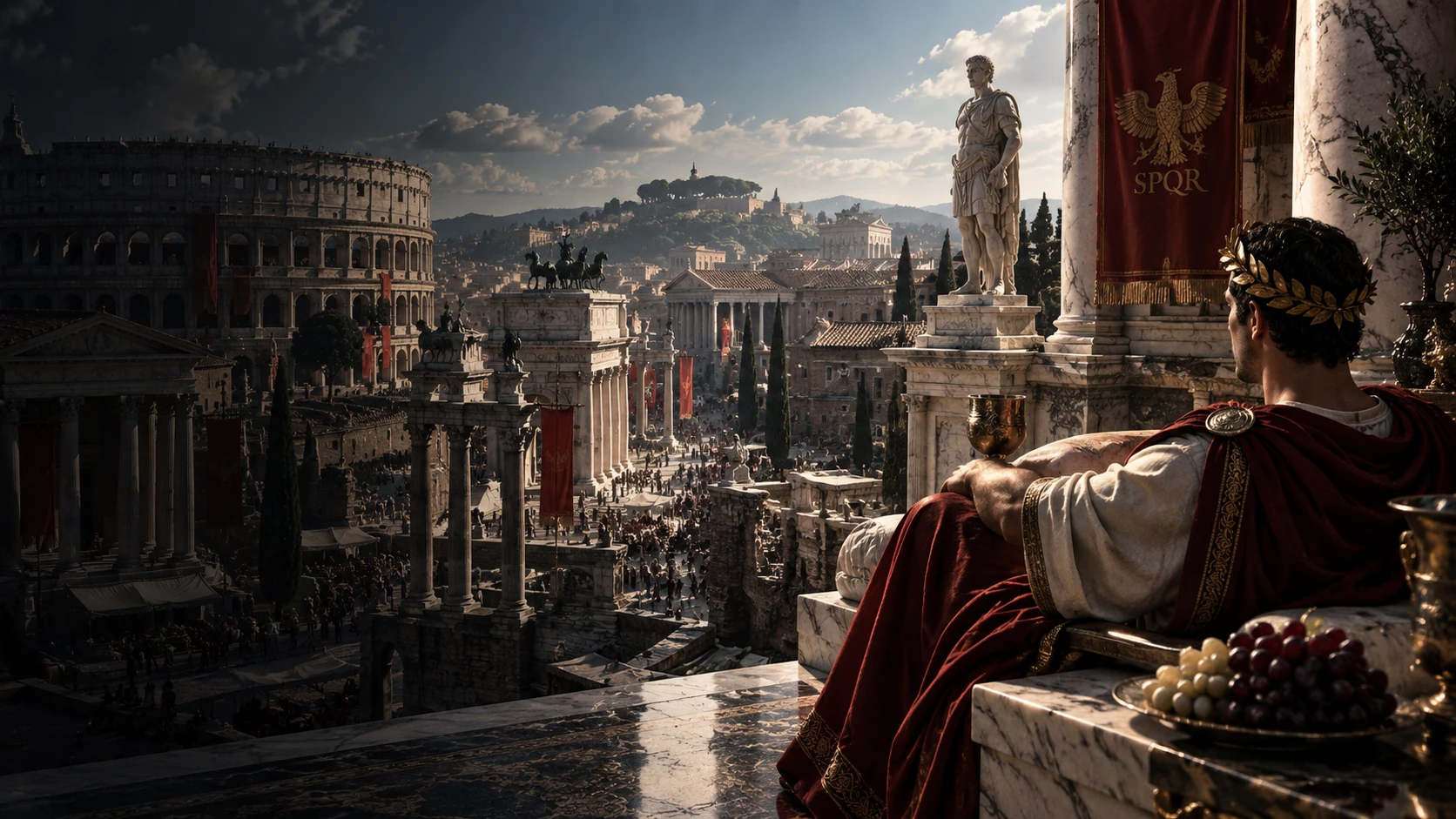
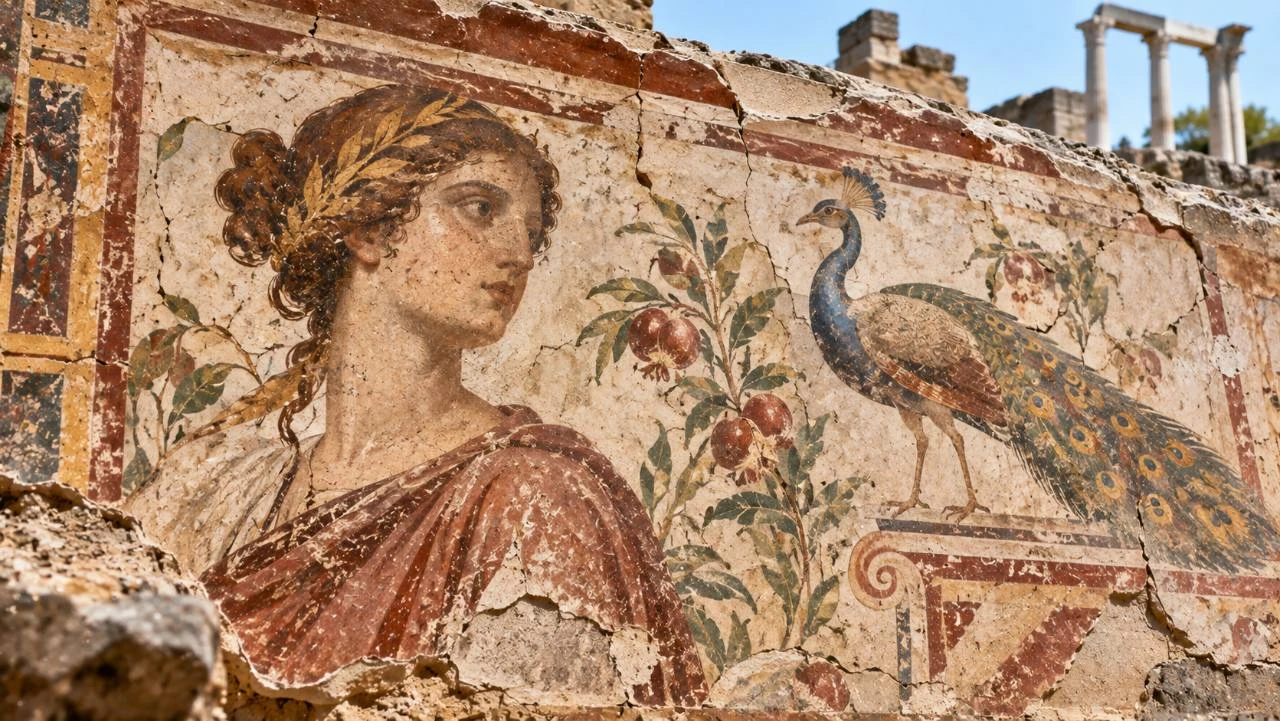
Editorial illustration supplied for PRESDA.
Roman wall paintings newly exposed at Huerta de Otero are revealing another part of a richly decorated house in Mérida, Spain. In a November 17, 2026 announcement, the city council confirmed paintings on the interior and exterior walls of its peristyle, including peacocks and other natural and mythological motifs. The discovery comes from a continuing excavation by the municipal Barraeca V training school under the supervision of the Consorcio de la Ciudad Monumental. It adds colour to a house already known for its Medusa mosaic. Mérida City Council: November 17, 2026 excavation announcement
What did the primary announcement confirm?
| Date | Milestone |
|---|---|
| 25 BCE | Foundation of Augusta Emerita |
| 1976 | Initial excavation at Huerta de Otero |
| 2019 | Work resumes through the Barraeca programme |
| November 17, 2026 | City council confirms newly exposed peristyle paintings |
The council’s report identifies a newly investigated strip of ground left unexcavated during work in 1976. Removing it has helped clarify the relationship between the room containing the Medusa mosaic and a previously exposed section of the peristyle. Archaeology instructor José Vargas described well-preserved painting on both sides of its walls. These details place the discovery in a specific building and excavation problem. The finding concerns newly revealed parts of an established site, rather than an entirely unknown Roman city. Mérida City Council: November 17, 2026 excavation announcement
The same report describes birds, natural imagery and mythological subjects, with peacocks explicitly mentioned. Those descriptions support a picture of elaborate domestic decoration. They do not yet provide a published catalogue identifying every figure or a complete technical analysis of the pigments. The supplied hero is an editorial illustration inspired by Roman wall painting. Its female figure and arrangement are not used here as evidence of the exact composition excavated at Huerta de Otero.
Where is Huerta de Otero?
The site lies within Mérida’s historic urban fabric, close to the Alcazaba. The Consorcio’s excavation record describes a substantial Roman house built inside the city walls, alongside remains of a street and a stretch of the wall itself. Several courtyards at different levels, a marble staircase and private baths demonstrate the building’s complexity. The house was part of a working city, with circulation, water and boundaries connecting it to the neighbourhood around it. Consorcio de Mérida: Huerta de Otero excavation record
Why does Mérida contain so much Roman archaeology?
The city began as Augusta Emerita, founded in 25 BCE, and became the capital of Lusitania. UNESCO identifies its bridge, theatre, amphitheatre, circus and water-supply remains as an exceptional provincial ensemble. Monumental public buildings show how a Roman capital presented itself. Houses such as Huerta de Otero reveal a more private architectural world. Considering both helps explain how status, civic life and domestic display were expressed through the same urban landscape. UNESCO: Archaeological Ensemble of Mérida
What is a peristyle?
A peristyle is a space framed by columns, commonly associated with a courtyard and its surrounding circulation. In a Roman house, it could organise movement between rooms while bringing light and an outward-looking setting into the interior. The Huerta de Otero announcement matters because it connects painted surfaces with that architectural arrangement. The paintings can be studied in relation to where people walked, paused and looked, rather than solely as isolated pictures detached from their walls.
The Consorcio records several courtyards and different floor levels in this house. Its marble staircase, baths and mosaic floors indicate considerable investment in space and finish. The new paintings add another surface to that coordinated design. Their relationship with walls, passages and adjoining rooms may help researchers reconstruct how different parts of the residence were experienced. That reconstruction depends on precise plans and surviving evidence; attractive images alone cannot establish how every room was used. Consorcio de Mérida: Huerta de Otero excavation record
Why do peacocks and mythological motifs matter?
Natural and mythological subjects brought recognisable cultural references into the domestic environment. They also offered colour, rhythm and opportunities for skilled workmanship. At Huerta de Otero, the municipal announcement interprets the rich decoration as evidence of the resources available to the household. That is a reasonable reading of the investment required, while the owner’s personal identity remains a separate question. No named resident has been established by the release cited here. Mérida City Council: November 17, 2026 excavation announcement
Paintings and mosaics are different kinds of evidence
A mosaic is assembled from pieces set into a surface; wall painting applies colour to prepared layers. The National Museum of Roman Art stresses that Mérida’s surviving examples largely come from private architecture. Their survival is uneven because walls often collapse or lose their upper portions, leaving painted decoration near the base. A well-preserved stretch can therefore supply information missing from more fragmentary houses. The Medusa mosaic and the newly exposed paintings belong to the same residence’s decorative history, but are distinct finds. National Museum of Roman Art: paintings and mosaics
Were the paintings made as frescoes?
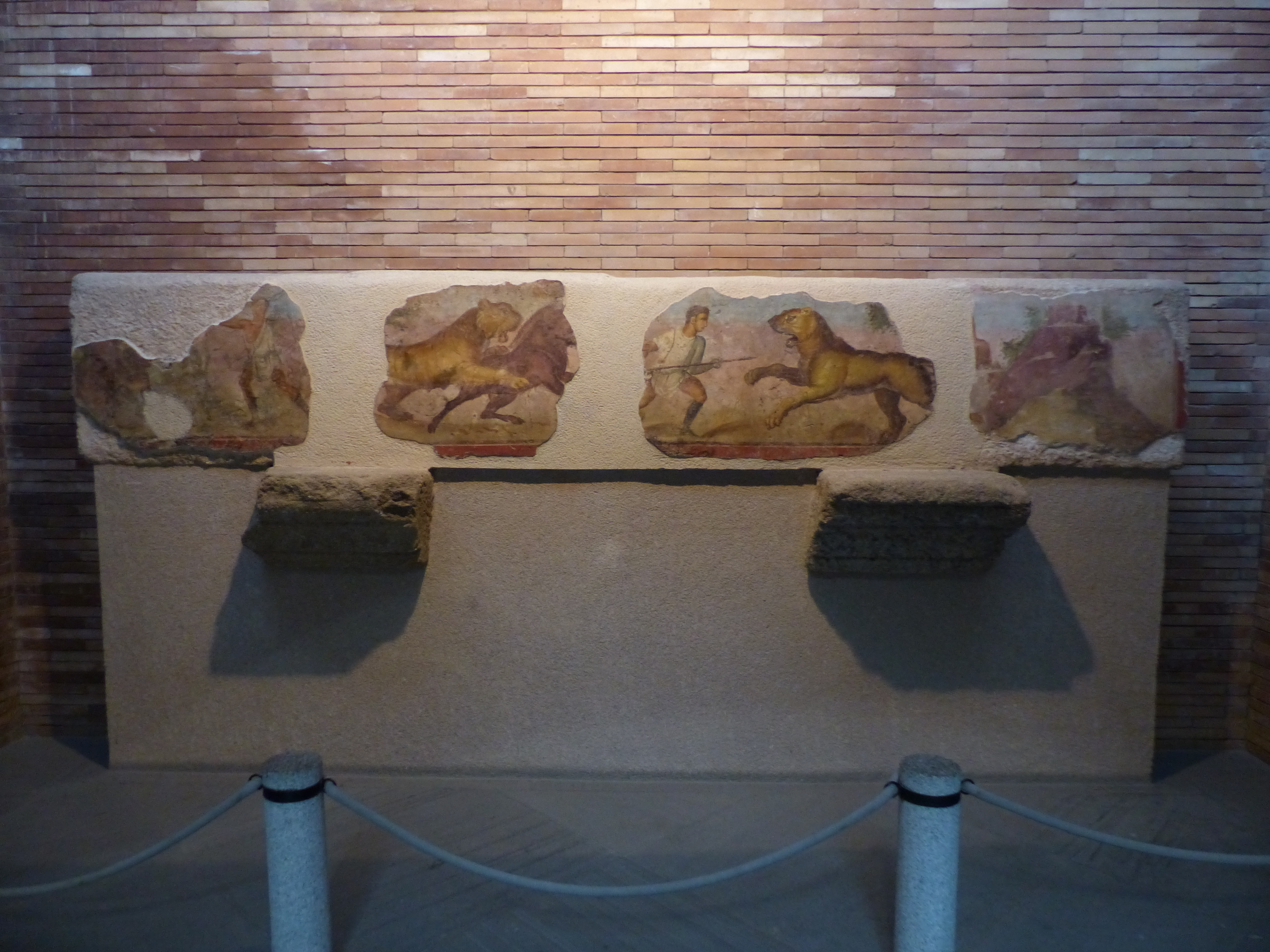
Paintings from Mérida’s amphitheatre podium, photographed in 2017. This museum example provides local context and is distinct from the newly exposed Huerta de Otero paintings.
Fresco describes painting onto fresh, moist plaster, so the setting of the plaster helps bind the pigment. Getty’s architectural teaching material provides that general definition. Roman painters could also use other applications and finishing techniques. The city council’s announcement does not establish a complete technical recipe for these newly exposed surfaces. Calling them wall paintings is secure; assigning every passage to one technique requires examination of the plaster, paint layers and any surviving traces of the working process. Getty: fresco and Roman architecture
The National Museum of Roman Art’s research bibliography includes studies of Mérida paintings using methods such as X-ray fluorescence, X-ray diffraction and infrared spectroscopy. In general, these approaches can investigate elements, minerals and compounds in materials. Their availability explains how future research might answer technical questions. It does not demonstrate that those tests have already been completed on the 2026 Huerta de Otero finds, or establish a particular expensive pigment from colour visible in a photograph. National Museum of Roman Art: research on pigments and plaster
How much of the site has been excavated?
Vargas describes a plot exceeding 5,000 square metres, of which approximately 15 percent has been excavated. Both figures are attributed estimates in the municipal report. The percentage measures investigated area, not the proportion of paintings discovered or the quantity of artwork still buried. Unexcavated ground may contain different kinds of remains, and later activity can affect preservation. A large remaining area creates research possibilities without guaranteeing a predictable number of future masterpieces. Mérida City Council: November 17, 2026 excavation announcement
Work began in 1976 and resumed through the Barraeca programme in 2019. The 2026 campaign therefore belongs to a sequence of investigation, documentation and training. The Consorcio lists the intervention as awaiting scientific publication. This distinction matters: a public announcement can securely identify a discovery while detailed analysis, phasing and specialist conclusions remain in preparation. For the wider society that produced such houses, see PRESDA’s account of life in the Roman Empire. Mérida City Council: November 17, 2026 excavation announcement Consorcio de Mérida: Huerta de Otero excavation record
Why conservation begins during excavation
Exposing a painted wall changes the conditions around it. Loose material, moisture, salts and weakened plaster can affect its stability. Conservators need to assess what survives before deciding how to clean, secure or present it. Their records also help distinguish ancient material from later repairs. A sharp, brightly coloured photograph represents one stage in that process. The long-term achievement is to retain enough stable evidence for research, interpretation and carefully managed public access.
What will make the discovery scientifically significant?
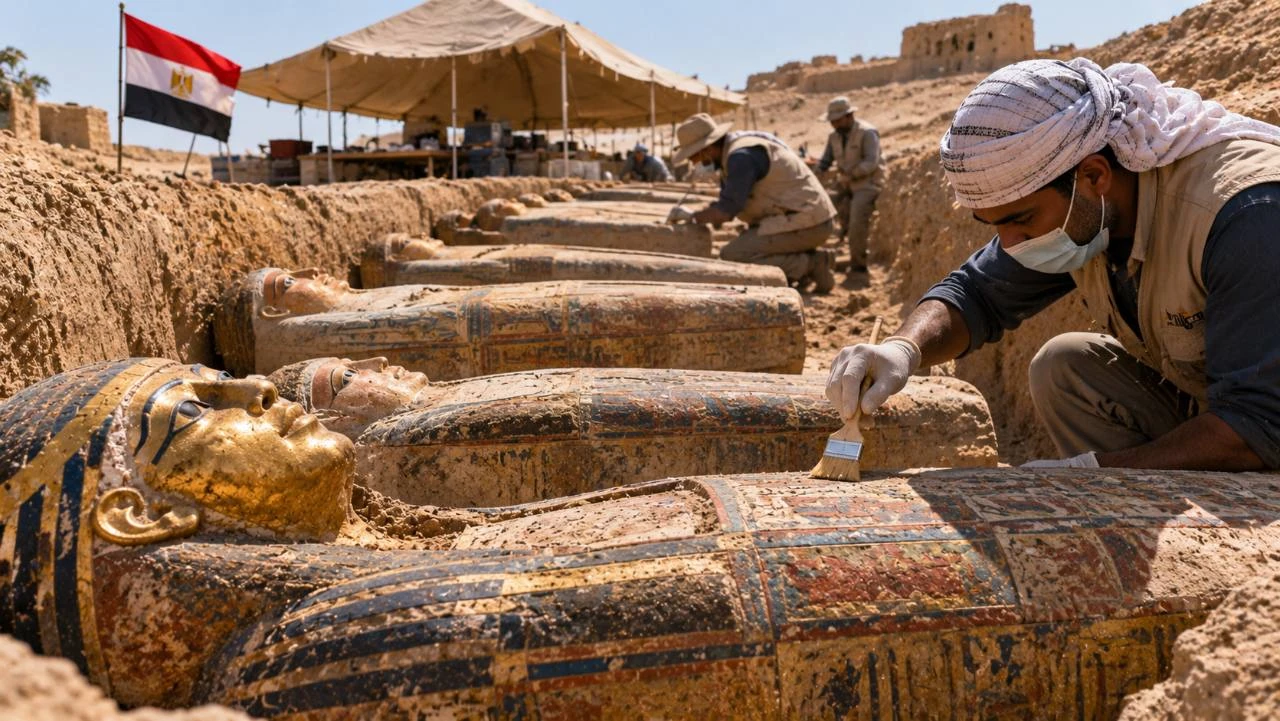
Its value will grow through the connection of image, architecture, materials and chronology. Plans can locate each surface; specialist study can refine the decorative sequence; conservation can preserve layers that are easily lost. The new paintings make Huerta de Otero more legible as a house, while the house gives the paintings their setting. Comparing this discovery with Saqqara’s painted coffins also shows why colour needs context: similar visual impact can belong to very different places, purposes and periods.
The verified news is already substantial: a supervised municipal excavation has exposed rich painting in a known Roman residence and clarified part of its layout. Outstanding questions are part of that achievement. They point toward the work needed to move from a discovery announcement to a fuller account of how the house was made, occupied and changed. The distinction leaves room for the evidence to become more precise without asking the first photographs to answer everything. Mérida City Council: November 17, 2026 excavation announcement Consorcio de Mérida: Huerta de Otero excavation record
FAQ
Frequently Asked Questions
Where were the paintings found?
They were exposed in the peristyle area of a large Roman house at Huerta de Otero in Mérida, Extremadura, Spain. The site is inside the ancient city walls and includes several courtyards, private baths and mosaic floors.
Who confirmed the discovery?
Mérida City Council published the primary announcement on November 17, 2026. The municipal Barraeca V school conducts the excavation with the collaboration and supervision of the Consorcio de la Ciudad Monumental.
What do the paintings depict?
The official report describes natural imagery, a rich variety of birds, mythological subjects and peacocks. A complete published catalogue identifying every figure and composition is not supplied in that announcement. The hero is an illustration, not a photographic record of the exact scene.
Are these the same discovery as the Medusa mosaic?
No. They are wall paintings newly exposed in the same house, helping clarify the connection between the mosaic room and the peristyle. The house’s decorated floors and painted walls are complementary but different kinds of evidence.
Is only 15 percent of the artwork known?
The reported 15 percent refers to the area of a plot exceeding 5,000 square metres that has been excavated. It is not an estimate of the proportion of paintings recovered or a prediction of how many artworks remain underground.
PRESDA Dispatch
Stay Informed. Stay Aware.
A sharp briefing across AI, gaming, sport, business, world affairs, paparazzi, and lifestyle.