THE MINOANS: EUROPE'S FIRST GREAT CIVILIZATION
Explore Bronze Age Crete: Knossos, Minoan rulers, maritime trade, art and Linear A. Archaeological evidence, Greek myths and the debated decline explained.
Before classical Athens, Bronze Age Crete supported towns, elaborate palatial centres, workshops and writing. Its inhabitants sailed into a Mediterranean already connected by trade. The Minoans left an extraordinary material world, but few words we can understand. Their buildings tell us how power operated more clearly than they tell us who held it. Sources: UNESCO
Calling them Europe’s first great civilization captures their importance, not an uncontested ranking of human societies. Earlier European farming communities had their own achievements, while Egypt and Mesopotamia developed complex states earlier. Minoan Crete is best understood as one of Europe’s earliest major urban, literate civilizations, shaped through exchanges across Europe, Africa and Asia. Sources: UNESCO Sources: British Museum
FROM FARMING COMMUNITIES TO PALACE SOCIETY
Knossos was inhabited in the Neolithic, long before its monumental buildings. During the third millennium BCE, settlements, craft production and regional networks grew. The label ‘Minoan’ is modern, associated with Arthur Evans and the legendary Minos; it is not a securely known name that these people used for themselves. Sources: Heraklion Sources: British Museum
Around 1900 BCE, the first major palaces developed. Archaeologists distinguish a First Palace or Protopalatial period, approximately 1900–1700 BCE, and a Second Palace or Neopalatial period, approximately 1700–1450 BCE. These are useful working ranges, not exact dates shared by every settlement. Rebuilding after destruction produced some of the complexes visible today. Sources: Heraklion Sources: Ellen Adams
Approximate BCE dates. Ordered stages, not an equal-duration scale; regional sequences vary.
c. 1900–1700 BCE
First Palace period
c. 1700–1450 BCE
Second Palace period
c. 1450 BCE onward
Destructions and later Mycenaean administration
Sources: Heraklion; Ellen Adams / Cambridge
PRESDA Data Graphics
FOUR PALACES, MORE THAN ONE CENTRE
Knossos, near Crete’s northern coast, was the largest and most elaborate palatial complex. Phaistos overlooked the fertile Messara plain in the south. Malia linked a northern coastal settlement with its surrounding agricultural land; Zakros, in eastern Crete, occupied a position suited to maritime contacts. Their different settings mattered to their economic lives. Sources: ICOMOS
In 2025, UNESCO inscribed six Minoan Palatial Centres, adding Zominthos and Kydonia to those four familiar names. The designation recognises a network of archaeological places, not proof that a single king governed the entire island. Shared architectural traditions coexist with differences in regional development, administration and political relationships. Sources: UNESCO
Selected sites, not a complete settlement list or a map of political boundaries.
Knossos
Northern Crete; largest palatial complex
Phaistos
Southern Crete; above the Messara plain
Malia
Northern coast; palace and settlement
Zakros
Eastern Crete; maritime connections
Sources: ICOMOS / UNESCO
PRESDA Data Graphics
WHO RULED THE MINOANS?
No securely identified, named king can be reconstructed for the Linear A palace world. Monumental courts, storerooms, seals and accounting documents show organised authority and unequal access to resources. They do not provide a readable dynastic history. Even ‘palace’ is an archaeological convention: these buildings combined economic, ceremonial and administrative functions, rather than simply being royal homes. Sources: ICOMOS Sources: Whittaker
One model envisages rulers whose authority joined political command with religious ceremony. Others emphasise elite households, competing institutions or forms of collective leadership. Knossos may have gained greater influence during the Neopalatial period, but the extent and mechanisms of island-wide control remain disputed. A shared cultural style is not, by itself, evidence of a unified state. Sources: Schoep and Knappett Sources: Ellen Adams
The visibility of female figures in ritual imagery has also encouraged arguments for powerful priestesses or female leadership. Those possibilities deserve examination, but images cannot establish a universal matriarchy. Nor does the absence of easily recognised royal portraits prove that kings never existed. The strongest conclusion is narrower: elites organised substantial resources, while the identity and institutional form of leadership remain uncertain. Sources: Schoep and Knappett Sources: Heraklion Museum
MINOS, THE MINOTAUR AND THE LABYRINTH
In later Greek mythology, Minos ruled Crete, Daedalus built a labyrinth, and Theseus confronted the Minotaur with Ariadne’s help. These are stories transmitted by later Greek traditions, not contemporary Minoan biographies. Archaeology has not authenticated a historical king matching the legendary Minos, or a creature imprisoned beneath Knossos. Sources: British Museum Sources: Heraklion
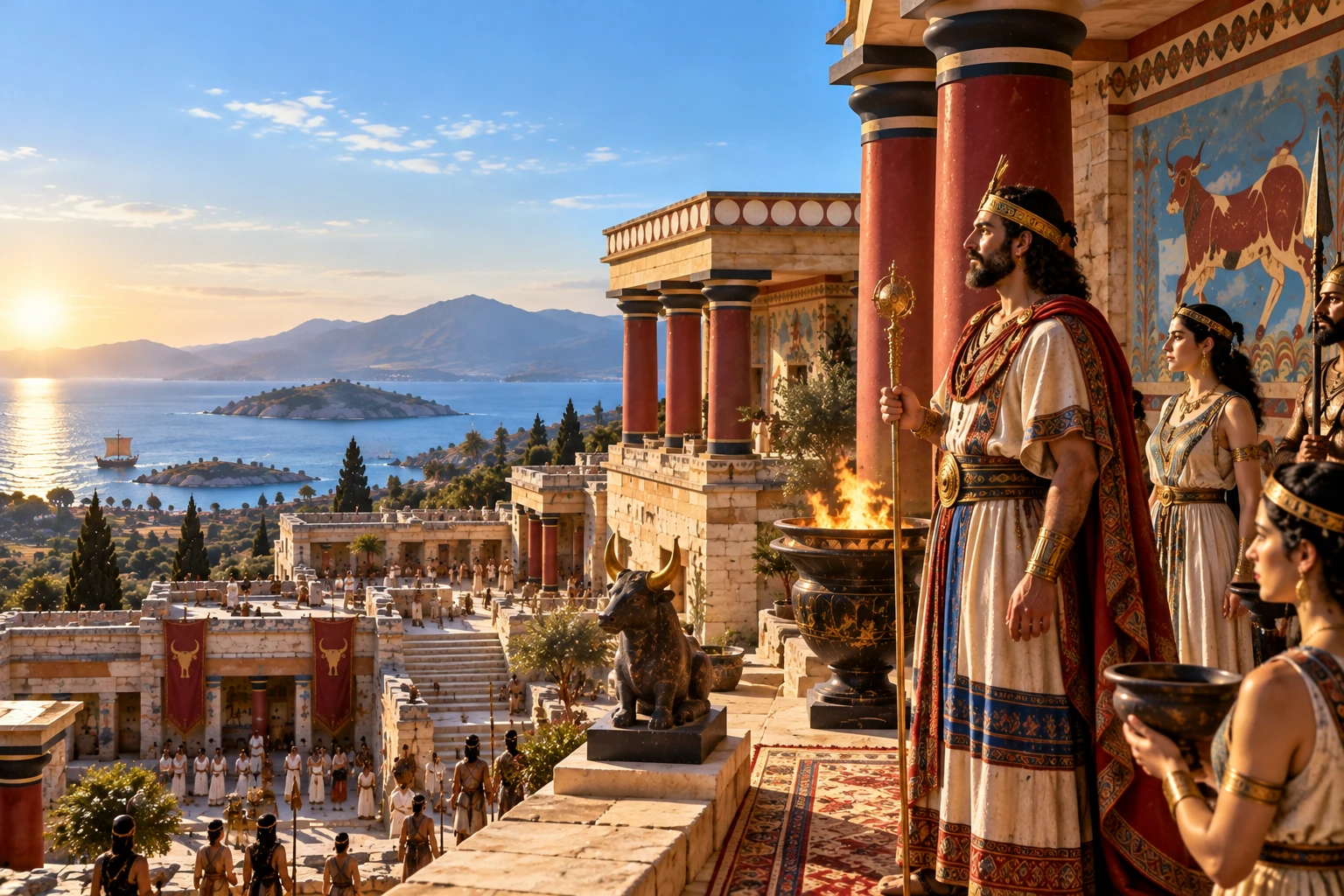
The palace’s intricate arrangement and the importance of bulls in Cretan imagery help explain why those legends seem to fit the ruins so vividly. A connection between memory, place and myth is possible, but identifying an architectural maze or a ceremonial bull image does not verify the narrative. The imagined ruler in this article’s hero is likewise a reconstruction, not Minos recovered from history. Sources: Heraklion
BUILDING A WORLD OF COURTS, LIGHT AND WATER
Palatial architecture organised movement through courts, corridors, stairs, storage areas and reception spaces. At Knossos, light wells, timber reinforcement, door partitions and water-management installations reveal careful building practice. Drainage and water supply were significant achievements; describing the entire island as possessing modern sanitation would go beyond the evidence. Sources: Heraklion
The buildings were also stages for gathering, display and ceremony. Their scale suggests labour mobilisation and specialist knowledge. Large storage jars and workshops connect monumental architecture with everyday production. Yet an excavated floor plan is not a complete instruction manual: the uses of some rooms, and labels such as ‘queen’s apartment’, depend partly on later interpretation. Sources: ICOMOS
DAILY LIFE AND UNEQUAL SOCIETY
Behind the palace façades were farmers, craftspeople and households sustaining the economy. Agriculture, including cereals, vines and olives, supported settlement and exchange. Pottery, metalwork, textiles, jewellery and carved seals required different skills and materials. Storage, distribution and administrative recording linked producers with institutions, although not every transaction passed through a palace. Sources: Heraklion Museum Sources: Ellen Adams
Wealth and status were uneven. Differences in buildings, burial goods and access to prestige objects support social differentiation, but a complete class hierarchy cannot be read from Linear A. Elite art makes certain people highly visible while leaving others almost anonymous. Palace imagery is therefore a selective representation of society, not a census of its inhabitants. Sources: Ellen Adams
Painted figures and figurines show elaborate hairstyles, jewellery, fitted garments and flounced skirts. Women appear prominently in ceremonial imagery; men also participate in ritual and other activities. Such depictions establish visibility, not modern legal equality or a securely documented system of female government. Some famous fresco compositions include extensive modern restoration, which must be distinguished from surviving ancient fragments. Sources: Metropolitan Museum Sources: Heraklion Museum
A MARITIME CIVILIZATION, NOT A PROVEN SEA EMPIRE
Crete’s position supported contacts with the Cyclades, mainland Greece, Egypt and the Levant. Pottery, materials and artistic influence reveal movement between communities. Maritime connections carried goods and techniques as well as prestige. The spread of Minoan styles is often described as Minoanisation, but influence could involve local adoption rather than conquest. Sources: Metropolitan Museum Sources: Heraklion Museum
Later traditions of Minos’s naval power have encouraged the picture of a tightly controlled sea empire. Archaeology supports extensive networks more securely than fixed imperial borders. A Cretan-style object abroad may reflect trade, imitation, travelling craftspeople or settlement. These possibilities must be tested locally, rather than converted into a single map of territories ruled from Knossos. Sources: Metropolitan Museum Sources: Ellen Adams
Selected documented contacts. These are networks of exchange and influence, not proven imperial territories or measured shipping volumes.
Cyclades and mainland Greece
Objects, styles and cultural interaction
Egypt and the Levant
Eastern Mediterranean contacts and exchanged objects
Sources: UNESCO; Metropolitan Museum
PRESDA Data Graphics
ART, BULL-LEAPING AND THE SACRED
Frescoes, painted ceramics and engraved seals draw on marine life, plants, processions and human movement. Bull-leaping appears in paintings and seals and in an ivory figurine from Knossos. These objects document the theme; the precise rules, risks and social meaning of the activity are harder to reconstruct from its stylised representations. Sources: Heraklion Museum
Ritual took place in palatial settings and at sanctuaries beyond them, including caves and high places. Offerings, figurines, ceremonial vessels and recurring symbols provide evidence of religious practice. Identifying a figure as a worshipper, priestess or deity is often an interpretation. A complete pantheon, the names of most deities and a single uniform theology cannot be recovered from these objects alone. Sources: Heraklion Museum Sources: Heraklion Museum
LINEAR A: RECORDS WITHOUT A READABLE HISTORY
Linear A, mainly attested on Crete around 1800–1450 BCE, remains undeciphered. Administrative tablets, sealings and inscriptions on ritual objects preserve traces of counting, organisation and written communication. Researchers can recognise numerical notation and recurring patterns without possessing a reliable translation of the underlying language. Partial understanding is not the same as full decipherment. Sources: Cambridge Sources: Whittaker
Linear B is different. Deciphered by Michael Ventris in 1952, with John Chadwick central to its scholarly interpretation, it records an early form of Greek and illuminates later Mycenaean administration. Similar signs do not mean Linear A wrote Greek. Its short texts, limited corpus and poorly understood language make proposed translations difficult to test; no invented royal names or decoded speeches belong in this story. Sources: Cambridge
Reading numerical patterns is different from translating a language. No invented signs or inscriptions are shown.
Linear A
Mainly c. 1800–1450 BCE; language undeciphered
Linear B
Early Greek; deciphered in 1952
Sources: Cambridge: Linear A; Cambridge: Linear B
PRESDA Data Graphics
SANTORINI DID NOT END THE STORY IN ONE DAY
The great eruption of Thera, modern Santorini, occurred in the second millennium BCE, often placed around 1600 BCE in scientific literature. Its precise date remains debated. Research at Malia identifies evidence interpreted as a tsunami deposit associated with the eruption. This demonstrates a coastal impact, not that every Cretan settlement was destroyed or that palace society immediately disappeared. Sources: Nature Communications Sources: Scientific Reports
The eruption and the widespread destructions around 1450 BCE should not be collapsed into one event. Palace life continued after the volcanic disaster. Later disruption and the growing role of Greek-speaking Mycenaean administration changed the island’s political and cultural landscape. Conflict, local instability and external involvement are discussed, but the exact sequence and causes differed across sites. Sources: Scientific Reports Sources: Ellen Adams
Knossos continued as an administrative centre after other palaces were destroyed. Linear B documents belong to that later world; the dating of its final palace destruction is itself debated. Neither a change of script nor a destroyed building proves that the population vanished. Communities, techniques and religious practices could continue and change under new political conditions. Sources: Heraklion Sources: Cambridge
EXCAVATION, RECONSTRUCTION AND A LASTING LEGACY
Minos Kalokerinos excavated at Knossos in 1878; Evans began his major campaigns in 1900. Excavation revealed archives, fresco fragments and architecture that transformed the study of the Aegean. Evans’s extensive rebuilding also shaped what visitors see. UNESCO recognises the need to distinguish original remains from later reconstruction, and museum records show how restored images can exceed the surviving fragments. Sources: Heraklion Sources: Metropolitan Museum Sources: UNESCO
Ancient DNA adds another kind of evidence. A 2017 study found substantial shared ancestry between sampled Minoans and Mycenaeans, with differences in their later ancestry histories. Genetic similarity cannot identify a king, decode a script or turn archaeological labels into timeless ethnic identities. Combining genetics with buildings, objects and texts strengthens the questions rather than eliminating every uncertainty. Sources: Lazaridis et al.
The Minoans’ legacy lies in a distinctive experiment in urban life: maritime exchange, administrative writing, skilled production and elaborate ceremonial architecture. Their world helped shape the Bronze Age Aegean and later imagination. What remains compelling is the tension between its extraordinary visibility and its silence. We can walk through the spaces where authority was performed, yet still cannot securely name the people who ruled.
Sources reviewed on October 8, 2026. The hero is an AI-generated artistic reconstruction. Its ruler, clothing, ceremony and setting are imaginative, not a documented historical person or exact archaeological scene. Continue with PRESDA’s Indus Valley feature for another civilization whose surviving evidence leaves major political questions open.
FAQ
Frequently Asked Questions
Who ruled the Minoans?
The evidence supports elite authority but does not securely identify named rulers of the Linear A palace world. Monarchy, ritual leadership and collective elite institutions are debated.
Was King Minos a historical person?
Minos belongs to later Greek mythology. No contemporary inscription securely establishes a Minoan king matching that legendary figure.
Has Linear A been deciphered?
No. Numerical notation and some patterns are understood, but the language has no generally accepted full decipherment.
Did Santorini destroy Minoan civilization?
The eruption had regional impacts, but palace society continued afterward. Later destruction and Mycenaean administration formed a separate, complex transition.
PRESDA Dispatch
Stay Informed. Stay Aware.
A sharp briefing across AI, gaming, sport, business, world affairs, paparazzi, and lifestyle.