MOROCCO'S GREEN MARCH AT 51: THE HISTORY BEHIND NOVEMBER 6
The 1975 Green March, Hassan II and 350,000 volunteers: the history, Western Sahara’s legal context and UN developments on November 6, 2026.
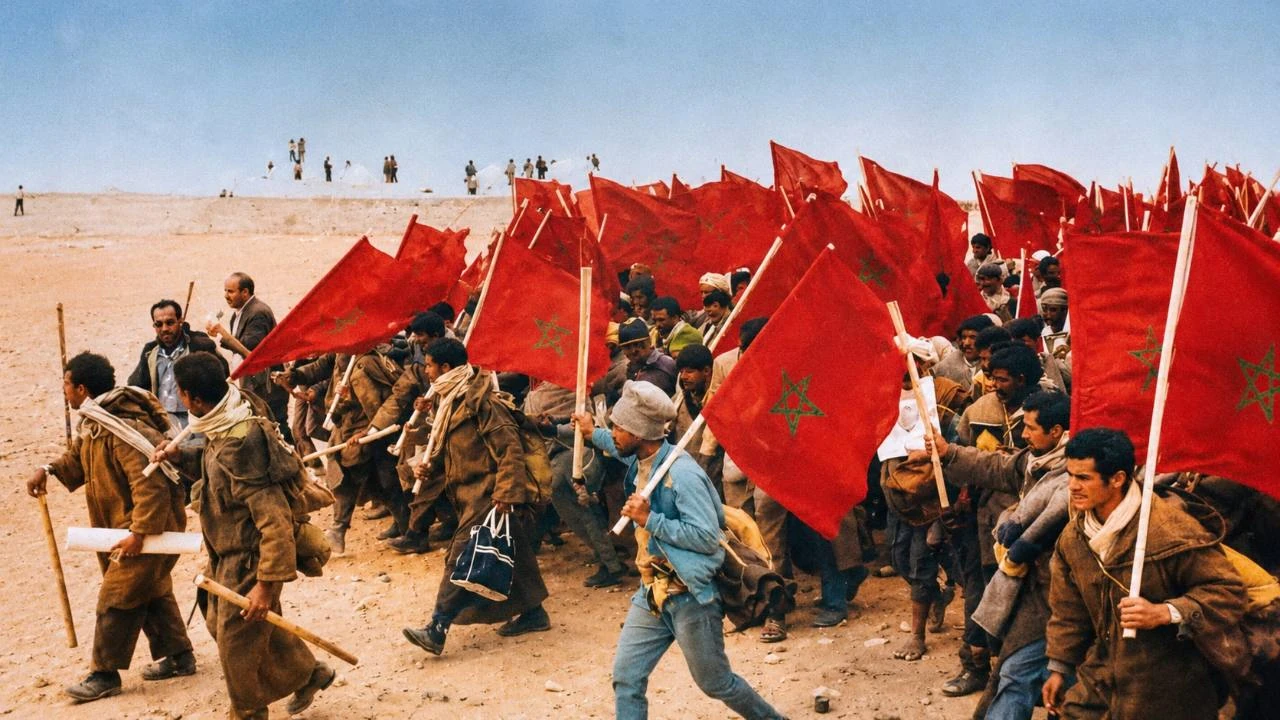
Supplied image associated with the Green March. The photographer, exact date and archival provenance were not provided or independently established. The image does not by itself verify the number of participants or a territorial claim. Editorial image supplied for PRESDA. Original creator and reuse licence not provided.
On 6 November 2026, Morocco marks 51 years since King Hassan II’s Green March into then Spanish-administered Western Sahara. Associated Press: the 51st anniversary, 6 November 2026
The anniversary brings together a powerful national memory and a dispute that remains unresolved. Understanding it means separating the march itself, Spain’s departure, the legal record and the choices still facing the territory’s people. A crowd carrying flags can change the political pressure on a government. It cannot, by its size alone, answer a question of sovereignty. That distinction is especially important this year, as the end of a long-running UN mission creates a new diplomatic situation without supplying a final settlement.
What happened on 6 November 1975?
Hassan II mobilized 350,000 unarmed Moroccan civilians in the operation that became known as the Green March. The figure appears in the US State Department’s archived background account of Morocco. The aim was to press Morocco’s claim to Western Sahara while Spain was still the colonial administering power. The number describes the mobilization, not a headcount that can be reconstructed from one photograph, and it should not be confused with the population of Western Sahara. US Department of State: archived Morocco background note
The civilian character of the march is central to Morocco’s account of the event. It also helps explain the lasting strength of its imagery: ordinary participants, national flags and a royal call made visible on the ground. But a history of that mobilization is not a complete history of the conflict that followed. Describing the march as unarmed does not mean that the wider struggle over the territory was peaceful, or that everyone affected accepted Morocco’s claim.
Why was Spain still involved?
Western Sahara lies on Africa’s northwestern Atlantic coast. Under Spanish rule it was known as Spanish Sahara. The UN placed it on its list of Non-Self-Governing Territories in 1963, within the international process of decolonization. This was not simply an administrative dispute between two capitals. The territory’s inhabitants and their political future were part of the question. The UN classification is important because the end of colonial administration and the completion of a lawful decolonization process are not necessarily the same event. United Nations: Western Sahara and decolonization
What did the International Court actually find?
On 16 October 1975, the International Court of Justice delivered an advisory opinion requested by the UN General Assembly. It rejected the idea that Western Sahara had been a territory belonging to no one when Spain colonized it. It also found legal ties of allegiance between Morocco’s sultan and some tribes, as well as certain ties involving the Mauritanian entity. Those findings should not be erased from the account. Neither should their limits: the material before the Court did not establish ties of territorial sovereignty with Morocco or the Mauritanian entity. International Court of Justice: Western Sahara advisory opinion, 1975
The Court’s conclusion preserved the application of self-determination through a genuine expression of the territory’s people’s will. An advisory opinion is not the same procedure as a binding judgment between states in a border case, but it remains a central judicial reference. Selectively citing the recognition of historical ties while omitting the finding on sovereignty changes its meaning. Equally, saying that the Court found no historical relationship at all would misstate the record in the opposite direction.
The Security Council’s response in 1975
The Security Council did not endorse the march as a settlement. In resolution 380, adopted on 6 November 1975, it deplored the event and called for the withdrawal of its participants from Western Sahara. That response belongs beside the pictures of civilian mobilization, rather than outside the story. Morocco’s subsequent commemoration and the Council’s contemporary reaction are different parts of the historical record; reporting one does not require concealing the other. United Nations: Security Council resolution 380 (1975)
What the Madrid Agreement did, and did not do
Spain, Morocco and Mauritania signed the Madrid Agreement on 14 November 1975, creating arrangements for a temporary administration. Spain notified the UN on 26 February 1976 that it was ending its presence. Mauritania withdrew from the territory in 1979. In a 2002 opinion prepared for the Security Council, UN Legal Counsel Hans Corell explained that the agreement had not transferred sovereignty or conferred the status of administering power on its signatories. The administrative arrangements had not changed Western Sahara’s status as a Non-Self-Governing Territory. UN Legal Counsel: opinion S/2002/161
This is why a simple sequence of dates can mislead if it ends with Spain’s departure as though every legal question had been answered. The march, the Madrid arrangements and withdrawal happened at different moments and had different consequences. Corell’s document was a legal opinion concerning the territory and resource activities, not a new court judgment. It is valuable precisely because it distinguishes changes in administration from the international status of the territory.
One anniversary, different political meanings
Morocco controls most of the territory. Polisario, supported by Algeria, seeks independence and controls areas east of the sand berm. Associated Press: the dispute’s context, 1 November 2026
Morocco’s official commemorations present the Green March as a defining act of national unity and territorial recovery. Royal anniversary speeches show how the event links the monarchy, public participation and the state’s understanding of its borders. This is a political memory with real significance for Moroccans. Reporting it accurately means attributing the territorial interpretation to Morocco, rather than quietly converting a national account into an agreed international legal conclusion. Moroccan government: royal speech on the 43rd anniversary
The Polisario Front advances a different claim: Sahrawi self-determination with independence among the available outcomes. Its representative’s statement to the 2026 UN decolonization seminar sets out the movement’s position; it is a party’s submission, not a ruling by the United Nations. The distinction matters in both directions. A document hosted by the UN does not automatically express UN policy, just as an official Moroccan speech does not establish an uncontested border. Frente POLISARIO representative: statement to the 2026 decolonization seminar
The people behind the diplomatic language
UNHCR’s Algeria programme includes protection and assistance for Sahrawi refugees in camps near Tindouf. Their continuing needs are part of the story, alongside the lives of people in the territory itself. A history told only through monarchs, borders and resolutions can lose sight of families and the search for a durable future. None of these populations should be treated as politically uniform. Providing humanitarian assistance is not the same task as deciding sovereignty, and people’s rights do not depend on whether their views fit an anniversary narrative. UNHCR: Algeria and Sahrawi refugees
Why MINURSO was created
The UN established MINURSO in 1991 under a settlement plan accepted by Morocco and the Polisario Front. It also monitored a ceasefire; hostilities resumed in 2020. Its name referred to a referendum in Western Sahara, with independence and integration with Morocco as the envisaged options. That vote never took place. A mission intended to accompany a political transition instead became a long-term presence. Its history helps explain why a mandate renewal was never just a technical staffing decision: it concerned a peace process whose central promise remained unfulfilled. United Nations: MINURSO background and settlement plan
What resolution 2797 changed in 2025
Security Council resolution 2797, adopted on 31 October 2025, put Morocco’s 2007 autonomy proposal at the basis of negotiations and extended MINURSO until 31 October 2026. It identified genuine autonomy as a potentially most feasible outcome. It also called for a mutually acceptable political solution providing for self-determination. Those provisions must be read together; the resolution did not itself announce a completed territorial settlement. UN Security Council: resolution 2797 (2025)
The latest UN developments, checked on 6 November 2026
At its 30 October 2026 meeting, the Security Council failed to adopt competing US and Russian drafts concerning MINURSO. A proposed renewal is not an adopted renewal. The outcome, rather than a preview of what negotiators had hoped to pass, is the relevant record for this anniversary. UN Security Council: meeting 10260, 30 October 2026
UN News reported on 1 November that the mandate had expired at midnight on 31 October and the mission was entering liquidation. The Secretary-General reaffirmed support for a negotiated political solution and self-determination. The closure of a mission therefore cannot be reported as the disappearance of the people’s rights or the legal resolution of the dispute. UN News: MINURSO ends, 1 November 2026
At the UN’s 2 November press briefing, the spokesperson described an orderly, phased closure rather than the instantaneous disappearance of every staff member and asset. The available automated transcript is a supporting record, not an official verbatim document. It corroborates the dated UN account of winding down; it should not be used to invent a new sovereignty decision. United Nations: spokesperson briefing, 2 November 2026
How to read the anniversary without losing the history
November 6 can be a national commemoration without being an internationally agreed answer to Western Sahara’s future. Historical ties, effective administration, diplomatic support and a people’s political rights are related subjects, but they are not interchangeable. Keeping them separate allows the Green March to be understood as a consequential event rather than a slogan that must explain everything that came after it.
The image accompanying this article has a similarly specific role. It shows marchers with Moroccan flags, but its photographer, exact date and archival provenance were not supplied. It is not offered as an independent count of participants or proof of a legal claim. For readers looking further into Morocco’s past, Chefchaouen’s documented history offers another example of why a memorable image and a carefully sourced account should be read together.
Related reading: Morocco’s dynasties, colonial period and independence.
FAQ
Frequently Asked Questions
What was Morocco’s Green March?
It was the civilian mobilization organized by King Hassan II into then Spanish-administered Western Sahara, beginning on 6 November 1975. It pressed Morocco’s territorial claim. The march, Spain’s withdrawal and the territory’s international legal status are distinct parts of the history, not a single event that resolved every question.
Why is 6 November 2026 the 51st anniversary?
The march began on 6 November 1975. The same calendar date in 2026 is 51 years later. The anniversary refers to that mobilization, not to 51 years since a UN-approved final settlement or the date Spain formally ended its presence, which came in February 1976.
Did 350,000 people take part?
The established mobilization figure is 350,000 unarmed Moroccan civilians, recorded in the archived US State Department account. It is not an independently reconstructed count from the supplied photograph, nor the number of Western Sahara’s inhabitants. The image and the historical figure serve different evidentiary purposes.
Did the ICJ award Western Sahara to Morocco in 1975?
No. The advisory opinion recognized certain historical legal ties, including allegiance between the sultan and some tribes, but did not establish ties of territorial sovereignty with Morocco or the Mauritanian entity. It preserved the application of self-determination through the people’s genuinely expressed will.
Did the Madrid Agreement settle sovereignty?
The UN Legal Counsel explained in 2002 that it did not transfer sovereignty or confer administering-power status on its signatories. The agreement concerned administrative arrangements. Spain’s subsequent departure did not itself remove Western Sahara from the UN’s list of Non-Self-Governing Territories.
What is the latest verified UN development as of 6 November 2026?
The Council failed to adopt competing MINURSO drafts on 30 October. Its mandate expired on 31 October, and the UN reported the start of liquidation on 1 November. The Secretary-General continued to uphold self-determination and a negotiated solution; mission closure did not itself settle sovereignty.
PRESDA Dispatch
Stay Informed. Stay Aware.
A sharp briefing across AI, gaming, sport, business, world affairs, paparazzi, and lifestyle.