Mount Erebus: The Antarctic Flight That Never Returned
The 1979 loss of Air New Zealand Flight TE901, its 257 victims, the disputed investigations and the long journey toward remembrance and accountability.
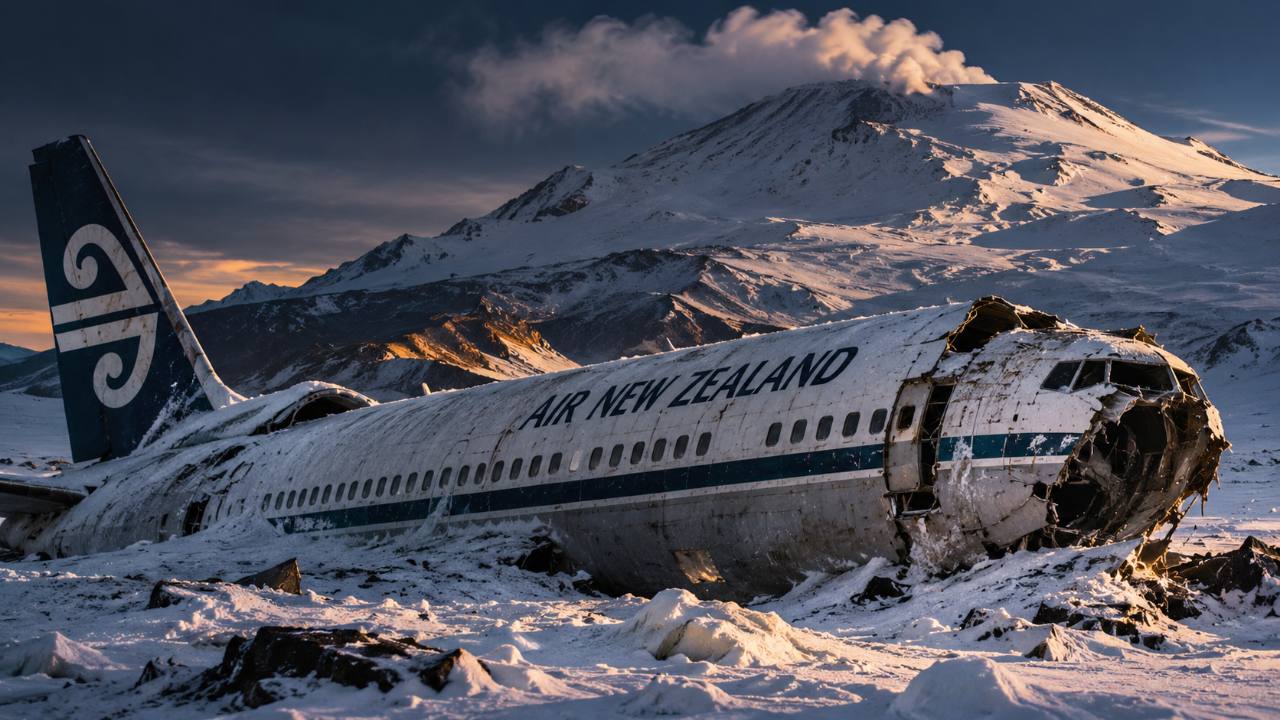
AI-generated editorial illustration supplied for PRESDA. The aircraft form, wreckage and landscape are imagined and do not reproduce the actual DC-10 crash site or investigative evidence.
On November 28, 1979, an Antarctic sightseeing journey became New Zealand’s worst civil accident. Air New Zealand Flight TE901 struck the lower slopes of Mount Erebus on Ross Island, killing all 237 passengers and 20 crew. Forty-seven years later, the disaster remains a story of lives lost, conflicting investigations and the long struggle to establish how an ordinary commercial operation could end on a mountain its crew did not expect to be approaching. NZ History: Erebus disaster overview Manatū Taonga: National Erebus Memorial and timeline
The flight was not intended to land in Antarctica. Passengers had purchased a return excursion from Auckland, with views of the continent before the aircraft came home. The phrase a flight that never returned describes a documented crash, not an unexplained disappearance. Its location was found, its recorders and other evidence examined, and its causes investigated at length.
An extraordinary destination sold as a day trip
Air New Zealand’s Antarctic sightseeing service began on February 15, 1977. The ministry’s historical timeline describes a popular package combining the journey with commentary and onboard service. The appeal was access to a landscape most passengers would otherwise never see. The aircraft was a platform for looking at Antarctica, rather than a transport link to a settlement. Manatū Taonga: National Erebus Memorial and timeline
| Date | Documented event |
|---|---|
| February 15, 1977 | First Air New Zealand Antarctic sightseeing flight |
| November 28, 1979 | TE901 crashes; 237 passengers and 20 crew die |
| June 1980 | Chippindale accident report released |
| July 7, 1980 | Royal Commission public hearings begin |
| April 27, 1981 | Mahon report publicly released |
| October 20, 1983 | Privy Council dismisses Mahon’s appeal on challenged findings |
| November 28, 2019 | Government and airline apology at the 40th anniversary |
| November 28, 2026 | 47th anniversary of the disaster |
| December 13, 2026 | Memorial unveiling scheduled, according to the November 27 update |
On TE901, that commercial promise depended on a close relationship between planning, navigation, briefing and the view from the cockpit. Passengers could reasonably experience the trip as a carefully organized excursion. The later investigations exposed how assumptions made in different parts of an organization could fail to match.
The coordinates changed before departure
Captain Jim Collins and First Officer Greg Cassin attended a route briefing on November 9. NZ History explains that the material gave the impression of a route down McMurdo Sound over sea ice. In the early hours of November 28, a flight-plan coordinate was changed. What the navigation section believed was a minor correction shifted the destination point 27 nautical miles east because of an earlier typing error. NZ History: flight briefing, coordinates and crash chronology
The resulting route led toward Mount Erebus. The crew were not alerted to the change and entered the supplied coordinates into the aircraft’s computer. This was not simply a computer spontaneously making an inexplicable decision. The information put into the system and the information understood by the pilots were part of the same operational problem. NZ History: flight briefing, coordinates and crash chronology
When the view did not reveal the danger
The inquiry examined polar white-out: conditions in which snow, pale surroundings and horizon definition can make terrain difficult to interpret. Visibility of distant features does not necessarily provide a reliable visual outline of the surface directly ahead. Understanding that distinction helps explain why a mountain encounter cannot be reduced to the question of whether anyone could see out of a window. NZ History: Mahon inquiry evidence and white-out
The aircraft struck Erebus at 12:49 p.m. New Zealand Standard Time. Accounts using New Zealand daylight time place it an hour later; mixing those time standards produces an avoidable contradiction. The official national memorial history uses NZST. All aboard died. There is no basis for presenting an eruption of the active volcano as the cause. Manatū Taonga: National Erebus Memorial and timeline
Operation Overdue and the work after the search
Search aircraft located wreckage around midnight NZST, with confirmation of no survivors following the next day. Investigation and recovery brought together people in Antarctica and New Zealand under extremely difficult circumstances. The search for an overdue aircraft had become the recovery of a national tragedy. NZ History: Erebus disaster overview
NZ History’s account of Operation Overdue records the work of professionals and volunteers supporting the site operation and identification effort. Remembering that work is part of the history, not an appendix to it. The people sent to the ice had to gather evidence and care for the dead while confronting conditions far outside an ordinary emergency response. NZ History: Operation Overdue
A loss larger than an accident statistic
The total of 257 is essential, but it cannot describe the relationships broken by the crash. Families were left with grief and, later, public argument about responsibility. For the flight crew’s relatives, the way official findings were interpreted could become another source of distress. A historical account should explain the controversy without treating those families as characters in a mystery entertainment.
The supplied hero is an AI-generated reconstruction. Its aircraft shape, relatively intact wreckage and landscape are imagined. It does not reproduce the actual DC-10 site or show evidence recovered by investigators. That distinction is particularly important when a visually convincing illustration could otherwise reshape a reader’s understanding of the accident.
Why the investigations reached different conclusions
Chief air accident investigator Ron Chippindale’s report, released in June 1980, emphasized the decision to descend below the applicable safe altitudes, while also identifying other organizational shortcomings. His conclusion became widely understood as pilot error. Justice Peter Mahon’s Royal Commission instead placed responsibility on Air New Zealand’s systems and cleared the crew of responsibility for the accident. Its report was publicly released on April 27, 1981. NZ History: the accident investigation and Royal Commission
The disagreement concerned how to interpret a chain of events, not whether a crash had happened. Briefings, coordinate changes, altitude procedures and visual conditions had to be considered together. The commission’s hearings examined those connections through witness testimony and documentary material. Attribution matters: a finding of an inquiry should be reported as that inquiry’s conclusion. NZ History: Mahon inquiry evidence and white-out
What the subsequent courts did and did not decide
Mahon also made allegations about deception during the inquiry and imposed costs. Those matters generated court proceedings. The Court of Appeal found breaches of natural justice in the challenged findings about officers’ conduct and quashed the relevant costs order; the Privy Council dismissed Mahon’s appeal on October 20, 1983. Those proceedings were not a fresh ruling on the accident’s physical cause. NZ History: court proceedings after the inquiry Privy Council, October 20, 1983: Mahon v Air New Zealand
It is therefore misleading to say simply that a court overturned the whole Mahon report. It is equally misleading to present every allegation in that report as an unqualified final judicial finding. The distinction between the accident investigation, the commission’s conclusions and judicial review is central to telling the story fairly.
Apology, remembrance and the 47th anniversary
On November 28, 2019, Prime Minister Jacinda Ardern delivered a formal apology at the 40th anniversary, speaking for and with Air New Zealand. The speech acknowledged the failure and the suffering that followed. An apology did not restore the lost lives, but it marked an important public recognition for families whose experience had extended far beyond the day of the crash. New Zealand Prime Minister, November 28, 2019: formal apology
The ministry’s November 27, 2026 update says the National Erebus Memorial at Cracroft Reserve in Christchurch is scheduled to be unveiled on December 13. As this article is published on the 47th anniversary, that ceremony remains in the future. The planned memorial is intended to bring all 257 names together in one place. Manatū Taonga, November 27, 2026: 47th anniversary update
Erebus endures as a warning about the distance between what an organization assumes it has communicated and what its people actually understand. It is also a continuing act of remembrance. The essential responsibility of retelling it is to keep the evidence precise and the people at the center, without turning uncertainty, blame or loss into spectacle.
FAQ
Frequently Asked Questions
What happened to Air New Zealand Flight 901?
On November 28, 1979, the DC-10 sightseeing flight struck Mount Erebus on Ross Island, Antarctica. All 237 passengers and 20 crew died.
Was the crash caused by a volcanic eruption?
No. The documented investigation concerns the flight path, navigation changes, altitude, briefing and visual conditions. The aircraft struck the mountain; an eruption is not the explanation.
Did the courts overturn Mahon’s crash-cause findings?
The challenged proceedings concerned allegations about officers’ conduct and related costs, not a fresh determination of the crash cause. The Court of Appeal and Privy Council must not be described as simply reversing every inquiry finding.
Has the new national memorial already opened?
As of November 28, 2026, the ministry’s November 27 update schedules the Cracroft Reserve unveiling for December 13, 2026. That is a planned event, not a completed opening.
PRESDA Dispatch
Stay Informed. Stay Aware.
A sharp briefing across AI, gaming, sport, business, world affairs, paparazzi, and lifestyle.