MUGHAL EMPIRE: HOW A DYNASTY BUILT ONE OF INDIA’S GREATEST EMPIRES
From Babur’s Central Asian inheritance to Akbar’s imperial system, the Taj Mahal and the dynasty’s fall, discover the achievements, conflicts and people behind Mughal power.
The Mughal Empire was a dynasty-led state founded in northern India by Babur in 1526. Its rulers expanded across much of the Indian subcontinent, drawing on agricultural taxation, military service, alliances and a rich court culture. Imperial power fragmented during the eighteenth century, but the dynasty survived in diminished form until the British deposed its last emperor and sent him into exile in 1858.
At the Taj Mahal, Mughal history appears in marble, proportion and light. Elsewhere it survives in a painted manuscript, a fort, an administrative document or the memory of a contested conquest. These traces belong to a political world that could produce exceptional art while extracting the resources to sustain armies, courtiers and monumental building.
The Mughals did not create civilization in India, nor did they govern an unchanging or uniformly obedient society. They entered a subcontinent with long-established states, commercial networks, religious traditions and regional cultures. Their achievement was to construct an exceptionally powerful imperial order within that world. Its endurance depended on far more people than the emperor alone.
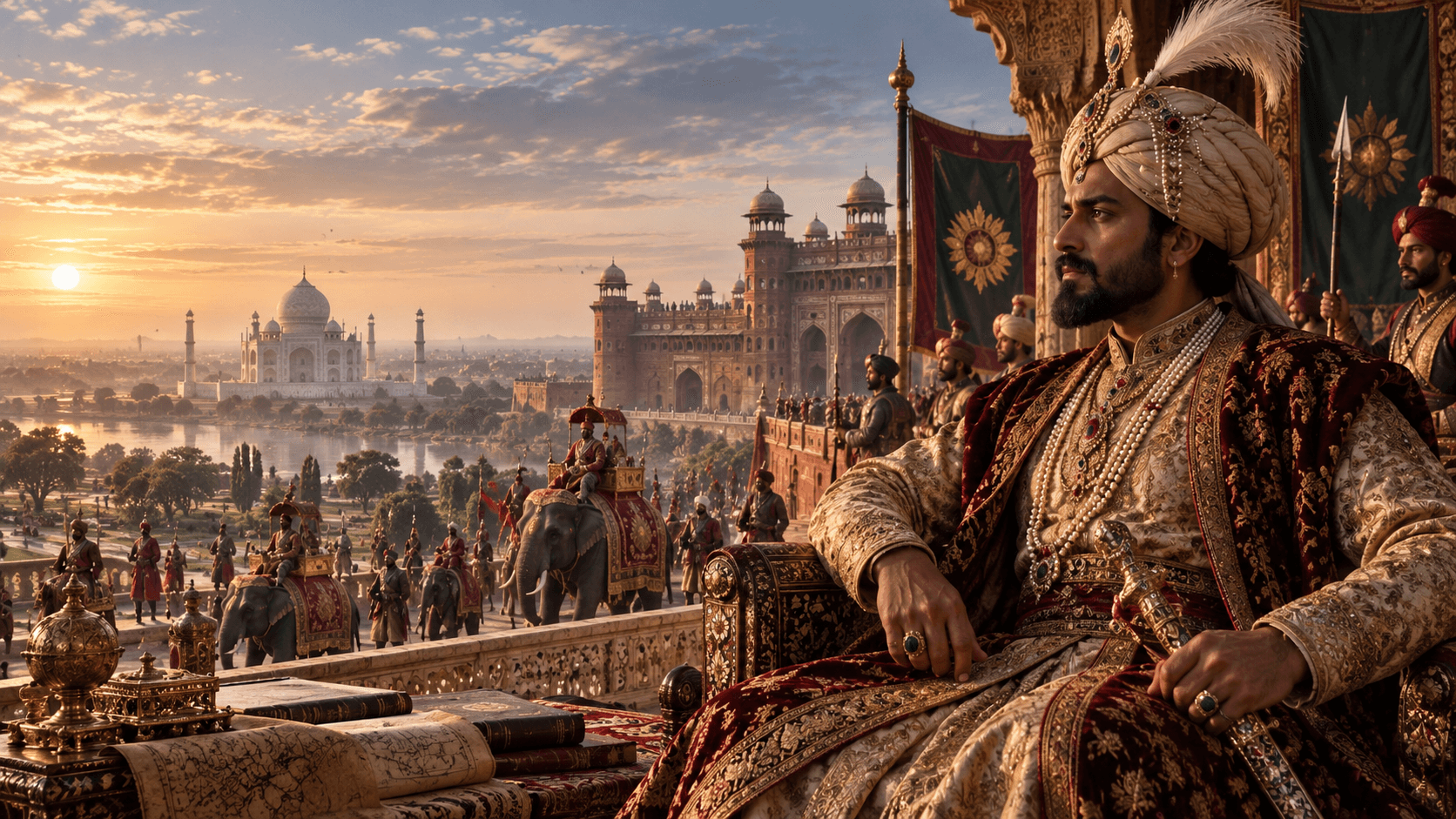
The opening image is an imaginative editorial illustration of a Mughal court and monumental architecture, not a contemporary portrait or a reconstruction of one historical scene.
BABUR AND THE TIMURID CONNECTION
Babur descended from Timur through his father and from Genghis Khan through his mother. Born into the competitive dynastic world of Central Asia, he sought power in the lands associated with his ancestors before establishing a new base in Kabul. His early career included repeated reversals, especially in struggles over Samarkand. Encyclopaedia Iranica: Babur
That ancestry supplied legitimacy and ambition, but not an army guaranteed to win. Babur had to recruit followers, maintain alliances and survive rival claimants. His move toward India was one outcome of those struggles, rather than the execution of a lifelong plan whose success was assured. PRESDA's Timurid Empire history explains the political and cultural inheritance behind him.
The dynasty's Central Asian origins also carried a Persianate literary and artistic inheritance. These traditions changed as the Mughals established themselves in South Asia. The word Mughal evokes Mongol ancestry, but the Mughal state was not simply the medieval Mongol Empire transplanted unchanged into India.
Panipat and the beginning of a new empire
On April 21, 1526, Babur defeated Ibrahim Lodi, the sultan of Delhi, at the First Battle of Panipat. The victory opened the way to Mughal power in northern India. Artillery and tactical organization mattered, but the battle did not place the entire subcontinent under Babur's control. Government of Haryana, Panipat district: First Battle of Panipat
Further campaigning was necessary. In 1527 Babur defeated the Rajput coalition led by Rana Sanga at Khanwa, consolidating his position against another formidable rival. Military success established the dynasty, but converting battlefield victories into reliable government would occupy his successors. Metropolitan Museum of Art: The Art of the Mughals before 1600
Babur also left the Baburnama, originally written in Chagatai Turkish. The British Library preserves an illustrated Persian translation commissioned under Akbar. The memoir provides an unusually personal source for an imperial founder, but it remains a ruler's account, shaped by what he wanted to remember and explain. British Library: Baburnama manuscript Or 3714
HUMAYUN: THE DYNASTY ALMOST LOSES INDIA
Humayun succeeded Babur in 1530, but his inheritance was insecure. Afghan rivals, competing regional powers and divisions within his own family complicated his reign. Sher Shah Sur defeated him, and in 1540 Humayun lost his position in northern India. Mughal rule was interrupted, not continuously dominant from Panipat onward. Encyclopaedia Iranica: Humayun
Exile took Humayun to the Safavid court in Iran. He later recovered Kabul and, in 1555, returned to power in northern India. He died the following year. His restoration gave Akbar a throne, but the memory of dynastic vulnerability helps explain why institutions and reliable service became so important under the new emperor.
The interruption also challenges a tidy story in which each Mughal ruler merely added to his predecessor's achievements. The Sur period was an important political episode in its own right. Mughal government developed in conversation and competition with earlier and contemporary South Asian practices.
WHY DID AKBAR BECOME SO IMPORTANT?
Akbar, who ruled from 1556 to 1605, transformed a vulnerable inheritance into a durable imperial system. He expanded territory while drawing a wider range of military and regional elites into service. Conquest mattered, but so did creating incentives for powerful people to work through the emperor rather than only against him.
His early rule depended on the regent Bairam Khan. As Akbar took personal control, campaigns extended Mughal authority across northern and central India. Gujarat's commercial centers and access to maritime trade made its incorporation particularly valuable. Expansion was neither bloodless nor universally welcomed: accommodation followed or accompanied military pressure.
Akbar's achievement was therefore not simply tolerance, as modern summaries sometimes imply. It was the construction of a broad ruling coalition under a strongly centralizing monarch. Rajput participation helped reshape imperial service, but Rajput houses did not all respond in the same way or surrender their interests to a single policy. Encyclopaedia Iranica: Akbar I
Mansabdars, jagirs and the practical business of government
A mansab was an official rank; its holder was a mansabdar. The system connected status, remuneration and obligations of service, including the maintenance of cavalry. Civil administration and military organization overlapped, rather than forming entirely separate careers in the modern sense. Journal of the Royal Asiatic Society: Rank in the Mughal State Service
A jagir was principally an assignment of revenue, often used to pay an official, rather than unrestricted ownership of the land itself. Historian Nandini Chatterjee's work shows how rank and revenue assignments connected imperial officeholders with local powerholders. Governing meant negotiating the collection of resources, not merely issuing orders from a palace. Nandini Chatterjee, Cambridge University Press: Contractors, Engaging the State
This distinction explains both strength and vulnerability. The emperor could distribute opportunities and demand service, but assigned revenue had to be collected in real villages and districts. Rival claims, resistance and the interests of intermediaries could intervene between an entry in an account and usable resources.
JAHANGIR: IMPERIAL CONFIDENCE AND COURT POLITICS
Jahangir ruled from 1605 to 1627, inheriting a much stronger state than Babur or Humayun had possessed. His court is remembered for painting, natural history and sophisticated collecting. Those interests were part of kingship: the ability to commission rare works and gather expertise demonstrated imperial prestige.
Nur Jahan, whom Jahangir married in 1611, exercised substantial political influence. The V&A's account emphasizes her ability and the importance of her family within the court. She belongs in the history of government and patronage, not only in a romantic story attached to an emperor. Victoria and Albert Museum: The Arts of the Mughal Empire
Courtly refinement did not eliminate coercion or conflict. Jahangir's reign began with his son Khusrau's rebellion. The execution of Guru Arjan in 1606, which Jahangir associated with support for the prince, became a defining rupture in Mughal-Sikh relations. Artistic patronage and political violence must be examined together rather than treated as incompatible descriptions of the same ruler. Encyclopaedia Iranica: Jahangir
SHAH JAHAN, THE TAJ MAHAL AND MUGHAL ARCHITECTURE
Shah Jahan ruled from 1628 to 1658. His reign gave monumental expression to imperial authority through palaces, mosques, gardens and tombs. The Taj Mahal is its most famous surviving achievement, but understanding Mughal architecture requires looking beyond a single building.
Why was the Taj Mahal built?
Shah Jahan commissioned the Taj Mahal at Agra as the mausoleum of Mumtaz Mahal, who died in 1631. UNESCO's detailed statement dates the beginning of construction to 1632, completion of the mausoleum to 1648, and completion of associated elements to 1653. Different completion dates often refer to different parts of the complex. UNESCO: Taj Mahal
Its impact depends on an ensemble: the tomb, river setting, garden, gateway, mosque and corresponding guest-house building. White marble contrasts with red sandstone, while calligraphy, carved ornament and stone inlay reward close attention. The monument brought together the labor and expertise of many craftspeople; attributing it to an emperor identifies its patron, not its sole maker.
For the Taj Mahal's place among internationally celebrated landmarks, see PRESDA's New Seven Wonders guide. Its modern fame is only one part of a longer architectural history.
The architectural inheritance
Humayun's Tomb in Delhi had already established an influential Mughal garden-tomb composition. UNESCO identifies it as a major precursor to later architecture, including the Taj Mahal. The connection shows how imperial building developed through inherited forms and new combinations rather than isolated acts of genius. UNESCO: Humayun’s Tomb, Delhi
Akbar's Fatehpur Sikri presents a different expression of power: a courtly city of monumental spaces and buildings, including the great mosque. Its architecture reveals the diversity of forms available to Mughal patrons. The empire's visual language was never limited to white marble. UNESCO: Fatehpur Sikri
At Shah Jahan's Red Fort in Delhi, audience halls, pavilions and water channels organized the experience of approaching royal authority. UNESCO describes a synthesis of Persian, Timurid and Indian traditions. Architecture made distinctions of rank and access visible, while placing the emperor within a carefully ordered setting. UNESCO: Red Fort Complex
AURANGZEB: EXPANSION, CONFLICT AND THE LIMITS OF POWER
Aurangzeb emerged victorious from the succession struggle among Shah Jahan's sons and took power in 1658. Shah Jahan was confined at Agra. Aurangzeb ruled until 1707, extending the empire's territorial reach while confronting sustained opposition. The scale of his conquests should not be mistaken for uniformly secure control. Metropolitan Museum of Art: The Art of the Mughals after 1600
The Deccan became a major theater of imperial warfare. Bijapur fell in 1686 and Golconda in 1687, ending important independent sultanates. These were Muslim-ruled states, a reminder that dynastic ambition cannot be explained through a simple Muslim-versus-Hindu division. Encyclopaedia Iranica: Safine-ye Solaymani and the Deccan conquests
Defeating a court or taking a fortress did not end resistance. The rise of Shivaji and the Marathas, followed by continuing Maratha challenges, made expansion costly to consolidate. Military commitments, disputes over resources and the politics of regional elites created problems that could not be settled by enlarging the imperial map.
How should his religious policies be judged?
Aurangzeb reimposed jizya, a tax on non-Muslims, in 1679, and his reign included documented temple destruction. These actions should not be minimized. Yet records also show protection or grants for some Hindu religious institutions. UCLA historian Vinay Lal's discussion stresses the need to examine particular acts and contexts rather than assuming one uniform policy explains every case. UCLA, Vinay Lal: Aurangzeb’s Religious Policies
Historians differ over the relative importance of religious conviction, dynastic authority, rebellion and political calculation. Context explains why actions occurred; it does not make their consequences disappear. Neither a portrait of flawless piety nor one of indiscriminate destruction can substitute for examining the evidence.
HOW RICH AND POWERFUL WAS THE MUGHAL EMPIRE?
The Mughal state commanded enormous resources through taxation of agricultural production and trade, supplemented by tribute and conquest. Those resources sustained armies, administration and court patronage. John F. Richards's economic account emphasizes the scale of accumulated treasure and ordinary revenues, while showing that power depended on systems of extraction as well as spectacular objects. John F. Richards, Cambridge University Press: Economy, Society and International Trade
Calling the empire wealthy does not mean every subject was prosperous. The surplus supporting a jeweled throne or a campaign came from people producing crops, moving goods, making cloth and collecting revenue. Court expenditure reveals concentrated resources, not a representative household budget.
India in global trade
Textiles connected South Asian producers to markets far beyond the Mughal court. The V&A traces exports to the Middle East, Africa and Asia before European companies arrived, followed by increasingly distant markets. Manufacturers adapted materials and designs to customers. European merchants entered established commercial worlds rather than inventing Indian overseas trade. Victoria and Albert Museum: Indian Textiles
Economic historian Shireen Moosvi's study of the Mughal economy around 1595 identifies textiles as a major export and bullion and horses as major imports. Silver mattered because imported metal could enter monetary circulation. The empire's economy was connected to global exchange without being reducible to trade with Europe. Shireen Moosvi, Oxford University Press: Foreign Trade and the Internal Economy
Precise internet claims about an emperor's fortune in today's dollars require caution. A treasury, annual revenue and total economic output measure different things. Estimates for the whole subcontinent also cannot automatically be assigned to Mughal-controlled territory. The evidence establishes exceptional resources without requiring a fictional modern net worth.
HOW DID MUGHAL MILITARY POWER WORK?
Mughal warfare combined mounted forces, firearms, artillery, fortifications and the ability to mobilize supplies. At Panipat, Babur's deployment of guns and protective arrangements mattered alongside maneuver. Later armies depended on the service obligations and contingents of commanders, not only on a single centrally paid force.
A Cambridge study of early modern imperial institutions describes how the mansabdari system linked officials to mounted followers and how inspections and horse branding helped make service accountable. Such measures addressed a practical problem: a ruler needed to know that men and equipment existed beyond what a commander claimed on paper. Cambridge University Press: Safavid, Mughal and Ottoman Imperial Institutions
Local powerholders also mattered. Chatterjee's research shows zamindars providing troops, assisting collection or resisting officials, depending on circumstances. Military capacity and negotiation were intertwined. A state able to win major battles could still struggle to make authority routine across distant districts. Nandini Chatterjee, Cambridge University Press: Zamindars, Lords of the Marches
RELIGION AND CULTURAL DIVERSITY
Mughal emperors were Muslim rulers of a religiously and linguistically diverse population. Their policies varied across reigns and places. Akbar abolished jizya in 1564 and developed an ideal commonly called sulh-i kull, or peace with all. His court's discussions included representatives of several religious traditions. This was a model of imperial accommodation, not modern democratic equality.
Religious encounter also took literary form. Sanskrit works were translated into Persian under court patronage. Such projects brought traditions into new settings, but translation did not dissolve differences or guarantee equal power. Cultural exchange and hierarchy could exist together.
Relations with Sikh communities show how profoundly conflict could reshape religious and political life. J. S. Grewal's history follows the transformation of the Sikh Panth through the seventeenth century, including the consequences of Guru Arjan's death and the later leadership of Guru Tegh Bahadur and Guru Gobind Singh. A narrative of uncomplicated harmony would leave out this history. J. S. Grewal, Cambridge University Press: Transformation of the Sikh Panth
Women, households and historical evidence
The imperial household was a political institution, not merely a private backdrop. Nur Jahan's career makes that visible, while Gulbadan Begum's Humayun-nama provides a family-centered account of the early dynasty. Its attention to relationships and movement broadens a history often told only through battles and male officeholders. Gulbadan Begum: The Humayun-nama, translated by Annette Beveridge
Royal women did not represent every woman's experience. Nor do court chronicles provide a complete account of farmers, artisans, servants or enslaved people. The imbalance of surviving evidence matters: the people most visible in imperial records were often those closest to power.
MUGHAL ART: MORE THAN IMPERIAL LUXURY
Mughal painting developed through collaboration among artists working with Indian, Persian and European visual materials. Court workshops produced illustrated histories, literary manuscripts, portraits and albums. The results were shaped by patronage but also by individual skill, observation and artistic choice.
Mansur's studies of plants and animals, discussed in the Met's account of the Shah Jahan Album, show close attention to the natural world. Portraits and elaborate borders served different purposes within the same collecting culture. These were objects to examine carefully, not simply ornaments demonstrating how much an emperor could spend. Metropolitan Museum of Art: The Shah Jahan Album
Official histories need equally careful reading. Abu'l-Fazl's Akbarnama celebrates Akbar, while its associated administrative material records the empire's organization. These works are indispensable sources, but their closeness to power is part of the evidence. An account written to explain and praise kingship should not be mistaken for a neutral report. Encyclopaedia Iranica: Akbarnama
WHY DID THE MUGHAL EMPIRE DECLINE?
Mughal power declined through a combination of succession struggles, military demands, disputes over revenue and the growth of regional centers of authority. Aurangzeb's death in 1707 was a turning point, but the dynasty did not disappear then. Decline at the imperial center also did not mean that every region's economy or culture stopped developing.
Scholarly explanations assign different weight to pressure within the jagir system, agrarian conditions, Deccan warfare and the rise of regional competitors. The Oxford University Press collection The Decline of the Mughal Empire presents these as connected debates and emphasizes the resilience of parts of the subcontinent despite weakening central power. Oxford University Press: The Decline of the Mughal Empire
Bengal, Awadh and Hyderabad developed increasingly autonomous governments, while Maratha and Sikh power challenged older arrangements. Regional rulers could preserve Mughal offices, practices or claims of legitimacy while controlling resources for themselves. Political fragmentation was therefore also a redistribution of power, not simply the disappearance of government.
Nadir Shah and the shock of 1739
Nadir Shah's invasion exposed the center's vulnerability. After defeating Mughal forces at Karnal in 1739, he entered Delhi. His troops carried out a massacre and plundered the city; he removed immense treasure, including the Peacock Throne. These events were catastrophic without requiring an unverified modern casualty total. Encyclopaedia Iranica: Nader Shah
The invasion did not create every existing weakness, but it sharply damaged imperial prestige and resources. Nor did the departure of the invaders restore the earlier political balance. The Mughal emperor's symbolic importance could survive even as other powers increasingly determined events.
FROM MUGHALS TO BRITISH RULE
British expansion was a process of war, diplomacy, finance and intervention in regional politics, not a single victory over a unified Mughal state. At Plassey in 1757, the East India Company used an alliance with opponents of Bengal's nawab to secure a decisive political advantage. The battle's importance lay partly in the arrangements surrounding it. National Army Museum: The Battle of Plassey
Victory at Buxar in 1764 strengthened the Company's position. In 1765, Shah Alam II granted it the diwani, the right to collect revenues in Bengal, Bihar and Orissa. H. V. Bowen's Cambridge account explains how acquiring such powers helped transform a trading organization into a territorial state. Mughal forms of authority could thus be used in the construction of Company rule. H. V. Bowen, Cambridge University Press: The Business of Empire
Further expansion required Indian soldiers, intermediaries, resources and alliances as well as British institutions and force. Its outcome should not be projected backward as inevitable from the arrival of European traders. For the wider imperial context, see PRESDA's history of the British Empire.
The rebellion of 1857 and the formal end in 1858
In 1857, rebellion against Company rule spread from military mutiny into a wider uprising in parts of northern and central India. Grievances included military practices, annexation and threats to established social and religious arrangements. Rebels in Delhi rallied around the elderly Bahadur Shah Zafar, whose limited practical power did not erase the dynasty's symbolic authority. National Army Museum: Why the Indian Rebellion Happened
The rebellion did not unite every region or political group. Its suppression involved severe violence, and the British captured Delhi. Bahadur Shah was tried and exiled to Rangoon in 1858. The British Library's surviving papers document his removal and banishment, marking the dynasty's final destruction as a reigning house. British Library: Papers on Bahadur Shah’s Trial and Banishment, 1858
A separate but related change occurred that year: the Government of India Act transferred the Company's governing powers and Indian territories to the British Crown. The end of Mughal kingship and the beginning of direct Crown rule belong to the same aftermath, but they were not the same legal event. UK Parliament: East India Company and the Raj, 1785–1858
MYTH VS REALITY: THE MUGHAL EMPIRE
“The Mughals were simply the Mongol Empire in India”
Their founders claimed Central Asian dynastic ancestry, but Mughal institutions and culture developed in South Asia through interaction with existing political and social worlds. Ancestry is not a complete description of a state.
“Akbar's tolerance meant modern religious equality”
Akbar's accommodation was significant, but it operated within imperial kingship. It should neither be dismissed nor confused with equal citizenship in a modern constitutional state.
“The empire's wealth proves everyone lived well”
Treasures, buildings and revenues demonstrate concentrated resources. They do not establish living standards for every cultivator or artisan, and they cannot be converted casually into a ruler's modern net worth.
“One religious policy explains every ruler and every conflict”
Policies changed, alliances crossed religious boundaries, and particular communities experienced both accommodation and coercion. Evaluating specific actions is more informative than assigning an entire dynasty a single moral personality.
“Aurangzeb alone caused the empire's collapse”
His campaigns and policies mattered, but later succession conflicts, fiscal pressures, regional ambitions, invasions and Company expansion also require explanation. A process lasting generations cannot be reduced to one man's character.
“The Mughal Empire ended in 1707”
Aurangzeb died in 1707, after which imperial power increasingly fragmented. The dynasty continued in diminished form until the deposition and exile of its final emperor in 1858.
WHAT THE MUGHAL LEGACY MEANS TODAY
The Mughal legacy survives in architecture, painting, gardens, texts and the histories of communities across South Asia. Its geographical reach crossed several modern national borders; its cultural inheritance cannot be contained in the biography of one ruler or the politics of one present-day nation.
To understand that legacy is to hold several truths together. Patronage could sustain remarkable artistic work. Revenue systems could organize a vast state and impose heavy demands. Alliances could bridge differences while conquest deepened wounds. The empire becomes more understandable when its grandeur and its costs are examined through the same evidence.
FAQ
Frequently Asked Questions
Who founded the Mughal Empire?
Babur founded Mughal power in northern India after defeating Ibrahim Lodi at the First Battle of Panipat in 1526. He descended from Timur through his father and Genghis Khan through his mother.
Why was Akbar important?
Akbar expanded the empire and developed a durable system of imperial service, revenue administration and alliances. His accommodation of different religious and regional elites strengthened a diverse ruling coalition.
How wealthy was the Mughal Empire?
The empire commanded enormous agricultural and commercial revenues and participated in extensive trade. Court wealth does not measure ordinary living standards, and modern-dollar estimates of individual emperors’ fortunes are unreliable.
Who built the Taj Mahal and why?
Shah Jahan commissioned the Taj Mahal at Agra as Mumtaz Mahal’s mausoleum. UNESCO dates construction from 1632, completion of the mausoleum to 1648, and completion of associated elements to 1653.
What was the difference between a mansab and a jagir?
A mansab was an official rank connected to remuneration and service obligations. A jagir was an assignment of revenue, commonly used to pay an officeholder, rather than unrestricted ownership of the land.
Why did the Mughal Empire decline?
Succession struggles, military commitments, revenue disputes, regional ambitions and invasions weakened central power. British expansion later transformed the political landscape. Historians debate the relative weight of these causes.
Did the Mughal Empire end when Aurangzeb died?
No. Aurangzeb died in 1707, but the dynasty continued as central power fragmented. Its final emperor, Bahadur Shah Zafar, was deposed and exiled by the British in 1858.
Were the Mughals and the British Raj the same empire?
No. The Mughals were a dynasty of South Asian emperors with Central Asian origins. The East India Company acquired territorial power through a separate process, and direct British Crown rule began in 1858.
PRESDA Dispatch
Stay Informed. Stay Aware.
A sharp briefing across AI, gaming, sport, business, world affairs, paparazzi, and lifestyle.