NUMIDIA: THE BERBER KINGDOM THAT CHALLENGED ROME
From Massinissa’s cavalry alliance at Zama to Jugurtha’s war against Rome, Numidia was a changing North African kingdom shaped by diplomacy, agriculture and war.
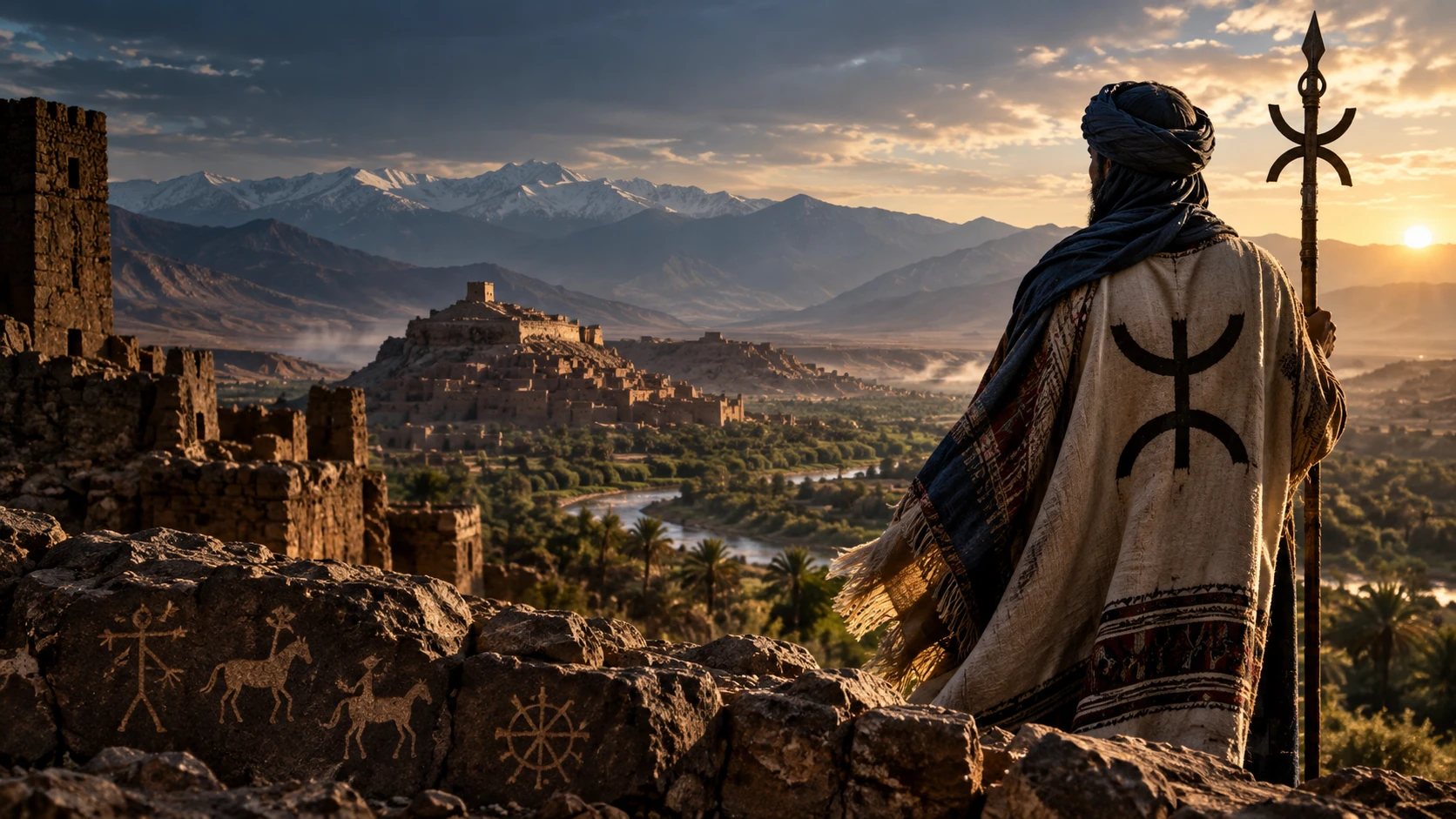
Numidia was an ancient North African kingdom centered largely in what is now northern and eastern Algeria, with territory that extended into parts of modern Tunisia and, at different moments, neighboring regions. It was not identical to modern Algeria, and its borders changed with dynastic power, war and Roman intervention. The Numidians were Indigenous peoples of North Africa whom later historians often connect with the wider Amazigh or Berber population, although ancient identities and modern ethnic categories should not be treated as exact equivalents.
Numidia became famous in Mediterranean history because its rulers and horsemen influenced the Second Punic War, Rome’s struggle with Jugurtha and the civil wars of the late Roman Republic. Its history was not a simple contest between an African kingdom and a foreign empire. Numidian kings made their own alliances, fought one another, managed cities and farms, and used Carthage and Rome as partners or rivals when circumstances changed.
THE LAND AND PEOPLES OF NUMIDIA
The region called Numidia stretched between the Mediterranean coast, the Tellian highlands, inland plains and routes leading toward the Sahara. Rainfall and soil varied sharply. Northern valleys supported grain, olives and livestock, while steppe and upland communities moved with herds or combined pastoralism with farming. Ports and inland markets connected these communities to Carthaginian, Greek and later Roman commerce.
Greek and Roman writers used names such as Numidae, Massylii and Masaesyli for communities whose political boundaries were not fixed national borders. The Massylii were based in eastern Numidia around Cirta, while the Masaesyli held much of the west and were associated with Siga. These labels are useful for reconstructing ancient politics, but they came through outside authors and royal inscriptions. They do not provide a complete census of Amazigh society or prove that every Numidian community shared one identity.
MASSYLI, MASAESYLI AND THE FAMOUS CAVALRY
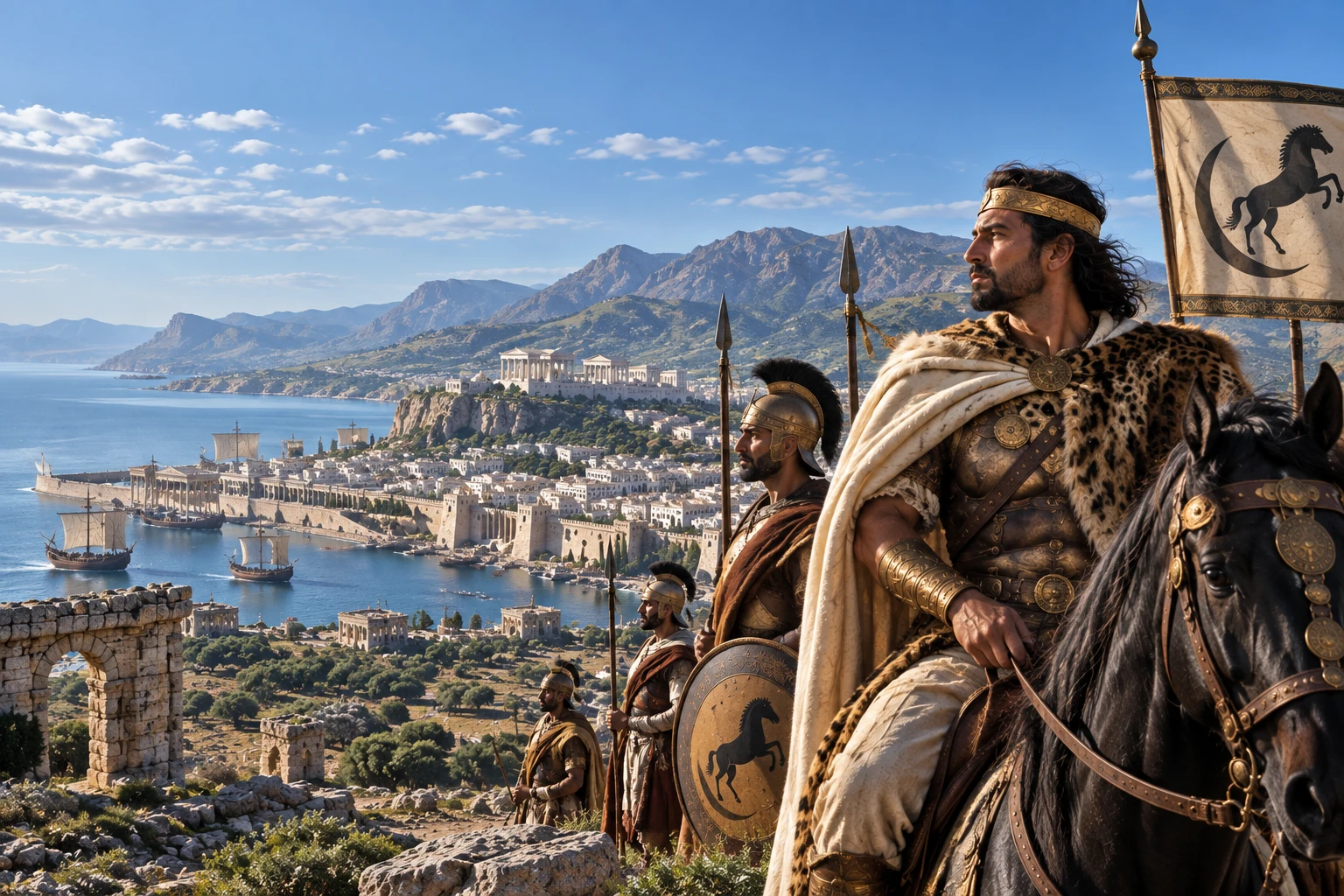
Numidian armies were diverse, but their light cavalry became their most celebrated military arm. Riders used small, agile horses, carried light equipment and relied on speed, harassment, feigned retreats and sudden attacks. They could scout, screen an army and disrupt heavier infantry without seeking a direct collision. Ancient writers sometimes turned this style into a racial stereotype about natural horsemanship. The historical explanation is more practical: local terrain, breeding, training and the military value of mobile forces all mattered.
The Massylii and Masaesyli competed for influence while Carthage built its own power along the coast. Numidian rulers traded with and fought Carthage, and they also hired out or allied with their cavalry. The relationship was never static. A king could support Carthage in one campaign and negotiate with Rome in another if the balance of power shifted.
SYPHAX, MASSINISSA AND THE SECOND PUNIC WAR
The Second Punic War, fought from 218 to 201 BCE, transformed the political map of North Africa. Syphax, king of the Masaesyli, initially cooperated with Rome and became an important diplomatic figure. Massinissa, ruler of the Massylii, first supported Carthage before changing sides as the war moved toward its decisive phase. Their rivalry was both a local struggle for the Numidian throne and part of the wider contest between Carthage and Rome.
Massinissa joined Scipio Africanus and brought Numidian cavalry to the Roman alliance. At the Battle of the Great Plains and in the campaign that followed, Syphax was defeated and captured. Massinissa then commanded Numidian horsemen on Scipio’s right at the Battle of Zama in 202 BCE. His riders helped force Hannibal’s cavalry from the field and later returned to strike the Carthaginian rear. The battle ended the war and made Massinissa an indispensable Roman ally. Oxford Classical Dictionary: Masinissa
After Zama, Massinissa unified much of Numidia under his rule. His kingdom was not a modern centralized nation-state, but it was a durable monarchy with a court, fortified and urban centers, agricultural districts and a diplomatic presence in the western Mediterranean. Cirta, the later Constantine in Algeria, became a major political center. The alliance with Rome gave Massinissa room to expand, while Rome expected him to remain useful and predictable.
MASSINISSA’S KINGDOM
Massinissa ruled for a long period, traditionally dated from 202 or 201 BCE until his death in 148 BCE. He encouraged settled agriculture and the cultivation of grain, olives and vines in areas where water and soil allowed it. Numidia’s farms and herds supplied local markets and Mediterranean trade. The kingdom also benefited from caravan routes, coastal exchange and the movement of soldiers, animals and agricultural knowledge across North Africa.
Royal power depended on personal authority, dynastic relationships and cooperation from local leaders. Numidian cities used Punic, Greek and eventually Latin forms of writing alongside local languages. Coinage, inscriptions and archaeological remains show a society connected to Carthage and the wider Mediterranean without being reduced to a Carthaginian or Roman colony. Cirta’s political importance grew from its location, resources and royal patronage rather than from a single fixed capital territory.
Massinissa’s expansion brought him into growing conflict with Carthage. The peace settlement after Zama restricted Carthage’s ability to wage war without Roman approval, while Numidian claims over borderlands became more difficult for the weakened city to resist. Massinissa used arbitration, raids, legal arguments and military pressure to recover or assert territory. Roman senators often favored their ally, even as some worried that his success could destabilize the region.
The tension between Carthage and Numidia helped create the political atmosphere before the Third Punic War. Massinissa died in 148 BCE, before the final breach, but Roman fears about Carthage’s recovery and Numidian pressure shaped the debate that ended with Rome’s destruction of Carthage in 146 BCE. The larger history of Carthage and the Punic Wars shows why Numidian choices were central to a conflict often told only through Roman and Carthaginian leaders.
SUCCESSION AFTER MASSINISSA
Massinissa’s sons divided responsibilities after his death, and later arrangements placed the kingdom under shared or changing leadership. Micipsa eventually became the principal ruler and tried to preserve the dynasty through a combination of family politics and Roman diplomacy. His sons Hiempsal and Adherbal shared the succession with their cousin Jugurtha, who had gained military experience while serving alongside Roman forces in Spain.
The arrangement failed. Jugurtha killed Hiempsal and challenged Adherbal, while Rome attempted to impose a settlement that divided Numidia. The crisis was not simply a story of Roman aggression against a united African kingdom. Rival Numidian elites sought power, Roman senators and commanders pursued their own interests, and the geography of the kingdom made it difficult to enforce a stable division.
JUGURTHA AND THE JUGURTHINE WAR, 112–105 BCE
The Jugurthine War is usually dated from 112 to 105 BCE. After Adherbal was killed at Cirta, Rome declared war on Jugurtha. Early Roman commanders struggled to defeat him, and negotiations repeatedly broke down. Jugurtha used mobile forces, fortified positions, local knowledge and alliances with neighboring rulers. He did not need to defeat every Roman army in a pitched battle. Avoiding destruction and keeping the conflict politically expensive could be enough to prolong the war.
The Roman historian Sallust made the conflict a moral history of the late Republic. In his War with Jugurtha, the Numidian king buys Roman officials and exposes a Senate willing to treat public authority as private property. Sallust’s account is indispensable, but it is also an argument about Roman corruption, aristocratic competition and the decline of traditional virtue. Modern historians therefore compare his narrative with inscriptions, other ancient writers and the military sequence rather than accepting every speech or motive as a transcript. Oxford Academic: Sallust and the War Against Jugurtha
Rome eventually sent Quintus Caecilius Metellus and then Gaius Marius to command the war. Marius reorganized recruitment and operations, while his quaestor Lucius Cornelius Sulla pursued the diplomatic solution that ended the conflict. Bocchus I of Mauretania, Jugurtha’s father-in-law and sometime ally, negotiated with Rome and handed Jugurtha over in 105 BCE. Jugurtha was taken to Rome and later executed after Marius’s triumph. The outcome showed the limits of Roman power in rugged North Africa, but also how a Numidian succession struggle had opened the door to sustained Roman intervention.
LATER NUMIDIAN RULERS AND ROME’S GROWING CONTROL
After Jugurtha, Numidia continued under rulers who operated within an increasingly Roman political framework. The kingdom’s territory and status changed repeatedly as Rome rewarded allies, punished opponents and reorganized the region. Some rulers retained meaningful autonomy, while others depended on Roman recognition. Numidia’s history during this period cannot be reduced to a single annexation date because client kingship, territorial transfers and provincial administration overlapped.
Juba I, who ruled in the middle of the first century BCE, supported the Roman Senate’s cause during the civil war between Pompey and Julius Caesar. His forces fought for the Republican coalition in North Africa. Caesar’s victory at Thapsus in 46 BCE ended Juba’s kingdom; the king died soon afterward, and much of Numidia was reorganized under Roman authority. His son, Juba II, later ruled Mauretania as a Roman client, showing how royal lines could survive in a different political setting.
Numidian resistance and collaboration continued in changing forms. Local elites entered Roman military service, towns received new institutions and land was redistributed, while rural communities negotiated taxes and authority. The incorporation of Numidia was therefore a process of imperial restructuring rather than an overnight replacement of every local practice.
NUMIDIA UNDER ROMAN RULE
Roman rule integrated Numidian lands into provinces whose boundaries changed over time. Roads, forts, colonies and municipal institutions expanded, especially in productive northern zones. Grain and other agricultural products moved through Mediterranean markets, and veterans and merchants settled in towns. Roman law, Latin inscriptions and imperial cults became visible, but local languages, religious practices and social networks continued.
The Roman period produced neither total cultural replacement nor an untouched Numidian survival. People could identify with a city, a tribe, a royal lineage, a Roman citizenship and a local religious tradition at the same time. The wider history of the Roman Empire and ancient Rome helps place North Africa inside imperial institutions, while archaeological evidence shows how unevenly those institutions reached farms, mountains and desert routes.
In later centuries, North Africa became a major center of Christianity and urban life. Numidia’s cities and countryside participated in the religious, economic and political transformations of the late Roman world. The ancient kingdom had ended, but its people did not disappear. Communities that Roman authors classified as Numidian remained part of the diverse Amazigh and North African societies that shaped subsequent history.
LEGACY OF A NORTH AFRICAN KINGDOM
Numidia’s long-term legacy is larger than the image of a cavalry force hired by Rome. Massinissa’s kingdom demonstrates that Indigenous North African rulers could use Mediterranean diplomacy while building their own institutions. Jugurtha’s war reveals how a local succession crisis could become a test of Roman republican politics. Cirta, royal tombs, inscriptions, coins and rural settlements provide material evidence for a society whose history was not preserved only in Roman literary memory.
The connection between Numidians and later Amazigh or Berber populations is historically important, but it should be described with care. Ancient communities changed languages, alliances and identities, and modern Amazigh identity includes many regions and historical experiences. Numidia was one chapter in North Africa’s history, not a fixed blueprint for a modern state. Its story remains compelling because it shows an African kingdom negotiating power among Carthage, Rome, Mauretania and its own neighboring communities.
FREQUENTLY ASKED QUESTIONS
**Where was Numidia?**
Numidia was centered mainly in present-day northern and eastern Algeria, with territory that extended into parts of modern Tunisia and neighboring regions at different periods. Its historical borders changed and do not match modern Algeria.
**Were the Numidians Berbers?**
Numidians were Indigenous peoples of ancient North Africa and are often connected to the wider Amazigh or Berber population. The ancient labels and modern identity are related, but they are not exact equivalents.
**Why was Numidian cavalry famous?**
Numidian light cavalry used speed, scouting, harassment and feigned retreats. Their small horses and mobility were effective in North African terrain and made them valuable allies in Mediterranean wars.
**Who was Massinissa?**
Massinissa was a Massylii king who allied with Scipio Africanus, helped defeat Syphax and Hannibal, and unified much of Numidia after the Battle of Zama in 202 BCE.
**What was the Jugurthine War?**
It was Rome’s war against the Numidian king Jugurtha, conventionally dated 112–105 BCE. Jugurtha’s resistance and Roman bribery became the subject of Sallust’s influential but strongly moralized history.
**When did Numidia become Roman?**
Roman control developed in stages. Juba I’s defeat in 46 BCE ended his independent kingdom, but later rulers, client arrangements and provincial reorganizations mean that incorporation was a process rather than one simple event.
> Numidia was a North African kingdom whose rulers turned cavalry, agriculture and Mediterranean diplomacy into tools of political survival between Carthage and Rome.
FAQ
Frequently Asked Questions
Where was Numidia?
Numidia was centered mainly in present-day northern and eastern Algeria, with territory extending into parts of modern Tunisia and neighboring regions at different periods.
Who was Massinissa?
Massinissa was a Massylii king who allied with Rome, helped defeat Syphax and Hannibal, and unified much of Numidia after Zama in 202 BCE.
What was the Jugurthine War?
It was Rome’s war against the Numidian king Jugurtha, conventionally dated 112–105 BCE, and the subject of Sallust’s influential history.
When did Numidia become Roman?
Roman control developed in stages. Juba I’s defeat in 46 BCE ended his independent kingdom, followed by client arrangements and provincial reorganizations.
PRESDA Dispatch
Stay Informed. Stay Aware.
A sharp briefing across AI, gaming, sport, business, world affairs, paparazzi, and lifestyle.