Archaeologists Find 1,200-Year-Old Mummified Dogs in Peru
Explore the roughly 1,200-year-old dog remains at Castillo de Huarmey: radiocarbon dating, hairlessness, diet, burial rituals and the limits of the evidence.
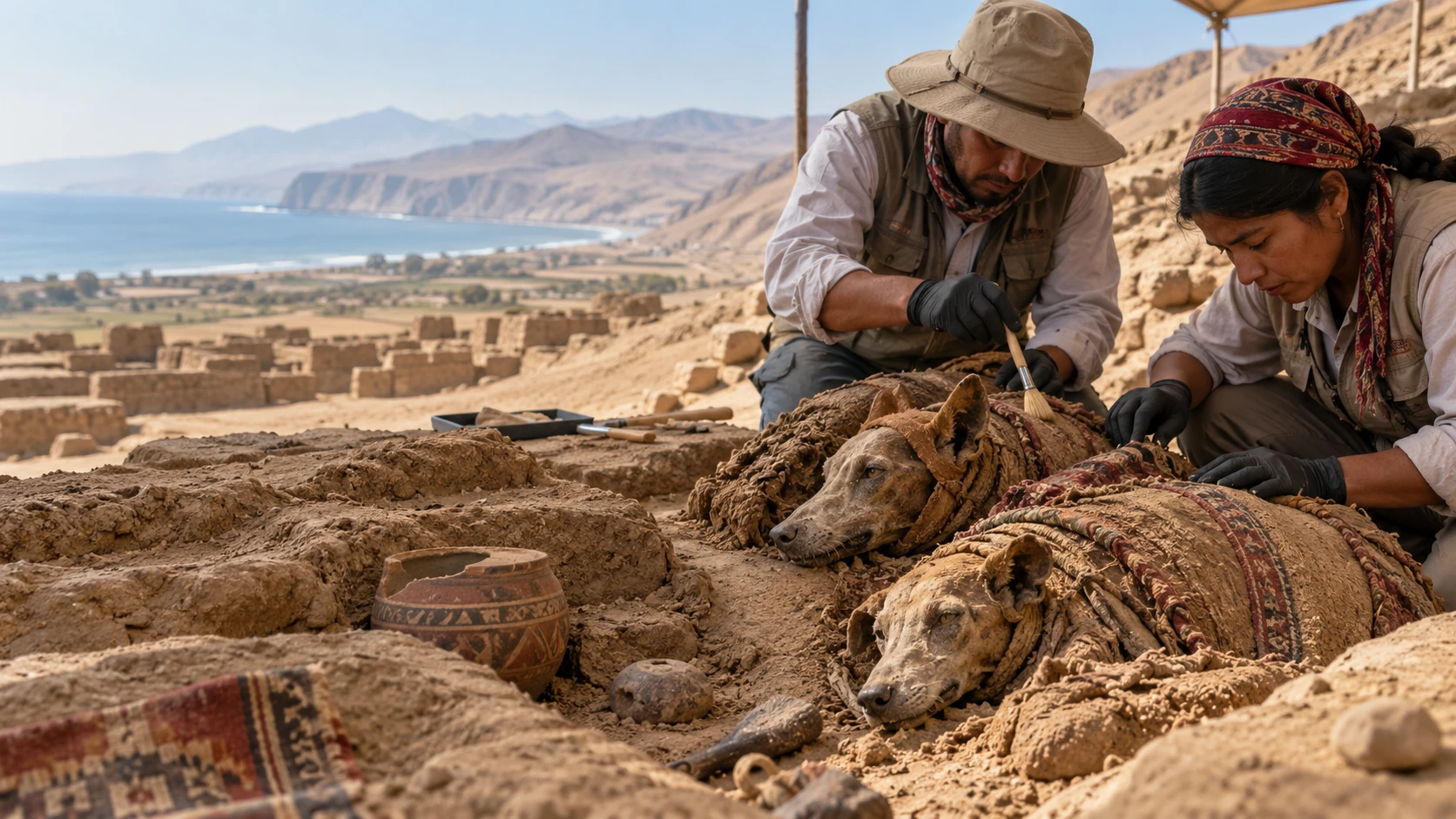
PRESDA AI-generated editorial illustration. The imagined dogs, wrappings and excavation are not photographs of the Castillo de Huarmey specimens or evidence of their burial treatment.
A dog's missing teeth can tell a story that gold cannot. At Castillo de Huarmey on Peru's Pacific coast, archaeologists have identified canine remains, including naturally mummified specimens, that illuminate life alongside people in the Wari period. One remarkably preserved male dates to roughly 1,200 years ago. The discovery opens a window onto companionship, unequal treatment and the place of animals among the dead.
The findings come from research published in the June 2026 volume of the Journal of Anthropological Archaeology, drawing on excavations conducted between 2010 and 2025. They are not evidence that a row of intact, wrapped dogs was freshly uncovered this October. The study combines bones, burial context and chemical signatures, with unusually candid limits on what those traces can reveal. Read the peer-reviewed study by Weronika Tomczyk and colleagues.
What was actually found?
The researchers recorded 341 dog bone specimens, alongside an almost complete, naturally mummified male. These are archaeological counts of remains, not 341 dogs. Three individuals attracted particular attention because their anatomy was consistent with Peruvian hairless dogs: a preserved skull with skin and ears, another skull, and the mummified male. Dartmouth's account describes a minimum of 19 dogs represented by the bones, plus that male. Dartmouth's account of the discoveries.
That distinction changes the picture. Archaeologists are reconstructing a varied population from scattered bones, partial bodies and exceptional preservation. An articulated skeleton can preserve relationships between bones that disappear when a deposit is disturbed. A detached skull can reveal anatomy while leaving its original burial circumstances uncertain. Each object answers a different question; none supplies a complete biography.
A Wari center, long before the Inca empire
Castillo de Huarmey was a ceremonial and administrative center with elite burials, associated with the Wari world of approximately 600–1050 CE. It lies about 305 kilometers north of Lima. The setting matters because animals there belonged to an inhabited landscape of work, food and ceremony, rather than an isolated cemetery. Peru's Andina news agency interviewed excavation co-director Miłosz Giersz about the significance of the hairless-dog evidence for ancient Andean society. Andina's interview with Giersz.
Archaeology also depends on what happened after burial. Earthquake damage in 1970 exposed parts of the site to looting, and many upper deposits became mixed. A bone found near an expensive object therefore does not automatically belong to the same ceremony. Undisturbed associations carry a different evidential weight from disturbed material, a distinction essential to understanding this discovery. Dartmouth on preservation and disturbance.
Why missing teeth point toward hairlessness
Hairlessness is not diagnosed simply by looking at a mummy and noticing little fur. Decay can remove hair. The team examined congenital dental absence, meaning teeth that never developed, rather than gaps left by teeth lost during life or after burial. Reduced dentition is associated with the hereditary hairless condition. Preserved skin and the dental pattern together supported the identification of three probable Peruvian hairless dogs. The study's anatomical evidence.
The careful word is probable. This was an anatomical identification, not an ancient-DNA demonstration of an uninterrupted pedigree connecting those animals to every modern dog bearing the breed's name. Hairless dogs may also retain patches of hair. Their cultural significance is compelling without turning a morphological diagnosis into a genetic certainty or claiming that researchers discovered the world's oldest domestic dog.
What does the 1,200-year date mean?
The study reports a calibrated radiocarbon range of 688–870 CE for the mummified male, identified as PIT-211. “About 1,200 years old” is a readable approximation, not an exact birthday. A radiocarbon measurement estimates age from radioactive carbon in organic material; calibration translates that measurement into calendar dates using reference records. The reported range belongs to the tested animal, not automatically to every dog fragment at the site. Radiocarbon results in the research paper.
Natural mummification is another crucial distinction. Exceptional dryness can preserve tissue without deliberate embalming. The existence of a mummy therefore does not prove that people used a special preservation recipe. Our hero image is an AI-generated reconstruction: its textiles, arrangement and imagined excavation should not be read as a record of the actual finds.
Burials, pigment and the limits of ritual interpretation
One preserved skull bore cinnabar pigment. Other canine remains were associated with human burials, including a puppy beside an elite craftsperson known as the Master Basketmaker. These associations make ceremonial significance plausible, but they do not establish one universal Wari belief about dogs. Andina's account of the research emphasizes their varied everyday and ritual roles, including animals whose remains were deliberately placed with people and others discarded after death. Andina on the study's conclusions.
The mummified male lay in a shallow pit without funerary offerings. Its missing lower forelimbs are not proof of ritual amputation. Similarly, a puppy in a person's grave does not by itself reveal whether the animal was sacrificed, died naturally or was moved later. The most responsible account separates the observed association from proposed explanations, rather than supplying an emotionally satisfying scene that the excavation cannot verify.
A chemical record of meals and movement
The researchers compared isotopes in teeth and bone with information from humans and camelids at the site. Carbon and nitrogen help investigate diet; oxygen and strontium can contribute clues about water sources and geographical histories. Different tissues form or remodel at different times, so the comparison can distinguish aspects of early life from later experience. The results suggest participation in food systems shaped by people, including a maize-related dietary signal. Methods and dietary interpretations.
This is not a preserved menu. Maize can reach an animal directly or through other foods, and similar chemical signatures need not mean identical dishes. Deliberate feeding and scavenging from human waste can also produce overlapping patterns. The paper raises the possibility of special provisioning for hairless puppies and organized breeding, but explicitly acknowledges the small sample and alternative explanations. It does not establish a Wari kennel business or a standardized puppy diet.
Were these dogs loved?
Bones can show that animals lived near people, ate from related food webs and sometimes accompanied them in death. Affection is harder to excavate. A dog could be useful to one household, tolerated by another and unwanted somewhere else. “Companion” need not mean a pampered modern pet, while a modest burial need not mean that an animal was unimportant. That complexity is the discovery's human significance.
The next advances will come from stronger context and additional independently dated specimens, not more confident storytelling. For readers drawn to the way preserved places illuminate daily life, PRESDA's guide to Pompeii explores a related challenge: exceptional survival makes ancient lives more visible, but it never makes every interpretation certain. At Huarmey, the dogs remain individuals whose traces can be studied, even when their names and the feelings surrounding them are lost.
FAQ
Frequently Asked Questions
What is this PRESDA article about?
Explore the roughly 1,200-year-old dog remains at Castillo de Huarmey: radiocarbon dating, hairlessness, diet, burial rituals and the limits of the evidence.
Which category does this story belong to?
This story is part of PRESDA's Science coverage.
Who published this article?
Archaeologists Find 1,200-Year-Old Mummified Dogs in Peru was published by PRESDA Editorial on PRESDA.
PRESDA Dispatch
Stay Informed. Stay Aware.
A sharp briefing across AI, gaming, sport, business, world affairs, paparazzi, and lifestyle.