PEUGEOT: FROM COFFEE GRINDERS TO A GLOBAL CAR BRAND
Peugeot’s path from an 1810 steelworks to grinders, bicycles and cars explains why its lion appears in kitchens as well as on roads.
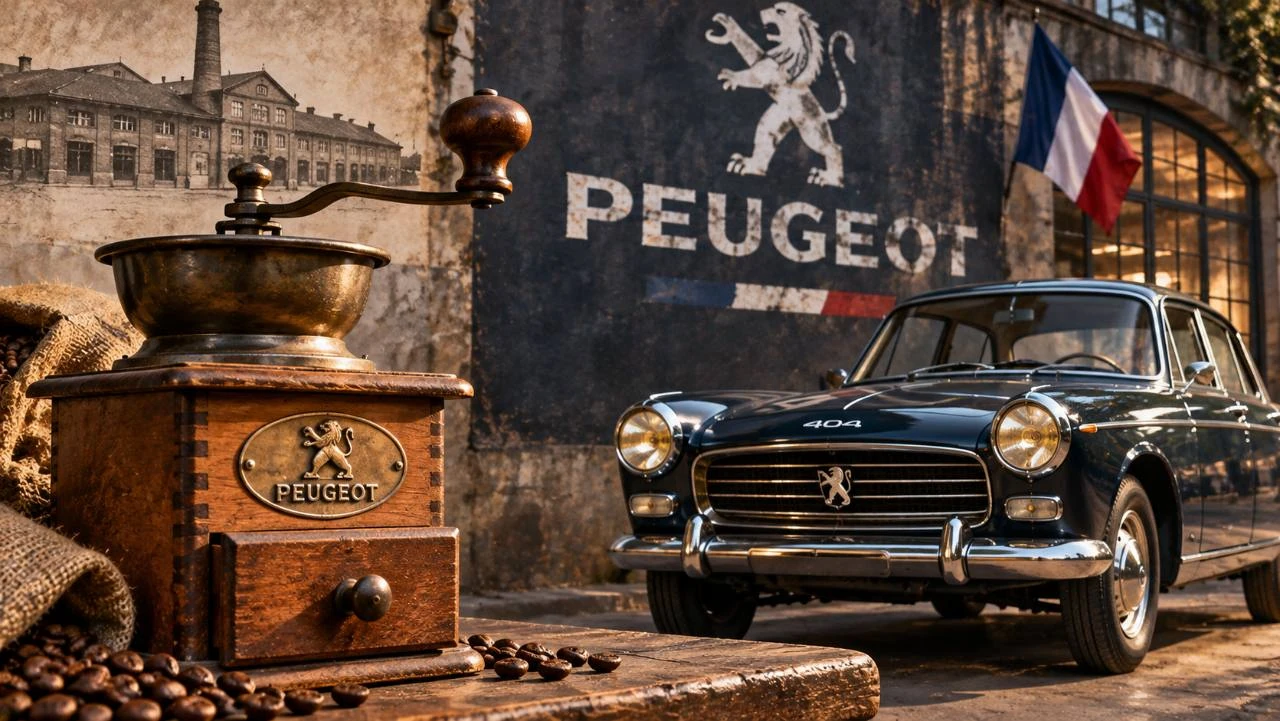
AI-generated editorial illustration supplied for PRESDA. The factory scene brings together products from different eras.
A Peugeot coffee grinder and a Peugeot car share an industrial ancestor. In 1810, the Peugeot family converted a grain mill into a steelworks in the Doubs region of eastern France. The family’s capacity to shape and manufacture metal came before the familiar kitchen products and long before its automobiles. That sequence explains why a name now associated with cars could make sense on a grinder in a kitchen. Peugeot: the family and automobile history
How steel reached the kitchen
Peugeot’s product history dates its first coffee mill to 1840. The grinder combined a casing people could use at home with a metal mechanism whose performance depended on consistent manufacture. Other family products included saws, springs and tools. Making several kinds of goods spread the use of industrial skills beyond a single market. It also gave the family name a presence in everyday life decades before motor travel became commonplace. Peugeot Saveurs: early products and coffee mills
Why bicycles belong in the story
Bicycles put Peugeot into transport before the automobile became its defining business. They required work on frames and moving parts, plus sales and service for a product used on the road. The shift to motor vehicles still demanded new expertise and suppliers. The bicycle matters because it shows the family business exploring mobility before it had settled on the technology that would dominate the twentieth century. Peugeot: the family and automobile history
Steam, petrol and a separate car company
In 1889, Armand Peugeot presented a steam tricycle developed with Léon Serpollet. The following year brought a petrol vehicle using a Daimler engine. The two milestones explain why accounts give different dates for the first Peugeot car: one marks a steam prototype and the other a petrol vehicle. In 1896, Armand formed a separate automobile company. The decision gave motor vehicles their own organization rather than treating them as one more item in the family catalogue. Peugeot: the family and automobile history
From Sochaux to a global group
Sochaux became a center of Peugeot’s automobile production. Later models such as the 404 and 504 belong to a much larger industrial era than the early steam experiments. Another change came in January 2021, when Groupe PSA and Fiat Chrysler Automobiles completed their merger to form Stellantis. The Peugeot automotive brand became part of that group. The family’s early ventures and the later group structure are different stages of the same industrial history. Stellantis: completion of the PSA and FCA merger
How the lion travelled between products
The lion first belonged to Peugeot’s tool business. The company’s history of the emblem traces it from saws to cars, with its design changing over time. On the 404, launched in 1960 with styling by Pininfarina, the lion was visible on the grille. The mark kept a family resemblance across products whose manufacturing, buyers and distribution were very different. Peugeot archives: history of the lion emblem
Related reading · Yangwang and the electric-car speed record.
FAQ
Frequently Asked Questions
When did Peugeot begin making coffee grinders?
Peugeot dates its first coffee mill to 1840.
Was the first Peugeot powered by steam?
The 1889 prototype was a steam tricycle. Peugeot’s first petrol vehicle followed in 1890.
How did Peugeot join Stellantis?
Its parent Groupe PSA merged with Fiat Chrysler Automobiles in 2021.
PRESDA Dispatch
Stay Informed. Stay Aware.
A sharp briefing across AI, gaming, sport, business, world affairs, paparazzi, and lifestyle.