RED BULL: HOW AN ENERGY DRINK BUILT A SPORTS EMPIRE
From Red Bull’s Austrian launch on April 1, 1987 to Formula 1 and media: how a Thai-Austrian partnership built a sports marketing empire.
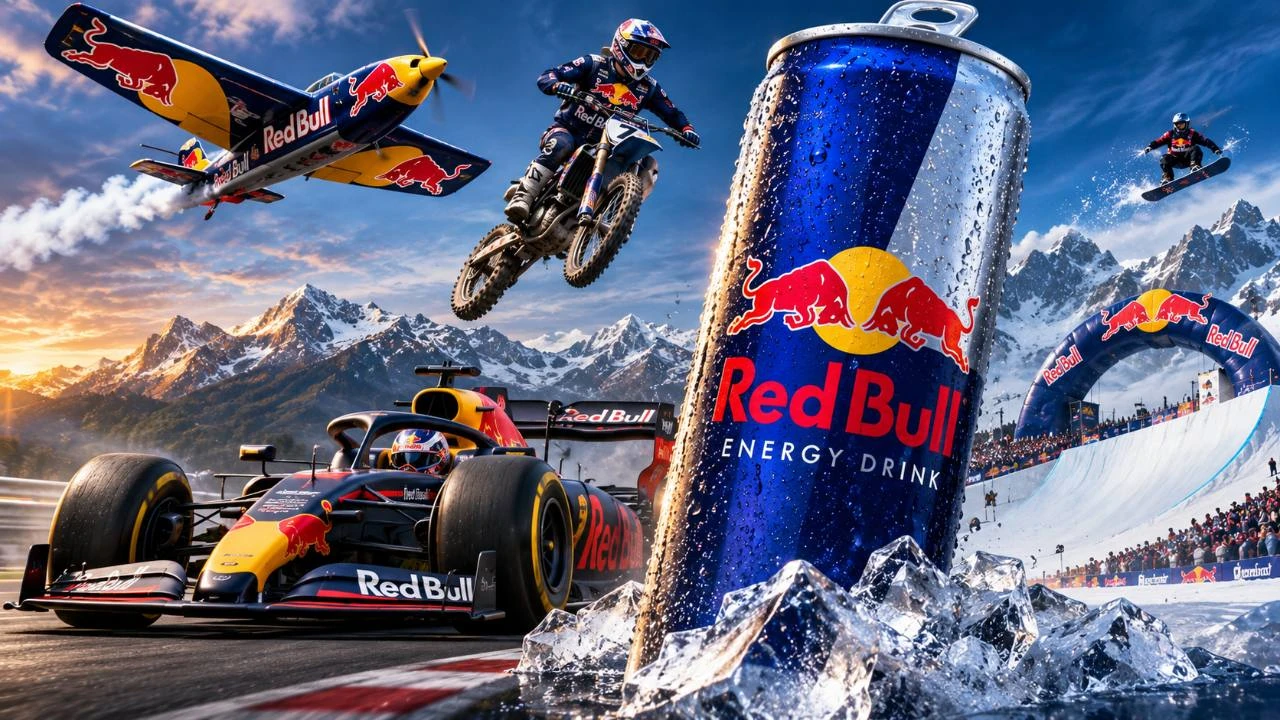
AI-generated editorial illustration supplied for PRESDA. This sports collage is conceptual, not a photograph of one event or evidence that the drink produces athletic achievement. Editorial image supplied for PRESDA.
A can of Red Bull is a product; a Red Bull race, film or football match is an experience. The company’s unusual achievement was to put both under the same name. Launched in Austria on April 1, 1987, the international energy drink grew into a business that sponsors athletes, operates sports teams and produces entertainment. Understanding that expansion requires looking beyond a logo on a racing car. Red Bull: company profile and 1987 launch
The Thai roots behind the Austrian launch
Red Bull did not emerge from an Austrian laboratory without a predecessor. Thai entrepreneur Chaleo Yoovidhya developed the business behind Krating Daeng through the company now known as TCP Group. Its history places Chaleo and Thailand at the centre of the original drink’s development. The later international brand should be understood as an adaptation and partnership, rather than a creation with no Asian roots. TCP Group: company history and Thai origins
Dietrich Mateschitz saw an opportunity to bring the Thai drink to new markets and formed a partnership with Chaleo in 1984. The international version was adjusted for Western consumers, including carbonation. Three dates therefore describe different stages: the Thai precursor, the 1984 partnership and the 1987 Austrian launch. Calling Mateschitz the sole inventor erases the collaboration that made the business possible. The Independent: Chaleo Yoovidhya and the international partnership
Why sport became the brand’s language
Sports marketing gives an abstract promise a visible setting. Speed, concentration, courage and endurance become stories audiences can watch. That does not establish that a drink causes the performances on screen. It explains the positioning: Red Bull placed its identity near activities that express energy, while the athletes supplied the skill, preparation and competitive risk.
Sponsoring an event and owning the stage
The media business makes that strategy more durable than a single advertisement. Red Bull Media House, founded in 2007, produces and licenses films, programmes and live-event coverage. A competition can generate a broadcast, a documentary and shorter clips. The company is therefore a participant in making the entertainment, not simply an advertiser buying space around someone else’s programme. Red Bull Media House: history and production model
Formula 1: a team, not just a sticker
Red Bull bought the Jaguar Formula 1 operation in 2004, and Red Bull Racing began competing in 2005. Its first constructors’ and drivers’ championships followed in 2010, with Sebastian Vettel taking the drivers’ title. Those milestones mark a shift from exposure to responsibility: running a team requires engineers, factories, recruitment and competitive decisions. The drink brand became attached to results it helped organise. Formula 1: Red Bull Racing year by year
Football widened the audience
The football network added a different rhythm: local supporters, league calendars and youth development. Red Bull’s own overview dates its involvement in Salzburg to 2005, New York to 2006 and Leipzig to 2009. These dates do not make every club a newly invented institution; Salzburg and New York had earlier histories. Nor should shared branding be mistaken for identical legal control in every national football system. Red Bull: football clubs and entry dates
What the sports empire actually sells
The commercial logic is a cycle: sport attracts attention, media extends its life, and repeated encounters make the brand familiar at the point of purchase. This is an interpretation of the model, not a claim that every sponsorship pays for itself. Team ownership, athlete support and film production carry costs. An exciting video alone cannot reveal profit margins or the return on a particular campaign.
The myth to leave behind
The simplest origin story makes Red Bull an Austrian invention that conquered sport through daring alone. The stronger account connects Thai product development, an international partnership, distribution and sustained investment in sporting institutions. Its lesson for business is less glamorous but more useful: a recognisable promise becomes powerful when a company repeatedly builds experiences around it. Athletic success remains the work of athletes and teams.
Related reading: Samsung’s transformation from food trading to technology.
Related reading: How the Dassler brothers built Adidas and Puma.
FAQ
Frequently Asked Questions
When did Red Bull launch?
The international Red Bull Energy Drink launched in Austria on April 1, 1987. Its Thai predecessor and the 1984 business partnership came earlier.
Who founded the international Red Bull business?
Dietrich Mateschitz and Thai entrepreneur Chaleo Yoovidhya built the partnership behind Red Bull GmbH. Chaleo developed the Thai precursor.
When did Red Bull enter Formula 1 as a team?
Red Bull Racing began competing in 2005 after the 2004 purchase of Jaguar. Its first drivers’ and constructors’ titles came in 2010.
PRESDA Dispatch
Stay Informed. Stay Aware.
A sharp briefing across AI, gaming, sport, business, world affairs, paparazzi, and lifestyle.