Richard Dawkins explores nature’s strangest forms in 42 Tales from Life
Dawkins pairs evolutionary essays with Ernst Haeckel’s art in a bestiary published in October in the US and November in the UK.
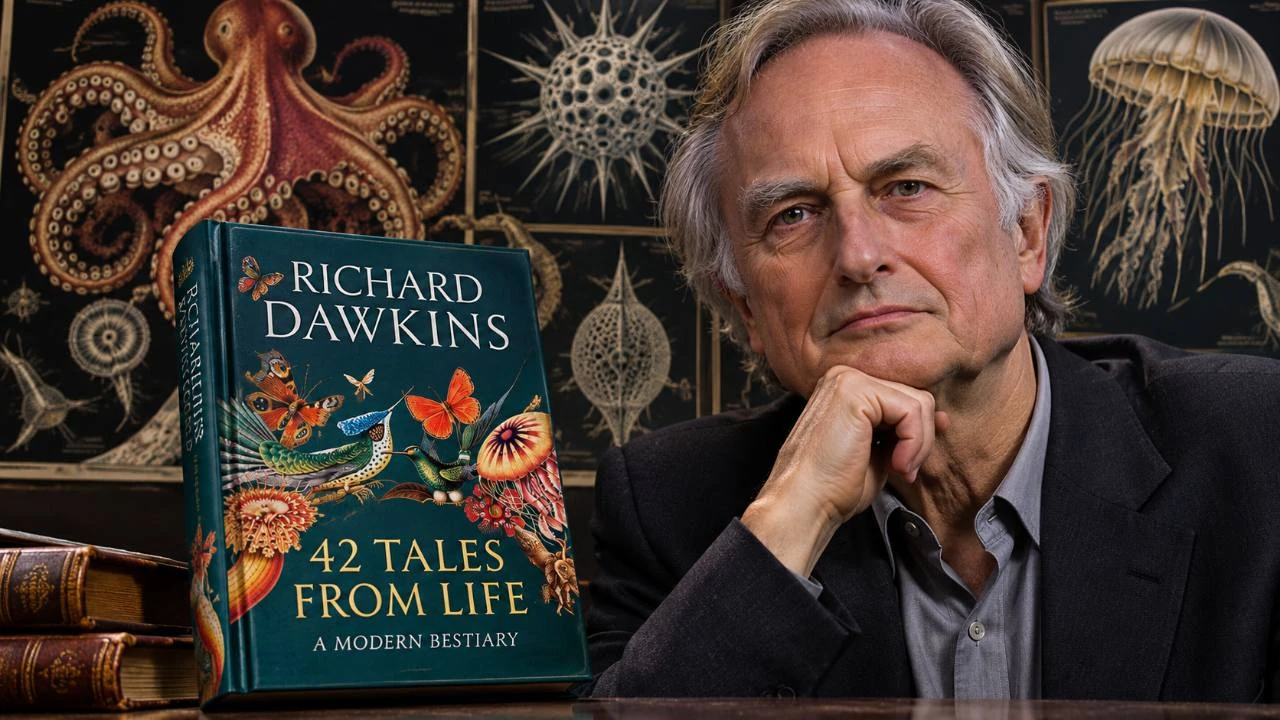
AI-generated illustration supplied for PRESDA. The cover shown is imagined.
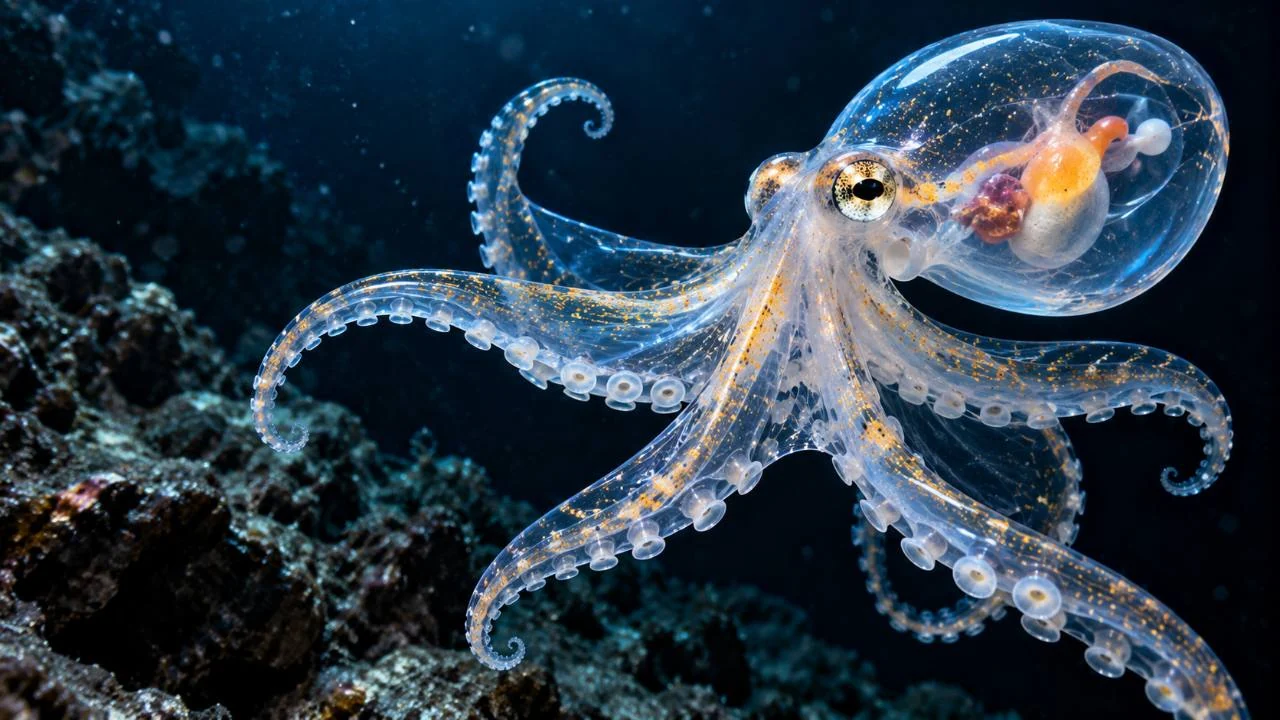
An octopus and a hummingbird ask very different questions of an evolutionary biologist. In 42 Tales from Life: A Modern Bestiary, Richard Dawkins moves between such examples to ask how living forms acquired their peculiar features. The book includes chapters on extinct animals, microscopic life, fungi and plants alongside its animal stories. Yale University Press
When the book came out
Apollo, an imprint of Bloomsbury, lists November 5, 2026 for the UK edition. Yale University Press lists October 20, 2026 for its US hardcover and ebooks. Both publishers list 368 pages. The UK hardback ISBN is 9781035924356 and the US hardcover ISBN is 9780300303797. Bloomsbury UK
What the creatures reveal about evolution
The contents range from Darwin’s pigeons to siphonophores and fossil trilobites. Pigeons illustrate how selection can shift inherited traits over generations. A siphonophore raises a different question about individuality because it is a colony of specialised units. The chapters invite readers to ask what evidence can connect a structure to its history, from living relatives to fossils. Yale University Press
What a modern bestiary can explain
A bestiary puts striking animals next to one another. In a book about evolution, the comparison is an invitation to ask separate questions about ancestry and function. What did the organism inherit? What changes made its present form possible? What evidence would show that a trait affected reproductive success? The publisher’s examples range from a rhinoceros horn to a hummingbird’s colors. A useful reading is to pause at each example and ask which of these questions the essay answers, rather than assume that an appealing story is itself evidence of adaptation. Source · Yale University Press
Why resemblance can mislead
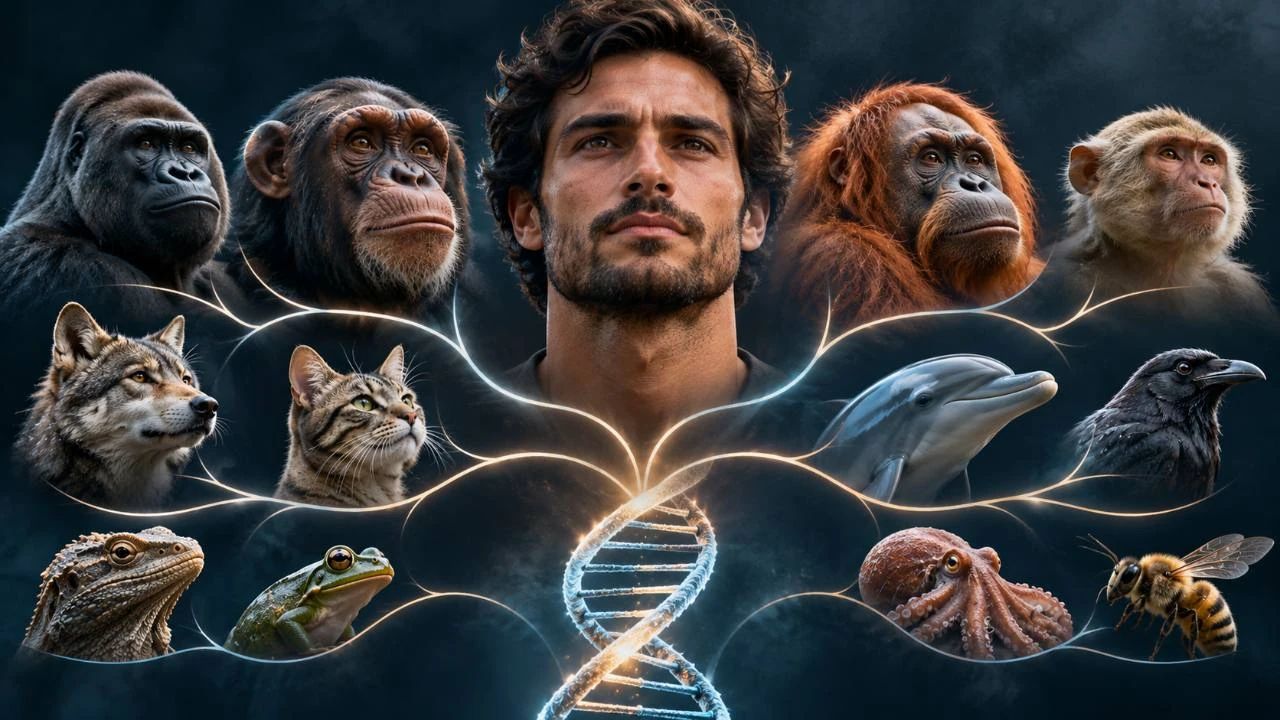
The publisher highlights a comparison between horses and lizards. A visible resemblance might reflect inheritance, or a similar form or behavior might appear independently under similar constraints. Biologists test those explanations with more than a picture. They can compare development, anatomy and genetic evidence in enough species to see which explanation fits the family tree. The PRESDA guide to how much DNA humans share with other species explains why the choice of comparison matters even when the evidence seems numerical and exact. Source · Yale University Press
Haeckel’s radiolarians reward a second look
Plate 71 of Haeckel’s 1904 Kunstformen der Natur arranges radiolarians of the group Stephoidea on a single page. Their minute structures become large enough on paper to compare spines, openings and symmetry. The plate is a historical example of Haeckel’s work. It should be read as a composed scientific illustration: the artist selects the specimens and arranges the views, so their placement on the page conveys comparisons, rather than a scene observed in nature. The illustration reproduced here comes from the 1904 collection. Source · Ernst Haeckel, plate 71
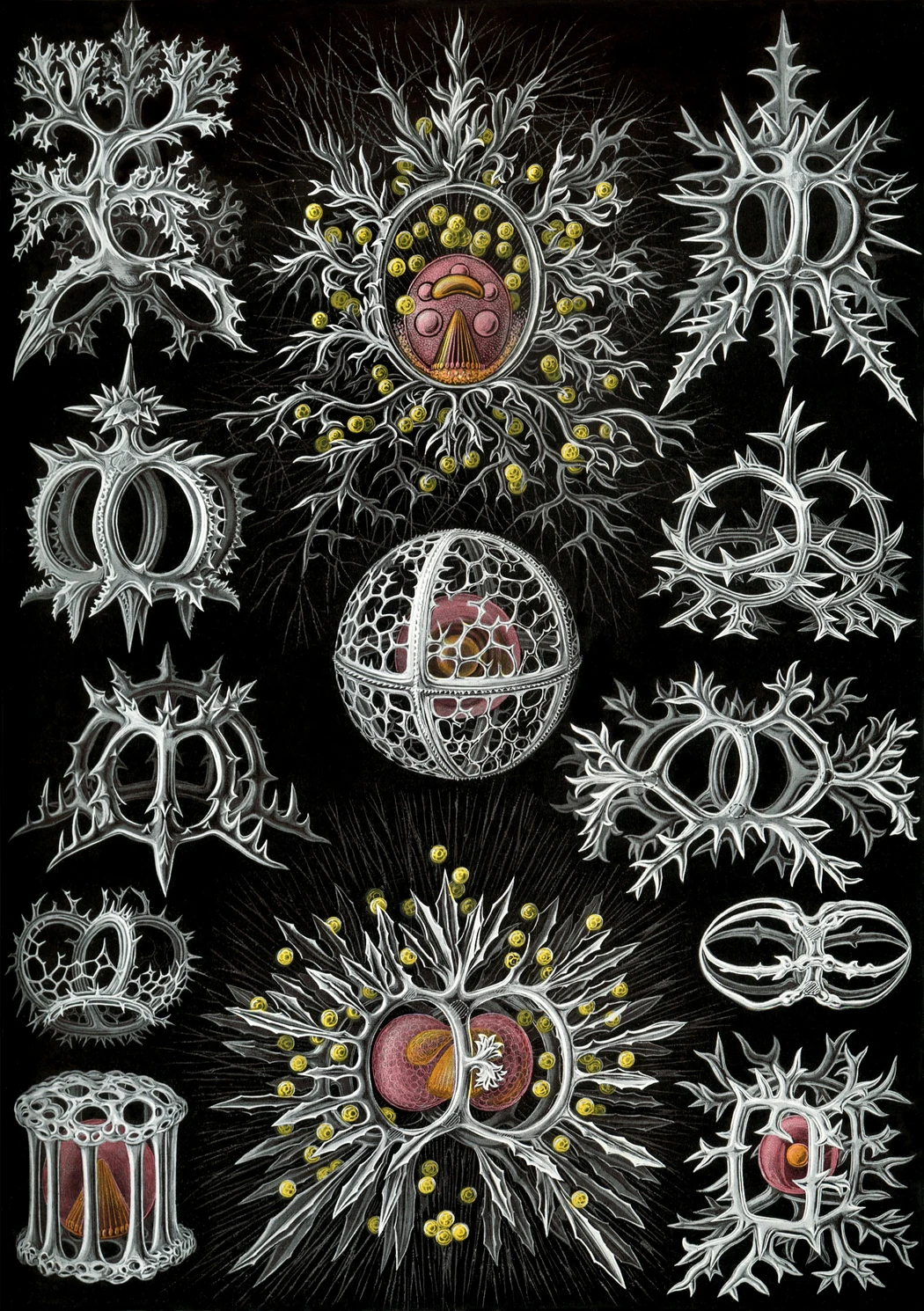
Radiolarians of the group Stephoidea, plate 71 of Ernst Haeckel’s Kunstformen der Natur (1904). Public domain.
Image recordWhere the book fits in Dawkins’s work
The Selfish Gene, published in 1976, brought a gene-centered account of evolution to a broad readership. The Extended Phenotype followed in 1982 and The Blind Watchmaker in 1986. Oxford University Press identifies Dawkins as the first holder of Oxford’s Charles Simonyi Chair for the Public Understanding of Science, from 1995 until 2008. The bestiary takes a different route into that long-running subject. Instead of organizing an entire book around one argument, it uses many individual forms to show how biological explanations can start from close observation. Its illustrations give the reader something concrete to question. Source · Yale University Press Source · Oxford University Press
Why Ernst Haeckel’s art is here
Haeckel’s illustrations bring the shapes of marine organisms, plants and other subjects into view. A plate can make symmetry and repeated structures easier to see. Modern evolutionary explanations still depend on evidence about ancestry and inheritance. The historical artwork gives the reader an entry point into those questions. Bloomsbury UK
The ideas that made Dawkins influential
An evolutionary biologist who trained in animal behaviour, Dawkins held Oxford’s first Charles Simonyi chair in public understanding of science from 1995 to 2008. The Selfish Gene (1976) popularised a gene-centred view of selection. The Extended Phenotype (1982) argued that inherited effects can reach beyond an organism’s body, as in structures built by animals. The Blind Watchmaker (1986) explained cumulative selection for general readers. The God Delusion addressed religion and belongs to a different part of his bibliography. Oxford University Press
What Dawkins actually asks about the animals
Yale’s description gives a sense of the book’s scale: it moves from the shape of a rhinoceros horn to the bright colors of hummingbirds, and from the movement of fish to similarities between horses and lizards. A reader can ask whether an observed feature is best explained by inheritance from a common ancestor, by how an animal functions today, or by a combination of historical and functional evidence. Source · yalebooks.yale.edu
See Haeckel’s work in its original setting
The Biodiversity Heritage Library has digitized the 1904 volume of Kunstformen der Natur. Looking through the plates shows the visual tradition that a contemporary bestiary can draw on. An illustrated plate records both an organism’s form and an artist’s decisions about how to arrange it. Source · biodiversitylibrary.org How DNA comparisons reveal shared ancestry.
FAQ
Frequently Asked Questions
Who illustrated the book?
It reproduces artwork by German naturalist Ernst Haeckel.
Did both editions come out in November?
Apollo lists November 5 in the UK. Yale University Press lists October 20 in the US.
PRESDA Dispatch
Stay Informed. Stay Aware.
A sharp briefing across AI, gaming, sport, business, world affairs, paparazzi, and lifestyle.