UAE'S HOPE PROBE: THE FIRST ARAB MISSION TO MARS
The UAE’s Hope orbiter reached Mars in 2021. How its orbit and three instruments help scientists study weather, atmospheric escape and Deimos.
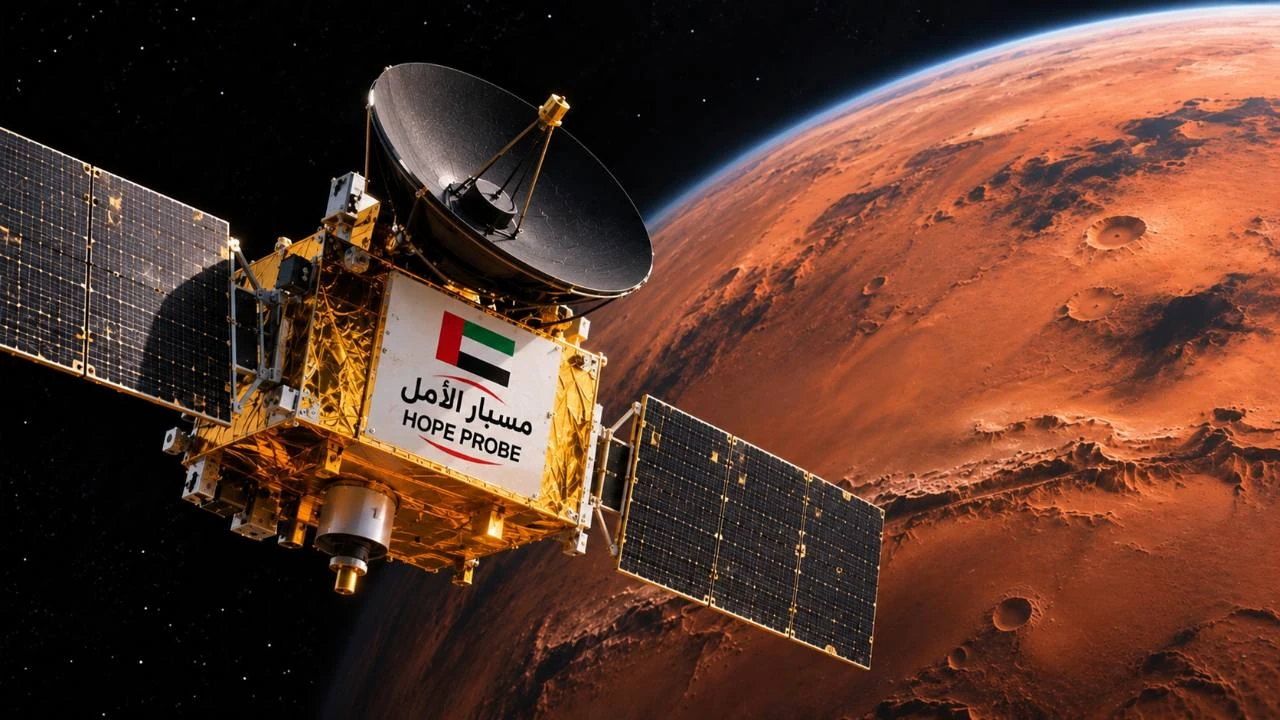
Editorial illustration supplied for PRESDA.
Hope reached Mars on February 9, 2021. The United Arab Emirates became the first Arab country to put a spacecraft in orbit around another planet. The spacecraft, called Al Amal in Arabic, had launched months earlier on a Japanese rocket. Its purpose was to watch the Martian atmosphere change over the course of a day and across seasons. That goal shaped where it would fly, what it carried and how the resulting observations could be used by researchers on Earth. Emirates Mars Mission team, Space Science Reviews UAE Space Agency
A single image can show clouds on Mars. To understand what produced them, scientists need to know the place, local time, season and conditions in the air. The pattern a spacecraft sees just after sunrise can look different in the same region during the afternoon. Hope was designed to observe across those changing conditions instead of sampling almost exclusively at the same local hours. Much of its scientific value comes from where and when its measurements were made. Emirates Mars Mission team, Space Science Reviews
| Instrument | What it observes |
|---|---|
| EXI | Visible and ultraviolet images, including atmospheric features |
| EMIRS | Thermal infrared signatures of temperature, dust, clouds and water vapour |
| EMUS | Ultraviolet emissions from the upper atmosphere |
The launch, the arrival and the science orbit
The Emirates Mars Mission launched from Tanegashima, Japan, on July 20, 2020 local time. In Coordinated Universal Time it was still July 19. This accounts for the two dates readers encounter. The H-IIA launch vehicle placed Hope on its interplanetary trajectory, and the spacecraft operated independently after separation. At Mars it needed to brake to become a satellite of the planet. Reaching the neighbourhood of Mars and settling into a useful orbit were two distinct engineering milestones. Emirates Mars Mission team, Space Science Reviews
Why entering orbit mattered
A spacecraft arrives with enough speed that it can pass a planet and continue into space unless it loses sufficient velocity relative to it. Hope fired its engines during arrival to enter an initial capture orbit. It subsequently moved to the higher, elongated orbit used to collect most of its planned science observations. The purpose of the manoeuvre was to remain at Mars and take measurements repeatedly. A lander would instead have needed to survive a descent and would have focused on a much more geographically limited setting. Emirates Mars Mission team, Space Science Reviews
What Hope’s unusually high orbit makes possible
The science orbit ranges from roughly 20,000 to 43,000 kilometres above Mars and takes about 55 hours to complete. From that height a sensor can see large portions of the planet. Repeated passes let the team build up coverage at different local times. A closer spacecraft can often see much smaller features, which matters when researchers want to study a particular canyon, crater or ground site. Hope’s approach trades some of that spatial detail for a wider view and a useful spread of observation times. Emirates Mars Mission team, Space Science Reviews
Local time is a measurement, too
When an observation is taken from orbit, the time on an Earth-based mission clock and the time of day over a point on Mars answer different questions. A single image of one place at dawn may show something that is typical only at that hour. If it is compared with a different place at midday, geography and time are both changing at once. Hope’s repeated observations help researchers distinguish daily heating and cooling from geographic patterns, provided they account for season, the instrument footprint and changing conditions on the ground. Emirates Mars Mission team, Space Science Reviews Hope instrument team, comparison with Mars rover measurements
Three instruments look at different layers
Hope carries the Emirates Exploration Imager, or EXI, the Emirates Mars Infrared Spectrometer, or EMIRS, and the Emirates Mars Ultraviolet Spectrometer, or EMUS. EXI collects visible and ultraviolet imagery. It helps trace features such as water-ice clouds and contributes to studies of ozone. EMIRS looks at thermal infrared radiation to investigate temperatures, dust, ice clouds and water vapour. EMUS uses ultraviolet light to study parts of the upper atmosphere, including emissions from hydrogen and oxygen. The instruments were chosen to make the measurements useful together. Emirates Mars Mission team, Space Science Reviews UAE Space Agency
What an instrument measures and what researchers infer
A spectrometer records how much radiation it receives at different wavelengths. Scientists use models and calibration to infer which constituents of the atmosphere contributed to a signal. Even if a measurement is very precise, there can be uncertainty about where the signal came from or how much of a material was present. A visible image provides extra context, but it also needs interpretation. Recording the instrument, location, time and observing geometry makes it possible for other teams to test those interpretations rather than having to take a press release at face value. Emirates Mars Mission team, Space Science Reviews Emirates Mars Mission Science Data Center
What counts as a weather observation on Mars?
The lower atmosphere changes as the surface heats and cools. Dust can change how sunlight warms the air, and water held in ice clouds behaves differently over the day. Hope provides a way to follow patterns over large areas at more than one hour of the day. In a study using EMIRS, a research team compared temperatures inferred from orbit with measurements by the Curiosity and Perseverance rovers. A rover can take measurements close to the ground at a specific location. An orbiter can observe a broader area, and its estimate may represent a different patch of ground. Those differences matter even when both instruments are working properly. Emirates Mars Mission team, Space Science Reviews Hope instrument team, comparison with Mars rover measurements
How atmospheric escape fits into the picture
The top of the Martian atmosphere contains atoms that can escape into space. Observations of hydrogen and oxygen help scientists investigate how material is distributed high above the surface and how that distribution changes. Measurements of the lower atmosphere make it possible to ask whether seasons and weather have a connection to those changes. A modern orbiting mission cannot watch billions of years go by, so current measurements are evidence used alongside models and other observations to investigate the planet’s long history. Emirates Mars Mission team, Space Science Reviews UAE Space Agency
Hope had a second target in view
The mission also obtained observations of Deimos, the smaller of Mars’s two moons. Capturing images and spectra under different viewing conditions helps researchers compare its surface with earlier observations. A separate NASA image taken by the Mars Reconnaissance Orbiter in 2009 provides a useful reference point for readers who want to see what the object looks like. That picture predates Hope. Correctly identifying the spacecraft and date lets a reader compare observations without mistaking one mission’s photograph for the other’s. UAE Space Agency NASA Deimos photojournal
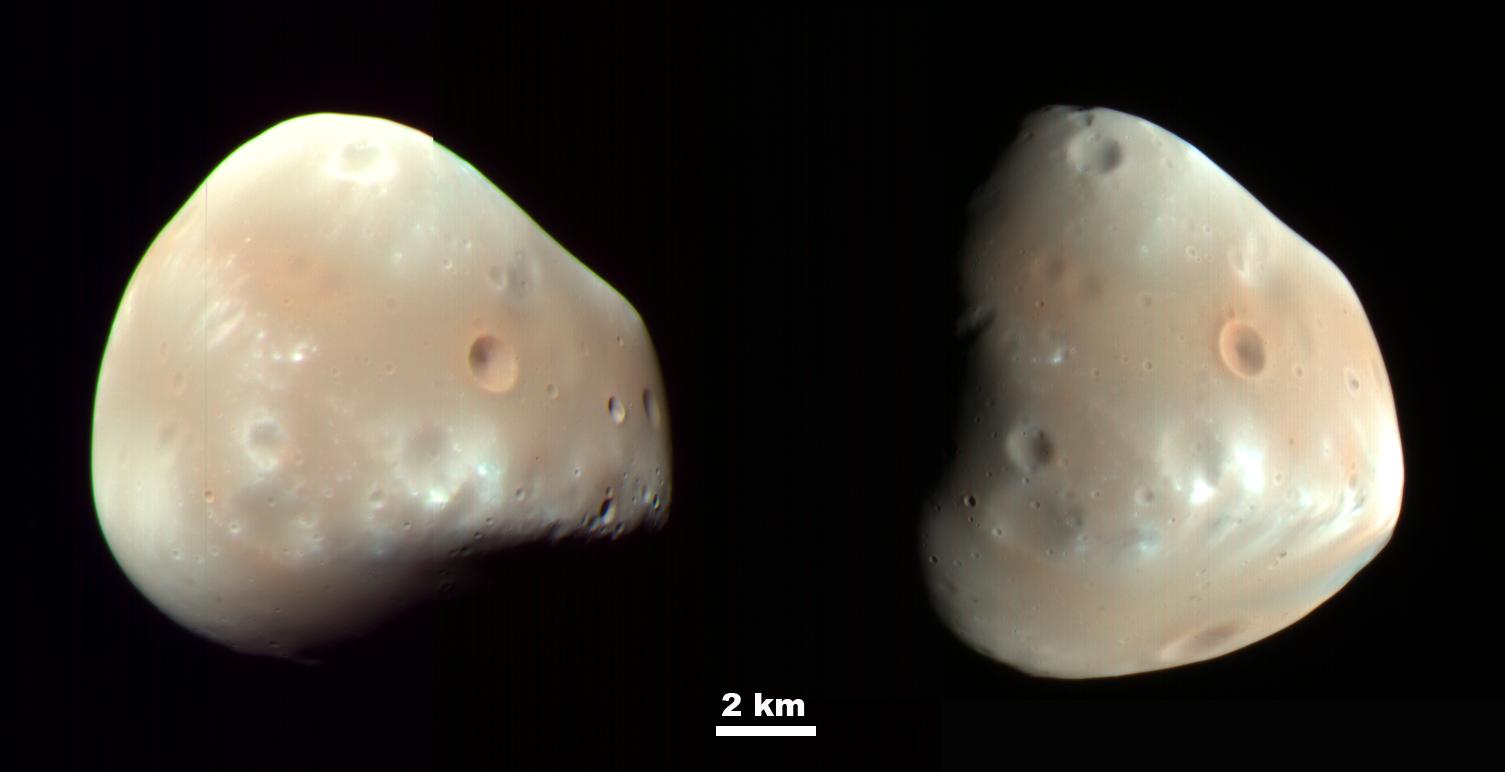
Colour-enhanced views of Deimos from NASA’s Mars Reconnaissance Orbiter, photographed by HiRISE on February 21, 2009.
What an open archive changes
The Emirates Mars Mission Science Data Center makes science data discoverable by instrument, processing level and date. An early image on a website can show what an instrument sees. An archive makes a different kind of work possible. Researchers can find observations taken at a time that overlaps a separate spacecraft, work with the calibration information and document how they reached a result. There is a parallel in PRESDA’s look at the Svalbard seed vault: a collection is more useful when the material is preserved alongside reliable records that explain what it represents. Emirates Mars Mission Science Data Center
What the UAE built through the mission
The Mohammed Bin Rashid Space Centre led a mission developed with international partners, including the University of Colorado Boulder’s Laboratory for Atmospheric and Space Physics. The science team’s account describes knowledge transfer alongside the hardware and observations. Working on an interplanetary mission means learning to build instruments and also to organise the less visible tasks that make data usable, from reviewing commands to maintaining documentation. Those jobs continue to matter after the televised moment a spacecraft arrives. Emirates Mars Mission team, Space Science Reviews UAE Space Agency
Why looking for clouds is also looking for a cycle
Water on Mars can move from one physical state to another. The same amount of water can give a different signal when it is held in a cloud, mixed through the air or frozen at the surface. Temperature measurements and images taken at compatible times help researchers test what might be happening. They also help to see whether an apparent trend is an artefact of the schedule. A spacecraft that observes a region at the same hour every day can offer an excellent fixed-hour record, while Hope’s varying local times make it easier to ask what changed between morning and evening. Combining the two kinds of record can reveal whether a model captures both the geography and the rhythm of the change. The mission’s planners made that combination part of the scientific case, rather than treating the orbit as just a means of keeping instruments above the ground. Emirates Mars Mission team, Space Science Reviews
FAQ
Frequently Asked Questions
When did Hope reach Mars?
It entered Mars orbit on February 9, 2021, after launching from Japan in July 2020.
Did Hope land on Mars?
Hope is an orbiter. It studies Mars remotely from above the atmosphere.
Where can I find Hope’s research data?
The Emirates Mars Mission Science Data Center offers records by instrument, observation date and processing level.
PRESDA Dispatch
Stay Informed. Stay Aware.
A sharp briefing across AI, gaming, sport, business, world affairs, paparazzi, and lifestyle.