NORWAY'S DOOMSDAY VAULT: PROTECTING THE WORLD'S FOOD
How Norway’s Svalbard Seed Vault stores duplicate seeds, who can retrieve them and how ICARDA used its backup to restore collections.
Editorial illustration supplied for PRESDA.
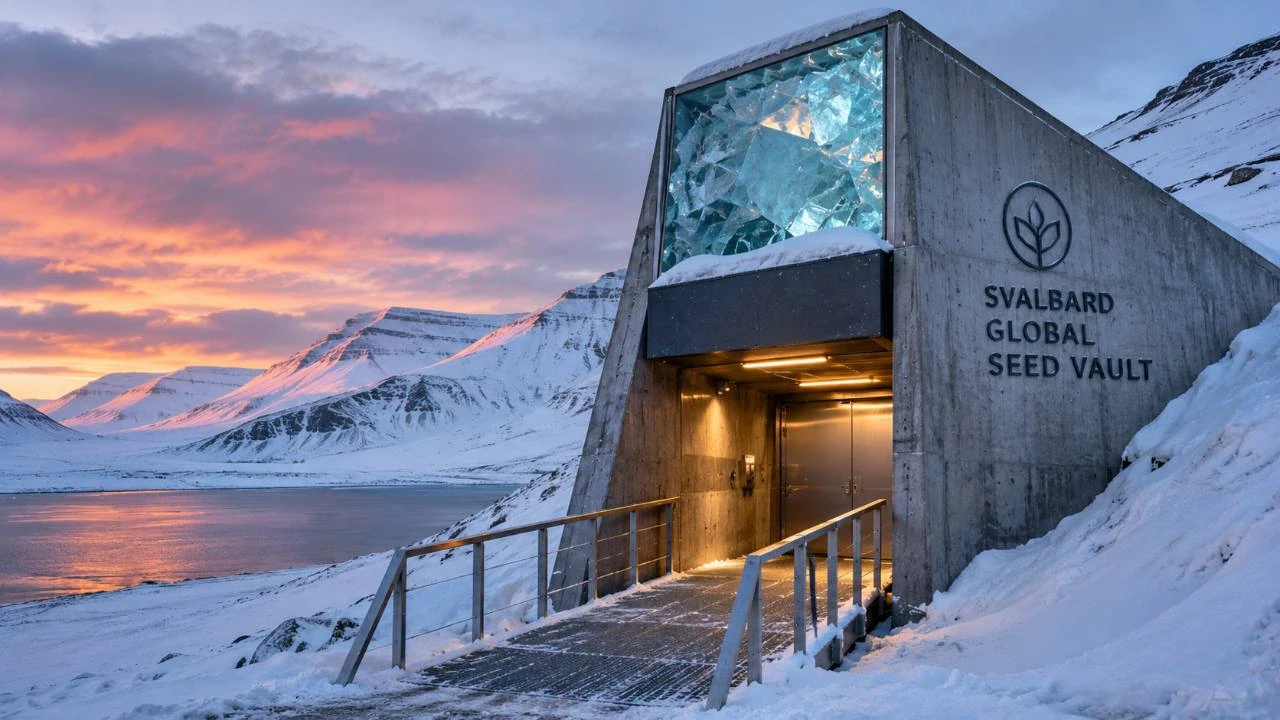
In a mountain near Longyearbyen, Norway keeps sealed boxes that can restore part of a lost agricultural collection. The Svalbard Global Seed Vault opened on February 26, 2008. Its real job is to hold duplicate samples from working genebanks, so the organisations that collected and maintained them have another copy if their own stocks are damaged or inaccessible. On October 14, 2026, the Food and Agriculture Organization reported that 21 institutions had deposited 16,676 samples, adding to more than 1.4 million already held. Those figures count samples, not crop species or individual seeds. Svalbard Global Seed Vault facility FAO seed deposit report
Why the world needs more than one copy
| Milestone | What it shows |
|---|---|
| February 2008 | Vault opens in Svalbard |
| 2017 | ICARDA redeposits more than 20,000 accessions |
| October 2026 | 21 institutions deposit 16,676 seed samples |
A genebank keeps collections available to breeders and researchers, tests the material, manages records and regenerates seed when stocks become old or scarce. A single institution can lose access to those collections through war, a natural disaster, a funding lapse or an equipment failure. A backup in a different location reduces the chance that the same event will destroy both copies. Svalbard sits at the end of that chain. The original genebank still has to be able to recognise its samples and manage them after retrieving a duplicate. Svalbard Global Seed Vault operations Svalbard Global Seed Vault collections
What an accession is
An accession is a documented sample, often collected in a particular place or maintained as part of a defined breeding line. Multiple samples can belong to the same crop species. A genebank might hold many wheats collected from different climates or many lentils from farming regions with different soils. Two samples of the same crop can matter separately because they contain different variation. An accession record, together with the physical seed, lets researchers ask where a line came from and whether it could help answer a specific question. A collection of bags without their records would be much harder to use.
Where the vault is and how it stays cold
The facility is inside solid rock in the permafrost on Spitsbergen, part of the Norwegian Svalbard archipelago. It was built for the purpose. Its resemblance to a mine entrance has fed the mistaken idea that the boxes sit in an old coal mine. Mechanical refrigeration maintains the collection at minus 18 degrees Celsius. The surrounding cold rock provides a buffer if artificial cooling is interrupted. That design still needs electricity, maintenance and monitoring. The mountain reduces exposure to the outside environment rather than eliminating every hazard. Svalbard Global Seed Vault facility Svalbard Global Seed Vault operations Svalbard Global Seed Vault history
What changes when the Arctic warms?
Engineering at the entrance is different from conditions in a storage chamber. Norway made the access tunnel waterproof and updated the cooling equipment. An entrance can be exposed to water while separately sealed chambers remain protected. That distinction is important both for understanding the investment and for evaluating claims that the seeds are sealed away beyond the reach of climate change. Long-term resilience also depends on inspecting the structure, maintaining the cooling system and watching how the local environment changes over time. Svalbard Global Seed Vault operations
Who owns the deposits?
Depositors retain control of their boxes. The facility uses a system frequently described as black-box storage. In practice a shipment is stored on behalf of the depositing institution, which has the right to request it back. Norway established and funded the facility, while NordGen and the Crop Trust are part of its operating partnership. That does not transfer ownership of the seeds to Norway. It also means a plant breeder looking for material normally contacts the originating genebank through its ordinary arrangements. They do not arrive at the vault entrance and take a packet off a shelf. Svalbard Global Seed Vault operations Svalbard Global Seed Vault collections Crop Trust questions and answers
The withdrawal that showed the system can work
The international agricultural research centre ICARDA had stored duplicates between 2008 and 2014. The conflict in Syria disrupted its ability to work with its collection near Aleppo. It requested samples and multiplied them at sites in Lebanon and Morocco. New harvests made it possible to send fresh duplicates back to Svalbard. The vault’s account records that more than 20,000 accessions were redeposited in 2017. This was a recovery process involving land, trained staff, documentation and growing seasons. The boxes were valuable because working institutions could bring the collections into use again. Svalbard Global Seed Vault ICARDA report
Why planting a backup takes time
Seeds in storage are a starting point. They still need appropriate growing conditions and enough plants to maintain the genetic variation the accession is supposed to represent. Collections also need careful tracking during multiplication. If different varieties are mixed or labels are lost, the bank may preserve material whose identity it can no longer establish. Physical protection and good records are therefore complementary forms of insurance. A deposit thousands of kilometres away can protect the material from a local disruption, but it cannot by itself provide the people or facilities that put the material back to work.
Which crops need other kinds of backup?
The vault is best suited to seed that can be dried and stored at low temperature. Some crops are normally propagated through cuttings or tubers, and some seed tolerates neither drying nor freezing under conventional conditions. Genebanks use methods such as field collections, tissue culture and cryopreservation for material that requires different handling. Those approaches have different needs for space, equipment and skills. The vault is one part of a conservation system that also depends on the plants people continue to grow and select on farms. Svalbard Global Seed Vault collections Crop Trust questions and answers
That wider system is what links a packet in the Arctic to a future harvest. Crop breeders may need variation that helps a line cope with a disease or different growing conditions. Access to diverse material gives them candidates to test, not a pre-made solution. For a primer on why genetic similarities and differences depend on what is measured, see PRESDA’s guide to DNA comparisons.
What the donation date adds to the headline count
The Food and Agriculture Organization’s October report is a snapshot of a deposit event. Some consignments may be duplicates of lines already conserved by related institutions, and an organisation can return fresh material after regenerating it. These are expected parts of a backup system. A growing number of accessions neither tells us that every crop is adequately represented nor measures how much variation farmers are still maintaining in the field. It does tell us that more material is available for recovery if a shipment’s original collection is damaged. FAO seed deposit report
Some losses would be particularly difficult to repair. A small local bank, for example, might maintain landraces from places where farmers now grow other crops. Even if a breeder knows the broad name of the crop, locating the same documented material again can be hard. A genebank can also protect research investments already made in describing a collection. Backing up the seed and keeping those descriptions usable are separate jobs. A future scientist will need both to decide what to test, how to grow it and whether the sample still contains the characteristics that matter.
FAQ
Frequently Asked Questions
Can visitors enter the seed chambers?
The vault is a working storage facility. Visitors can see the exterior, while access to the chambers is restricted.
Who may withdraw seeds?
The institution that deposited the material retains control and can request the return of its own samples.
Does Svalbard contain every food crop?
No. The collection depends on deposits and on the suitability of each type of material for cold, dry seed storage.
PRESDA Dispatch
Stay Informed. Stay Aware.
A sharp briefing across AI, gaming, sport, business, world affairs, paparazzi, and lifestyle.