ROMANIA'S MERRY CEMETERY: WHERE DEATH MEETS HUMOR
Who made Săpânța’s painted crosses, how the first-person epitaphs work and why the Merry Cemetery remains a place of remembrance.
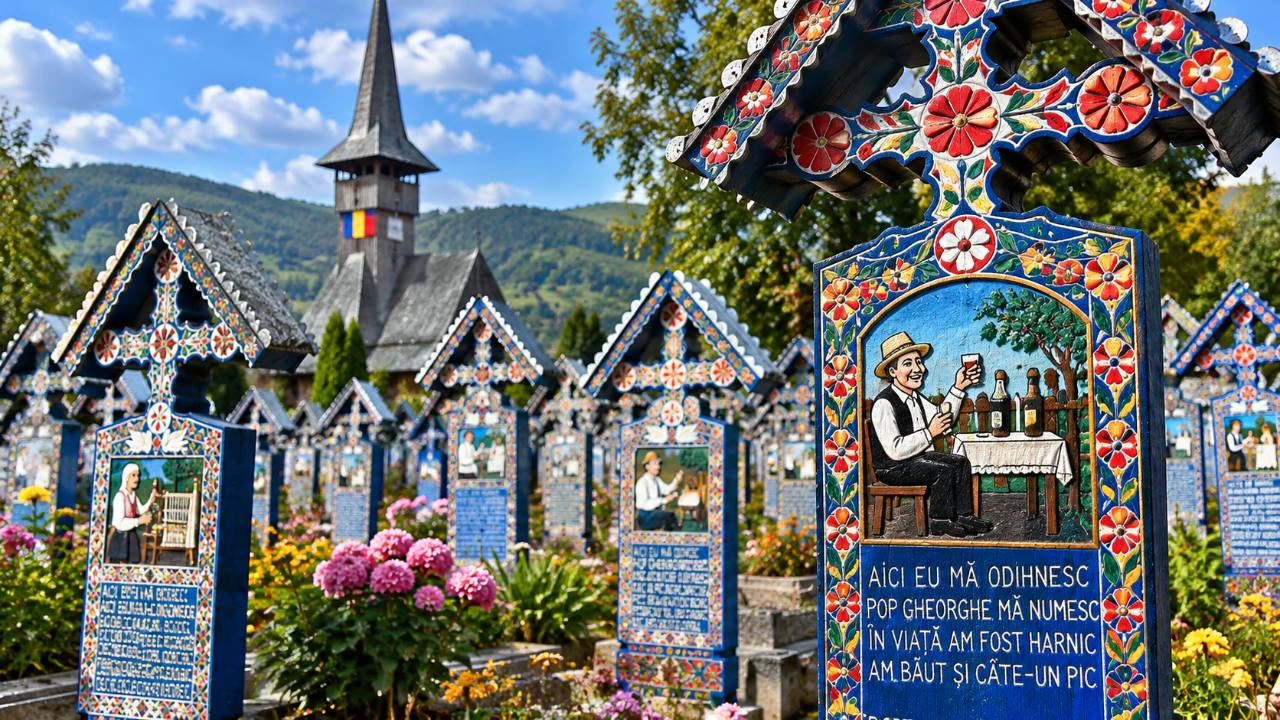
Editorial illustration supplied for PRESDA.
In Săpânța, a village in Romania’s northern Maramureș region, grave markers offer information a conventional headstone often leaves out. A small carved scene may show a person at work, in a familiar place or in an episode remembered by neighbours. Below the scene, a verse may speak from the first person. The painted wooden crosses, many with a deep blue ground, are the reason the place is known as the Merry Cemetery, or Cimitirul Vesel. The name reflects the unexpected tone of some inscriptions. The site is also the burial ground of a community that commissions the markers to remember its dead. Săpânța memorial house Maramureș regional guide to the Merry Cemetery Lonely Planet destination entry
Where the Merry Cemetery is
| Element | What it contributes |
|---|---|
| Painted wooden cross | Shared form and a background for individual designs |
| Carved or painted scene | A reference to work, family or an episode of life |
| Verse epitaph | A voice often composed in the first person |
| Village and workshop | Context for the commission and the craft |
Săpânța is near Sighetu Marmației in Maramureș County. The cemetery belongs to a village setting with a local history of woodworking. Its reputation has brought visitors who come specifically to see the crosses. For people with relatives buried there, the same place has another purpose. Keeping the distinction in view helps explain why a short, funny verse may matter beyond being a memorable line. The scene above it and the place where it stands connect the inscription to a person. Săpânța memorial house Maramureș regional guide to the Merry Cemetery Lonely Planet destination entry
Why the blue crosses lead people to stop
A repeated shape or colour can tie together many pieces. Within that shared form, makers give individual crosses different painted scenes, ornaments and text. A reader can look first at the craft and then ask what has been chosen to identify a specific life. A photographed detail may look like a picture detached from the grave. At the site, the marker still has a relationship to a name, a date and the others nearby. That setting is one reason short descriptions of the cemetery should name the village and its purpose. Săpânța memorial house Maramureș regional guide to the Merry Cemetery
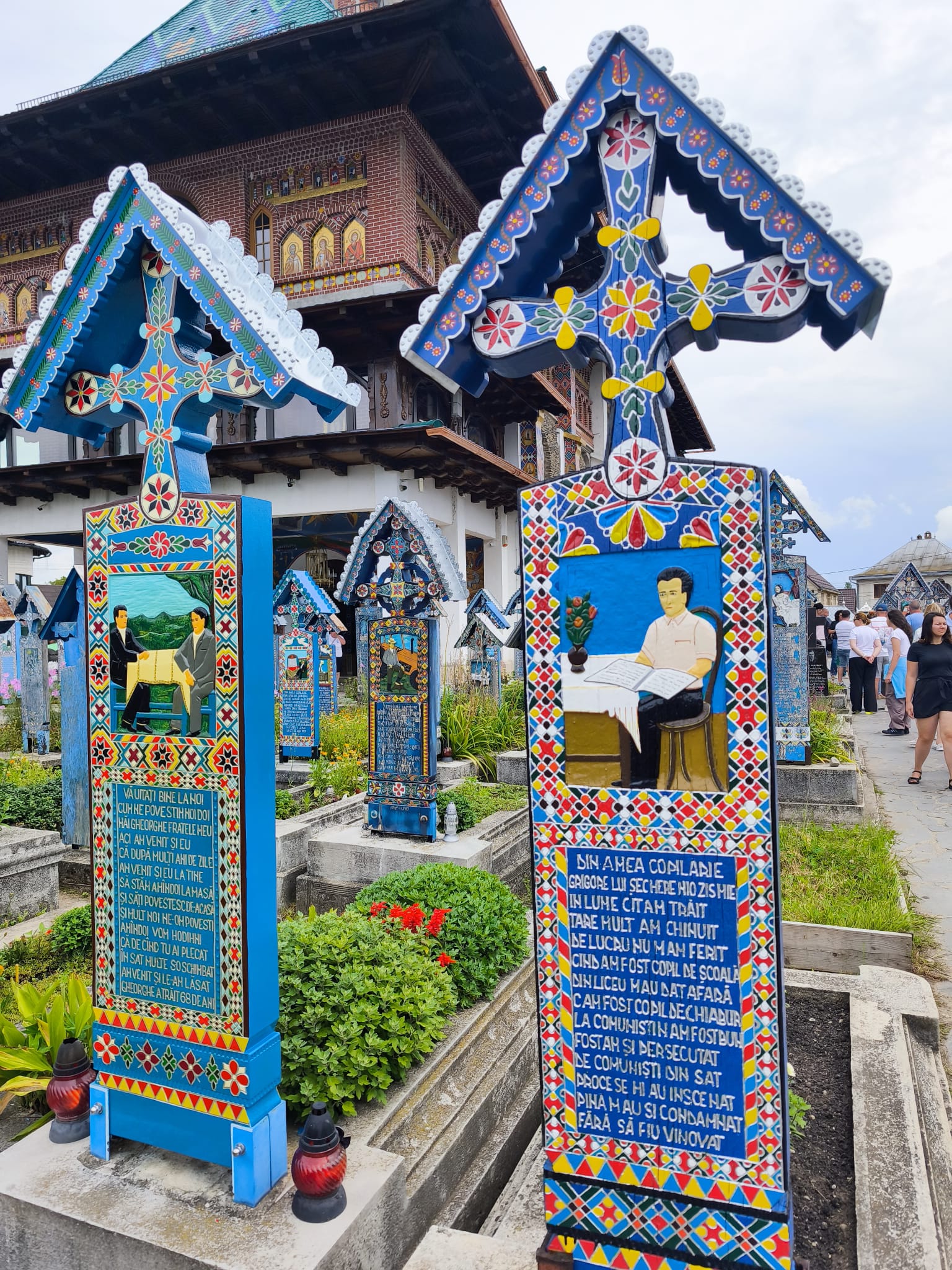
The Merry Cemetery in Săpânța, Romania, photographed in July 2026.
Who started the tradition?
The memorial house dates Stan Ioan Pătraș’s first verse inscriptions to 1935. The regional guide describes how early broader crosses made room for a written epitaph and identifies local collaborators in the development of the form. It is useful to say exactly what the date marks. It is an origin date for the practice associated with Pătraș, rather than the age of the entire burial ground. Artists working in the village had wood, tools, knowledge of carving and customers for memorials. Adding a painted scene and a short poem made it possible for the marker to carry a more particular account. Săpânța memorial house Maramureș regional guide to the Merry Cemetery Lonely Planet destination entry
The work behind an epitaph
A piece follows from decisions about the wood, carving, paint and layout. It also depends on a discussion about what to include. An episode that seems minor to a visitor may be important to a family because it fixes a person in a place or in a kind of work. A larger piece makes room for words, but someone still has to decide which words and what can fit. The image and the verse therefore work together. The task is more specialised than painting a blue background and adding an interchangeable joke. Săpânța memorial house Maramureș regional guide to the Merry Cemetery
Why some of the verses sound as if the dead are speaking
The memorial house describes short verses composed in the first person, often close to local speech. This form can make the voice feel immediate. It remains a crafted account. A sentence in the first person is not necessarily a verbatim statement made by the person who died. It may be how a carver renders a memory or how a family chooses to make a life recognisable. Regional speech, verse and tone can all shape how an inscription sounds to people who know the place. Săpânța memorial house
What translation can change
An unfamiliar term can refer to local work, relationships or the way a line rhymes. Translating the gist of an epitaph may lose a play on words, while reproducing a joke without context may exaggerate its importance. A dated photograph, a transcription and a careful translation serve different purposes. Some markers commemorate work, setbacks or causes of death, and some are more solemn than the cemetery’s popular name suggests. Reading any one example as a summary of local attitudes would overlook that variety. Săpânța memorial house Maramureș regional guide to the Merry Cemetery
How the craft continued after Pătraș
After Pătraș died in 1977, his former pupil Dumitru Pop, known as Tincu, continued the art. The local memorial house and tourism profiles record the place of apprenticeship. Visit Maramureș also profiles Stan Ioan, a craftsman carrying that work into another generation. The continuity is visible in painting, tools and the ability to fit a story to a marker. It also depends on commissions and on teaching a new maker to recognise how a family wants to be represented. Names of later makers matter because a cemetery with many crosses is the work of more than one career. Săpânța memorial house Visit Maramureș profile of artisan Stan Ioan Maramureș regional guide to the Merry Cemetery Lonely Planet destination entry
Why the workshop matters as much as the graveyard
The same pattern can look simple once it has been painted many times. A workshop reveals how much repeated practice goes into familiar shapes. Making room for a verse while preserving the visual balance of a marker is a design problem. Painting over carved or shaped wood adds other constraints. Keeping records of who made later pieces helps readers understand what the tradition borrowed from earlier work and where artisans adapted it to another family or another commission. Săpânța memorial house Visit Maramureș profile of artisan Stan Ioan
How to read what you see
The painted scene tells us something about the artist’s choice, and the verse offers one account of a life. To establish who wrote it, when it was made and whether it was restored, other records would be needed. This distinction also matters for the hero illustration. It evokes the design of the cemetery. Any text visible in it is part of an illustration and should not be treated as a transcription of an actual epitaph. For another example of funeral artisans using a visible form to describe a life, see PRESDA’s feature on Ghana’s figurative coffins.
A visitor looking for a joke may first notice a mischievous verse. The longer story is about what gets remembered and by whom. The pieces leave space for humour alongside grief, work and family. Reading the scene before moving to the text makes it easier to see why a local artist, a commission and a dialect can matter to the memory of a place. Săpânța memorial house Visit Maramureș profile of artisan Stan Ioan Maramureș regional guide to the Merry Cemetery
What a cemetery archive can capture
If a marker is photographed from both sides and its inscription is recorded, researchers can recover details even if the paint is later renewed. The record can distinguish the object’s date from the photograph’s date and can tell readers where it stands. This is particularly useful where a visitor’s close-up leaves the surroundings out. Săpânța memorial house Maramureș regional guide to the Merry Cemetery
The records can also follow changes in the workshop. An apprentice who carries on a design might change the size, panel or ornament to fit a new commission. A careful inventory can give credit for that work without requiring every marker to tell the same story about how the tradition began. Săpânța memorial house Visit Maramureș profile of artisan Stan Ioan
FAQ
Frequently Asked Questions
Where is the Merry Cemetery?
It is in Săpânța, in Romania’s Maramureș County.
Who began its painted epitaph tradition?
The local memorial house attributes the early verse inscriptions to Stan Ioan Pătraș in 1935.
Are all the inscriptions humorous?
The tone varies. Humour appears alongside remembrance of work, family and difficult events.
PRESDA Dispatch
Stay Informed. Stay Aware.
A sharp briefing across AI, gaming, sport, business, world affairs, paparazzi, and lifestyle.