ROMEO AND JULIET: THE TRUE ORIGINS OF SHAKESPEARE’S LOVE STORY
Shakespeare drew on earlier Italian, French and English stories. Trace the sources of Romeo and Juliet and separate literary history from romantic legend.
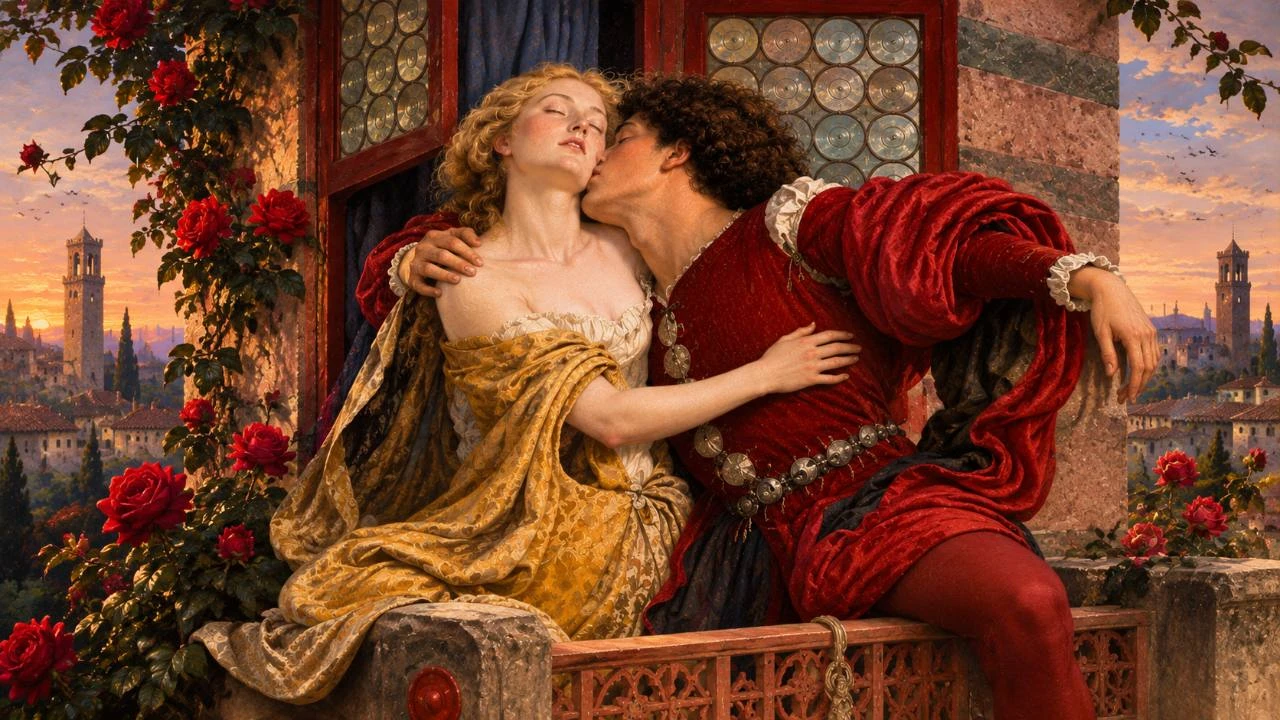
Conceptual romantic illustration, not authenticated portraits of Romeo and Juliet or a reconstruction of a documented encounter. The characters, costumes and Verona-inspired setting are artistic interpretations. Editorial image supplied for PRESDA. Original creator and reuse licence not provided.
The true origins of Romeo and Juliet are best found in books, not in a recovered love letter from two verified medieval teenagers. Shakespeare transformed an existing story that had travelled through Italian, French and English writing. His achievement was not inventing every incident, but making inherited material feel immediate through dramatic language, character and speed. Following that route does not diminish the romance. It reveals how one story became capable of speaking to audiences far beyond the world that first told it.
The English poem behind the play
The Royal Shakespeare Company identifies Arthur Brooke’s 1562 narrative poem The Tragicall Historye of Romeus and Juliet as Shakespeare’s immediate source. The poem already supplied much of the recognizable plot: the rival households, secret relationship, helpful intermediaries and fatal failure of communication. This is a documented literary relationship, not a claim that Brooke personally witnessed the events. A printed source can be historically real while the lovers whose lives it describes remain fictional. Royal Shakespeare Company: dates and literary sources
An Italian story crosses languages
Verona’s civic account traces an important early version to Luigi da Porto, whose novella placed the lovers in Verona. Later retellings developed the material before it reached Shakespeare. A real city and historically recognizable family names can give fiction a convincing setting, but they do not establish that the plot occurred as written. The city’s long relationship with the legend is itself a cultural history, different from proof of the original lovers’ existence. Verona civic museums: origins of the Romeo and Juliet myth
The RSC describes the route through Matteo Bandello’s Italian version and Pierre Boaistuau’s French retelling of 1559, on which Brooke drew. Details changed along the way, including how the deaths unfold. This matters because the story was not a sealed historical file passed unchanged from one author to another. It was adaptable material. Each telling made choices about suspense, morality and sympathy, creating the conditions for Shakespeare’s own transformation. Royal Shakespeare Company: dates and literary sources
What Shakespeare changed
One decisive change was time. Where the earlier narrative could unfold over months, Shakespeare compresses the action into a few urgent days. Decisions collide before the characters can recover from the previous consequence. Read as drama, that pressure is more important than treating the play as a timetable for an actual family scandal. The adaptation also demonstrates why tracing sources does not make Shakespeare a mere copyist: the arrangement and experience of a story can change even when many incidents are inherited. Royal Shakespeare Company: dates and literary sources
The printed evidence has its own history
The Folger Shakespeare Library distinguishes the early printed versions: a first quarto in 1597 and a second in 1599, with later editions and editorial decisions shaping the text readers encounter. These surviving books are concrete evidence for the play’s transmission. Their differences remind us that even a famous literary work has a material history. They do not provide missing birth certificates for Romeo and Juliet. The history of a text and the historical truth of its plot require different questions. Folger Shakespeare Library: textual notes and early editions
Were there real lovers behind it?
The Metropolitan Opera’s educational account treats the lovers’ story as fiction and notes that real Italian family names do not establish the legendary feud. That is the useful limit of the evidence: we can document a literary lineage without identifying a historical couple whose lives match the play. The approved hero similarly portrays imagined characters, not recovered likenesses. Its emotional truth belongs to interpretation. Shakespeare’s enduring achievement is that a constructed story can make an audience care intensely about people who need not have existed. Metropolitan Opera: Romeo and Juliet, fact and fiction
Related reading: The layered history of Valentine’s Day.
FAQ
Frequently Asked Questions
Did Shakespeare invent Romeo and Juliet from nothing?
No. His immediate source was Arthur Brooke’s 1562 poem, itself part of an earlier Italian and French literary tradition.
Were Romeo and Juliet a verified historical couple?
No documented couple matching the play is established by these sources. A real setting and family names do not authenticate its plot.
When did the play first appear in print?
The first quarto appeared in 1597; an important second quarto followed in 1599.
PRESDA Dispatch
Stay Informed. Stay Aware.
A sharp briefing across AI, gaming, sport, business, world affairs, paparazzi, and lifestyle.