VALENTINE’S DAY: THE REAL HISTORY BEHIND FEBRUARY 14
Trace Valentine’s Day from uncertain martyr traditions to medieval love poetry and commercial cards, separating documented history from familiar legends.
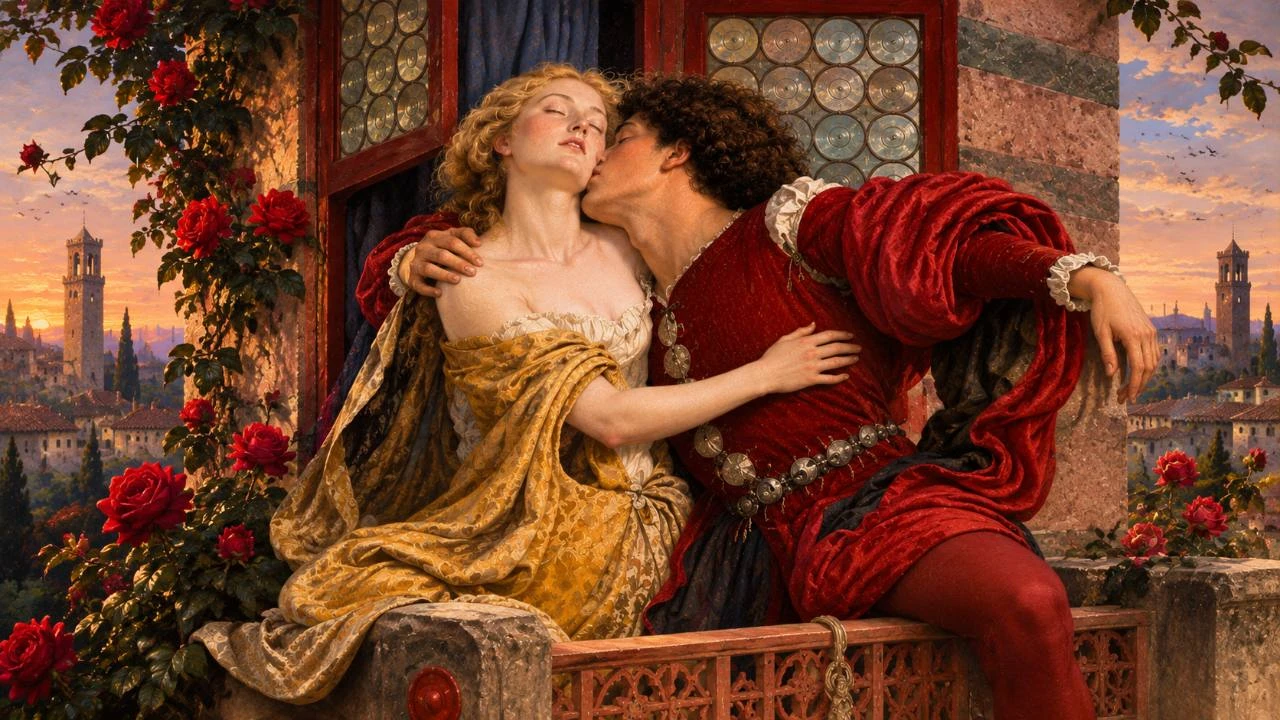
Conceptual historical illustration, not an authenticated portrait of a particular Saint Valentine or a documented martyrdom scene. The clothing, stained glass, roses and letter combine symbols from different periods. Editorial image supplied for PRESDA. Original creator and reuse licence not provided.
Valentine’s Day did not arrive fully formed with roses, chocolates and a perfectly documented saint who secretly married soldiers. Its history is layered: the remembrance of martyrs, medieval poetry about lovers, personal letters and a growing market for cards. Some parts can be traced through surviving objects and texts. Others belong to much later storytelling. The most revealing question is not which single legend explains everything, but how February 14 acquired meanings that earlier generations would not all have recognized.
The saint is harder to identify than the holiday
Ancient church historian Roland Kany, interviewed by LMU Munich, distinguishes the commemorative tradition from reliable biography. Traditions associated the date with Valentines of Rome and Terni, possibly versions of the same figure, but the later accounts are uncertain and contradictory. Stories of miraculous healing and martyrdom therefore need to be labelled as traditions rather than narrated as witnessed events. A long history of devotion does not automatically supply detailed evidence for the life of the person being remembered. LMU Munich: historian Roland Kany on Valentine traditions
Did a Roman festival simply become Valentine’s Day?
The familiar Lupercalia explanation is too neat to be presented as an established chain of events. Nearness on the calendar is not evidence that one festival was directly redesigned into the other. The more careful historical approach separates the ancient commemoration, later stories about its saint and the still later language of romantic choice. Saying the direct-replacement story is unproven does not mean Roman or Christian traditions are irrelevant. It means that an attractive connection needs documents, rather than repetition, to establish it. LMU Munich: historian Roland Kany on Valentine traditions
Medieval poetry helped make the day romantic
Historian Ronald Hutton’s account points to Chaucer and John Gower’s references to birds choosing mates on Valentine’s feast. Such texts are evidence for a medieval association between the saint’s day and romantic selection. They do not prove every modern custom began at the same time or that one poet invented the entire celebration. Scholars have also debated which feast date particular poems refer to. The strong conclusion is a literary and cultural connection, not a simple uninterrupted line from a Roman marriage ceremony to today’s gift shops. Ronald Hutton: Valentines, The Stations of the Sun
A surviving letter gives the custom a human voice
In February 1477, Margery Brews wrote to John Paston, whom she hoped to marry, using the language of a beloved valentine. The surviving Paston correspondence gives us something firmer than a picturesque martyr legend: a dated expression of affection within real marriage negotiations. It shows that romantic language lived alongside family expectations and material concerns. The letter is important precisely because it is particular. It does not need to be the first loving message ever written to illuminate the history of the custom. Paston Footprints: Margery Brews and the 1477 letters
Cards brought craft, humour and commerce
The V&A’s collection shows how varied nineteenth-century valentines could be: elaborate paper constructions, mechanical designs and insulting vinegar valentines as well as tender messages. The historical holiday was therefore not uniformly sweet or sincere. Objects preserve choices of design and tone that a single origin legend cannot explain. They also show why commerce should be studied as part of the tradition’s development, rather than treated as a recent intrusion into an otherwise unchanged ancient festival. Victoria and Albert Museum: Valentine card history
The Library of Congress situates Esther Howland within the American business of decorated valentines, while noting that cards were already available before her enterprise. That distinction avoids another origin myth: commercial success is not the same as inventing the custom. By the time paper lace, printing and organized production expanded the market, Valentine traditions already had a long history. The modern holiday emerged from the interaction of devotion, literature, personal expression and business, not from one perfectly recoverable founding event. Library of Congress: Esther Howland and the business of love
Related reading: The literary origins of Romeo and Juliet.
FAQ
Frequently Asked Questions
Was Saint Valentine’s biography securely documented?
No. Traditions about Valentines of Rome and Terni contain uncertain and contradictory later accounts. Specific marriage and healing stories should be labelled as legends.
Did Valentine’s Day directly replace Lupercalia?
A direct replacement is not established simply by the nearby dates. The origins of romantic customs require separate evidence.
Did Esther Howland invent valentines?
No. The Library of Congress notes that cards existed before her business. She was important to their American commercial development.
PRESDA Dispatch
Stay Informed. Stay Aware.
A sharp briefing across AI, gaming, sport, business, world affairs, paparazzi, and lifestyle.