THE SAN PEOPLE: AMONG THE OLDEST LIVING HUMAN LINEAGES ON EARTH
Explore San ancestry, languages, rock art and modern southern African communities, and why genetics cannot identify them as the world’s “first people”.
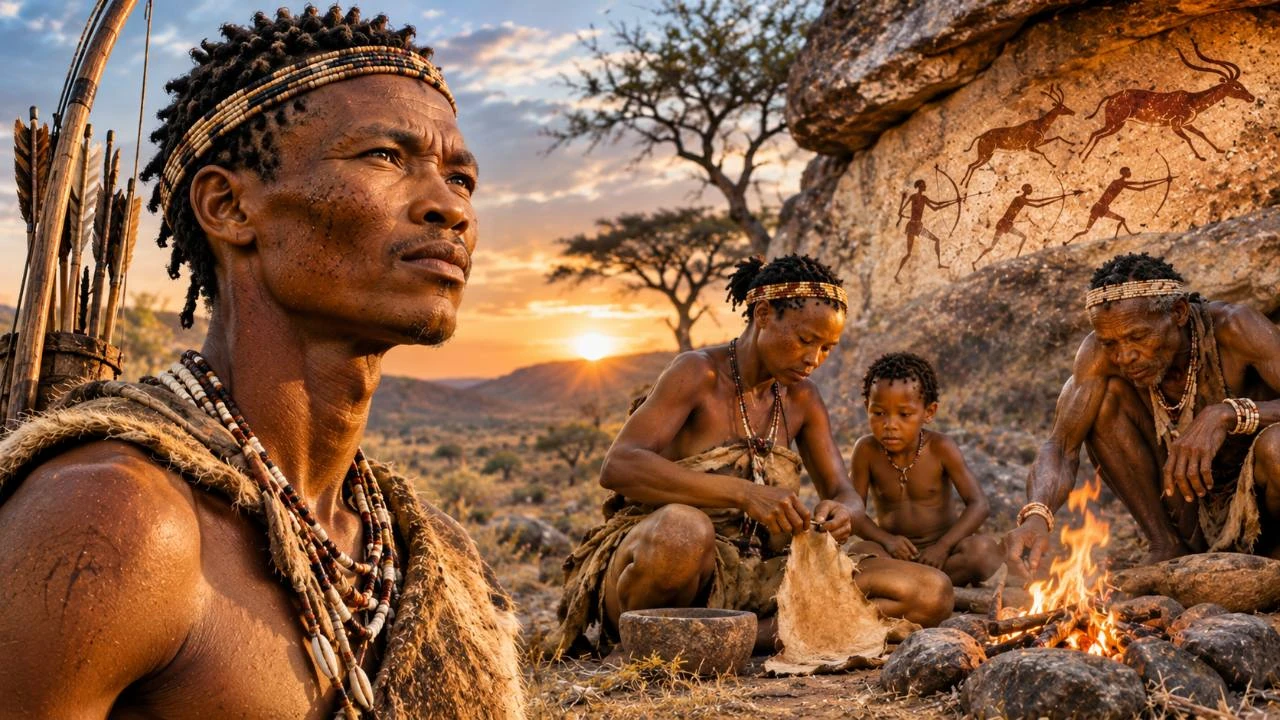
AI-generated editorial illustration supplied for PRESDA. The people, clothing, landscape and painted scene are imagined, not a documentary photograph, verified rock-art panel or representation of every San community. San people live diverse contemporary lives.
The San are living peoples of southern Africa, not a surviving stage of human evolution. Some ancestry carried by San communities belongs to deeply branching lineages studied by geneticists. That makes their history important to understanding humanity, but it does not establish that they are the scientifically proven “first people”. All living humans are equally modern. Genetic branches describe relationships among ancestors, not a ranking of peoples by age or worth. Smithsonian Human Origins: no single site for modern human origins
Who are the San?
San is an umbrella term for diverse communities with histories across southern Africa, especially Botswana, Namibia and South Africa, and connections extending into neighbouring countries. Names, languages and preferences differ. The San-led !Khwa ttu archive brings together contributors from settlements, villages and townships. Its account is a useful corrective to the idea that one photograph, one language or one way of making a living can represent everyone. !Khwa ttu: San-led digital archive and communities
A specific community’s preferred name is usually more informative than a broad label. “Khoisan” or “Khoe-San” also appears in scholarship, but it can group people with different linguistic and social histories. Neither a research category nor a DNA result automatically determines someone’s identity. Communities have their own institutions, memories and ways of describing belonging.
What deep genetic ancestry actually means
A 2017 study of ancient southern African genomes estimated an early divergence among human populations between roughly 350,000 and 260,000 years ago. The analysis included remains from KwaZulu-Natal related to ancestry found among southern Khoe-San descendants. These are model-based estimates of ancestral population relationships. They are not birth certificates for today’s ethnic communities, and the people whose remains were sequenced did not live hundreds of thousands of years ago. Uppsala University: ancient southern African genomes and divergence estimates
A branching history is not a ladder
Human origins are more complicated than one isolated group giving rise to everyone else in a simple sequence. A 2023 Nature study tested models involving interconnected ancestral populations in Africa, with gene flow over long periods. Models and estimates can change as evidence improves. A deep branch in one analysis does not prove an unchanged, genetically “pure” population or identify a single modern community as the source of all humanity. Ragsdale and colleagues, Nature: a weakly structured stem for human origins
Languages are more than their click consonants
The languages grouped under older “Khoisan” labels do not form one established language family. Researchers distinguish families including Kx’a, Tuu and Khoe-Kwadi. Click consonants are striking to outsiders, but a shared sound type does not establish a common linguistic ancestor. Each language has grammar, vocabulary and oral knowledge worth understanding on its own terms. A genetic family tree cannot simply be substituted for a linguistic one. Pickrell and colleagues: genetic prehistory and linguistic diversity
Knowledge rooted in particular landscapes
UNESCO’s account of the ǂKhomani Cultural Landscape describes detailed knowledge of plants, animals, seasons and geographical features. Tracking, storytelling and knowledge of resources were part of adapting to particular environments. They were learned skills, not mystical abilities shared automatically by everyone with San ancestry. Cultural transmission also involves decisions about what to teach, how to adapt and which knowledge a community wishes to share. UNESCO: ǂKhomani Cultural Landscape
Rock art is evidence, not a single illustrated diary
At Tsodilo in Botswana, rock art and archaeology preserve a long, complex history, while San and Hambukushu communities maintain living spiritual associations with the hills. The paintings do not all belong to one securely dated moment or one easily identified author. Images of animals and people require archaeological and cultural context. Calling every painted scene a literal hunting report, or every regional painting San, would erase that complexity. UNESCO: Tsodilo and its living cultural landscape
Modern communities have futures as well as pasts
Dispossession, settlement, changing economies and unequal access to opportunities have shaped San lives. Contemporary livelihoods can combine wage work, farming, crafts, heritage work and other activities. People live in varied settings and make different choices about language and tradition. Wearing contemporary clothes, working in a town or using a phone does not make someone less entitled to their heritage. Cultural identity is not a performance staged for visitors. !Khwa ttu: San-led digital archive and communities
A UNESCO report from August 2026 describes work with the ǂKhomani community on heritage governance, accountability and participation in tourism decisions. It offers a contemporary example of people shaping institutions rather than simply being described by outsiders. Preserving a landscape and improving everyday opportunities need not be competing ambitions; community authority matters to both. UNESCO: community governance at ǂKhomani, August 2026
Who controls the telling of San history?
The South African San Code of Research Ethics, launched in 2017, insists on respect, honesty, fairness and care, alongside a community approval process. Its significance extends beyond genetics: being a subject of research should not mean losing a voice in how knowledge is collected or presented. The most accurate account of San history combines scientific evidence with communities’ right to speak for themselves, without turning either ancestry or tradition into a stereotype. San Code of Research Ethics: origins and community approval
Related reading: Caral and the evidence behind an ancient society.
Related reading: How ancient proteins reveal a different part of human history.
FAQ
Frequently Asked Questions
Are the San scientifically proven to be the first people?
No. Deep ancestry does not identify a single living community as the first humans. Human origins involved ancient African populations whose relationships are still being studied.
Do all San communities speak one language?
No. San communities have diverse languages. The older Khoisan grouping is not a single established language family.
Do San people still live only by hunting and gathering?
No. Contemporary lives and livelihoods are varied, including employment, agriculture, crafts and heritage work. A single lifestyle does not define San identity.
PRESDA Dispatch
Stay Informed. Stay Aware.
A sharp briefing across AI, gaming, sport, business, world affairs, paparazzi, and lifestyle.