THE HISTORY OF SOUTH AFRICA: KINGDOMS, COLONIZATION, WAR AND APARTHEID
South Africa’s history was shaped by diverse African societies, colonial conquest, mineral wealth, racial segregation and organized resistance that culminated in democracy in 1994.
South Africa is not the story of one ancient kingdom that became a modern nation. It is a history of San and Khoikhoi communities, Bantu-speaking farming and herding societies, African kingdoms and chiefdoms, Dutch and British colonies, migrant workers, settler republics and an industrial state built through racial exclusion. Mapungubwe, the Zulu kingdom, the Cape Colony and apartheid belonged to different political worlds. Their histories are connected by migration, trade, conquest and resistance, but they should not be collapsed into one continuous state.
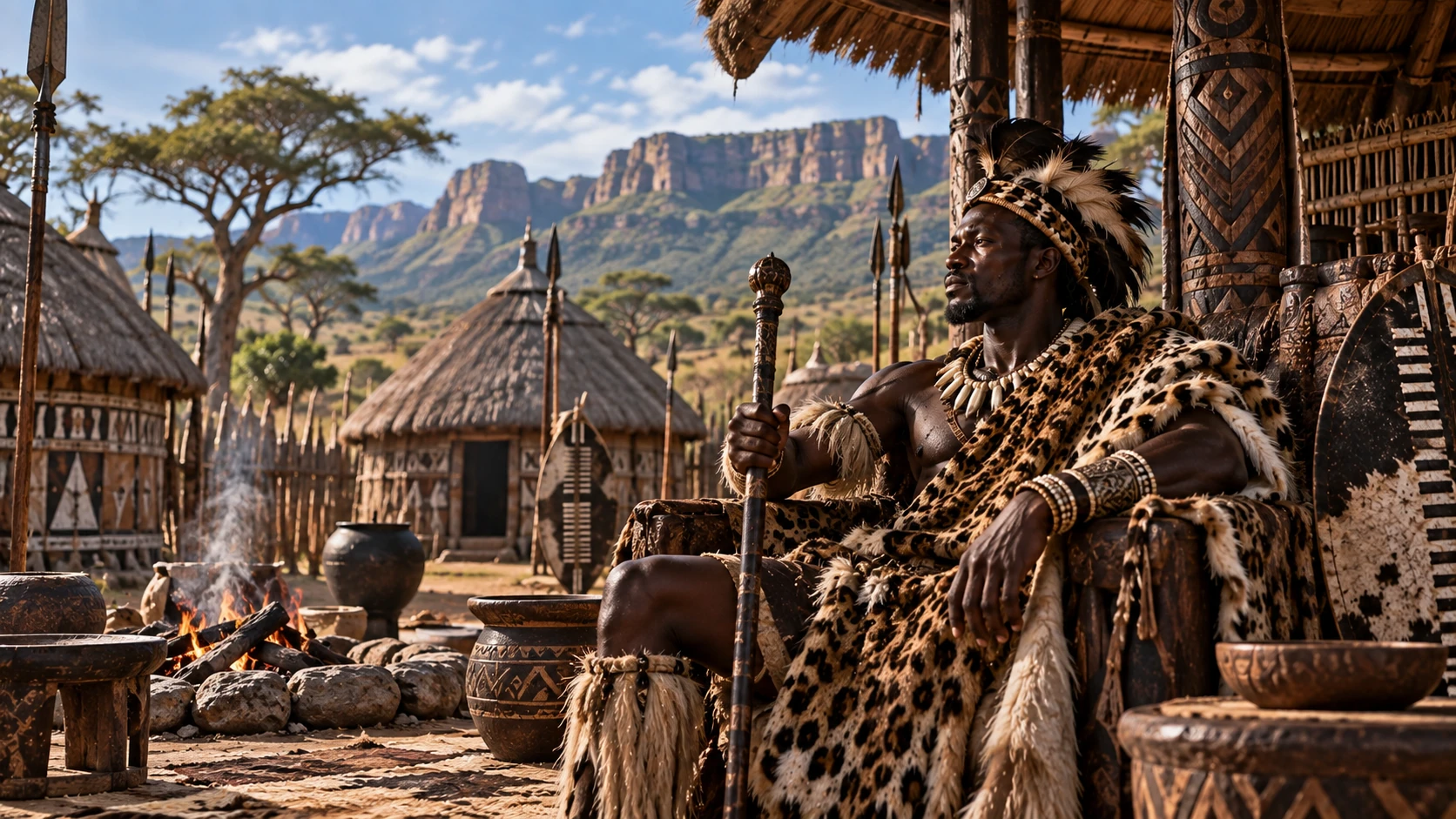
The supplied hero image is an editorial reconstruction of precolonial southern African authority. It is not a literal portrait of a named ruler or a documentary view of a specific settlement.
SAN, KHOIKHOI AND THE FIRST SOCIETIES
Southern Africa has been inhabited for a very long time. San communities developed diverse hunting, gathering, fishing and trading economies adapted to deserts, grasslands and woodland. Rock art records ceremonial and social worlds, although images cannot be read as simple illustrations of a single ‘San culture.’ Khoikhoi pastoralists kept cattle and sheep, moved through seasonal landscapes and traded livestock and goods with neighboring communities. San and Khoikhoi identities were varied and changed through interaction, marriage, conflict and colonial labeling.
There was no empty land waiting for Europe. Communities managed water, pasture, routes and social obligations through institutions that written colonial sources often misunderstood. Archaeology, oral traditions, linguistics and environmental evidence provide different windows onto these histories. Later colonial claims that Africans had only recently arrived or lacked political organization were used to justify dispossession and do not describe the evidence.
From the first millennium CE, Bantu-speaking farmers and herders expanded and settled in southern Africa through many movements rather than one invasion. Ironworking, cattle keeping, crop cultivation and new forms of political organization spread unevenly. The ancestors of present-day Xhosa, Zulu, Sotho-Tswana, Tsonga, Venda, Pedi and other peoples formed distinct communities in different environments. ‘Bantu’ describes a large language family and related historical processes, not a single nation or race.
MAPUNGUBWE AND PRECOLONIAL STATES
Mapungubwe grew near the Limpopo and Shashe rivers between roughly the eleventh and thirteenth centuries. Its settlement included a hilltop elite area, a large supporting population and evidence of social hierarchy. Gold objects, glass beads, ceramics and other imports connect the site to Indian Ocean trade through East African ports. Mapungubwe’s prosperity rested on cattle, agriculture, craft production and control of exchange, not on a mythical kingdom covering all of southern Africa. South African History Online: Mapungubwe and the pre-1500 timeline
Mapungubwe was later abandoned or transformed around the thirteenth century as political and environmental conditions changed. Great Zimbabwe became a major center farther north, while other communities developed in the interior and along the coast. Mapungubwe did not directly become the Zulu kingdom, which emerged centuries later in a different region and political context. Evidence instead shows successive and overlapping centers of authority in a connected southern African world.
Other important societies included stone-walled communities in the eastern highveld, Sotho-Tswana chiefdoms, Venda polities, Nguni-speaking chiefdoms and coastal communities linked to Mozambique and the wider Indian Ocean. Their political scale varied from villages and chiefdoms to kingdoms with courts, tribute and armies. Trade moved cattle, iron, ivory, salt, grain, beads and cloth, while local economies remained rooted in farming, herding, craft and seasonal mobility.
PORTUGUESE CONTACT AND THE CAPE
Portuguese sailors rounded the Cape in the late fifteenth century while searching for a sea route to India. Their voyages connected southern African coasts to an expanding European maritime network, but they did not establish a lasting Portuguese colony at the Cape. Portuguese ships traded, watered and sometimes fought along the coast, joining older African and Indian Ocean systems rather than discovering an unconnected land.
In 1652 the Dutch East India Company, or VOC, established a refreshment station at Table Bay under Jan van Riebeeck. The settlement was intended to supply ships traveling between Europe and Asia. Company officials soon allocated land to free burghers, seized water and grazing resources, and drew Khoikhoi communities into unequal trade and labor relationships. Smallpox epidemics, livestock seizures, commando warfare and loss of pasture weakened Khoikhoi independence. The first and second Khoikhoi-Dutch wars in the seventeenth century were part of a longer process of colonial expansion. South African History Online: Colonial conquest and resistance
The Cape became a slave society. The VOC imported enslaved people from Madagascar, East Africa, South Asia and Southeast Asia, and colonial officials also enslaved people captured or coerced in the region. Enslaved labor worked farms, workshops, households and the port. Some people escaped and formed communities beyond colonial control, while others maintained languages, religions and family networks under coercion. Cape society also included free people of color, sailors, soldiers and immigrants whose legal status was contested.
Settler expansion eastward brought repeated conflict with Xhosa-speaking communities. The Cape Frontier Wars, fought intermittently from the late eighteenth to the nineteenth century, involved land, cattle, labor, trade and rival claims to the Fish and Kei River frontiers. Xhosa polities were not a single kingdom, and British and colonial commanders often exploited divisions among neighboring leaders. Military campaigns, treaty-making, seizure of land and the destruction of crops gradually extended colonial control.
Britain seized the Cape during the wars with revolutionary France in 1795, returned it briefly in 1803 and occupied it again in 1806. British rule changed administration, language, labor policy and relations with Dutch-speaking settlers. The abolition of the Atlantic slave trade and later emancipation in the Cape altered labor relations, but colonial landholding and racial hierarchy remained deeply unequal.
GREAT TREK, AFRICAN KINGDOMS AND ZULU POWER
In the 1830s, groups of Dutch-speaking settlers known as Voortrekkers left the Cape Colony. Their reasons included resentment of British authority, land pressure, labor policy and the desire for independent government. The Great Trek was not one organized migration and did not move through unoccupied territory. Trekkers entered landscapes governed by African communities, negotiated and fought with them, and established new settlements and republics.
The early nineteenth century also saw major political change among Nguni, Sotho-Tswana and other societies. Shaka rose within the Zulu kingdom after serving under the Mthethwa leader Dingiswayo. He reorganized military age groups, emphasized close-combat tactics and built a more centralized Zulu polity through conquest, incorporation and political alliance. Later colonial writers turned Shaka into a one-dimensional tyrant, while some nationalist accounts idealized him. The evidence supports a powerful and innovative ruler whose reign also involved violence, coercion and contested memory.
The terms Mfecane and Difaqane refer to upheavals, warfare, migration and state formation in the region, often dated from the 1810s to the 1840s. Older colonial histories attributed widespread destruction almost entirely to Shaka and Zulu expansion, a narrative that helped portray African societies as self-destructive before European conquest. Later scholarship emphasized the effects of slave trading, drought, competition over land and ivory, colonial pressure and the political ambitions of several African rulers. Historians still debate the scale, causes and chronology, so no single ‘Mfecane’ explanation should be treated as settled. South African History Online: The Mfecane debate
Voortrekkers established the South African Republic in the Transvaal and the Republic of Natalia, while the Orange Free State emerged later in the interior. Moshoeshoe I built the Basotho kingdom in the mountains, combining diplomacy, refuge and military defense. Mzilikazi’s Ndebele state also developed out of the upheavals. These states and kingdoms had their own political histories and cannot be reduced to a contest between ‘Boers’ and ‘Zulu.’
In 1838, Voortrekker forces defeated Dingane’s army at the Battle of Ncome, remembered by Afrikaner tradition as Blood River and by many South Africans as Ncome. The battle followed the killing of Piet Retief and his party, events remembered through competing narratives and later political symbolism. Claims that hundreds or thousands of combatants died must be treated carefully because contemporary sources disagree and later commemorations shaped the numbers. The victory helped the Voortrekkers establish the Republic of Natalia, which Britain annexed in 1843.
ANGLO-ZULU WAR AND BRITISH CONQUEST
The Zulu kingdom remained independent while British colonial authorities expanded in Natal and sought a confederation of southern African territories. In January 1879, British forces invaded Zululand after issuing demands designed to provoke or force a political settlement. At Isandlwana on 22 January, Zulu forces defeated a British column whose camp was poorly prepared for defense. The victory demonstrated the effectiveness of Zulu organization and the danger of underestimating African armies.
Britain recovered through reinforcements, logistics and superior firepower. Battles at Rorke’s Drift, Kambula and Gingindlovu preceded the British victory at Ulundi in July 1879. The Zulu kingdom was divided into chiefly territories and later absorbed into colonial administration. The war was not a heroic pageant for either side. It was an imperial war that destroyed an independent African state, while Zulu soldiers and civilians made strategic choices under intense pressure. South African History Online: Anglo-Zulu Wars
DIAMONDS, GOLD AND THE ANGLO-BOER WARS
The discovery of diamonds near Kimberley in the late 1860s transformed the region. Mining companies drew labor from across southern Africa, concentrated capital in a few hands and expanded transport and colonial administration. Diamond mining relied on African workers whose movement, residence and wages were controlled through compounds and pass systems. Mineral wealth accelerated industrial development while deepening racial labor hierarchies.
Gold discoveries on the Witwatersrand in 1886 created the world’s most important deep-level mining region. Johannesburg grew rapidly, attracting capital, engineers, migrant workers and people from across southern Africa and overseas. The mines depended on cheap African labor recruited through contracts and coercive state regulation. Gold also intensified conflict between the British government, mining interests and the governments of the South African Republic and Orange Free State.
The First Anglo-Boer War of 1880–1881 ended with limited Boer self-government in the Transvaal. The Second Anglo-Boer War, or South African War, began in 1899 and ended in 1902 with British victory. It was an industrial conflict involving sieges, railways, commandos and scorched-earth operations. Britain destroyed farms and removed civilians to concentration camps. Tens of thousands of Boer women and children died from disease and malnutrition, while Black Africans were also forced into camps and suffered deaths that were less completely recorded. The camps and African civilian experiences cannot be treated as a minor footnote to a war remembered through Boer military resistance.
The Treaty of Vereeniging in 1902 brought the Boer republics under British sovereignty. Africans who had fought, supplied or resisted during the war were excluded from the political settlement. British and Afrikaner leaders negotiated a union that would protect white political power rather than create equal citizenship.
UNION, LAND DISPOSSESSION AND THE ANC
The Union of South Africa was created in 1910 from the Cape, Natal, Transvaal and Orange River colonies. It was a self-governing dominion within the British Empire. The constitution preserved a white-dominated parliament and allowed the Cape’s limited nonracial franchise to be narrowed. In 1912, African leaders founded the South African Native National Congress, renamed the African National Congress in 1923, to oppose exclusion and dispossession.
The Natives’ Land Act of 1913 restricted African land ownership and occupation to scheduled areas that represented only a small share of the Union’s land. It formalized a process that had begun through colonial conquest, reserves, labor controls and settler expansion. The Act produced overcrowding, tenancy restrictions and greater dependence on migrant wages. It was a foundation of later apartheid, but racial segregation and economic inequality were already embedded in law and practice. South African History Online: Union and the 1913 Land Act
Industrialization created cities where African workers, Indian South Africans, Coloured communities and white settlers lived under unequal laws. Pass controls, mine compounds, residential segregation and restrictions on political organization shaped everyday life. The 1913 Act was one turning point within a longer history of land loss rather than the first moment of injustice.
APARTHEID AFTER 1948
The National Party’s electoral victory in 1948 introduced apartheid as a more systematic program of racial classification, territorial separation and political control. The Population Registration Act classified people by race, the Group Areas Act separated residential space, and the Bantu Authorities and later homeland systems attempted to deny Black South Africans full citizenship in a common state. Forced removals destroyed neighborhoods and disrupted families, while pass laws and labor regulation sustained the mining economy.
Resistance had many forms. The ANC, South African Indian Congress, trade unions, churches, women’s organizations and local civic movements organized campaigns, strikes and boycotts. The Defiance Campaign of 1952 challenged discriminatory laws through nonviolent action. The Freedom Charter adopted at Kliptown in 1955 imagined a democratic country in which people of all races would share political rights. The Pan Africanist Congress and later Black Consciousness organizations offered different strategies and analyses.
On 21 March 1960, police killed 69 people at Sharpeville during a protest against pass laws and injured many others. The government banned the ANC and PAC and declared a state of emergency. After peaceful protest was met with repression, the ANC’s armed wing Umkhonto we Sizwe began sabotage in 1961. International criticism, sanctions, cultural boycotts and solidarity movements grew over subsequent decades, although pressure was uneven and apartheid survived for many years. South African History Online: Sharpeville
On 16 June 1976, students in Soweto protested against the compulsory use of Afrikaans in parts of education. Police killings triggered uprisings across the country. The Soweto generation linked school protest to a wider rejection of apartheid and inspired international mobilization. Detention, torture, censorship and security laws followed, but the state could not restore legitimacy.
MANDELA, NEGOTIATION AND DEMOCRACY
Nelson Mandela was imprisoned in 1962 and sentenced to life imprisonment at the Rivonia Trial in 1964. His imprisonment made him a global symbol, but the anti-apartheid struggle was never the work of one person. Walter Sisulu, Oliver Tambo, Albertina Sisulu, Steve Biko, Desmond Tutu, trade unionists, students, community organizers and armed activists all shaped the movement. People inside South Africa and in exile sustained resistance under severe repression.
F. W. de Klerk became state president in 1989. In February 1990 he unbanned the ANC and other organizations and released Mandela after 27 years in prison. Negotiations at CODESA and later forums addressed violence, constitutional design, the future of the security forces and the distribution of political power. The transition was threatened by massacres and conflict, and it was a negotiated settlement rather than a simple surrender by one side.
On 27 April 1994, South Africans voted in the first national democratic election open to all adults. Mandela became president, and a Government of National Unity began rebuilding institutions. The 1996 Constitution established a rights-based order, but political equality did not immediately remove economic inequality, segregated settlements or the accumulated effects of land dispossession and unequal education.
The Truth and Reconciliation Commission, established under the Promotion of National Unity and Reconciliation Act of 1995, held public hearings on human-rights violations committed under apartheid and by liberation movements. Conditional amnesty required disclosure and political motive. The Commission documented abuses and gave many victims a public forum, but it did not deliver every form of justice or repair. Its work remains central to debates about memory, accountability and reconciliation. South African Department of Justice: TRC
MODERN SOUTH AFRICA AND HISTORICAL LEGACY
Modern South Africa is a constitutional democracy with eleven official languages, a diverse population and a political system transformed by the end of apartheid. It is also a society in which wealth, land ownership, education, housing and employment remain sharply unequal. Mining, agriculture, manufacturing, services and cultural industries connect the country to global markets, while local communities continue to contest extraction, land use and public services.
The long history matters because inequality was made through identifiable laws and institutions. Colonial conquest narrowed African land access, mineral capitalism organized labor by race, Union politics protected white power, and apartheid turned segregation into a comprehensive state system. Democracy changed the political order, but it inherited those structures. Understanding South Africa requires attention to San and Khoikhoi survival, African state-building, slavery, settler societies, African resistance, industrial labor and the many people whose experiences do not fit a single national myth.
FREQUENTLY ASKED QUESTIONS
**Was precolonial South Africa one kingdom?**
No. The region contained many San and Khoikhoi communities, Bantu-speaking farming and herding societies, chiefdoms, kingdoms and trading centers. Their political forms and territories changed over time.
**Was Mapungubwe the beginning of the Zulu kingdom?**
No. Mapungubwe flourished near the Limpopo centuries before the Zulu kingdom emerged in southeastern Africa. It is evidence of an earlier state and trade network, not a direct Zulu predecessor.
**What caused the Mfecane or Difaqane?**
Historians debate the term, causes and scale. Warfare and state-building among African polities mattered, but so did drought, trade in captives and ivory, land pressure and colonial expansion. A single Shaka-centered explanation is inadequate.
**Why is Isandlwana important?**
On 22 January 1879, Zulu forces defeated a British column during the Anglo-Zulu War. Britain later won the war and dismantled Zulu independence, but Isandlwana demonstrates that colonial armies faced organized African military resistance.
**Did apartheid begin in 1948?**
The National Party systematized apartheid after 1948, but racial segregation, land dispossession, pass controls and unequal labor systems had developed under Dutch, British and Union governments earlier.
**Did the Truth and Reconciliation Commission prosecute apartheid crimes?**
The TRC documented violations and could grant conditional amnesty for full disclosure of politically motivated crimes. It was not a conventional criminal court, and many victims and families continued to seek justice and reparations afterward.
SOURCES AND FURTHER READING
For related regional histories, see PRESDA’s Great Zimbabwe, Ghana Empire, Ethiopian Empire and Dutch Empire articles.
> South Africa’s history is a shared but unequal past shaped by African state-building, colonial conquest, mineral capitalism, resistance and democratic negotiation.
FAQ
Frequently Asked Questions
Was precolonial South Africa one kingdom?
No. The region contained many San and Khoikhoi communities, Bantu-speaking societies, chiefdoms, kingdoms and trading centers whose political forms changed over time.
Was Mapungubwe the beginning of the Zulu kingdom?
No. Mapungubwe flourished near the Limpopo centuries before the Zulu kingdom emerged in southeastern Africa. It represents an earlier state and trade network.
What caused the Mfecane or Difaqane?
Historians debate the term, causes and scale. Warfare and state-building mattered, alongside drought, trade in captives and ivory, land pressure and colonial expansion.
Why is Isandlwana important?
On 22 January 1879, Zulu forces defeated a British column. Britain later won the war and dismantled Zulu independence, but the battle demonstrates organized African military resistance.
Did apartheid begin in 1948?
The National Party systematized apartheid after 1948, but racial segregation, land dispossession, pass controls and unequal labor systems had developed earlier.
What did the Truth and Reconciliation Commission do?
The TRC documented violations and could grant conditional amnesty for full disclosure of politically motivated crimes. It was not a conventional criminal court.
PRESDA Dispatch
Stay Informed. Stay Aware.
A sharp briefing across AI, gaming, sport, business, world affairs, paparazzi, and lifestyle.